▲ 62 points
back
31 comments
National parks are fantastic and extremely valuable. This fund has probably provided enormous long-term value. I do take issue with these statements though:
> The Land and Water Conservation Fund isn’t taxpayer-funded. Since 1964, the government has redirected money from offshore oil and gas drilling (plus a couple other sources of income) into the fund...
> It’s striking to see how much land has been added by the program, at no cost to taxpayers.
In reality, government revenue is fungible. If this fund didn't exist, that revenue would go toward other government expenses. So saying that it's funded by X revenue and therefore costs nothing to taxpayers is just mental accounting.
There's a word for that mental accounting: hypothecation.
Similar (kind of) concept but hypothecation is about collateral, not mental accounting, unless it has a second, different meaning too?
Yes, there's a second meaning in relation to taxes / revenue where a particular tax or revenue source is notionally allocated to a particular set of spending.
Acadia (http://npmaps.com/wp-content/uploads/acadia-map.jpg) has always been an example of this for me, both in how many private lands like this exist in National Parks, and of the striking difference between the east coast and the west in land ownership and attitude. It's dotted with and surrounded by private land, despite being a natural wonder in the class of Yosemite or Yellowstone in grandeur and uniqueness. At certain points, you drive over bridges that cross golf courses, and you can't help but wonder whether this Disneyland nature park isn't also inextricable from its web of humanity and history.
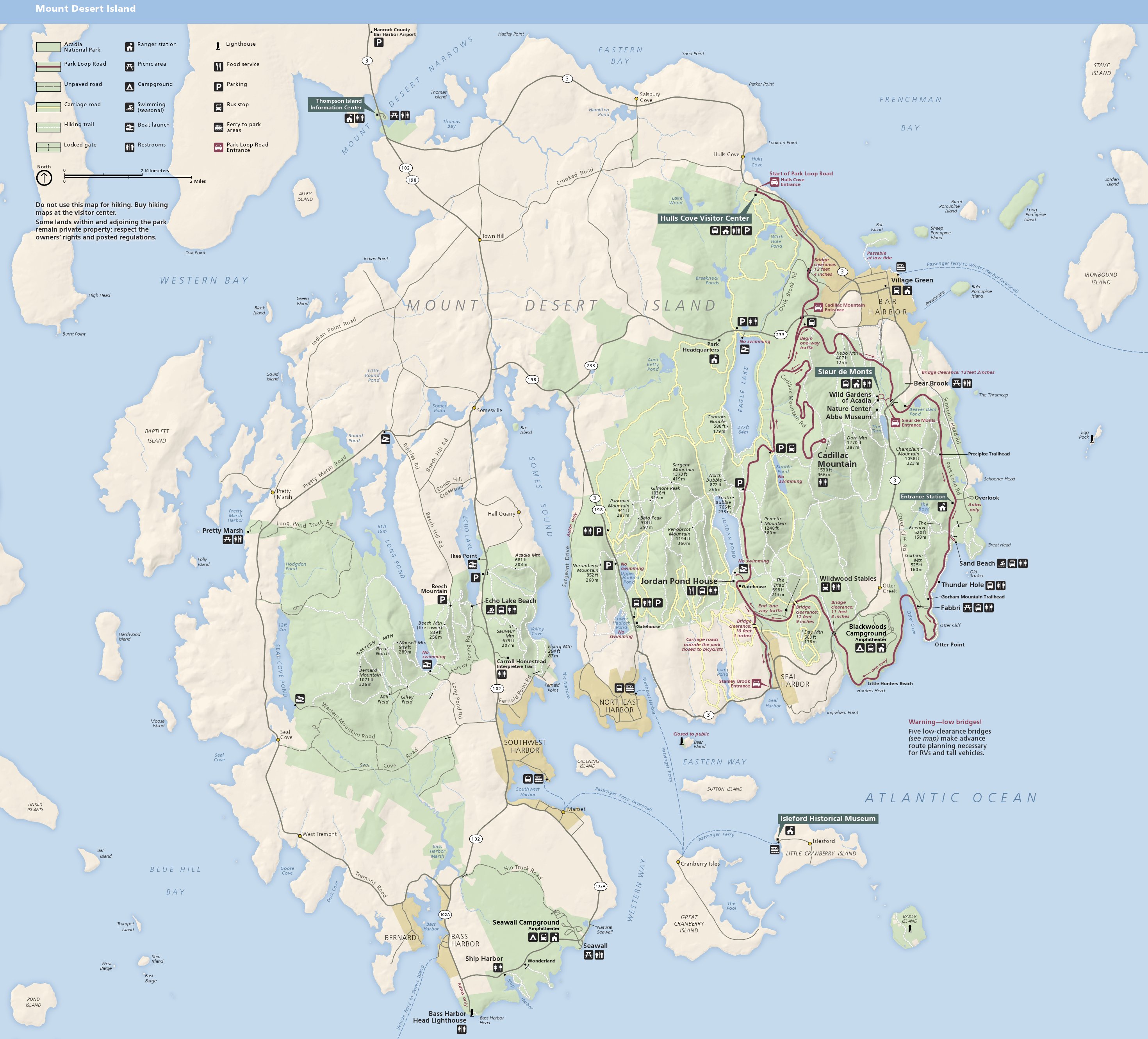
The west is still wild, and it's a human wonder that we've managed to keep it that way. I'm glad for public land. Its value to our society is truly immeasurable.
"The west is still wild, and it's a human wonder that we've managed to keep it that way. I'm glad for public land. Its value to our society is truly immeasurable."
So true - I remember what a shock it was when I moved from New Mexico to Texas. I thought, "Texas is huge, it's going to be great to live there with all that open space." Then I got there and found out that they had sold off every square inch of their state to private parties. The first week I was there, a coworker told me how excited he was to have found a great "hunting lease", and I was like "What the hell is a hunting lease?!?" He tells me you have to PAY people if you want to go out for deer season or whatever. I was shocked by it, literally. I have lived most of my life in various states where there are huge tracts of land that are just "yours" to go out in and do whatever the heck you want. It was really sad to see a place that large, with virtually no public land open for recreation.
I do prefer National Forests and Wilderness areas over Parks though - I like the idea of wild, untamed places where you can just head out into the brush for a week and sometimes not even see another soul. New Mexico was great for that, you could spend a week out in Gila wilderness and never see another person.
I'm glad to see that California is still like that in a lot of places - I was just up in the Mojave desert a few weeks back, and I felt like I was the first person that had ever set foot there. It's fun trying to imagine what it must have been like to be the very first people that wandered around out there.
I was surprised travelling across the US at a cultural difference - here in Australia, a 'national part' is a non-developed or little-developed area of land for everyone, free to enter, usually with campgrounds. In the US, a 'national park' is often a non-trivial payment to enter, with airconditioned visitors centers, good roads, staff everywhere, and sometimes even hotels and restaurants... Not all national parks are like that, but the first few I visited were. Bit of a shock.
I learned later in my trip about 'public lands' in the US, which were (basically) unmaintained and free for all to use, which was closer to national parks back home.
National Parks in the US have to meet four specific criteria to be granted the designation:
1) It is an outstanding example of a particular type of resource.
2) It possesses exceptional value or quality in illustrating or interpreting the natural or cultural themes of our Nation's heritage.
3) It offers superlative opportunities for recreation, for public use and enjoyment, or for scientific study.
4) It retains a high degree of integrity as a true, accurate, and relatively unspoiled example of the resource.
In the whole USA there are 59 such sites. But there are also national forests, national monuments, national seashores, national reserves, national historic sites, national historic landmarks, and other similar designations.
Our state forests system sound similar to what you mentioned from Australia. We had a couple of pretty huge ones near where I grew up:
https://en.wikipedia.org/wiki/Rothrock_State_Forest, https://en.wikipedia.org/wiki/Bald_Eagle_State_Forest, https://en.wikipedia.org/wiki/Sproul_State_Forest
Reference for National Park requirements, I only found an old link: http://web.archive.org/web/20000301003832/http://www.nps.gov...)
You must be from the east. In WA, there are massive tracts of land that you can't get through, privately owned. This of course doesn't matter much - who wants to get to the Gibson, anyway, but .. its not like Australia doesn't have its own private owners.
I am not aware of any free-to-use national parks in NSW. There is a fee even for day use at the Royal National Park. I think State Parks are free, but I have had to pay whenever I have camped in NSW or Tasmanian National parks.
It is possible to buy an annual pass for all parks in NSW for a reasonable price.
I live in Ellsworth (15 minutes from Bar Harbor, you have to drive through Ellsworth to get to any part of Acadia National Park).
You're overlooking a large part of the history: most of the park was donated land that was owned by the Rockefellers, of which they continually have grown the park over the past 50 years.
The park doesn't have islands in it as much as the park ate up all the land AROUND these islands, making the islands exist in the first place. I suspect Acadia is the only national park that is growing at the rate it has over the decades.
Oh I realize the history, hence why I said "inextricable from the humanity and the history" -- so true. I guess it's just a different way of looking at land, and the history is a big part of it. The parks of the west existed before the land was touched, so they have an air of wilderness about them. The East Coast was largely settled, so the National Parks here (what few there are) had to be slowly cut from owned lands like you're talking about.
It's no better or worse, just different. I'm glad that Acadia is reclaiming the private lands for the public good, and I'm glad that Yosemite has reserved them to prevent them from ever being privately owned. Both are a net positive.
But I still can't shake the difference in attitude about the land on the east coast versus the west. In the west, the National Parks are for the land itself, and I feel like a visitor being allowed to set foot as a privilege and an honor granted by the great wilderness so much larger than myself. On the East coast, National Parks and beaches and forests somehow feel like they exist for people and the land is there for us, and has no greater purpose than that. I find this in how people treat them and think about them and talk about them; it's why I said "Disneyland parks" before, it feels like people go to them for their own benefit. It's a subtle but remarkable difference, and it's pervasive in the culture, I find.
No one will probably read this, but I find it interesting all the same.
People have lived more or less continuously on Mount Desert Island since the end of the Seven Years War (It was in something of a DMZ between French Acadia and British Massachusetts, and everyone that tried to settle there soon got burned out by one side or the other).
The only reason that the park exists is that it became a resort town for the Gilded Age tycoons, and they bought up all the land that makes up the park, because they didn't want anyone industrying up their summering place.
Most of the palatial mansions burned in a wildfire in the 40s, and the tourism has a more middle-class flavor these days, but there's still a huge distinction between the natives and the summer people.
I always enjoyed Baxter State Park more. Up there, if you get off the AT, you might not see a person for days, unless you come out on a road and a log truck happens by.
I was just visiting Glacier National Park last month and the stories surrounding private landowners inside the boundaries of the park are pretty colorful.
http://missoulian.com/lifestyles/territory/private-land-insi...
http://billingsgazette.com/news/state-and-regional/montana/g...
http://news.heartland.org/newspaper-article/2002/11/01/promi...
http://landrights.org/mt/glac/mcfarland.htm
For example.
I was in Grand Teton a few months ago. It has 110 private inholdings[1] and our guide talked a length about them. You drive by a few of them on the road north of Jackson Hole. Just the drive-by made me think that these must be some of the most desirable properties in the US.
There were also interesting stories regarding the formation of the park [2]. An interesting story, for sure, but it also helps illuminate why there are inholdings in the park in the first place.
[1] https://en.wikipedia.org/wiki/Grand_Teton_National_Park [2] https://en.wikipedia.org/wiki/Snake_River_Land_Company
I'm surprised (but pleased) that the federal government hasn't simply used eminent domain to seize all of the private land within national parks.
The idealistic side of me wants to believe that it's because these people aren't interfering with the purpose of the park(s), and so there is no reason to force them out. But the cynical side of me says that it's more likely that the individuals who own this land are so rich that taking action against them would be impracticable politically.
Not everyone owns a luxury resort. Most of the landowners probably aren't that rich. They just happened to own some rural land when the surrounding area was declared a national park, and most rural land isn't particularly valuable.
As for the government, why waste time and money on a politically unpopular move (eminent domain) when they have no immediate use for that land? Since most rural land is cheap, buying might be cheaper than the cost of a potential lawsuit.
Sooner or later, landowners will die and their descendents will want to move somewhere else. The government, on the other hand, can afford to wait for years, decades, even centuries.
That is the story of Shenandoah National Park. It was created through eminent domain in the 1920s and 1930s and poor people were evicted off their land:
http://fff.org/explore-freedom/article/eminentdomain-origin-...
http://www.dailykos.com/story/2009/05/27/735042/-These-Hills...
The national parks are a success that is indescribable in its value and enormity.
We should be doing the same with some of the coastal waters. Those areas need to ban all fishing and motorized boats. At the least, they will serve as reservoirs of wildlife that can repopulate the rest of the overfished areas.
Why do you think the national parks are a great evil?
He thinks the opposite.
Enormity means great evil.
That is its first definition, not its only one. It is regularly used to simply mean immense.
"Gay" is regularly used to mean "stupid" but we would call out someone on HN that uses it that way.
This is stupid...
They're pretty interesting. The inholdings I've encountered are in the Los Padres National Forest in central California. It's strange to be hiking miles and miles into the wilderness and then come across a homestead complete with a house, barns, fences, horses, mules, and orchards.
This one and others I've seen in the area have been privately owned for many, many years.
National Forests are another story altogether. There are many, many parcels of private land inside them. Some NFs are more private than they are public.
Here's a longtime favorite spot of mine, in the middle of a National Monument. I was driving offroad through this area and stumbled upon this massive, 200+ acre field that had been cleared of cedar. There was a for-sale sign and they wanted around $2,500,000 for this plot. My dream homesite if I had the cash: https://goo.gl/maps/5iKAg
That's pretty neat, though I'd probably prefer trees on a good part of mine.
I was surprised this past summer to see even Cape Lookout National Seashore in North Carolina has an occasional odd private house, for example on Long Point Island. It's a park with almost no presence on the continental U.S. and almost entirely on Outer Bank islands and feels like being on the edge of the world. Kayaking past two such houses sound-side was rather unexpected!
In the UK our approach to national parks is quite different, due to our history and population density. Most of the land inside them is privately held and they contain hamlets, villages, towns and lots of farmland. I'm not sure about other parks but the Peak District contains many quarries and factories too.
We also have a different approach to private land though; within reason you can walk all over private agricultural land, and there are often rights of way through other private land which might otherwise block a walking route.