▲ 42 points
back
33 comments
Man I'm really glad he didn't get his way for Paris
There seems to be a similar sort of thinking between grand designs in urban planning and waterfall style development (because of course everything is like software development if you try hard enough). A lot of compartmentalizing into giant subsystems (let's put all the commerce here , all the houses there! In giant buildings!). And the results seem just as mediocre
Its kind of funny, despite having a lot of the same zoning vocabulary as this grand plan, playig Sim City for an hour will make you realise how foolish giant zoning areas are. And it's all because of the simple fact that people need to live close to various parts of the city.
+1 for first principles. A city is a bunch of people first, a zoning map second( or ideally, almost dead last)
In these plans it feels like the highest priority is to make the design comprehensible for the planners. An expression of incredible laziness. And still such a common planning behaviour. On a smaller scale you might look at one skyscraper and consider the raw quantity of human activity contained within, all utterly erased by the architecture so that every floor and window looks the same - what a loss!
On the level of roads and navigation we can start to consider ignoring comprehensibility entirely. With navigation systems and even more with automated vehicles we can traverse a city without understanding it. Who needs the strict hierarchy of transportation from the Radiant City? Or even the hierarchies we have now.
Transportation is the beginning, but commerce will follow - will we need the hierarchy of warehouses, big box stores, local shops, categories of retail...? New Urbanism principles may survive, but only as an aesthetic, urban planning as decoration.
The organic city structures we'll see (organic because what use has nature ever had for comprehensibility?) could go more than one way. Like an algae bloom of suburbia, structure without character or meaning. Maybe suburbia is already an expression of this trend.
But if we don't fetishize old patterns like New Urbanism, and we don't create spiritually beige non-patterns like suburbia, what other structures do we have to meaningfully organize our cities? I'm somewhat at a loss. But then no one is asking me anyway ;)
> (because of course everything is like software development if you try hard enough)
"A lot of compartmentalizing into giant subsystems (let's put all the commerce here , all the houses there! In giant buildings!)."
I'm not familiar with architecture nor city planning, but did these guys ever stop and look at how city centers work (in Europe at least.) Living spaces, parks and commerce places are all mixed, an arrangement that's the result organic growth and restructuration over time, converging towards a (at least local) optimum for people living there.
Many did, and many clearly thought it was too chaotic for their tastes and/or didn't actually stop to think where all the people were coming from or going to.
It also gets easier to understand the temptation when you look at the kind of stamps other planners have been able to put on cities.
Central Park?
Arch de Triomphe with it's radiating avenues?
The successful examples puts you in the history books. And even the not-quite-so-successful examples can look amazing and still be fantastic landmarks (e.g. la Défense, with the position of La Grande Arche as one end of the "historical axis" ending at the Louvre).
It's not that surprising that a lot of city planners gets seduced by broad strokes and grand structures when the "prize" is to have your work quite literally stand out even on maps.
Part of their motivation was scale: how do you house 10x as many people? Or 50x? As countries were rapidly urbanizing, it looked clear that the traditional European city center design couldn't handle the population influx, leading to a proliferation of ramshackle slums, lengthy commutes from the suburbs, etc. The modernist housing-block was one proposed solution, to provide housing at large scale while still letting light in, having high standards of cleanliness, etc.
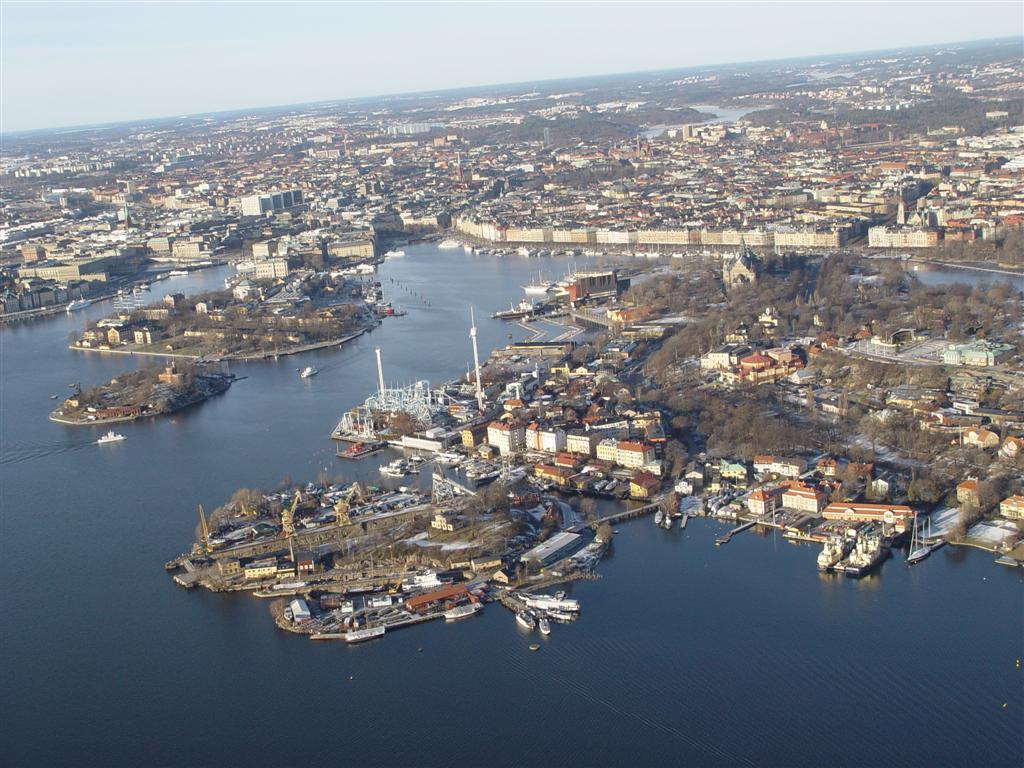
What actually happened in most places was the long-commute option, though. A European city center like Stockholm looks nice and quaint as a historical piece, but as a livable city it doesn't work very well, because it doesn't have sufficient living space for most of Stockholm's population. Instead, most Stockholmers live in modernist housing blocks out in the suburbs, and commute in. So you still have the modernist housing blocks, they're just placed in a more out of the way location. Is that better or worse? Better for the scenic Stockholm city center, but probably worse for livability.
Uhm. I'm not sure that is entirely correct. The city proper of Stockholm is very dense, often comparable to Paris. While not as uniformly dense there is higher building often six to eight floors, compared to the usual five in Paris [0, 1].
The modernist housing blocks in Stockholm were to some degree supposed to be self-supported in what was called an ABC-area. ABC (Arbete, Bostad, Centrum) is an acronym in Swedish for work, housing and service (or center). That's why they are as disconnected from the city as they are.
The problem with Stockholm is that the city stops very abruptly once you go outside the main islands. You essentially have suburbs just a couple of kilometers from the city center. While Paris just goes on and on. This becomes quite clear if you look west on a satellite maps of Stockholm [2] or compare panoramas [3, 4].
[0] http://www.arcgis.com/home/webmap/viewer.html?webmap=e532796... [1] https://en.wikipedia.org/wiki/Arrondissements_of_Paris [2] https://www.google.com/maps/place/Bromma,+Stockholm,+Sweden/... [3] http://www.tyreso.com/ovrigt/flygfoto/city/DSC01246Large.JPG [4] http://caliban.lbl.gov/panoramas/paris/paris_panorama5.jpg

It's very formalized in Barcelona's Eixample - the streets are on a square grid and each block is mix-zoned in order that each is a mini community e.g. you probably have a cafe and restaurant on your block, don't need to go far for a laundry etc
La Corbusier is still alive in parts of Southern California, resulting in places where it feels like you have to get on the highway for 20 minutes to go to the toilet. This kind of design philosophy results in places that look good from a distance and tick off all the desirability checkboxes but are not actually good places to live.
The comparison with waterfall development is apt: vision first, reality second, users last.
Brasilia, the capital of Brazil (mentioned in the article) was built by disciples of Le Corbusier. It is a horrible place, a totalitarian technocracy modeled as a city, a place that forgot that humans exist. But it is also a very interesting failed experiment.
I lived there for some years. It's not nearly as bad as you say. The main inconvenience is that it is very car-centric, but the consequence is that you get to walk around in nice green surroundings if you don't want to drive/take the bus. Other than that, it's a pretty nice place (I'm comparing it to other cities in Brazil, not to Paris).
Brasília is basically this:
https://eugene-kaspersky-wpengine.netdna-ssl.com/files/2014/...

http://www.domusweb.it/content/dam/domusweb/en/news/2010/04/...

edit: Just to mention that the buildings in the photos are all residential buildings.
Le Corbusier and followers are responsible for quite some ghettos in France and Belgium, and still he's seen as a hero by many architects.
As a consequence, instead of starting over, money is being poured into preservation and restoration of these monstrosities .
An example from Leuven: http://www.cvaa.be/en/project/social-housing-project or Antwerp: http://www.standaard.be/cnt/tp2cvh63
you can find many more
These aren't even monstruosities. Compared to actual social-architectural catastrophies they're cute.
There's a few stuff that went very very bad in this era of urban growth, and Le Corbusier was only part of it. If you look at his first big 'bar' in Marseille, cite radieuse, it was an acceptable concept, spacious hallways, carefully designed flats, with good lighting, good thermal thinking. Then you have national projects that took the idea of 1000s of people in a small land surface and removed all the actual individual value and beauty. It was all cramped and low-cost. Industrialization of social structures, that went sour pretty fast. Even though, based on the ads of the day, they truly believed in doing good and being correct in their proposal.
Doesn't them being ghettoes mainly have to do with them being occupied by poor people, not the architecture? Europe also has ghettoes in a number of other architectural styles. And in the other direction, Manhattan is packed full of International Style modernism, and yet not considered a ghetto... because it's full of wealthy people.
It might be that his constructions resulted in ghettos but it's not his exclusivity (or that the fault lies exclusively due to his way of building stuff)
Yeah, some should be conserved (maybe for historical purposes) but sometimes it would be better to start over
Architects are not wizards. Few things have intrinsical value. What one generation values is not necessarily what the next one will. To complicate the situation, individual values might not even be aligned with collective values/interests within that generation. For some time american suburbs were not even questionable as the best lifestyle that you could get, nowadays people are not sure anymore. Values change continually.
Large developments involve a lot of resources so they must be politically defendable. The architect has to distill reality and ideals to propose (bet) on something.
But there is more to it than that.
Le Corbusier has to propose something that makes people say "classic corbusier" or something like that. No name architects have to propose something weird if they ever wish to be remembered by anybody. Bad rock star architect probably makes lot more money than good no name architect.
Politicians actually making the decision are playing with someone else money. In most cases nobody remembers them in any way. Only if the building comes famous for looks or budget, the politicians get anything out of it. So again incentives for eccentricity.
If you would let regular people to vote on architecture, you would likely see incremental changes. And the system would be lot more like you described.
In general democracies are not great for architectural experimentation in large scale. There are too many veto players and experimentation must be aligned with investors short-term values/interest (AKA public or private money will only be spent if somebody will get fast gains from that investment, being it cash or advertisement).
In pro-totalitarian regimes, ideals are the most important. If architects don't diverge from that ideals, they have carte blanche to experiment.
E.g. Frank Gehry eccentricity is chosen mostly for the advertisement that will bring to the development. Even so, FB headquarters amount of experimentation is minimal. High level of experimentation is costy, risky and the potential reward would be minimal.
I really think representative democracies are almost as good/bad at public works than pro-totalitarian regimes. Veto players are as relatively likely to veto moderate approaches, because nobody has real interests considering the actual functionality of the building. It may be more towards cheap eccentricity than expensive eccentricity, but anyhow you aren't guaranteed to have anything beautiful.
Private business playing safe is not really surprise to anybody. Also completely private houses play safe most of the time too. When somebody actually has something to gain from architecture, there is no need to reinvent the wheel.
My point is that some form of direct democracy would calm down public works. Which only seems fair. If million eyeballs have to see a building daily, why do you let ten decide on it?
To simplify and agilise the process.
As an architect, I would say that it is exactly the main privilege of this job: being able to influence the decision of what will be built ;)
I didn't realize I was talking with an architect. Sorry if I come off too aggressive. :)
I honestly think that there would be big loads of cash to be made in architecture if somebody would take strict back to the roots + science approach.
If you could contact CEO of general electric and show him proof that his employees are 10% more productive in a workplace you designed than what is industry standard at the moment, budget is no real constraint anymore. You could do that, psychology is lot more quantitative these days than ever before.
The result would probably not be "WOW" architecture. It's probably lot about windows. And you have to take interior, exterior and surroundings into account at the same time. Probably quite traditional and boring building. But possibly lot more interesting than this: https://upload.wikimedia.org/wikipedia/commons/8/8b/GE_Schen...

You would not get your name on architecture magazines. But you would make lives better. Happy employee is productive employee.
I hope you are not offended. This is nothing personal. I'm just frustrated with so much outright ugly factories and offices everywhere, and architects are juggling around Guggenheim. What works in art doesn't work in buildings, because we have to live with the crap that never would have gotten out of studio.
I find it interesting how people love tearing everything down and starting again from scratch, whether it's developers doing a complete rewrite, a new government scrapping the previous government's entire plans, or an architect suggesting to demolish an entire city to be replaced with their own design. I'm just as guilty as anybody else, so it's not a judgement. It just seems to be something innate in many successful people.
FWIW Le Corbusier is responsible for perhaps the most livable city in India. Chandigarh. It is perhaps one of the few orderly cities in India.
I love Alexei Sayle's take on Corbusier, linked from this blog article:
http://blog.jasonbrackins.com/2012/12/brutalism.htmlA good summary of why I dislike brutalism so much:
We were experiencing one of the defining characteristics of Brutalism. The atmosphere of totalitarianism. The brutalists were masters of putting you in your place, which was in submission to the state (and the architect). The huge, blocky forms immediately create a dichotomy of scale. You are minuscule next to these things. The walls are flat. No decoration. Even the texture is on a small scale (no feature larger than a brick) and uniform. This lack of features reinforces the dichotomy. There is nothing human size in this place. The very structure of the building screams out "You are small. We who built this, we are large. You are small! We are in control!"
Brutalism is anti-totalitarian. It was a utopian movement using the latest technologies to rebuild accommodation and social environments with incredibly constrained postwar budgets after the devastation of the air war in Europe.
Le Corbusier was a monster, the purest of anti-humanist modernists, and he would have destroyed Paris in the name of ideology.
The office park and faceless, isolated and dehumanized tower are his legacies. The fact that he is still taken seriously, let alone respected, is a testament to the gnosticism, anti-humanism, puritanism and anti-historical rancor that has characterized the building (and broader artistic) community since 1900.
But that's none of my business...
That he survived WWII in an intellectual sense is unfortunate. His buildings, like Albert Speer's, are a concrete rendering of the idea of 20th century dictatorship. Thankfully there was already resistance to his ideas -- even his friend Salvador Dali loathed his architecture. But it took a long time before intellectuals such as Jane Jacobs developed a complete framework that explained why modernist buildings are so damaging (beyond prudence and horse sense).
His aesthetic offers a great lesson, and the lesson can be applied to any field: large-scale changes, applied top-down, incur a risk of inflicting deep social damage. This is why user feedback is so important. This is why going with your gut or channeling a theoretical framework must be strongly tempered by empiricism.
> anti-humanist modernists
And yet the totalitarian dictator types alway seem to prefer classicism
LC was the culmination of a barbaric trend, yes. But isn't it important to take the purest exponent of anti-human modernism seriously, since he's influenced our lives so much?
I can see the argument, like one should read 'Mein Kampf' or 'The Communist Manifesto' for historical reference.
On the other hand, I think its important to recognize that the mainstream of academic architecture does not reject his work, and continues to reject, in the main, the works of people like Jacobs and Alexander.
So, yes, perhaps we should still read some of his stuff (a lot of it is pretentious nonsense, in my opinion) but only with a proper understanding of what his aesthetic lead to.