▲ 107 points
back
52 comments
Surprised the article doesn't mention the theory that Speer is most famously associated with: the idea that future generations judge civilisations primarily by the aesthetic quality of the ruins they left behind. Largely true (and not an original idea, despite Speer's claims), but a surprisingly chilling observation in context.
See, for example, the Victorian fashion for building Gothic or neoclassical "follies", sometimes as ruins to achieve that aesthetic.
A lot of Fascism was based on emulating the Romans, whose ruins are famous. It's right there in the name, taken from fasces.
Ruinenwerttheorie
https://en.wikipedia.org/wiki/Ruin_value
The other thing is that the massive constructions of nazi Germany aren't dissimilar to the architecture of many public buildings in Washington or elsewhere.
Reich chancellery building: http://terrainandtoysoldiers.blogspot.co.uk/2011/10/54mm-rei...
National Postal Museum (DC) https://www.google.com/search?site=&tbm=isch&source=hp&biw=9...
At the end of day the codes to impress people with a building are always similar.
Actually the Nazi architecture is close to fascist architecture in Italy, not so much to classicist architecture elsewhere. You can see that in the details, for example that DC building you linked has classical doorways and round columns with greek capitals, while Speer-style Nazi buildings have a brutalistic tone with square columns and avoidance of details that point to a humanistic heritage (see also the stylized eagle). In some way, this is the fascist form of architectural modernism.
edit: yes, both are made to impress, but that's just as true for big glass&steel-buildings that share not much with those two examples other than the massive, larger than human size of everything.
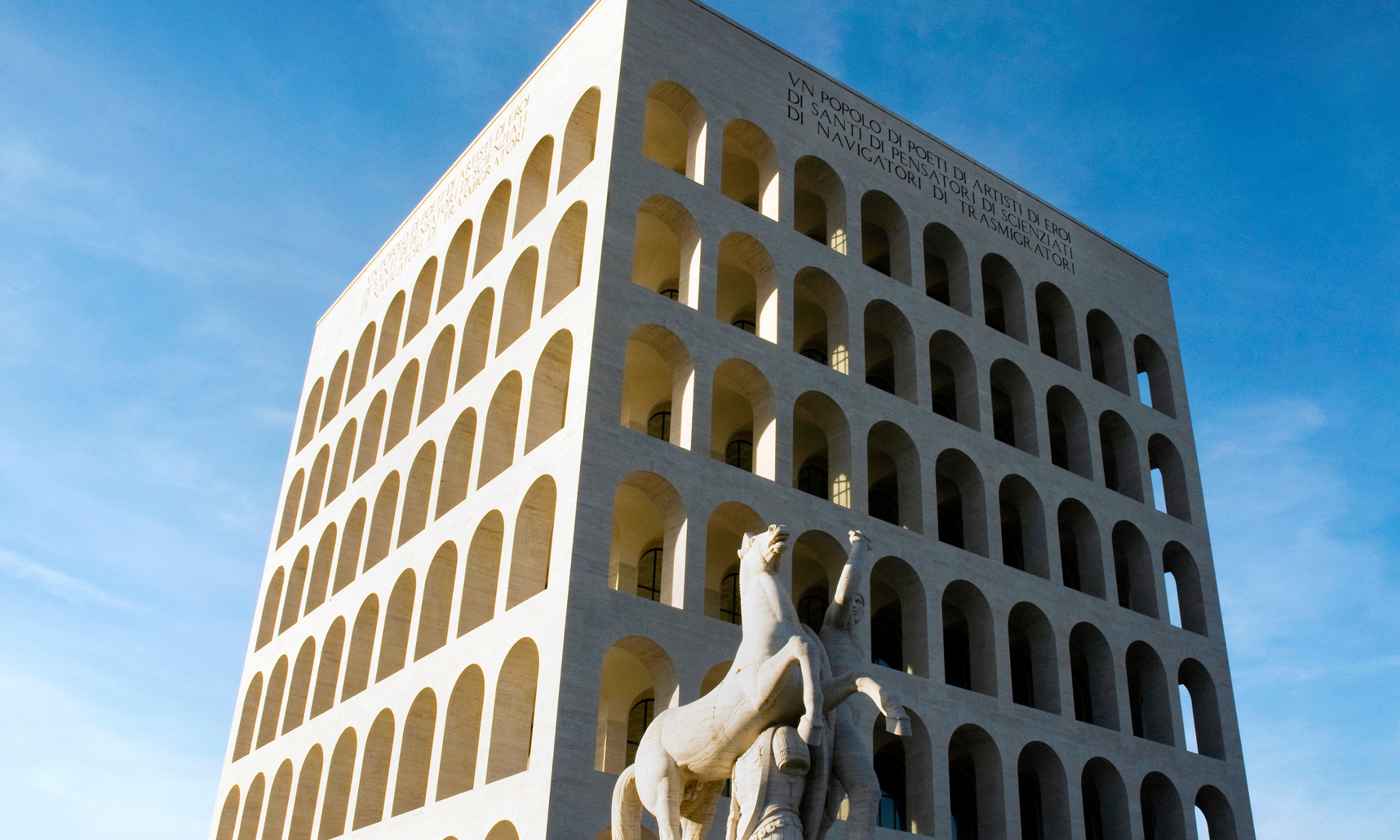
No comparison. Italian Fascist architecture was graceful [1][2][3].
[1]:https://static-secure.guim.co.uk/sys-images/Guardian/Pix/pic...
[2]: http://41.media.tumblr.com/9b6cfa0be5785abbfb2c8e107cbb1565/...

[3]: http://s4.thingpic.com/images/ho/S4VCpGhFJtXuBJVU5aY7ZKhR.jp...

It still gives you an imposing feel. Fascist regimes saw this style of architecture as another means to highlight the strength and imposing will of the state over its citizens.
Make no mistake, it was meant to be oppressive, discolored, and raw. Not terms someone readily associates with "graceful".
I think he was being sarcastic, since the last pic seems clearly "brutalist"? (is that the right term?)
"Brutalist" as a tendency definitely, as much of modernism is - but actual Brutalism is a style that is almost comically using modern materials, like this church in Cologne http://www.kirschfoto.de/galerie/bilderkiste/pics_high/koeln... or this university building in Berlin: http://40.media.tumblr.com/ed3608dcb4860ad6dc8df05c4bd807ca/...
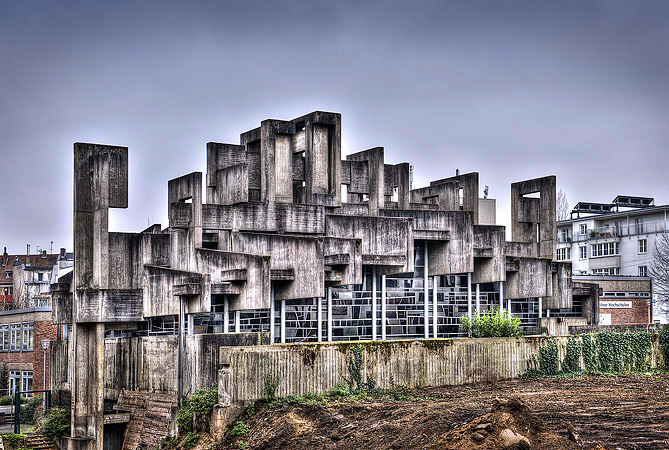

Wow, the last one looks reminds me of many public buildings in my city: https://farm4.staticflickr.com/3815/11038238423_8788196347_b...

I'm not sure I'm looking at the right details when "classifying" it, though.
This one was built in 1972.
Not being sarcastic. That last pic is 'Casa Del Fascio'. (Italians are the Japanese of the Europe, imo, in terms of design: even on a bad hair day they can't help but make beautiful stuff.)
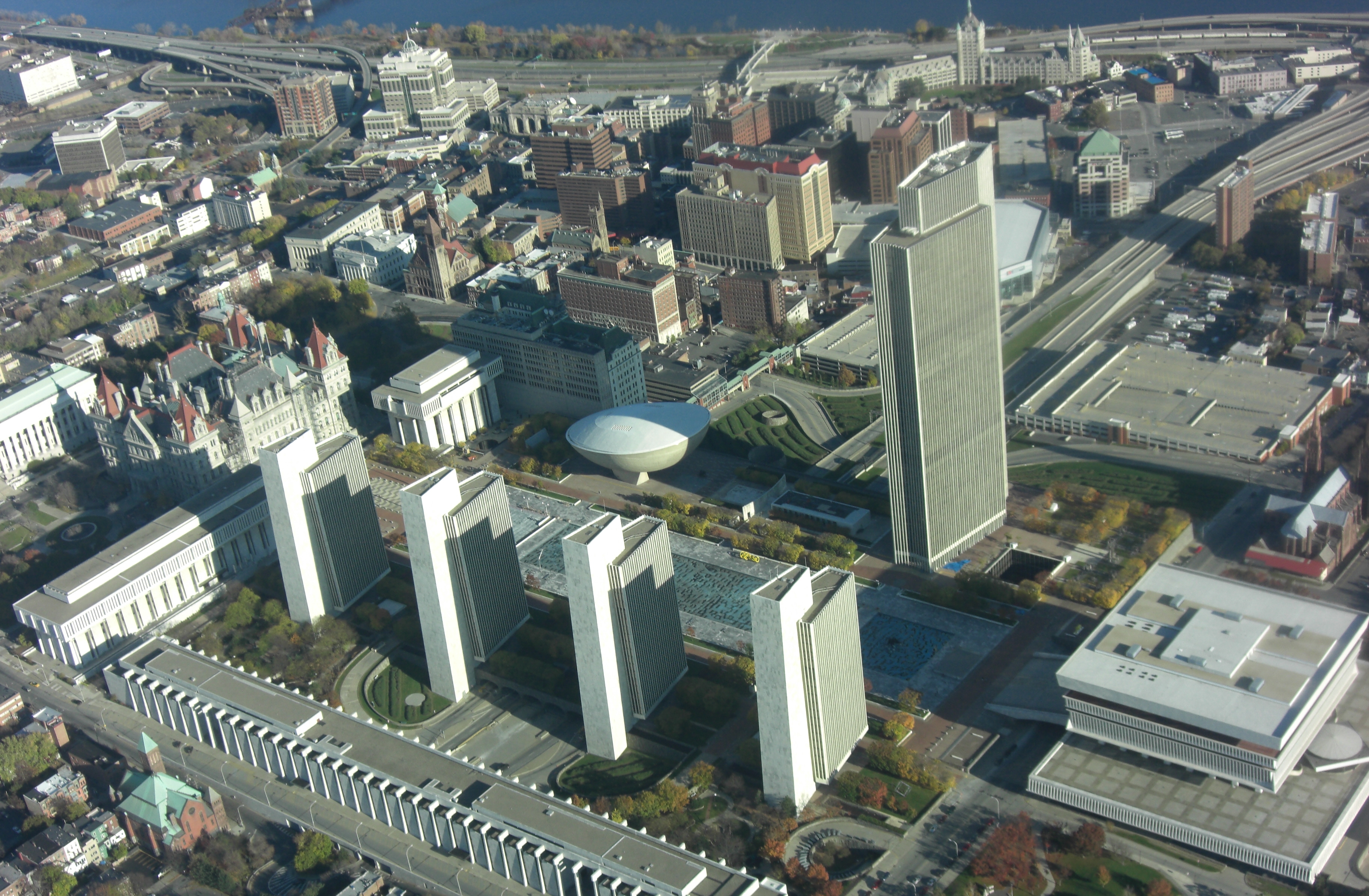
Back in the day in RPI, we affectionately called this complex [1] the "nazi plaza". This is brutalism. For a more masterly brutalist work, see the Carpenter Center by Corbusier [2].
[1]: https://upload.wikimedia.org/wikipedia/commons/f/ff/EmpirePl...
[2]: http://www.artandarchitecture.org.uk/assets/aa_image/700/4/a...

Thanks for clearing up. What does RPI mean? I totally bought that as a east german complex :)
That last one does appear more along the lines of brutalist, with its unapologetic blank wall on the right, covered in marks from the molds.
Throw a rock in downtown DC and it'll probably hit an imposing building. (And then you'll get hauled off.)
Wandering a bit, one thing that always strikes me about that area is how not striking the White House is. There are tons of massive, imposing buildings, including monuments, museums, and offices. Then you wander over and there's... a house. A big house, sure. A mansion, even. But considering it's the residence of the most powerful guy around, it's pretty indistinct in context. If you're not close to the fence, it's easy to lose it in the trees.
That was deliberate. Congress has the big impressive building, indicating that Congress is superior. (They can fire the President, but the President can't dissolve Congress.)
Not only that, it's mostly an office building. The President has an apartment upstairs. It's a nice big apartment, but it's not the whole house.
Up to the Truman administration, the White House was a low-budget operation and wasn't well maintained. When Truman moved in, they brought in their piano. It fell through the floor, and through the floor below. They had to move to Blair House while the White House got a major rebuild with a steel frame.
The Imperial Presidency goes back only to Nixon.
I'm not really seeing much similarity beyond 'both are roughly box-shaped and have a lot of vertical stuff going on in the front'.
I went to college in Pittsburgh, down the street from Carnegie Mellon. I remember people periodically making a stink because the architecture of some buildings on CMU campus resembled Nazi buildings, in their opinion.
That is because Waahington DC is not an expression of a democratic mindset. It is borrowed, entirely Masonic and presciently crypto-fascist.
@dang: you folks really need to force an input box on down voters. The above is a matter of historic fact.
The Venice Architecture Biennale will also have a focus on Nazi Architecture.
>The Evidence Room was the combined effort of a team of students and faculty of the University of Waterloo School of Architecture headed by Anne Bordeleau, Sascha Hastings, Donald McKay, and van Pelt.
>It features life-sized replicas and casts of key pieces described in his testimony about Auschwitz, including a gas column, gas door, a section of wall with a gas-tight hatch and other items that definitively proved the site was a factory of death.
There's a fascinating radio interview at this link: http://www.cbc.ca/radio/q/schedule-for-wednesday-march-2-201...
I have a distinct impression that half the modern architects are in on the conspiracy to demean and hinder the people who use their creation. Looking at most modern buildings they are either imposing or convoluted.
I find this era as fascinating as horrifying. It's surreal dreamy and timeless yet inhuman at the same time.
ps: some scenes of Total Recall were filmed in a military school in Mexico which such design. As a kid not knowing that school, it made 30% of the realism of that movie.
There have been some awful architectural fads.
- The MIT Stata Building.[1] The real world version of Dr. Seuss. Menlo-Atherton High School got stuck with an auditorium in a somewhat similar style.
- Twisted skyscrapers.[2] Panama City now has the world's biggest screw.
- Buildings with huge holes in them. The Grand Arch du la Defense near Paris started this trend, and there are striking examples in Beijing.[3]
Roofing over large areas with glass and then putting open-plan spaces into them is not unusual for air terminals, convention centers, and malls. The Crystal Palace started the trend in the mid 19th century. Google is proposing to build one for offices. This may be more cool-looking than useful.[4]
[1] https://en.wikipedia.org/wiki/Ray_and_Maria_Stata_Center [2] http://www.amusingplanet.com/2013/04/twisted-skyscrapers-aro... [3] http://www.starwoodhotels.com/sheraton/property/overview/ind... [4] http://www.digitaltrends.com/computing/google-shows-off-plan...
Christopher Alexander has been making this point for many years, that modern highbrow architects designs buildings without concern for the people who will live and work in them.
Are they really or do we only notice the ones that stick out?
We note ones thas are awful, while most of modern buildings are "just" bad.
Of course this is subjective, but when you walk a street built in early XX century, every building blends in while being nice in detail. When you meet a building built in later age, it either sticks out, too geometrical, too glossy, strangely shaped for no reason, looks cheap, lacks details... It is never good enough.
I have some thoughts on this, one that notes that the tax laws highly discourage ordinary businesses from owning buildings. To the need to build a ton of cheap stuff during the twentieth century population explosion. The introduction of new materials. The belief that progress was so fast that these new buildings would soon be surpassed and torn down. And finally general post WWI and especially WWII nihilism. Plus the extremely milign offects of B.F. Skinner[1].
Behaviorism teaches us that humans will successful 'adapt' to whatever horrible yet convenient for those running things environment we subject them to.
"introduction of new materials"
This is where fun starts.
"New" materials look like crap and become worn down in a few decades. Meanwhile "old" materials look expensive and pass century test.
One can argue "new" materials are cheaper, but buildings still cost awful amounts of money so it likely didn't help.
if you like this area, I highly recommend reading Adam Tooze's The Wages of Destruction - The Making and Breaking of the Nazi Economy. It takes an economics lens on Nazi Germany both pre and during the war. A lot of the book centers on Speer and other 2nd/3rd tier people in the Nazi regime.
Read his "Inside the Third Reich" many years ago. Had no idea until I read this article that he has been discredited. For anyone who hasn't read it, it can pretty much be summed up as "All I ever wanted to do was architecture, and I just got caught up in a series of events. I was surrounded by brutes and buffoons, and I just did my best with the situation I found myself in." Also some very valuable insights into Hitler's persona, but can you believe anything in that book now?
'Discredited' is a strong term, but the problem is that many people, even senior Nazis, made similar arguments. Read, for example, Eichmann in Jerusalem to see an account from a senior member of the SS making a similar explanation when justifying why he managed transportation of Jews to concentration camps. The world's reaction has been to universally reject such arguments, which may be unfair in any particular case but is necessary for a proper accounting of war crimes.
When I read that book I had to take some of his statements with a grain of salt. Even then, when the Posen proof was not yet known. As explained in this article he lied a lot. He had to, esp. the Posen incident where he got away with it even if it was totally unbelievable. We only got the proof recently. And his involvement in Todt's slave labour "Organization". He was his boss after all and got all the credit for its success. Even rising up to be the designated follower of Hitler. Todt got the death sentence for it and he successfully talked his way out of it.
But then his made up prison stories to impress his fellow germans just broke it. He was a lousy architect after all, as Poelzig correctly found out. What was interesting for the americans then, how he managed to be so incredibly successful as manager of war-time economy. It was unbelievable and unexpected. McNamara would have been very proud of Speer's accomplishments. He was a kind of genius figure for the americans.
Obviously you can't take his book as your only source of truth but it provides a lot of insight into how the Nazi system worked. I found especially the parts about Hitler very interesting.
It's a remark by the author and is simply an opinion - I wouldn't say this book has been 'discredited'.
Yeah, I was wondering myself how biased the article was.
Speer's monumental plans aren't that horrific as such things go. Other big, intimidating monumental complexes have been built.
- Governor Nelson A. Rockefeller Empire State Plaza in Albany, NY. This is the state capitol.[1] A big plaza surrounded by 1960s concrete brutalism at its finest.
- The Raj Path at Delhi.[2] Built by the British to impress the heathens.
- Place du la Defense, Paris.[3] Contains a building built to look like a wind tunnel intake. Built partly as a rebellion against the city of Paris building height limit. It's just outside the city limits.
There are other big monumental complexes - Washington, DC, Red Square, Tienanmen Square, and Brasilia, for example. But the three above stand out for their deliberately intimidating architecture.
As for the square-column thing, that was a 1930s-1950s fad. The US State Department Building has an imposing square-column facade. It's not as imposing as it used to be, because there are guard houses and terrorism barriers blocking the view. The Pentagon also has square columns, on all five faces.
The author of the parent article is a Jew, so he has to be negative on the work of a Nazi.
[1] https://goo.gl/maps/DF8n1Ew3ua52 [2] https://goo.gl/maps/AY43jg4WmN92 [3] https://goo.gl/maps/WCSdUqnaEek [4] https://en.wikipedia.org/wiki/Harry_S_Truman_Building
Excellent characterization and summary. In German those types are called "Angeber" but you really have to read his books to get that. Essentially he said he is soo clever, he memorized most of the books in his prison library
Architecture and authoritarianism go together like milk and cookies. There is an inherent desire to order and control in the architectural mindset.
An article about architecture with no pictures, seems a waste. Apart from that it was very interesting.