back

by walrus01·10y ago·view on hn ↗
I don't think it's "cars" are getting weird, it's just this one weird Tesla and their business model... The article says:

"Cars are big computers, and have been for a while"

Doesn't mean we need to treat them like software development platforms. Most of the challenges are still at OSI layer 1 and most of the problems to deal with are mechanical: Tire still wear out, disc brakes still function much as they did 10 or 15 years ago (and wear out), wheel bearings, hydraulic systems for power steering, etc.

Given that cars have much longer lifespans than typical consumer electronics, the last thing I want is a car with a built in 10" touchscreen running some ancient version of Android. I'd rather have some sort of standardized modular system where I can put my own tablet-sized computer in an appropriate place and have it get power, audio sync with the car's speakers. Look at the crap infotainment systems built into 2015 and 2016 model Toyotas, Hondas and Nissans and compare it with a good $400 Android 6.x tablet. Do you really want that same un-updated OS and software for ten years?

The idea of the "double DIN" size car stereo mounting location was a good one, but we need something bigger than this, and with standardized cable connectors:

http://www.autodvdgps.com/ebay/ZC620/ebay-3.jpg

Carmakers, please find a way to separate the 'infotainment' part of the car's computer from the embedded computer that's actually required for the car to run (engine timing/valves, fuel injectors, mixture, emissions monitoring, intake oxygen sensor, etc).
15 comments
> I'd rather have some sort of standardized modular system where I can put my own tablet-sized computer in an appropriate place and have it get power, audio sync with the car's speakers.

Oh my gosh yes!

The car should be the peripheral, not the main compute device.

Is it a big deal to plug in a 10-year old USB mouse into your computer? No, because that is a well-defined interface. Ditto for some other peripherals. This is what I'd like my car to be.

I don't think we'll see that anytime soon though. Unless everyone gets on-board with a Bluetooth standard that exposes sufficient functions to the phone/tablet to be useful.

Probably everyone here would like something like this. But the decisions aren't going to be made by the sort of people who read this, they're going to be made by auto marketing executives. Then they're going to operate in an environment regulated according to lobbying by automakers. We're going to get auto electronics with software that becomes obsolete about as fast as a typical Android smart phone. I realistically think that when the major legacy automakers ship something vaguely similar to a Tesla dashboard, the best a buyer can hope for is that it remains vaguely updated for a year or two, and then only critical vehicle safety changes might be made forever thereafter.

But you can also look at this and the point of view of carmakers. What an amazing boon to sales. This is a way to finally solve the ultimate problem of selling cars today. A car you make today has to compete with the extremely good car you made five years ago that still works great, still looks great, and is much much cheaper.

This makes tons of sense, especially in these early days of self-driving vehicles. There are of course enthusiasts who will want nothing to do with self-driving until the very end when their manual gearboxes are ripped from their cold, dead hands, who would honestly prefer precisely zero touch screens in their current and future vehicles (I consider myself part of this group). We're a small minority though, and as evidenced by how many cars are still available in the US with even the option to row your own, I don't think it's going to stop any manufacturer from eliminating the possibility of manual control entirely within the next few decades.
What I'm imagining is something similar to Android Auto / Chromecast / Samsung's smart TV "evolution kit", using a connector in like HDbaseT (everything-over-ethernet) or USB C 3.1 (both of these connector solutions even offer up to 100W power transfer and arbitary data streams).

Basically an RPi3 / RPi Zero with a single connector and a number of well defined interfaces for audio, video, talking to car systems, networking, etc...

The possibility to swap I/O devices would be nice too, so you can integrate stuff like Soli (Google ATAP) when modules for that shows up.

And I want that same thing for smart TV:s too. Ideally both of those could use the exact same standard too!

Sadly these are the exact reasons why it won't be modular. They can force you to buy a new car just by stopping support for its operating system.
Cars aren't iPhones though. Let's assume that the manufacturer supports the OS for 2 years and let's take the Nissan Versa 2016, which has the lowest cost to own of any car.

Sticker Price I found was $12,825 ,so let's go with that. Cost to Own for 5 years I found is $28,855. I assume this includes depreciation and that the car fully depreciates in 5 years. If the car lasts for 2 years, the monthly cost comes down to $796/month. If the car lasts for 5, the monthly cost is $476/month, which is a little more than half.

Now this is the most budget new car I could find. Straight up doubles in cost. Or you get the situation where people just decide to drive with the legacy version anyways, which sounds a lot like a literal ton of Windows XP at 50mph. And all because you couldn't come up with a universal plug for car entertainment systems.

> And all because you couldn't come up with a universal plug for car entertainment systems.

It will have absolutely zero impact on their bottom line sales to stop updating their carOS, since they have been doing it for years already and have never done it in the past. Every car with bluetooth / cellular / wifi support has to, by design, contain a computer to provide that service. Every car with a dash more sophisticated than dials has a computer in it.

Nobody has ever considered the security or ethical consequences of these wholly proprietary computers in their cars, and in the same way modern John Deere tractors are complete black boxes with no ability for quote unquote "owners" to inspect, audit, modify, or replace the software part cars have been the same way for years, even if the computer hasn't given you an obvious touchpad UI to notice it.

The car won't stop working just because they do updating the software. At least in America they have to provide parts for at least 10 years. And eventually they won't be able to continue to yell copyright to prevent people from updating the software
There are people with John Deere tractors who claim they can no longer use said tractors because the tractor's owner won't pay for an authorized tech to come out and plug into the tractor. Because farmers have to be frugal. So maybe they can yell copyright.

On the other hand, things with engines can hurt people so you cannot allow unconstrained access to that port. Safety, IP and "who owns what" will make things more interesting as things emerge.

This is actually an interesting question when combined with OTA updates. Could (auto maker of your choice) theoretically supply all the parts you want but deny you from using them via software blocks? Or would that be illegal?
If the software is internet-facing (hint: it is) and contains unpatched vulnerabilities, it could easily be made to stop working by a drive-by (hah) script kiddie attack.
>I'd rather have some sort of standardized modular system where I can put my own tablet-sized computer in an appropriate place and have it get power, audio sync with the car's speakers

I did pretty much this in my car, and it was surprisingly easy. ~7 inch tablets are just about the same size as Double DIN radios, so a little but of modification to the mounting bracket, some wiring, and a used Nexus 7 I picked up on ebay got me this: http://paste.click/RILfPr

It's hooked into the car's speakers via a USB dac and a small amp, and pulls sensor data from the OBDII port with a cheap bluetooth scantool, but otherwise is completely independent of the car's systems. Turns on and off instantly with the car's power thanks to Timur's Kernel (super low power standby really, but the battery drains isn't much different than having it completely off).

I also attached a wireless remote via OTG so I don't have to mess with the touchscreen for simple things like volume and media controls while driving.

So it's definitely a viable option. I'm surprised no one has come out with a standardized D-DIN to <popular tablet> bracket yet.

the last thing I want is a car with a built in 10" touchscreen running some ancient version of Android... Do you really want that same un-updated OS and software for ten years?

One of the nice things about Tesla is their regular, free software updates. Even the earliest Tesla Model S models can be updated to the latest software. You get all the features that the 2016 Teslas have, except of course where the required hardware is not present (like Autopilot).

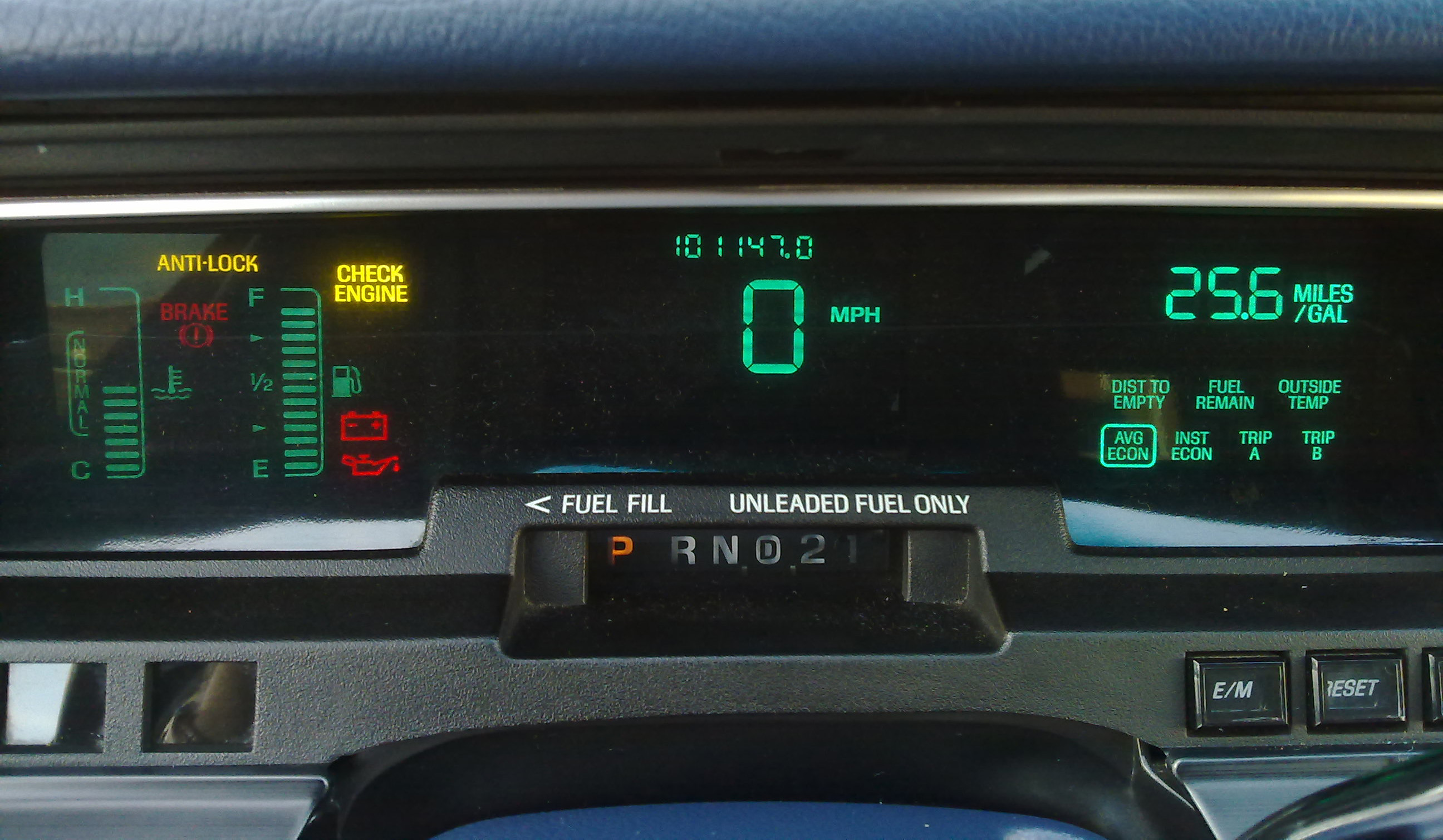
In things like smart TVs, smart fridges with LCDs on them, and infotainment systems in cars, this is sadly the exception and not the norm. Hardware-oriented manufacturers push a product out the door and things frequently get little or no updated after that. I'm willing to bet money that in ten years from now, a lot of 2016/2017 model year Toyotas that ship today with some sort of infotainment touchscreen system in them will be still running the exact same software. In fifteen years from now such cars will look as quaint as the cars from the 1980s with full LED dashes:

https://upload.wikimedia.org/wikipedia/commons/d/db/Vfd_car....

> In fifteen years from now such cars will look as quaint as the cars from the 1980s with full LED dashes:

Those are vacuum fluorescent displays and not LEDs, and were used in new vehicles (at least by Ford) until the early 2000s. They are still a great choice for vehicle instrument panels and are commonly used for aftermarket retrofit units (see for example http://www.parrautomotive.com/index.cfm/page/ptype=product/p...)

Is it sad that I prefer that relatively clean and functional full LED display over a lot of the modern touchscreen infotainment junk?
One of the nice things about Tesla is their regular, free software updates.

Regular, free software updates are nice as long as the regular, free software updates are nice.

As soon as whoever controls the software updates decides to do something not nice, however, those updates become a huge liability. It's annoying enough with things like evergreen browsers or Windows 10, all of which apparently break basic functionality all the time. But with cars, where an enforced OTA software downgrade can reduce what you bought to something less than you thought you were paying for, and you can have the original back for a few thousand bucks? That's just a legalised extortion mechanism IMNSHO, and I don't want anything to do with it.

Or in cases as directly described in the post: like when Tesla uses software-limits to prevent the car from using the whole battery... and charges you $9000 for the rights to use the whole battery as it was designed.
They will still drop features or stop updates at some point
I just want a car that still runs even if all its electronics (not really counting ignition here) are fried.
I had a 2003 Camry. I recently bought a 2nd hand 2014 Camry. I have not done any research, but I swear that the car is magically doing things for me.

Eg.

When the parking break was on and you forgot and tried to drive, the 2003 had some resistance. On the 2014, it seems that it disengages the brake for you if you are not in Park. Which can be annoying if you have to stop on an incline with traffic.

It also seems to regulate your speed in very wet conditions. On a straight road, in moderate rain, it definitely feels like I need to push the accelerator down more to get up to speed.

I admit the 2014 model is nicer to drive, but I don't know what will happen if the electronics get fried.

I'd like my car computer software to be re-copied from ROM every time the car is started. The ROMs will only be updateable by someone who has physical access to the car so they can push the physical "write enable" switch.

I.e. not a software "write enable" switch.

Just disconnect or shield the wifi or cell antenna used for remote access. For bonus points plumb in a repeater/firewall to filter any traffic you want.
I would really like a 100% mechanical automobile, with no computers involved, designed such that when something breaks and you're fifty miles away from anything, you can actually crawl underneath and fix it. Analog radio, crank windows, keyhole locks on every door, real guages. I'll concede the electric starter and the windshield wipers, since I'm not that nostalgic for the days of the Model T.

Completely off-topic, but if I saw a new truck with the old-style floor-mounted stomp pedal for the dimmer switch, it'd almost be a shut-up-and-take-my-money situation. I cannot comprehend why automakers keep piling more stuff into the steering wheel. Some of the little sedans have handles and buttons coming off them every which way.

I've found computer-controlled electronic fuel injection much more reliable than carburetors. And OBDII is very handy for diagnosing mechanical problems, even with the manufacturer idiosyncrasies.
The fact that automobiles are on the road for longer than ever and their life expectancy keeps growing makes me think they're getting better at reliability and maintainability rather than worse.

edit

I also find AAA much better than crawling under my car in the middle of the night 50 miles away from anything...in general. But I know that's a personal preference.

My uncle was showing off his new car to me - it had all the fancy bells and whistles of "modern" cars, including a sensor for everything. The same day, one of the sensors told him a tire was low on air. He filled it up at a gas station and ended with a blowout on the highway (up until then the sensor still said it was "low"). The damage to the car was minimal, but it wiped out the "blind spot" sensor on that side of the car. Needless to say, these sensors are ridiculously expensive to replace.

I hate that cars are bloated with superfluous components that always break before the car itself does. That said, there are some gadgets that I would miss on a fully mechanical car. I'd be happy to find a manufacturer that could balance that correctly.

Why would you want that? How often does your car actually break? What computer-controlled components break in it?
That's why I still drive my 2000 Integra. It's not without a computer, but it's mostly mechanical. I can fix nearly everything myself, and I do. It still gets decent mileage, it's incredibly reliable, and parts are relatively cheap and plentiful.
>when something breaks and you're fifty miles away from anything, you can actually crawl underneath and fix it.

Where are you going to get the parts if you are 50 miles away from anything?

Yes, but API's for cars are not going to be very popular with the manufacturers, who would like you to pay big $ for their crappy un-upgradeable bs. This is one reason why you'll upgrade your whole car, after all.
I would image they'll go through the same evolution that was brought on by the competition from Android devices: cheap, full-features, and massively popular.
Agreed.

I recently got a Pioneer 4100 NEX aftermarket CarPlay device fitted in my 2010 Camry just for this. Unfortunately, CarPlay itself has many usability issues that have not allowed me to use the system the way I had imagined.

This is a bit of a tangent, but could you expand on that? I'm interested in getting CarPlay in my next car, but I'd like to know what some of the limitations and downsides are.
Are you on Android? If you are I assume you're referring to being locked into the Pioneer interface and compatible apps.

There is actually a way to use the native Android interface if you have a rooted device: http://forum.xda-developers.com/showthread.php?t=2451980

I do not use this personally, but I was looking into the Pioneer 4100 NEX myself and plan to buy one after finding this workaround.

I'd love to hear more about this-I have a 2009 Camry hybrid that has a janky screen that I've been thinking about replacing with a more modern audio device.
> "Carmakers, please find a way to separate the 'infotainment' part of the car's computer from the embedded computer that's actually required for the car to run"

They have, sorta (but it's still rather limited in functionality):

https://www.android.com/auto/

Android Auto and I believe Apple Car Play both run totally from your phone/tablet, with the car just being a view screen. Thus, you get updates when your phone updates.

I don't even want a modular computer slot - I just want a built-in 'remote' display panel & speakers. Just setup a peripherial that can be wirelessly or usb/lightning cable linked that also transmits the touch info back to my phone and plays sound.

Maybe a switch to flip the display to access direct car controls (but really just give me hard-buttons/dials etc for climate control and keep the consumer electronic part simple and separate).

Extra points if there's a standard for sending car control api calls back and forth to the phone, but 90% of utility could just be handled with a remote touch display.

You are exactly describing Apple CarPlay and Android Auto
Do you think those are physical switches in cars with tactile components? All of that UX stuff is still backed by a controller. If they are going to proved a remote display, i would prefer those pieces to be integrated so that if I move my mobile device to a different vehicle, then that vehicle imports my settings. While we are wishing for horses, we might as well make them unicorns :D
Why not both? Eventually whatever connection you're using will be dated and considered inefficient crap. Would you want to have to deal with Bluetooth 1.0 today?

Use a standard modular platform so you can hook up whatever SoC you like. Whenever the old one gets dated, upgrade it and get all the latest fancy radios.

Sadly, this is unlikely to happen since car makers can up sell cars based on the software they ship with. Aside from bugs, there's little motivation to ever update that or release newer versions compatible with older models. We even see the same forces in action with the aforementioned android tablets. Consider how long the typical manufacturer releases android upgrades for a given model. It's typically a year or less.
How about we don't have "infotainment" in cars?

The cumudgeonly John Muir ( who wrote "Volkswagen Maintenance for the Compleat Idiot") is on record as saying cars would be safest if "... drivers were strapped to the front like an Aztec sacrifice" (paraphrased). Exploits to take over cars through the infotainment systems only reinforce my prejudice.

> disc brakes still function much as they did 10 or 15 years ago (and wear out)

Actually, regenerative breaking means they last quite a bit longer.

Brake pads are cheap, discs aren't very cheap but are still reasonable. A regenerative braking system? I'll bet that's a lot more expensive.
Theoretically, that standardized system is called CANBUS, but companies like Toyota think it should be encrypted and out of your reach.
Of all the innovations in modern auto design, I'm not sure that's the one I'd go for.

IIRC, a CAN bus design is essentially a jazz model for connecting different subsystems with no built-in security standards. For some reason, I'm not sure externally connected hardware, OTA-updated software, a vehicle's essential mechanical control systems, and implicitly trusted access from everywhere to everything via a centralised bus is a good combination.

Some of the relevant technology is patent-encumbered as well, which is rarely an ideal basis for standardisation and interoperability IMHO.

I think that's what my old Chrysler had. The one where when it failed, absolutely every electrical accessory went dead at the same time. HVAC, radio, wipers, turn signals, tailights.

The only thing that still worked was the engine management computer (it still ran fine) and the headlights which seemed to be wired directly. I think the brake lights also worked but I'm not sure.