https://upload.wikimedia.org/wikipedia/commons/d/db/Vfd_car....
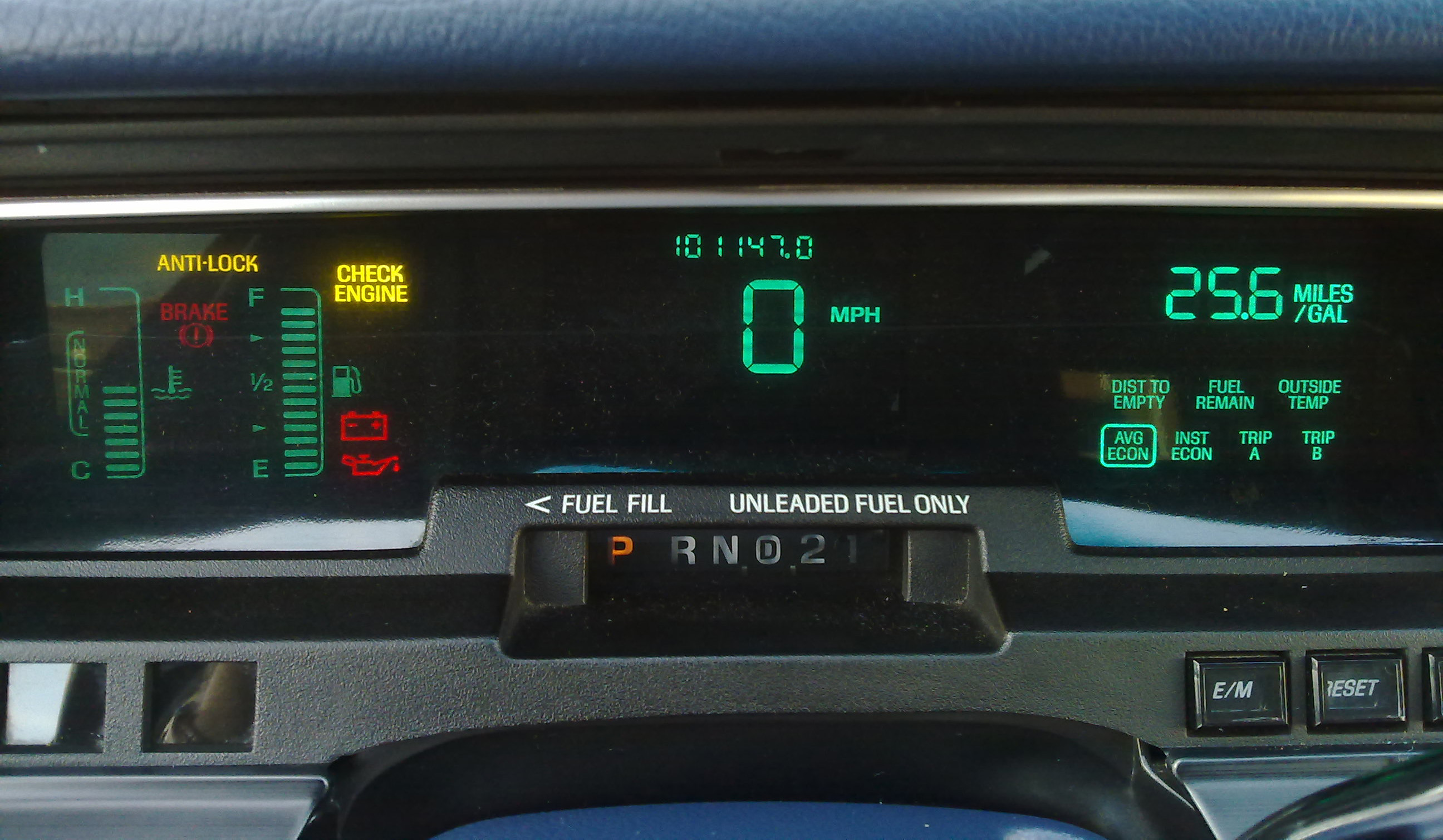
Those are vacuum fluorescent displays and not LEDs, and were used in new vehicles (at least by Ford) until the early 2000s. They are still a great choice for vehicle instrument panels and are commonly used for aftermarket retrofit units (see for example http://www.parrautomotive.com/index.cfm/page/ptype=product/p...)
I've been really enjoying my Mazda 3's setup though; it's got the touchscreen thing, but it actually turns the touchscreen off while you're driving, and has a little dial near the console that you can move around like a joystick to manipulate the controls. This sounds weird, but is highly intuitive, and once I knew my way around the controls I could easily work the display blind, with my eyes still firmly on the road in front of me. I'm OK with a compromise like this. The system isn't perfect, but the input method seems like it achieves the best of both worlds.
My 2002 Nissan has physical buttons and also little feeler dots to enable completely blind operation, and the information is displayed high on the dash so you don't have to look far.
But by far the best experience I have had with in car entertainment was a simple bluetooth link to my phone and a physical volume knob on the head unit.
Hop in, start driving and the music is automatically playing what I was listening to wherever I was before. Volume up or down as appropriate, eyes never leaving the road.
If your infotainment system is down but there is nothing physically wrong with the AC compressor or fan system it should not prevent you from using the AC in 43C weather. That's as close as I've seen yet to a touchscreen-system software problem breaking the mechanical driving functionality of a car.