▲ 48 points
back
18 comments
Scratch holograms may have led to the invention of stereo photography.
Someone recently found that Charles Wheatstone wrote about this phenomenon first, after noticing it in lathe-turned flat surfaces. Wheatstone looked at it a bit, then taking inspiration from the obvious 3D images, went on to invent stereo drawings, photography, and the stereopticon.
But, Wheatstone never got it. He never realized that we can make our own scratches, and therefore draw any 3D object. "Steampunk holography" remained lost for about 150 years.
"It is curious, than an effect like this, which must have been seen thousands of times, should never have attracted sufficient attention to have been made the subject of [scientific] observation. It was one of the earliest facts which drew my attention to the subject I am now treating." From Wheatstone, Philosophical Transactions of the Royal Society, 128, (June 1838) "On some remarkable, and hitherto unobserved, Phenomena of Binocular Vision" p371-
The same thing happened again in 1992. Two scientists at Polaroid corp. accidentally made some scratch-patterns producing flat images floating in 3D. They analyzed the scratch geometry. But they missed the secret trick, and never attempted drawing their "holograms" using individual scratches. doi: 10.1364/AO.31.006585
I love this article. My first reaction is "no way!", but when you think about it it's obvious that it must be so.
The hologram of a single point of light is a "zone plate": concentric rings. Move a sharp point in concentric circles on a surface and the scratches will form a zone plate which focuses light to a point. An abrading object is just an array of sharp points, so the scratches formed by moving the object in concentric circles will focus light to an array of points, corresponding to the shape of the object: an image of the object. Simple! (but not initially obvious.)
Sorry to burst your balloon, but this has nothing to do with zone plates, or even "holography" in the strict sense; no wave interference is taking place. The mechanism is purely geometric: a gleaming scintillation of reflected light in a scratch from a point source will exhibit apparent parallax if the scratch is horizontal and curved. The greater the curvature, the less the scintillation moves, and the less the apparent parallax.
I wouldn't be quite so dismissive of scratch holograms not being (a type of) hologram. See the reference in the article:
http://amasci.com/amateur/holo3.html
Having studied with Steve Benton at the Media Lab and built some of the highest fidelity white light 3D displays of the time, I would agree with this article: scratch holograms behave very similar to rainbow ("Benton") holograms. They use a combination of diffraction, diffusion, and parallax to produce an HPO (horizontal parallax only) 3D image.
Yes, it isn't made by interference. No, it isn't full parallax or does it form an image purely by diffraction. But a scratch hologram is the superposition of the equivalent of many zone plates, and the basic mechanics are the same as in a hologram (well, a holographic stereogram). It definitely isn't "just" parallax.
All that said, I agree that what's happening is very different from a computed hologram that models interference mathematically and records the detailed pattern on a recording material. Computing and writing such a pattern requires very high resolution to get the high spatial frequencies needed to get large diffraction angles. That makes it very tedious to make any image, and even worse one made of lots of points.
A scratch hologram (or a holographic stereogram) gets around that problem by essentially modulating details in the spatial domain (the image) onto a high frequency diffractive or diffusing carrier signal (the scratch, or a holographic diffraction pattern in a holographic stereogram).
I find this reply confusing, and I think your citation is a little confused too. "This can be taken to ridiculous lengths: giant "holograms" composed of curved, polished metal rods become practical. The metal rods are the interference fringes!" We have obviously left the traditional definition of "interference fringes" well behind here.
You say "They use a combination of diffraction, diffusion, and parallax". But the source you cite says, first thing, "They employ no diffraction in reconstructing images" (quite apart from the fact that diffraction is a form of interference).
You then say "a scratch hologram is the superposition of the equivalent of many zone plates". But a zone plate, being the intersection of a planar wave and a spherical wave, only works for one wavelength. Scratch holograms have no wavelength-dependent effects. Furthermore, the geometry isn't even the same - in a zone plate, the ring spacing gets smaller as you get further from the center. This is not the case with the curved scratches on a scratch hologram: http://amasci.com/graphics/swatch.gif. And it's perfectly clear why - it's not about wave interference, but about maintaining curvature. It's much more akin to a fresnel lens.

So, unless I'm missing something deep, zone plates and interference etc are a total red herring and not useful to understanding scratch holography at all.
Key concept: what do the zoneplates of Benton holograms look like, as opposed to those conventional (off axis) holograms?
A Benton white light hologram is composed of narrow horizontal slices of zoneplates, one for each reconstructed point. Something like this:
http://amasci.com/graphics/swatch.gif
My insight was this: if the above zoneplate-slice is squared off and increased in spatial frequency, it still reconstructs the same 3D image point. If we drew the nested fringes of that above zoneplate by scratching with a needle, it still produces the same glowing pixel floating in space.
In other words, white-light holograms are frequency-independent, just as always claimed. Yes, if we change the frequency of the above zoneplate pattern, the rainbow coloration will shift, and may even appear white. Yet the reconstructed 3D image remains unaltered. The 3D image data is not contained in the spacing of the interference fringes. That's another way to say that the hologram still functions even if the spacing between fringes is randomized.
It even keeps working if all fringes but one are removed.
Here's the relationship between the zoneplates of Benton holograms, versus the 'zoneplates' of scratch holograms:
http://amasci.com/graphics/holo/onestp2.gif
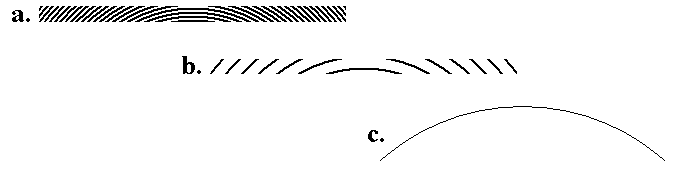
Benton white-light holograms only use interference to record their zoneplates. They don't use interference to reconstruct the 3D image. (That's why they still function under white-light illumination.)
Or, here's another approach. Benton holograms and scratch holograms are based on Poisson's Spot. They don't act like a fresnel lens, instead they act like a conical lens, causing an incoming beam to both converge and scatter into a long locus with no focal point. The "facets" of Benton holograms and scratch holograms need no be diffraction patterns or prisms, they can be random striations, parallel fibers, narrow cylinder lenses, reflective wires, etc.
It's perfectly OK to insist that scratch holograms aren't genuine holograms. But to remain honest and consistent, we're also then forced to declare that Benton holograms aren't true holograms.
Or, as I said in the linked articles, the bench setup for making Benton white-light holograms is actually an optical device for producing entire scratch holograms all at once, with no individual scratching needed.
Heh, "metal rods are the interference fringes!" needs quotation marks, since I guess it wasn't obvious that I was being silly.
...and that's how we prove that white-light holograms aren't holograms. (Credit-card holograms function just like scratch-holograms, and their 3D image is not created via diffraction.)
[Are these REALLY holograms?](http://amasci.com/amateur/holo3.html)
You are referring to stamped foil or embossed holograms such as the ones used as security marks on credit cards. Here's a description of the process:
http://www.holoeast.com/holography/holograms_maiking.html
Inspired by the process for creating compact disks, stamped holograms took Benton's rainbow holograms and made them cheaply reproducible through a mechanical process. Mike Foster developed the process and Steve McGrew made it commercially viable.
Other types of white light holograms, such as the two-step "rainbow" white light transmission hologram that Steve Benton created or the white light reflection hologram of Yuri Denisyuk are both holograms proper -- they are both made using a traditional holographic process.
A transmission white light hologram has less controllable color because it uses broad spectrum diffraction. A white light reflection hologram uses a thick diffraction pattern to additionally filter white light down to a narrow spectrum, producing a more pure color. Full color reflection holograms can be produced by superimposing multiple diffractive patterns in the hologram layer, one for each primary color.
Interesting. I never quite grokked rainbow holograms, so perhaps there's something in that.
But it's unfair to say all white-light holograms aren't holograms. A normal Denisyuk reflection hologram made with lasers and everything will replay perfectly well under a halogen lamp.
> I never quite grokked rainbow holograms,
If you made a scratch hologram, but your compass-point had a small cluster of fifty tiny needles instead of a single big needle, that comes close to the fringe-structure of Benton white-light holograms.
:)
> But it's unfair to say all white-light holograms aren't holograms
True. By "white light" I was referring to Rainbow / credit-card / Benton holograms.
It might be better to use the "Scratch Holograms" link at the top of that paper, as it has better exposition and a video. :)
Latest trick: LP albums, rotating scratch-hologram animations:
https://www.youtube.com/watch?v=DLuvkcV2oi4&t=0m26s
https://www.youtube.com/watch?v=jqNF9IWmFQE&list=PL60100E8F3...
https://www.youtube.com/watch?v=H9gRPtkSOn0
Also gallery artists:
https://www.youtube.com/watch?v=dQ_sjQRYhX4
The Museum of Math in NYC has a wall with several intricate examples.
http://momath.org/wp-content/gallery/main-gallery/img_2757.j...

I've played with this a bit, it was fun.
The lazy nerd in me wonders if he can abuse sth like a dot-matrix printer to automate this.
This is actually something I did as a university project. We calculated computer generated holograms (CGH). To print them out, we found a ultra-high-DPI fotographic slide printer and got special small-grain film to print on. Then we printed the holograms, shone coherent light through the slides, and... nothing. I think we never found out why it didn't work, probably the contrast was not high enough. However, as a last effort, we used a simple 600dpi inkjet printer on overhead slides, and it actually worked! It seems there is actually enough information in the low-frequency part of the hologram to reconstruct an image.
A couple of things we printed were simple geometric objects, 3d models of ants, and the USS enterprise :-). It was pretty cool, unfortunately I don't have the material any more.
One thing I'm wondering is why nobody is trying to create a 3D holographic display (the Microsoft HoloLens isn't holographic AFAIK). TFT displays are getting in the dpi range where it should be possible. You could easily render the holograms with modern GPUs. (We actually investigated this back then (~2005) and it was then possible by abusing textures and doing things like putting two complex numbers in one ARGB texture. However we did not have more time for the project, and there was no benefit over just running on our cluser. This was before shaders, so it should be even easier now.)
The inkjet method sounds like it has reasonable cost. Maybe there is a way to use a laser printer. Thanks!
Back in the old "Circuit Cellar" magazine era, they made a printer-hologram by photographing it onto film transparency.
I recall that it was a "binary hologram" 300dpi covering a full 11" page, then reduced to a few-mms-wide patch on monochrome slide film. Obviously the main challenge would be in getting the darned thing in focus, so the fine pattern doesn't blur out into gray.
Then, print out a feet-wide paper copy, so the pattern ends up as a few-cm hologram on your slide film.