▲ 64 points
back
15 comments
Vermeer was also suspected to have used optics to help him paint, as highlighted in the documentary Tim's Vermeer [0]. Although their evidence is circumstantial, some color artifacts are difficult to explain in other ways. For instance, the falloff of light matches what would come from a video camera, but would be extremely difficult for an artist to see by eye.
I used to be a fine arts student and my favorite painters were/are Vermeer and Rembrandt and their circles. I always hated the theory that they used optics, but couldn't quite put my finger on why until I started reading press coverage of that documentary. The problem isn't with the argument (at this point I'm convinced that they did, it stands to reason given the context of them being artisans in the same time and place as people like Antonie van Leeuwenhoek, etc.) but with the way that some people in the press and public seem to see it as lessening their achievements.
I.e. Tim's Vermeer copies are held up as examples of how anyone can paint like Vermeer given the tools, whereas to me a direct comparison makes it even more clear how perfectly Vermeer chose when to use a technological aid and when to change things:
http://flyingfox.jonathanjanson.com/wp-content/uploads/2014/...

Things like the bluriness of the paintings in the background and the slightly softer and more abstracted faces, the additional creams and blue tints in the whites of the walls, the blues that are picked out in the rug in the foreground, etc are what make me love Vermeer so much, not that he's photorealistic.
Anyway, I realize I'm constructing a partial strawman here because I don't think people like David Hockney or others supporting the optical argument are trying to claim that Vermeer is less talented than we thought, but it does seem like the press sometimes spins it that way.
As an aside, one of the only paintings of Carel Fabritius to escape the gunpowder explosion that killed him as well (made more famous recently by Donna Tartt's 'The Goldfinch') is a really cool example of a painting from the time that was clearly made using lenses. It looks to my eyes more or less exactly like a photo made using the iPhone's panoramic setting. Would be really cool if someone could find the same location in Delft and take the same type of image:
https://upload.wikimedia.org/wikipedia/commons/thumb/d/d9/Fa...
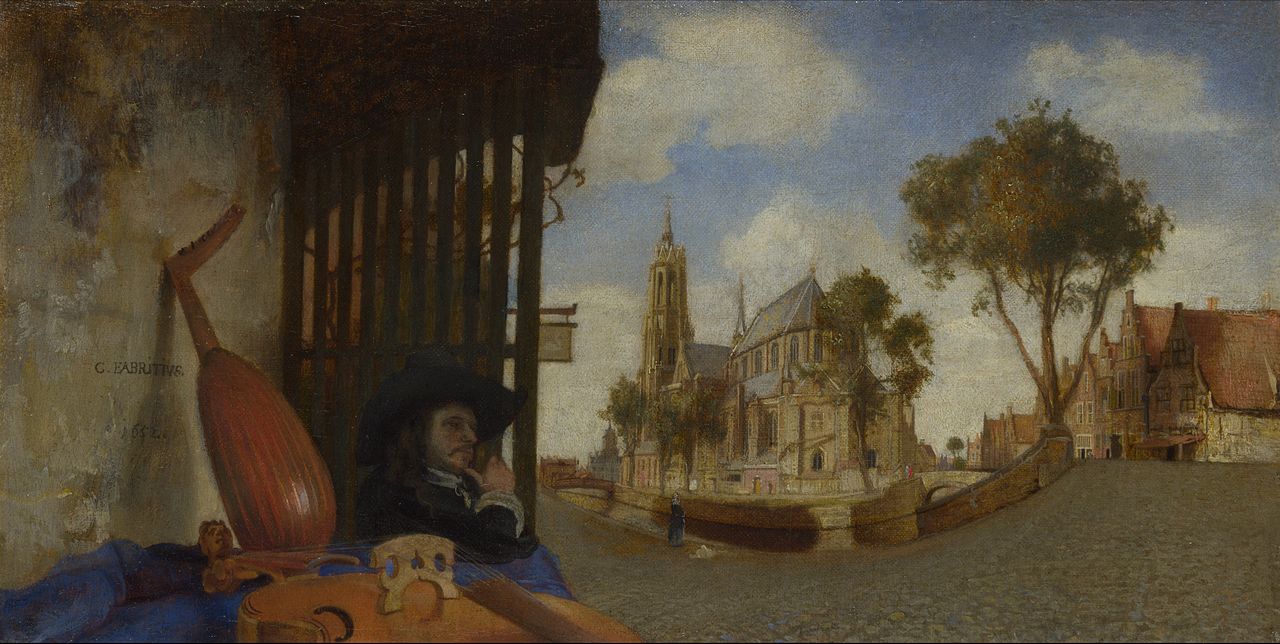
It seems as if what they were doing was merely a different kind of talent than painting purely by eye is. Creating and using the apparatus is its own kind of art, sort of a hybrid between photography and painting. Both arts on their own, so surely an art when done together.
Questions like this are why, I think, realism became less valued on its own in the art world, after the advent of photography. Then it became merely about how the painting looked, rather than how difficult it was to produce.
Right, and it's worth pointing out that even Italian renaissance artists from the 15th century, presumably working without the same optical technologies, were still using techniques for duplicating images. It was very common for instance to make a full scale mockup on paper, then punch holes along the lines and rub charcoal in them to make an imprint on the canvas before painting. Not to mention the fact that engraving and printing are themselves new technologies for duplicating images in the same period, so it was clearly in the purview of artists to think about this sort of thing from a technical as well as artistic angle.
The more I think of this stuff the more I love it as an example of the incremental nature of technology - photography wasn't just invented in a certain year, it was a process over about two centuries of experimenting with ways of replicating images that finally converged with advances in chemistry to lead to a breakthrough that we then demarcate as the beginning of a new era. But in some ways it was just the culmination of a process of optical and artistic tinkering that goes back to the early Renaissance (or arguably even earlier, with Grosseteste's experiments with lenses in 13th century Oxford).
If it means anything, I was not nearly so interested in Vermeer until after I heard the press about optics.
I find technological cleverness, and maybe a bit of hustle, more fascinating aptitudes than mere technical skill.
(Or maybe that's still disappointing, because I'm similarly focusing on technical choices rather than artistic choices, just going the other direction...)
This makes artists more impressive not less.
The article references the collaborative work done by optical physicist Charles Falco and famed artist David Hockney on Renaissance painters:
https://en.wikipedia.org/wiki/Hockney%E2%80%93Falco_thesis
I recall this thesis was quite disruptive within the world of art history; there was significant (and vocal) pushback from people who had spent their lives researching these famed artists who were now being confronted with the use of aids (I make no comment here as to any impact on the 'art'). Articles were published in both art history publications and IEEE journals.
Falco was a professor of mine in graduate school, and is both a great lecturer in his field and unique in the breadth of his outside interests.
I think why I found this topic particularly fascinating was that it took the combination of an artist (Hockney) to start the hypothesis -- the paintings were too "real" to his experienced eyes -- and a physicist (Falco) to confirm the theory through scientific analysis (along with some art history!).
I read the article but could not find any pointers to evidence.
It just said that with the technology available at that time it was possible for him to use optics. There is a big gap between that statement and the claim that he did actually use it.
He had the means to by a gun, hence he is the murderer.
May be there indeed is mounting evidence, but I could not catch it in the article. Unless by evidence the author means the scale of his detailed portraits, but that has been known for a while.
> The researchers examined several other common aspects in the Dutch artist’s works such as his off-center gaze, which they say may suggest he was facing a projection surface off to the side rather than looking directly at his reflection in a flat mirror.
And a painter like Rembrandt would not be able to adjust for this, by moving the painted eyes a few millimeters? I can't believe that.
If he didn't think he was cheating, why would he?
Also, I do not rule out that he didn't want the eerie feeling you can get from a portrait where the subject looks straight at you (https://researchnews.osu.edu/archive/eyefolow.htm)
Sorry, there's not really a lot of evidence here. I'm a believer; and I think it's super-cool and it enhances my appreciation of the artists. But saying his eyes are focused off-center and that he painted mainly at life-size ... that's not much to go on.
I thought painting on copper sounded like a good argument. There were some good points made.
this is a great documentary along the same lines.
This video was fantastic. I became firmly convinced that optics were used during this time period when I saw the subtle optical distortions that could be explained by optics being repositioned during painting.
This assumes an artist is stuck with the same limitations as a camera. AKA they must accurately represent a situation. Reality is an a painter can for example paint an outfit on a mannequin and then paint someone's head.