▲ 79 points
back
48 comments
It amuses me that nearly every comment in this thread advances the same theory that the article discards as inaccurate: that the artists had never seen an elephant and were working from description only. It notes that the accuracy does not seem to improve when there is a real, local elephant they can use as a model.
The article irritatingly answers its own question mainly by saying, "we don't know why", but suggests that medieval artists may have been less interested in realism than in convention and what the art communicated symbolically. That seems reasonable to me. Compare medieval babies: http://www.vox.com/2015/7/8/8908825/ugly-medieval-babies
This seems like a strange thing for an artist to do, but if you think about it, we do it, too. Here are some representations in modern entertainment dominated by convention rather than realism: http://tvtropes.org/pmwiki/pmwiki.php/Main/TheCoconutEffect
"It notes that the accuracy does not seem to improve when there is a real, local elephant they can use as a model."
The single specimen mentioned in the article was kept inside the Tower of London which was off-limits to the vast majority of population. I doubt many artists had access to it and had a chance to see a real elephant. Even if it was on display publicly, mostly London artists could see it anyway, as people didn't travel much back then.
My first reaction was "probably because elephants sound like I'd like trumpets," and indeed that's the main theory (more of a guess) floated at the end of the article.
About those medieval babies, this line jumped out at me:
> In some of these images, it looks like he had male pattern baldness.
My kid was born nearly bald, and as her hair slowly grew out, her head looked a lot more like Sir Patrick Stewart's than the traditional golden curls of babies in other paintings that we take as stock images of babies.
And some of those paintings barely get the humans right, either - in the sliding-example image, the woman seems to be missing her chin, and the rest of her face looks more like Pepe the Frog than a realistic huma.
> King Louis IX of France gifted King Henry III of England an elephant in 1255, and the elephant came to live at the Tower of London, which at the time was used as a castle and residence rather than a gloomy prison. It’s often said that after that, British artists were able to draw the elephant more naturalistically.
My high school teacher would have flayed the skin from my right hand for that sort of writing.
"It's often said..." By whom? And were British artists actually able to draw an elephant in a more realistic fashion between 1255 and the elephant's death? Were any bestiaries created at the time? Or even any crude sketches that made it into margins?
To invoke Occam's Razor, I'd point out that the more realistic the trunk is in the example pictures, the more realistic the rest of the body is (horse-like legs => trumpet-like trunk). I wonder if many of these pictures were drawn by people who knew what an elephant looked like only by the description of others. 4 legs + tusks + big ears + this trumpety thing. Yeah I could see how they get their pictures.
This reminds me of the first penguin to be stuffed and mounted. The taxidermist only had the skin and a brief description to work with. https://imgur.com/a/2XjCk It's in the Peabody Essex Museum in Salem, MA along with a bunch of other cool weird things. I recommend stopping in if you get a chance.
Which reminds me of the overstuffed walrus in the horniman museum, London, where similar events transpired: https://www.allinlondon.co.uk/images/musttry/419.jpg

As far as I understand it, the taxidermist didn't know when to stop, as he'd never seen a live specimen, so just...kept going.
It's also how you get Unicorns from descriptions of Rhinos. Four legs, big as a horse, one horn.
They can look kind of like Trumpets at the tip:
http://ichef.bbci.co.uk/wwfeatures/wm/live/1280_640/images/l...

Try drawing that, then have someone copy it, and then have someone copy that picture. I suspect the game of telephone will end up with an odd creature with an exaggerated look. Rhinos > Unicorn is not as big a jump as you might think. Especially as the article points out some people in the middle may have been exaggerating or simply poor artists.
PS: Also look at the horses in those pictures, some of them look rather 'off'.
This is also encoded in some natural languages.
In Polish an elephant trunk is called "trąba", which also means "trumpet".
Likewise, the Online Etymology Dictionary says the English word may have originated from confusion with "trump" short for "trumpet."
Same in Spanish: "trompa"
Kind of - "trumpet" is "trompeta". On the other hand, "trompa" can translate to "horn", which is not quite the same thing as a trumpet.
In French "trompette" (trumpet) is a diminutive form of "trompe" (trunk, but it also has other meanings: [0] and trompe d'Eustache, trompe de Fallope (Eustachian and Fallopian tubes)...).
Maybe not quite the same, but it is indeed a similar theme.
The evolution of the rhinoceros in art is equally fascinating. Here's Dürer's famous rhino, from 1515:
https://en.wikipedia.org/wiki/File:The_Rhinoceros_(NGA_1964....
_enhanced.png)
Dürer had received a rough sketch from an artist in Lisbon, where a real rhino was being displayed, and he sketched and printed it based on a physical description by two different people who had seen it. It's beautiful, but also hilariously inaccurate.
Dürer's rhinoceros was copied — and made further inaccurate — by tons of artists who also had never seen one in real life.
Hilarously inaccuarte? It looks pretty accurate to me, compare this photo of a live one: http://www.rhinoresourcecenter.com/pictures/o/1195761552/Ind...

Anatomically speaking, it has the right parts, but Dürer imagined all sorts of things that aren't real:
He depicts an animal with hard plates that cover its body like sheets of armour, with a gorget at the throat, a solid-looking breastplate, and rivets along the seams. He places a small twisted horn on its back, and gives it scaly legs and saw-like rear quarters. None of these features are present in a real rhinoceros,although the Indian rhinoceros does have deep folds in its skin that can look like armor from a distance. (Wikipedia)
Also worth mentioning is the very wrong horn, the fuzzy ears, and the entire anatomy of its rodent-like jaw/facial area. To me, it's the distinctly ratty appearance that's hilarious.
I challenge the "hilarious inaccurate" because I suspect it is due to people not knowing how a rhino actually look, combined with a prejudice towards pre-modern artistic depiction of exotic animals. If you actually compare the drawing to the photo, the drawing is actually amazingly accurate, down to details like the skin on the legs and the toes.
And if you look at the photo you will notice the rhino actually has hairy ears.
There are so many details that are wrong. Rhinos have a tiny fringe of hair at the top of the ear (http://wandering-photographer.com/wp-content/uploads/2011/11...), but Dürer draws them as being all hair, like a dog.

The shape is right, everything else is wrong, which makes sense given that he mainly had a textual description of the animal to work from.
I was going to cite that. Excellent example.
People see what they expect to see, and what they already understand. I'd love to see the actual description Durer had to work with.
This is an area I've been exploring in depth -- the ways in which we form, transmit, and (occasionally) validate our mental models. Key to this was also that Durer's model was, within reason, "good enough". His average reader would never encounter a rhino in the flesh (or armour plate, as it were), whilst those who did might realise they had a sufficiently accurate portrayal to recognise the creature when they did see it, allowing for the artist's own lack of immediate familiarity.
Saved you a click: to symbolize the sound the trunk made, maybe? We don't know.
It is almost like the author went back in time a few decades, asked the 4 year old version of me this same question, came back to the present and wrote an article about it.
http://lolmythesis.com/ is essential reading for everyone in this subthread
Thanks. I'd like to see more of these "saved you a click" answers around the internet. It's one way we can fight back against click bait.
What a devious trick this article does, baiting you with a question and then providing long-form journalism on the answer.
It avoids answering the question until the ultimate paragraph, and even then it doesn't explain or justify the answer. The whole article is filler.
Artists pull inspiration from things they're familiar with, both then and today. Travel in Medieval times was challenging, causing people to generally stay where they were, limiting their view of the world.
You can see this throughout art history. Renaissance depictions of Jerusalem are very "European". For instance, The Sermon of St. Stephen At Jerusalem: http://www.louvre.fr/sites/default/files/imagecache/940x768/...

I'm sure these artists had only heard descriptions of elephants from the few that had travelled and actually seen an elephant. They then referenced things they knew are were familiar with in northern Europe: wild boar, trumpets, etc.
> Artists pull inspiration from things they're familiar with, both then and today.
I think that you can broaden this to humanity as a whole. And this is why i find that old Ford quote about faster horses so aggravating.
It is used to claim that the masses are dumb or unimaginative.
But thats not the case.
People would ask for a "faster horse" because that is the means of travel they were used to.
That is not to say everyone (though perhaps some) would mean an actual horse, but that they can't begin to describe something they are not familiar with because they are not familiar with it.
Even the ancient philosophers had to use allegories etc to get an idea across.
That quote can be used without drawing negatives judgements about consumers. And in any case, there's no evidence that Henry Ford actually said it. https://hbr.org/2011/08/henry-ford-never-said-the-fast
We draw elephants with trunks like trumpets ( https://media.giphy.com/media/Qms9I3pAiN2la/giphy.gif )… why shouldn't they?
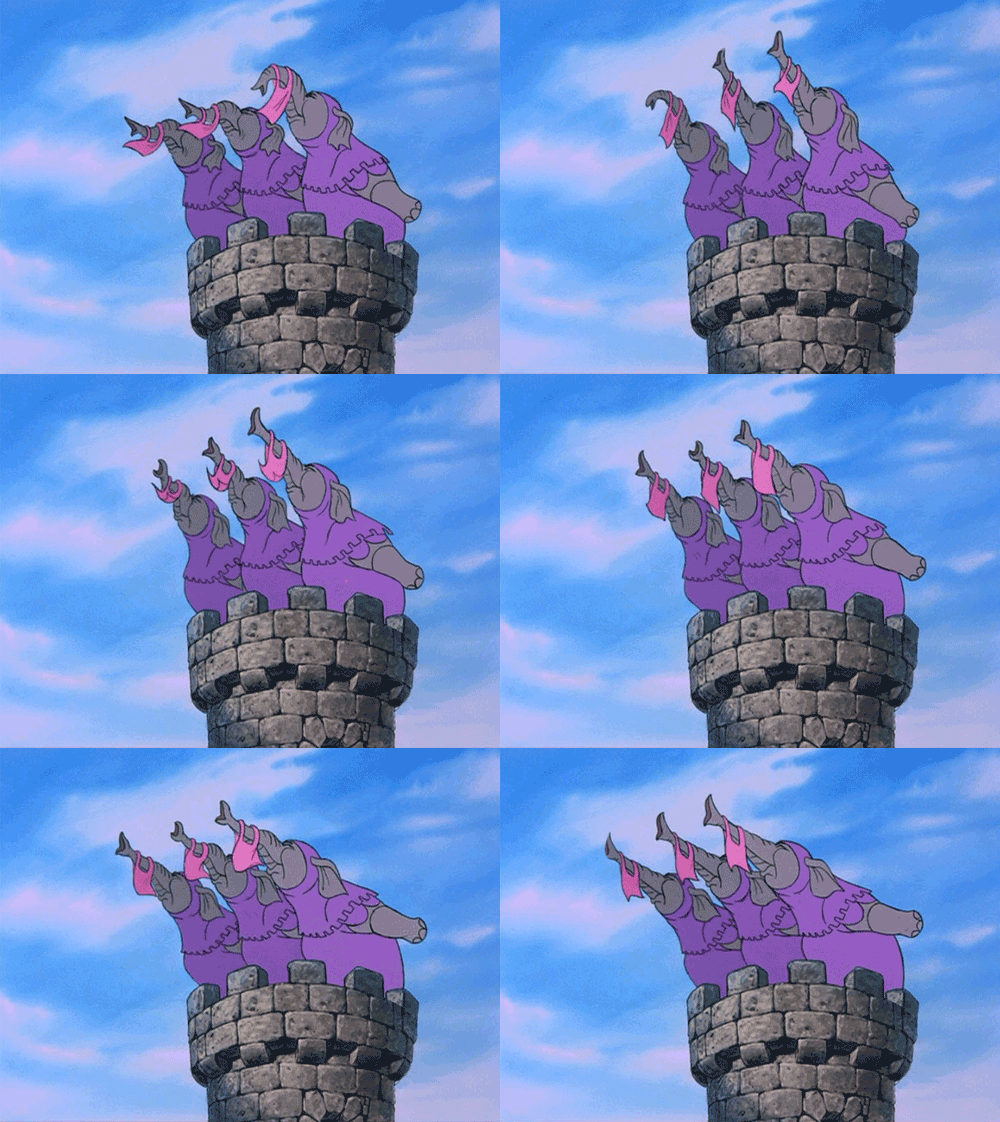
This sounds pretty similar to how we deal with dinosaurs today. We know that they had feathers, but most people just don't want to stray that far from the image they grew up with. Maybe to these people, elephants with snake-like trunks seemed as silly and unappealing as a T. Rex covered in colorful feathers.
Umberto eco's The Name of the Rose has numerous ruminations from different perspectives on the symbolism and semantic objectives of medieval illustration - or as it's more properly called, illumination.
You might say the images were meant to be taken seriously but not literally.
Think of how you know things, and what images you have come up with of places, creatures, people, processes, or other entities, which you didn't have direct knowledge of, though you'd heard reports from others. Possibly even seeing them on television, video, cinema, or photographs.
If you work in technology, think of the types of reports you receive from users on problems or software or systems when they're having difficulties. Terminology, descriptions, and behaviour are all over the map.
If you'd like more recent examples of imagined images, look at how atoms and molecules were popularly visualised in the 1930s - 1960s, or how remote landscapes of the Moon, or Mars, or Venus, were imagined.
Often people will fill in extensive detail rather than simply present a set of successively less-blurred images -- the somewhat-less-than-a-century history of images of Pluto present, or even the succession of images from the New Horizons spacecraft, illustrates that. But that interpolated high-resolution detail is often false.
https://timedotcom.files.wordpress.com/2015/07/new-horizons....

It's useful to remember that we're all inhabitants of our various Plato's caves. But we don't all see the same sets of images. Instead we're trying to communicate our set of shadows to others, some of which do or don't match up.
Ideas are interfaces. They give us the general bounds, outputs, and inputs of a system. And the corrospondence of those interfaces (as well as the mutation in the retelling) has a great deal to do with what information can or cannot be effectively communicated.
I thought that this was interesting.
Apparently the term 'barritus' used to refer to the sound an elephant makes with it's trunk (trumpeting). It was a term that was also used during Roman times to describe the Roman war-cry which they had adopted from Germanic soldiers. http://worldofdictionary.com/dict/latin-english/meaning/barr...
It's possible that this association may have colored educated naturalists to paint an elephant with a 'war-trumpet' on it's trunk. It's also possible that the author was getting the viewer to visualize the sound that the animal makes via visual imagery.
The same reason they painted knights fighting giant snails. Medieval artists were an odd bunch.
http://www.smithsonianmag.com/smart-news/why-were-medieval-k...
Why do cartoons make elephants trunks look like trumpets when they trumpet?
a better question is why do they look like sad boars?
Those are elephants? Look like boars.
"F"
Because in the middle ages hardly anyone ever saw an elephant.
Exactly, even the taxidermy was awful because hardly anyone saw these animals in person: http://hyperallergic.com/307949/terrible-taxidermy-from-when...
The subtitle of article is, "Maybe not just because they didn't know what elephants looked like."
At the end of the article, it says even people who'd seen an elephant -- there was one in London -- didn't necessarily draw it correctly.
Fewer people were able to tune to Animal Planet back then and see for themselves what an elephant looked like.
I'd be more interested to see medieval depictions of elephants from the South of France, Spain or Italy to compare against.
Stuff from England or Northern France is going to be driven by descriptions given by priests and monks. So not only do you have secondhand accounts or reproductions of other pictures, but you're filtering it through a religious filter. Trumpets and ivory have religious significance, and depicting them incorrectly may have some significance.
Also, didn't mammoth tusks curve upward? There may have been some symbolic legacy taking place there as well.
The article notes that some scholars would ascribe religiously inspired characteristics to real animals, but it also says that readers were generally canny enough to realize this was going on and points out that there were well-known works that didn't do this.