back

by shagie·8y ago·view on hn ↗
The data at http://www.nationmaster.com/country-info/stats/Energy/Coal/C... for 2001 shows the US and Germany neck and neck in the coal per capita with the US slightly more. https://www.statista.com/statistics/604946/per-capita-coal-c... for 2015 has similar comparisons.

The 2015 data shows the US at 1.63 metric tons of coal per person (?!) and Germany at 1.38 metric tons of coal per person.

https://www.forbes.com/sites/jamesconca/2017/10/10/why-arent... goes into the breakdown of German power generation. As noted, its actually going to get worse as Germany gets rid of its nuclear power (currently 13% of load).

Overall, for power consumption per capita, yes... Germany uses much less than the US (12,071 kWh for the US, 6,602 kWh for DE).

One thing to note in that is the further north and continental you get (colder winters), the more the power consumption goes up. Norway (24k kWh), Canada (14k kWh), Finland (14k kWh), and Sweden (12.8k kWh) all use more power than the US per capita. Likewise, industrialized equatorial countries also use more power per person (probably for cooling?).
1 comments
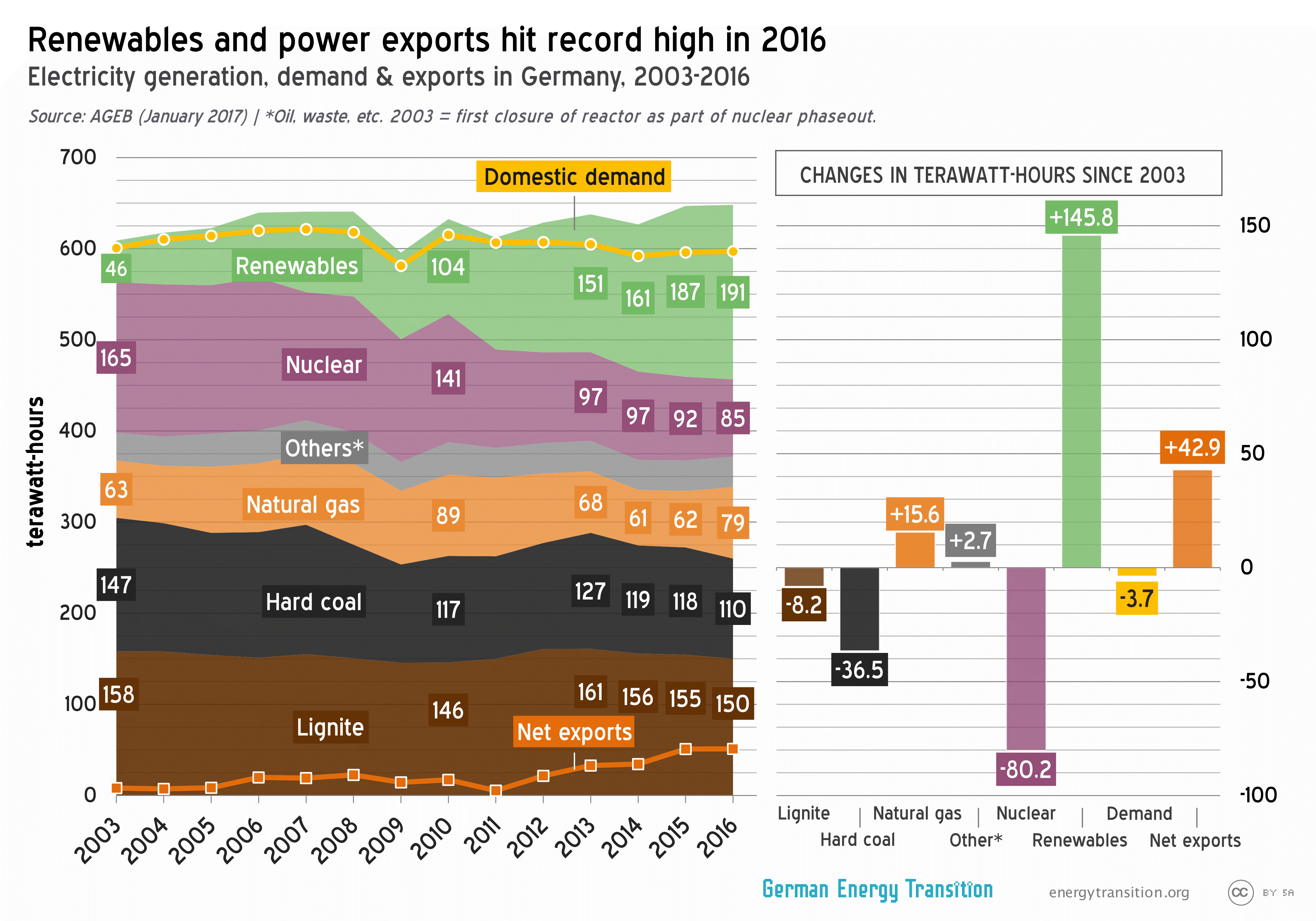
In 2016 renewables in Germany produced 191TWh, up from 46TWh in 2003. The last reactors will shut down in Dec 2022. Over the next 5 years, renewables will increase more than the remaining 85TWh/yr of Nuclear generation.

https://energytransition.org/wp-content/uploads/2017/01/img3...

https://book.energytransition.org/sites/default/files/GET_en...

In order to reduce emissions new zero carbon electricity generation will need to be continually built. Germany is doing this.

Germany gave nuclear a chance, even spent billions on a thorium reactor. They learnt that nuclear is expensive and not compatible with their democracy. The currently running plants were built in 80s and will be shut down after running for decades. Much of the cost, i.e. the waste storage will be socialised. The first long term storage site has already failed. There is no public support for building new reactors, nuclear cannot be part Germany's ongoing decarbonisation.

> Germany gave nuclear a chance, even spent billions on a thorium reactor. They learnt that nuclear is expensive and not compatible with their democracy. The currently running plants were built in 80s and will be shut down after running for decades. Much of the cost, i.e. the waste storage will be socialised. The first long term storage site has already failed. There is no public support for building new reactors, nuclear cannot be part Germany's ongoing decarbonisation.

Yeah, it's totally cool to misinform public, and then claim "public does not support nuclear power" . . . NOT.

Current German "decarbonisation" results in more carbon per kWh produced, so job well done I guess. Oh and "nuclear is expensive" - nice, so Germany has cheap energy after turning green? http://ec.europa.eu/eurostat/statistics-explained/index.php/... http://ec.europa.eu/eurostat/statistics-explained/index.php/... NOT

But nuclear energy plants cheaper then coal plants. And can not even understand how decarbonization relate to nuclear.
Even in the US with less regulation and more subsidies, nuclear is more expensive than coal.

https://www.lazard.com/perspective/levelized-cost-of-energy-...

Keeping old nuclear plants online for a few extra years is not a solution to climate change. If some other western democracy can show how to build and operate nuclear plants cheaply and safely, great, do it.

So far the examples of recent new builds are slow and expensive. See VC Summer, Vogtle, Flamanville, Olkiluoto, and Hinkley point. From where I sit it looks like the German decision in 2001 to phase out nuclear was the right one, but only time will tell. (Merkel really did make a big mess in 2011 though)

Edit: Finish names are hard to spell.