▲ 32 points
back
13 comments
Under the article you can read most ironical comment I've ever read.
> This article is not only an uneducated embarrassment to modern scientific progress, but also a dangerous attempt to spread misinformation by somebody who is simply too lazy and/or incapable to understand and accept the scientific and mathematical facts of the matter. The only real achievement here is that you managed to write so much content without really saying anything of value.
> To summarize: You, sir, are an idiot, as is any person who unironically believes in any flat earth theory. Educate yourself, and stop spreading lies in an attempt to feel important. You’re not.
> Feel free to reply to this comment and try to deflect or argue, or maybe even take the “Thanks so much for your feedback!” approach so that you can feel like the good guy in the situation. In the end, though, the simple fact is that you are wrong, and that’s all there is to it.
> What I’m arguing is that science is not a property of the Universe, but rather a construct of our limited brains.
By definition, it is a human construct: "the intellectual and practical activity encompassing the systematic study of the structure and behavior of the physical and natural world through observation and experiment"
Was this ever up for debate?
The real point being made is that the Universe might not be governed by finite, universal, consistent, "knowable" laws.
This is a point that has been advanced by several physicists. (My first memory was a book by Hawking.)
If it's not, science won't be able to know everything. But let's try anyway, because it's the best we can do.
This idea of model-dependent realism [0] strikes me as a very mature approach to epistemology, which I was very glad to discover a few years ago.
As to what extent science is a human construct: personally I'm with you but I think many would disagree. I feel like Tegmark's ideas about the universe stand in contrast to the idea that science and maths is inherently anthropocentric.
For every scientist (or philosopher) worrying about an ultimate theory there are thousands more concentrating on solving specific and less universal problems.
There seems to be a popular narrative that suggests that because it might not be possible to come up with an ultimate theory, that science is fundamentally flawed, and that we should just give into mysticism or whatever “alternative” theory the author proposes.
This is a straw man argument. Science doesn’t have to solve everything.
Here's a translation of the Saggiatore at the beginning, for those who are curious and don't trust machine translation.
> Philosophy is written in this huge book that is always opened in front of us (which I call the Universe), but you can't understand it if first you don't learn the language and characters in which it is written. It is written in the language of mathematics, its characters are triangles, circles and other geometric figures, without which it's impossible to understand a single word; without them all you can do is wander around an obscure labyrinth.
I'm confused by this article. I agree with the author that the flat earth coordinate model as advocated by him can converge with the spherical model if we allow it to account for changes as we move away from the poles.
But I think he misses the point why people hate or discount the flat earthers. I don't think they are advocating for a practical model that works in approximation. Their illustrations literally seem to portray the earth as a flat pan. For our 3D perception that is not true. It's nothing to do with how we measure distances on the ground. That's the image or belief everyone is fighting against, not against a particular coordinate system.
The phrase flat earth is misrepresented in his article when compared to popular parlance (https://video-images.vice.com/articles/596717d19d542017b4db7...). So we aren't even talking about the same thing.
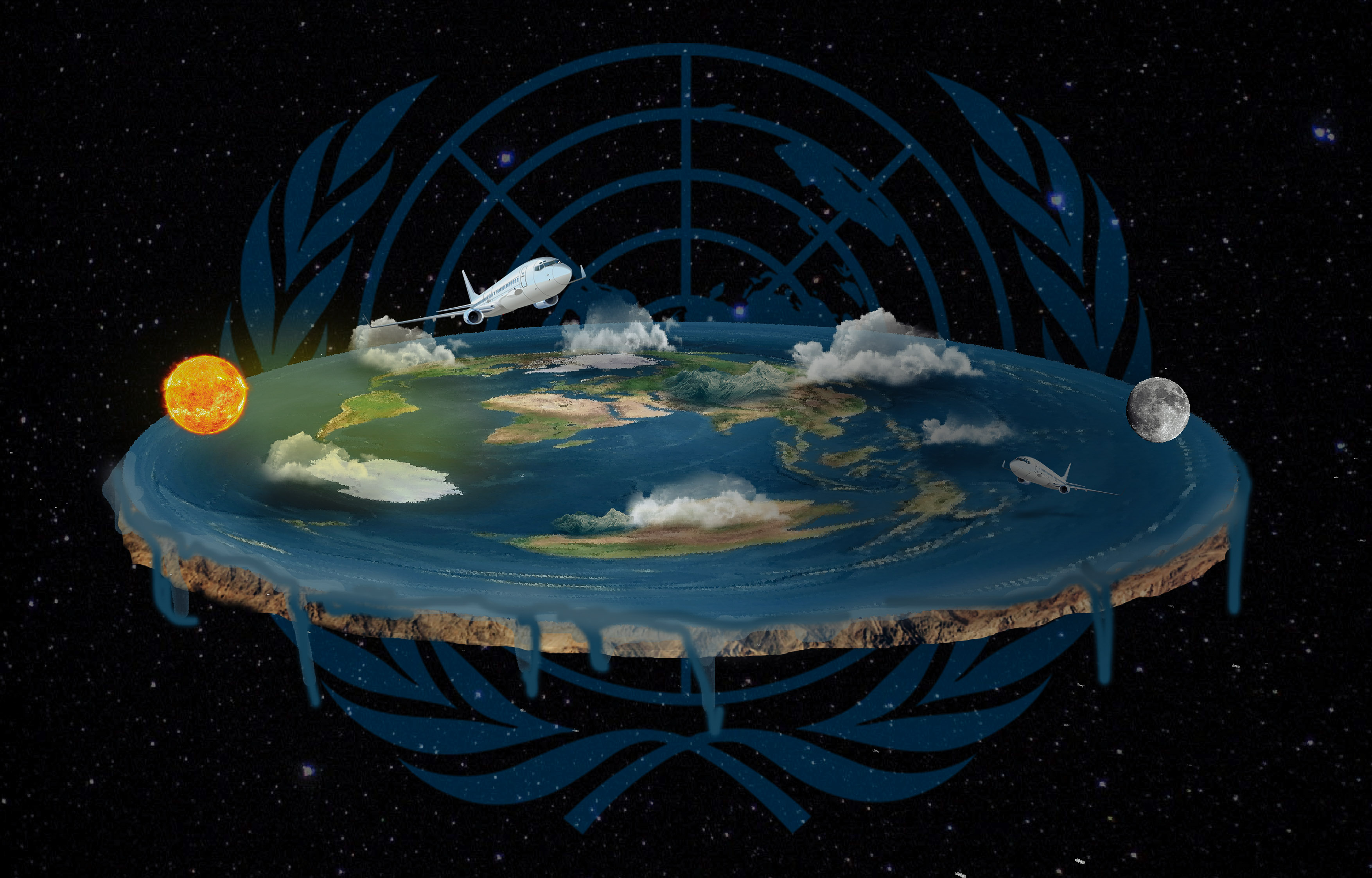
Pretty sure he is just using flat Earth as a convenient example for his main point about scientific theories, not actually trying to explore what today's flat Earthers think. Here's a hint, from the article:
> Unlike present-day flat-earthers, who are not scientifically sophisticated, they would actually put some effort to refine their calculations to account for the “anomalies.”
A great read! A sharp commentary on conflating our models of reality with reality itself. So many of our current debates are simply dialogues over which model of the world is most accurate, but we have a tendency to identify our ego with our pet models, which can lead to righteous certainty that we are right and our model is in fact reality itself -- which brings all conversations to an impasse. Reminds me of this quote I read in another HN post recently: "Stanford business school’s motto is “change lives, change organizations, change the world” — though they rarely seem to know what or how. Or what the role of chance and circumstance is. But if the goal is to change something, they must have the ability to determine the future, mustn’t they?" (source: https://americanaffairsjournal.org/2017/11/western-elite-chi...)
His point is that earth is flat if your perception is in a spherical coordinate system ... ok. The crazy youtube conspiracy theorists though certainly aren't claiming that or even have a sophisticated enough understanding of 3 dimensional geometry to begin to grok it.
The author is assuming a radical mind-body dualism in which human minds construct an idea of reality, but never actually contact it.
This is an idea from Western philosophy whose most famous advocate was Descartes. However, it has some deep philosophical contradictions, as anyone who has taken intro philosophy can tell you.
In the last century and a half, a long line of leading Western philosophers, including Wittgenstein, Strawson, the pragmatists James, Dewey, and Pierce, Whitehead, Husserl, Heidegger, Merleau-Ponty, and Derrida, have rejected radical mind-body dualism.
And let me add that modern scientists generally assume something like pragmatism, which not a surprise given that two of the founders of pragmatism, namely James and Pierce, were professional scientists, and Dewey took modern sciences as one of his models for knowledge.
Speaking of the problems with Cartesian dualism, here's a marvelous article by Anthony Gottleib about a Bohemian princess whose critique was so persuasive that Descartes himself admitted the theory is wrong.
https://www.laphamsquarterly.org/states-mind/ghost-and-princ...
Isaacs Asimov touches on similar themes in his essay The Relativity of Wrong: http://chem.tufts.edu/answersinscience/relativityofwrong.htm
Public education at its best.