▲ 155 points
back
78 comments
We have FreeBSD running with radeon driver and will have a ~linux4.20 amdgpu driver up by the time blackbird ships. Most the performance work is usable, our goal is to have a usable daily driver around Q1 https://github.com/POWER9BSD/freebsd
That's great, I've been hoping to see amdgpu support on FreeBSD. Thanks for your hard work!
This is fantastic news. I am glad this showed up as the top comment for me.
Hmmmm... the $1,129.99 for the "Lite" motherboard seems like a better value, especially because the "Lite" motherboard supports 22-core (88-thread) CPUs... or more importantly... the 18-core (72-thread) CPU, which seems like a good value.
However, at $799 + 4-cores or 8-cores, the main purpose of this board is for "toy" uses. There's no way that the 4-core IBM is going to be anywhere as fast as a 16c/32t Threadripper 1950x (going for ~$450 these days btw), but it would be the cheapest machine to build for the Power9 system.
So that alone is important. The "Basic" box would be for developer machines, while the "production" machine would be 22-core, or maybe 12-core SMT8 (the "thicker" IBM design where 8-SMT is possible).
Consider this: what if you were developing for Summit? Do you want to rent supercomputer time when you're writing your code? Or do you test it out on a cheaper 4-core, $799 motherboard machine? https://www.olcf.ornl.gov/summit/
You seem to be forgetting one of the key advantages of the platform: fully available and controllable source code, including firmware.
For some applications, the compute performance is secondary to that, but price always plays a role. A moderately powerful workstation that runs 100% audited code is very desirable for some uses.
I think the other advantage is the size. The EATX size of the T2 and T2 Lite is a bit bulky for some applications. We're actually thinking of sticking the 4-core Blackbird we ordered in the home theatre and using it for media as well as general computing. The mATX form factor just gives you much more flexibility.
Can you please share details about your HTPC build? What case will you be using? Did you choose Raptor's 2U heatsink assembly, their 3U HSF assembly, or something else?
This is great! I’ve been hoping someone — IBM or one of it’s partners like Raptor or Gigabyte — would make a lower-end POWER8/9 system available. The price of this board ($1K) is much more affordable for a hobbyist developer who wants to tinker with POWER, try porting some open-source projects, etc.
The price is a little high, sadly. I don't blame them, it can't be that cheap to design and produce, and it really is what I would like to see as a desktop option.
I mean it really sucks that we cry for non-X86 desktops, and when someone finally delivers, we complain about price. It's just little hard to justify for something I'd basically buy as a "toy".
The price isn't THAT high!
Compare to an Intel 16 thread CPU + motherboard with ECC RAM and the ability to address more than 64GB of RAM. You're well into Xeon parts probably in the $300-400 range just for the CPU, then to get a decent motherboard is probably another $200. So you're paying a 2x premium for this Raptor Computing offering, that's really not THAT bad of pricing!
This pricing is an order of magnitude better than some of the previous Raptor Computing POWER systems which will hopefully open up their market to a wider audience and help drive down prices in the future.
The price is low compared to the high-end, low-volume, RISC workstations of the past. Those started at around five digits. On the not-quite-as-performant end, there's even more ARM solutions showing up. Escaping Intel and increasing ecosystem diversity has never been cheaper.
Sure it costs something, though.
What is the space to the immediate right of the right RAM slot for? (https://static.rptorcs.com/BK1B01/images/boardlarge.png) The white connector almost looks like an M.2 connector.
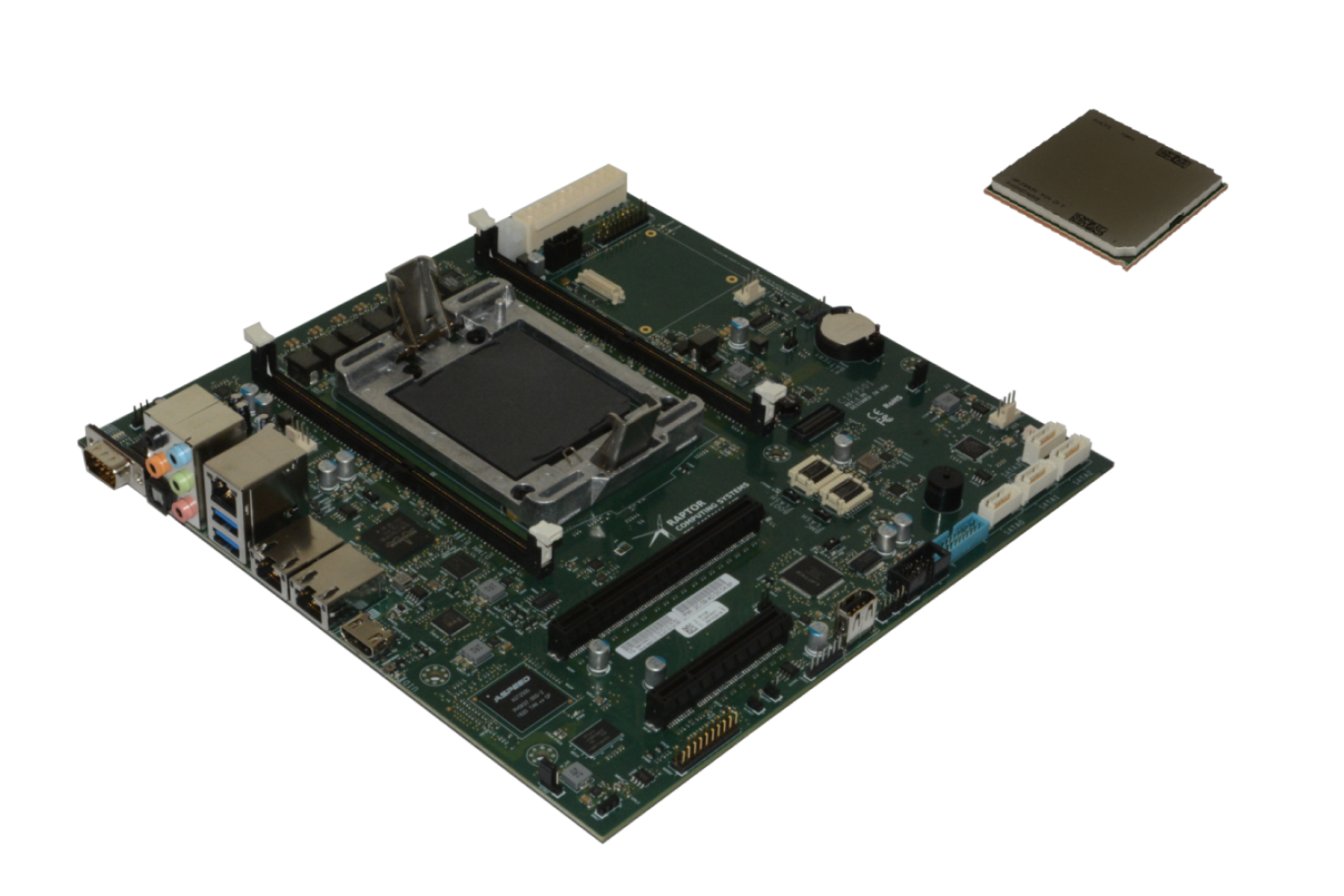
It's a connector for the optional FlexVer module they intend to release in the future. It's not OCuLink.
Thanks!
More information on FlexVer: https://www.raptorengineering.com/TALOS/documentation/flexve...
> FlexVer™ is a new, owner-controlled security technology designed to safeguard critical data and applications in the event of software or hardware tampering. FlexVer™ allows a system to be provisioned in a trusted physical environment, then deployed to an untrustworthy physical location while retaining system integrity.
I've send an e-mail to Raptor about this (and the other connectors), I'll share if I get an answer
I don't think that's M.2, but I don't know what it is. It looks kind of like a hat connector of some kind. GPIO?
I'm going to take a wild guess and say its an OCuLink connector.
OCuLink can turn into M.2, U.2, or a variety of SATA connectors.
For dev workflows the high-end 22 core with dual sockets seems to perform pretty well already: https://www.phoronix.com/scan.php?page=article&item=power9-t...
Having such a powerful (or at least performant), free and risc-y machine has been a dream of mine for quite some time now... If I can only find a good argument to my wife as why we need one :P
> high-end 22 core with dual sockets seems to perform pretty well already
Oh nice! Almost 2x the speed of i9 for 7-Zip compression and ahead of everyone on LLVM compilation speed and Rust prime benchmarks.
From the specs:
> 2 Broadcom Gigabit Ethernet ports > 1 Isolated BMC Gigabit Ethernet port
What does 'isolated' mean in the context? AFAIK ethernet connections are always isolated using transformers, so I don't suppose they are talking about galvanic isolation here.
Can anyone elaborate?
On many servers you can have a single physical ethernet port that works for both the service processor (BMC) and host processor. If you want someone to have access to only the host system and not the BMC then you place your trust in a bunch of hardware and firmware that does the sharing of the port.
Having the port shared can save in cabling, but you trade that off for trusting some firmware to do the right thing.
Isolated ports mean that you can have one cable that goes to the BMC and only the BMC, and one that goes to the host and only the host. i.e. you place trust for isolation in the fact that two cables go to two different places, and don't involve another bit of firmware.
Some BMCs have the ability to listen on both the normal ports and the BMC-dedicated port (or just the sole normal port). Some do that all the time and some do that when the BMC-dedicated port isn't plugged in.
I think this research was where I heard about this:
Makes sense, thanks!
They don't mean electrically isolated. This means there is a dedicated ethernet port that's isolated to just the BMC (physically incapable of speaking to the IBM processor). It's a security feature.
They mean it is a separate physical conector. Some motherboards reuse an Ethernet port.
So basically a quad CPU + motherboard for $1000. IBM doesn't seem confident enough in the performance of the power 9 to publish standard benchmarks like CPU2017.
So if you want something with published scores on a wide variety of benchmarks that are included in CPU2017 get an Epyc or a Xeon.
Have you seen https://www.spec.org/cpu2017/results/res2018q3/cpu2017-20180... from back in July? There are more submissions as well if you want to browse around a bit.
Ah, looks like someone formatted the IBM entries incorrectly, at least unlike all the AMD and Intel entries I could find.
Usually the description has a CPU entry something like "Intel Xeon Gold 6148". The IBM entries have things like "3.4 - 3.8 GHz, 40 core, SLES". So if you search any of the lists for "power9" you don't find anything.
I looked around on the floating point, and found none. There are some integer throughput results.
Is the power9 only competitive for integer related workloads? E950 finds results on the Integer throughput list, but not the FP throughput list.
Phoronix just did a comparison. Power9 22 core, did well on 7zip, octave, and rust, but lost most of the benchmarks to the Xeon and Epyc dual sockets.
Seems like Power9 does really well on interpreters.
It doesn't seem to say anywhere what drives the HDMI output, just "2D". Is that just for connection to a PCI card? Or is there some rudimentary VESA frame-buffer chip on it, just to watch it boot?
It'd be better to watch it boot over serial (which can also be done via SSH to the BMC) rather than this graphics port.
the BMC chip (ast2500) has support for being a GPU for the host processor. It's a good old pretty dumb 2D framebuffer. Good for running an OS installer on.
Because (currently, we're working on it) boot time is more than a couple of seconds before we could bring up a discrete GPU, this connector will get you boot progress (and let you see an error) that occurs before we could fire up a PCIe GPU.
It has a server-style BMC which drives the HDMI port. It's only a basic 2D framebuffer device (with basic 3D "support" through the LLVMpipe OpenGL/Mesa software rasterizer), though Raptor Computer claims it's good enough for daily use. Obviously if you need high-performance 3D or more than 1 display you need would an add-in card.
You might run into problems with compositing window managers on that interface. Gnome supposedly has a pure-software fallback now, but it may be less than ideal.
Most systems assume a minimal level of 3D acceleration support for desktop use. Watching video, browsing the web, etc... could suck down a lot more CPU than you're used to.
NBD if you're using it as a server, but problematic as a daily driver desktop.
How many threads per corse does it support? or is that a concept that doesn't apply to power9 procs?
All POWER products offer SMT. The POWER9 OpenPOWER chips are all 4 threads per core (SMT4), so a 4 core device presents 16 logical cores to the OS. POWER's hardware threading system is also unique and has high performance compared to offerings from other vendors (mainly x86) -- check out the processor user manual [1] for all the details.
[1] https://wiki.raptorcs.com/w/images/8/89/POWER9_um_OpenPOWER_...
Can anyone recommend a 2U case that's known to work with this bundle and the 2U heatsink assembly? I'd prefer a short-depth case if possible.
I think that, when Raptor were demoing the blackbird at OpenPOWER Summit EU 2018, they were using a Lian-Li PC-05 case w/ the 2U HSF. You'd want to check with their sales/support for recommendations though.
Edit: It was a Lian-Li PC-06SX and not an 05!
Anyone know when these are supposed to ship?
from the page:
> Expected to ship late Q1 2019
a little bit disappointed that the motherboard only support up to 8 cores and actually comes with a 4 cores processor.
such low core count is making the product not that attractive - I can go with µATX MB + Xeon if I want computing power or a decent 6/8-core ARM board for smaller form factor. to just try a different ISA, I'd probably choose RISC-V to maximize my potential investment return.
Power9 is one of the highest instructions-per-clock architectures in the world.
Power9 just has relatively weak vector units: only 128-bit. (Even AMD Threadripper has support for 256-bit. Power9 128-bit is executed per super-slice, so its really 2x64-bit, to compare against AMD's 2x128-bit support) Otherwise, its throughput is downright insane. 6-issues per clock (Skylake only has 6 if its in the uOp cache: otherwise the decoder only pushes 4 uOps), 10MB of L3 per pair of cores. That's 20MB of L3 on the 4-core, and 110MB of L3 cache on the 22-core.
-----
As far as price/performance goes, the 18-core / 72-thread chip seems best. But the 4-core / 16-thread or 8-core / 32-thread chips aren't bad, as far as I can tell.
The main issue is that most compute-heavy code these days use those vector units (2x128 on AMD, 2x256 on Intel). But if you got a big GPU for SIMD / vectorized ops, then that disadvantage kinda goes away. GPUs are way fatter than Intel or AMD.
The other issue is that AMD is offering cores at stupidly low prices. AMD Threadripper and EPYC are the machines to look at for raw CPU power these days. But I'd argue that the 18-core Power9 ($1,050) is at a good price/performance level. If you can find any application that benefits from the stupid-high 90MB of L3 cache on the 18-core, then you're more or less golden.
I'd bet that databases love that L3 cache.
The same "bundle" with the 8-core POWER9 processor [0] is also available for pre-order.
Considering you don't even mention the openness of the raptor products vs. the xeon alternative, you're not the target market.
Bear in mind the P9 chip does SMT4, so four cores gives you 16 hardware threads, and 8 cores 32 threads etc.
this will give much more performance and compatibility than risc, at least if it ships soon I guess.
Or a 4-core ITX ARM board with almost[1] 100% open TianoCore UEFI firmware with ACPI and with x86 emulation for VBIOS [2] that allows video output from the EFI framebuffer… with a DIMM included… for a THIRD of the price of the Blackbird:
https://www.solid-run.com/marvell-armada-family/macchiatobin...
[1] one 12kb blob: https://github.com/MarvellEmbeddedProcessors/binaries-marvel... [2] https://github.com/MarvellEmbeddedProcessors/edk2-open-platf...