▲ 377 points
back
205 comments
The "best" fake news these days is the stuff that doesn't register even to people are read-in on the usual anti-patterns.
Subtle framing, selective quotation, anonymous sources, "repeat the lie" techniques, and so on, are the ones that I see happening today that are hard to immunize yourself from. Ironically, the people who fall for these are more likely to self-identify as being aware and clued in on how to avoid fake news.
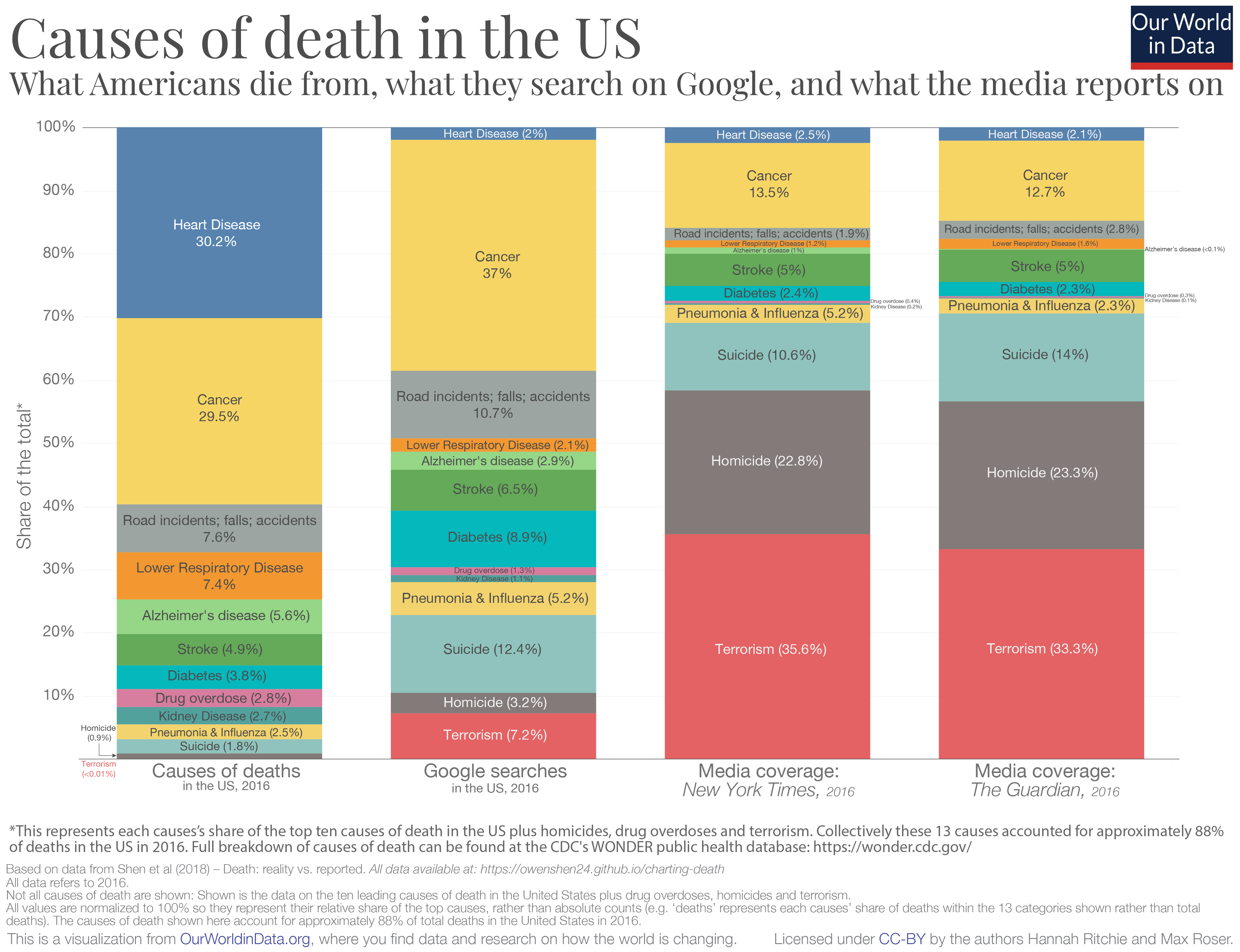
Second best. The best is selective reporting. Even if every story is reported 100% accurately and objectively, by choosing which stories are promoted, and which buried, you can set any agenda you want.
Edit: See https://ourworldindata.org/uploads/2019/05/Causes-of-death-i... for an example.
My favourite example of fake news came from real life. A friend uploaded a video of him salmon fishing on Haida Gwaii a sea lion came and snatched their fish off the line just as they were about to get it on the boat. He ended up licensing the video out and it ended up on msnbc, some news talk show and a few other news sites. Not a single one gave the correct information. One video said it was in california another got the place right but said he was sturgeon fishing another one said an eagle came and took the fish and didn't give the location. Even a simple fishing video was turned into complete and outright lies. I honestly don't trust anything from anywhere after seeing that.
Precisely, the subtle "bias" in traditional news is extremely powerful to pull mindshare this way or that. It's not tabloid level shit like spacemen are coming to get you, but wrapped as trustworthy articles vetted by sources, studies or science.
And so so many people can't even spot the "usual anti-patterns."
I gotta believe that starting with the basic stuff will be the first step to getting better at recognizing the less basic stuff.
The same techniques could potentially help people recognize the less basic stuff, teach them how to do it.
But I think an equal and opposite problem is that these days people don't believe "real" news as much as they believe "fake" news. They accuse anything that they don't like of being 'fake news' and refuse to believe it, no matter how extensively reported.
I really don't know what to do about that, but I still gotta think that developing basic 'news literacy' skills anywhere is the foundation for more advanced.
Fake news is less about outright lying and more about controlling and enforcing a certain narrative. That’s a problem especially when 6 companies own almost all of the media.
I think the solution is more independent journalism. I’m already seeing a lot of it on Twitter with independent researchers. These people have obvious biases but it’s clear, which makes these sources oddly more useful even if they’re openly partisan but independent.
I would point out that without anonymous sources, there would be no real way to hold powerful people to account.
And while problems like subtle framing are real and problematic, they are long standing and democracy has long been able to cope with them. They are no more effective now than they have been for centuries.
And they are insignificant compared to the recent effectiveness of blatant falsehood and fabrication. Often state sponsored.
This isn't new, it's how subtle bias in the media has always worked. These techniques have been used practically since the beginning of the press.
> Subtle framing, selective quotation, anonymous sources, "repeat the lie" techniques, and so on,
I can recall this being a part of the news since I was a young child, and I'm in my mid 40s. It's certainly not a new phenomenon.
A good documentary about the topic is The Century of Self, a BBC doc about the inception of propaganda and marketing in the US.
Immunity is trivial: all media lie, nobody in their right mind blindly trusts them.
Key quote from the article:
To gauge the effects of the game, players were asked to rate the reliability of a series of different headlines and tweets before and after gameplay. They were randomly allocated a mixture of real (“control”) and fake news (“treatment”).
The study, published today in the journal Palgrave Communications, showed the perceived reliability of fake news before playing the game had reduced by an average of 21% after completing it. Yet the game made no difference to how users ranked real news.
The researchers also found that those who registered as most susceptible to fake news headlines at the outset benefited most from the “inoculation”.
“We find that just fifteen minutes of gameplay has a moderate effect, but a practically meaningful one when scaled across thousands of people worldwide, if we think in terms of building societal resistance to fake news,” said van der Linden.
The original study can be found here: https://www.nature.com/articles/s41599-019-0279-9
Every time I read about some new clever way to fight "fake news" I ask the same question. Can this method be used to reinforce any arbitrarily chosen agenda or does it work because there is something fundamentally wrong with the information it targets?
I like how this links to the same site that the currently trending HN post "I was 7 words away from being spear-phished" involved :P
(note: no reason to believe THIS post is phishing, just funny to see the same url)
"Fake news" isn't the problem, it's the symptom of a mainstream media landscape which has sacrificed its credibility for partisanship, activism, and sensationalism. People are willing to believe new sources because they don't know who to trust.
The game is at https://getbadnews.com/#intro but unfortunately it is down.
This is intriguing. Assuming more research confirms this effect, I'd go so far as to say it should be taught in schools and should be a standard part of everyone's education.
Imagine a society where everyone has a stronger resistance to disinformation. It seems like it could only be a good thing.
As someone who played a lot of MMOs growing up I think there is a Part 2 to this study that will be interesting to see: does this critical thinking atrophy over time?
I think there is a continuous pressure for negligent behavior that heavily outweighs any good attempts to educate people of privacy, finance, health, news, and many other categories. :(
Why don't mainstream newspapers (like NYTimes, Economist, etc) include a list of citations at the end of articles the way that scientific papers do? It seems like this would be easy to do, and would help to restore a lot of trust, because people could easily see if they like the sources being referenced and if the sources are actually fairly represented in the article.
played the game. It felt like I was taking a "push poll" where I'm being asked if I understand a conclusion being drawn for me. I found it to be less than compelling to say the least.
There are similar games on Steam. I have both of these:
1. Headliner: https://store.steampowered.com/app/680980/HEADLINER/
2. Headliner: NoviNews https://store.steampowered.com/app/918820/Headliner_NoviNews...
There is also one by Nicky Case that I've played too:
We Become What We Behold - https://ncase.itch.io/wbwwb
I recommend them all.
There may be some signature that identifies real-world fakes, in the same way that the Onion, well smells like an onion.
But, I have a general criticism about this area of research, which seems to conflate the semantic truth. value of content with the content itself, for example in statements like "fake news spreads faster" (veracity is an extrinsic property of data, and not one that is cognitively accessible to its consumers, and so can have no causal role in it's dissemination). Instead, the relevant variables can only be things like: sensationalism, accords with priors, emotional response, etc.
Still, when it
'It’s Easier to Fool People Than to Convince Them That They Have Been Fooled'
Making people take push poll style 'tests' and asking them to then believe they are more discerning is really stretching it.
The larger issue today is arguably suppressed information, which leads people when they find it to jump to conclusions based on lack of contextual data. Ass in 'official' versions of events that don't make sense and you are feeding a wildfire of paranoia
In case anyone has just skipped the article to post here without reading, you can play the game here: https://getbadnews.com/#play
It helps to play it to understand what they are trying to accomplish.
The problem is that real reporting costs money and the bottom fell out of the industry awhile back, so what we now have is lots of people repeating what they saw on Twitter or Facebook and making up the rest..which is passed off as 'news'.
Rather than being an honest game to reduce "disinformation", this game is simply defending mainstream media. It's message is essentially "trust mainstream media". Not that shocking coming from cambridge considering they are at the forefront of cultural war being waged in the west today.
How about get opinion/news from a wide variety of sources ( mainstream and fringe, big and small, national and international, right and left, globalist and nationalist, etc )? That's the only reliable way to wade through all the disinformation.
Especially regarding controversial, cultural, military, trade and geopolitical issues.
If you are getting your "news" from one source then you are getting propaganda and lies. How many wars have we been sold on lies by the media? And yet, we are expected to trust them regardless of their lies. And that's just the most glaring and obvious example.
For example, with the recent hong kong protests. It would have been nice to see what the chinese media or asian media were also saying about the issue. I suspect it's a lot different than the "news" we've been seeing about it in the US. If we are interested in the "truth", then it would be nice to see what iranians/iranian media and the media of nearby countries are saying. Rather than just a one sided pro-war "news".
But I suspect that neither cambridge nor the media they are protecting truly care about "news, disinformation, fake news, etc".
The Indiana University Social Media Observatory created something similar: https://fakey.iuni.iu.edu/
It's interesting to play through, and they've created other tools such as Twitter bot detectors to help curb disinformation: https://osome.iuni.iu.edu/tools/
Yeah, they claim this supposed study showed the game increased resistance to fake news, but how do we know that's really true!?
Seems an excellent start, very worthy of extended efforts. I'm curious about the durability of the 'inoculation' effect. Do players revert to their old assessments soon, after a long period, or are their perceptions permanently shifted (e.g., they can't 'unsee' the effects that they've now seen in action)?
How do you get past "Loading..." on https://getbadnews.com/#intro , starting from bsaic ad-blocking config?
Or is the site hugged to death?
"502 Request Error The page you requested generated a server error and could not be processed."
The post about how we live in a low trust society (or at least more so due to the internet) is really ringing true.
The problem with everything related to "fake news" is that it is not in the context of establishment propaganda.
Effectively it is an attempt to co-opt the concept of propaganda but with the supposed idea that there is a certain authoritative group that will tell you what's real and always presents just the facts in an impartial way.
It's quite amazing. What they have done is to create an enthusiasm for censorship. The net effect is actually the opposite of what it is advertised to be. It enforces top-down information control.
In a similar vein, Libra is advertised as a real cryptocurrency that can act as a digital cash. And yet it is actually an attempt to replace real cryptocurrencies with something that can be controlled, easily tracked, and profited from by the companies it was designed to disintermediate.
Was there data on whether it made people distrust reliable and accurate sources?
ITT: "but the real fake news is the lying MSM!", etc.
Too bad that reality isn't cut and dry enough that you can even define "fake news" unambiguosly, which opens all sides up to enforcing censorship of their particular spin.
Conspiracy Theories make a lot of assertions and hardly ever provide the proof. They just say it, and move along. If you don't get it, you are an ingrate fool.
It makes total sense that the way to learn to spot it, is to practice making it.
Analogous to how you can't do defensive IT security unless you understand how people do offensive.
>buy twitter bots
I was pretty disappointed the game was "you'll lose if you do the stupid thing!!11!". Bots are not that good and are rather visible as bullshit.
Has anyone found a link to the wording of the headlines?
So you mean Fox News?
let me know when this is replicated a few times
It's a shame that now when I see Cambridge as a news source I think of their shabby treatment of Jordan Peterson and Noah Carl and discount it somewhat before reading it ... because there are still many fine scholars there.
If only we could "inoculate" people against mainstream media, then we'd really be talking.
Skepticism should be the default position on every issue. We should be teaching the Socratic Method to our children rather than a "core curriculum" that is designed to program them to become workers in an economic system that is rapidly crumbling and will no longer exist in a short period of time. Teaching people how to think is far more important than any specific piece of information. The problem those in government and the upper echelon of society has in this regard is that they want it both ways. They want a population that uncritically accepts government propaganda, but rejects "fake news" (propaganda and disinformation from other, non-governmental sources). Since the creation of the public school system, people have been conditioned to uncritically accept information (which wasn't a problem for the government when there were only 3 television channels that all broadcast permutations of the same government-approved message). With the explosion of the internet and social media, the government has lost control of the narrative, with a population conditioned to uncritically accept information being blasted by a variety of actors from a multitude of sources. The election of carnival barker Donald Trump (and the rejection of Hillary Clinton, universally backed by the entire establishment) was the ultimate warning bell. Those at the top are desperate to regain control of the narrative (rather than teaching people how to think, which would also preclude government propaganda from being effective). This is why we see such an avalanche of censorship, information control and an attack on free speech (on Wikileaks and beyond) coming from government officials and their allies in big tech.