▲ 328 points
back
133 comments
Exxon is currently pushing misleading ads embeded in @nytimes articles about #ExxonKnew:
https://twitter.com/JoanieLemercier/status/11877355477600419...
From above thread.
They're all over Twitter as well, the first thing that came up on opening Twitter on the morning their trial started.
I'm slightly surprised it is legal, aren't there restrictions on prejudicing the trial?
In 1982 we had just emerged from the decade where the 1973 Yom Kippur War oil crisis and the 1979 Iranian Revolution oil shock has us waiting in line for gasoline and filling only on odd/even days depending on whether we had odd or even license plates.
People were interested in producing more oil, not less. Even the Club of Rome could not get much traction with its "Limits to Growth" reports. It was also the middle of the Cold War and oil is a vital military supply - the Department of Defense is a huge consumer of refined oil products.
They didn’t just withhold, they actively sowed disinformation
https://climateinvestigations.org/drilled-climate-change-den...
Are they doing it this very morning on popular forums?
Motorists rush to fill their gas tanks in Martinez, Calif., on Sept. 21, 1973.
During two separate oil crises in the 1970s, Americans from coast to coast faced persistent gas shortages as the Organization of Petroleum Exporting Countries, or OPEC, flexed its muscles and disrupted oil supplies.
In 1973 and again in 1979, drivers frequently faced around-the-block lines when they tried to fill up.
Drivers would go to stations before dawn or late at night, hoping to avoid the lines.
Odd-even rationing was introduced — meaning that if the last digit on your license plate was odd, you could get gas only on odd-numbered days. New Jersey and New York have just reintroduced the system.
Back in the '70s, some gas stations took to posting flags — green if they had gas, yellow if rationing was in effect and red if they were out of gas.
-NPR https://www.npr.org/sections/pictureshow/2012/11/10/16479229...
> People were interested in producing more oil, not less.
That's not really a correct categorization. In fact the oil shock also drove serious interest (i.e. among "serious thinkers") in efficiency of consumption and distribution. The CAFE standards et. al. date from this period too.
It wasn't until the mid 90's, long after climate change became a public meme, that most of our government turned away from the idea.
Even in the mid-90's we were being taught that the coming global catastrophe related to oil was that we wouldn't be able to produce <<enough>>. Peak Oil theory that was accepted at the time said that the world would have already hit peak oil production by now.
Hope it was worth it.
I bet driving sedans/trucks powered by 4.4-8.2 liter (!) engines consuming 15-35 liters per 100km didnt help the situation either.
That is good context but it's not quite satisfying. It would be better if exxon was honest about the science and didnt try to obfuscate it with a coordinated campaign.
loved this comment (saw it on twitter):
Well, the scientists seemed not very grilled at all, they seemed eager to share their opinions. It's not the scientists fault executives tend to not listen to what the data says in favor of profits.
Boeing is another company that comes to mind.
It's not uncommon for factions of an organization to have different opinions, and for a higher-up to pick a side as a winner.
You could look at any decision any large company has ever made and certainly find advocates arguing for the opposing side.
That doesn't make every one of those decisions fraud.
Yeah, shocked to see someone being questioned by Congress so willing to own up to what happened. I don't think business ethics courses back then covered "avoid the apocalypse" and it seems subsequent CEOs went to the same business school.
Boeing CEO is an engineer (rightfully so). There's probably a more systemic issue with that company than executives ignoring scientists.
You can see that they where successful in their mission to spread FUD about climate change in these very comments.
Pretty scary for a supposedly educated crowd.
The strange part is that even if all climate change scientists are completely wrong, what do we really stand to lose by switching to renewable sources and just polluting less?
If you could replace a coal guzzling, smoke spilling power plant with a silent solar panel field, why wouldn't you?
I wouldn’t doubt that hacker news has its share of fake accounts, shills, and propagandist. Just like the rest of social media, people are being manipulated by special interests with lots of money.
"We were excellent scientists" - great quote!
Imagine yourself in their shoes. You have been trying to bring to attention the adverse effects of fossil fuels to the planet. And you are doing this using scientific methods and getting them peer reviewed. And you have built models that, in hindsight, are as accurate as possible.
And what reception you get for this? A large apparatus is deployed to label your work as pseudo-science. Your credibility is questioned.
In that light, those 4 words, "We are excellent scientists!" is profound. It contains within it the struggle, suffering, pain, integrity and pride of the experience they have gone through for many decades.
This reminded me of Clair Cameron Patterson [0] and his struggle to bring to light the effect of lead in gasoline. Cosmos' "The Clean Room" [1] is an accessible view on this subject.
Why is this downvoted? If you watch the video it's the outstanding quote from the entire clip. They predicted everything accurately!
what if in 1982 there were a million such studies with predictions all over the place and that one just happens to match what really happened?
what if Exxon uses this as an explanation for why this result wasn’t taken into account? “It was not possible to predict which prediction would have turned out correct, you can’t fault us for that!”
Why would a company with the biggest interest in a conservative estimate happen to be the one with the most accurate study? If anything, the argument should be opposite: their study doesn't hold any water because of a potential conflict of interest.
I answered a similar question in another thread: https://news.ycombinator.com/item?id=21369078
TLDR: That model was fairly in line with what the scientific community was saying at the time. That excuse might have carried some weight in the early 70s but it was marginalized by scientific consensus in the 80s.
Didn't we get confirmation of global warming only in the 2000s with the IPCC and all? Who would have trusted Exxon then? Who would trust it now? Would you have changed your ways had you read that Exxon report? Have you really changed your ways by now?
So she had a phrase there "you understood the consequences [of 1 degree of temperature rise]". Am I missing something? What _are_ the consequences? Record breaking prosperity worldwide? Best I can tell there's no tangible negative impact on the homo sapiens so far, but there _is_ very much a tangible positive impact. I'm not saying we're not on a dangerous trajectory, don't get me wrong, but if you're honest, you have to also consider the consequences of _not_ using all those fossil fuels, especially 20-30 years ago when tech to replace them simply wasn't available.
False
Do you want to do something about this? I suggest joining the Sunrise Movement. Go to https://www.sunrisemovement.org/ to join.
So... maybe we should find out what they’re predicting for 2056?
https://www.ipcc.ch/site/assets/uploads/sites/2/2019/02/SPM1...
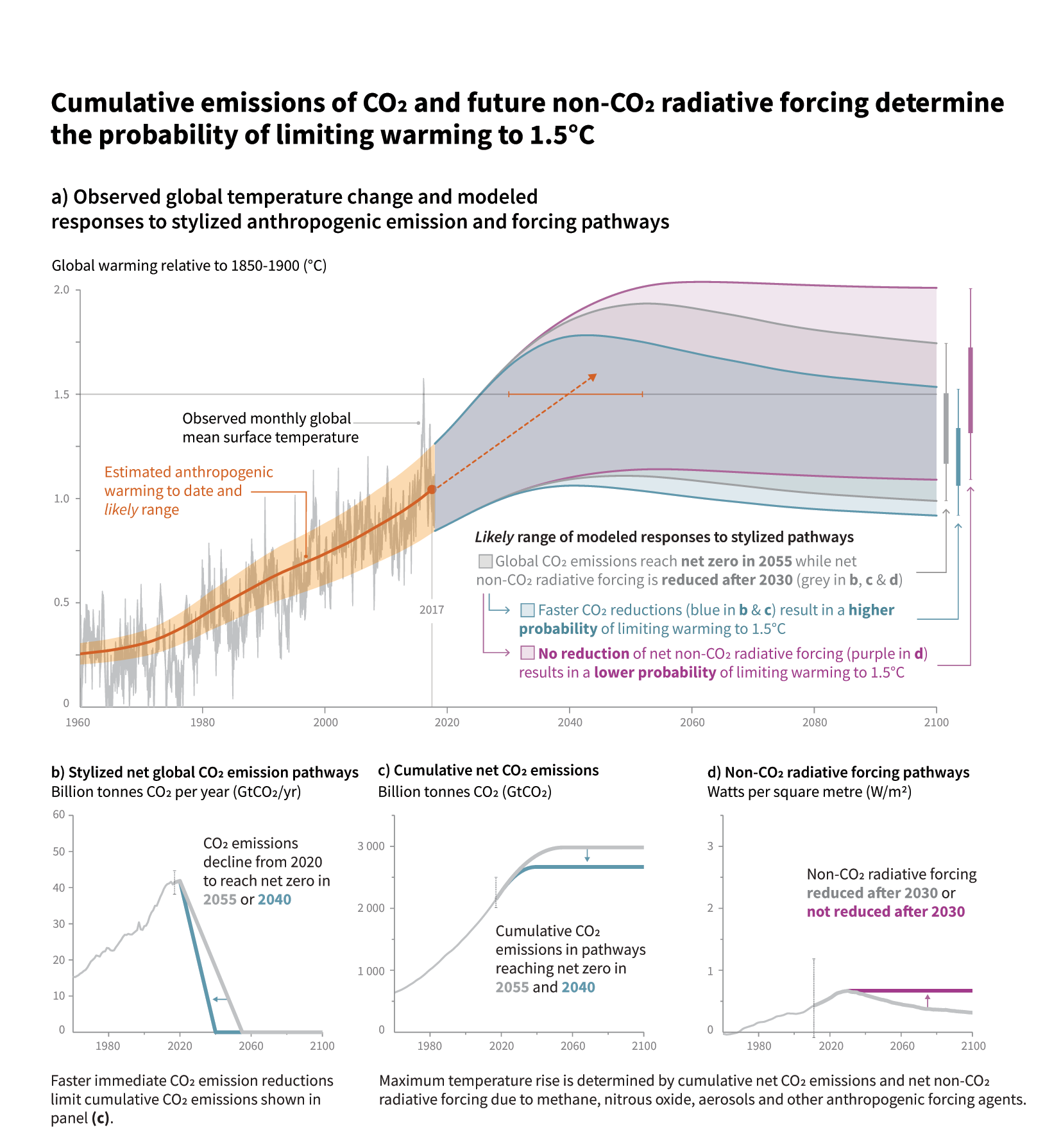
1.5 - 2C depending on how hard (if at all) we cut emissions going forward.
Different document. I think this is probably referring to https://insideclimatenews.org/sites/default/files/documents/... since that's what the news articles making the same claim are based on.
There's a few things worthy of note in there. Firstly, according to the document Exxon wasn't at all sure that their products actually were causing global warming. Secondly, they predicted if it did happen it would have much lower impacts than claimed by all the climate activists and press pointing to Exxon's "accurate" predictions as proof they knew their products were destroying the world. Highlights inclue 1.9 to 3.1 C warming by 2090, no potentially serious climate-caused problems until the end of this century, and rising sea levels maybe causing coastal flooding in several centuries but only at the upper end of possible warming. Thirdly, they argue any major shift from fossil fuels would have had to be based on nuclear rather than solar and wind - not exactly popular with environmentalists, to put it lightly.
I mean, until somebody does something about it, there's value in repeating it over and over. Maybe at some point it'll sink in how criminal these companies are.
It is back in the news.
https://insideclimatenews.org/news/24102019/massachusetts-su...
[video]
We can blame Exxon and greedy capitalists as much as we want but this is the textbook example of a system with perversive incentives. Human society, and I would even argue human nature in itself, presents us with the wrong system of incentives for self preservation at scale.
This is exactly what laws & regulations are for. So corporations can't do whatever they want, because they 'care' only about profits, and will do anything for profit within allowed framework.
Note, that 'care' in in quotes. It is because corporations are not humans, or even alive. They are not greedy, good, bad, evil etc. Do not anthropomorphize entity created to maximize profits, led by top people hired to do just that.
So our incentive structure- capitalism- is to blame.
Here is something else that oil company know and keep secret.
The unexploited oil reserves in the world are at least twice as big as we think.
Not exactly- the term "provable reserves" has a technical meaning, and is usually used with a modifier like "economically recoverable".
Because the public misunderstands that term to mean "absolute amount of supply ever to become available" doesn't make it misleading or even a secret.
That's astounding, because the IPCC did not accurately predict 2019's climate change or CO2 in 1982. In fact, Exxon scientists must be time travelers to have foreseen the rise of China at a time when all of the USA was afraid of losing to the Japanese.
One reason the IPCC might have missed that prediction in 1982 is that the organisation didn't exist. It was founded in 1988 [1].
If you meant the scientific community as a whole, a majority was predicting anthropogenic global warming since the 1970's, but consensus only started in the 1980's [2].
[1] https://en.wikipedia.org/wiki/Intergovernmental_Panel_on_Cli...
[2] https://en.wikipedia.org/wiki/History_of_climate_change_scie...
The most likely scenario is that their predictions at the time have been surprisingly neatly counterbalanced by what actually happened, some big factors off the top of my head:
1. The industrial/economic/demographic collapse in the (former) USSR and Eastern Europe 2. Huge per capita emissions reductions in Western Europe and the USA 3. Stagnation in Japan 3. Slower global population growth than predicted
Hell, the IPCC did not accurately predict 2019 climate change back in 1998 when they had far better models with far more computing resources.
This seems very hard to believe - mainstream science struggles to predict accurately even 5 years out. In 1982 they were predicting the ice caps would be gone by 2000, acid rain, holes in the ozone layer etc. But this one guy is the Nostradamus of climate and everyone ignored him?
Note: I am not saying that climate change isn’t real. I’m just sceptical that someone in 1982 made accurate predictions of 2019. And all points in between? Without anyone noticing?
> In 1982 they were predicting the ice caps would be gone by 2000
Citation please. No one was predicting that.
Edit: Also I have little problem believing that internal scientists knew the problem, and the extent, long before the outside world recognised the urgency. That also applied to tobacco, asbestos, leaded fuel - they had research showing issues decades before the wider world had the weight of evidence, or even recognised there was a problem to investigate...
> This seems very hard to believe - mainstream science struggles to predict accurately even 5 years out
In general, this might be true. Predicting the future is harder than it seems. But it depends completely on the type of system (chaotic or not), and how well we understand it. We can predict the position of the Earth thousands of years into the future.
Regarding climate models, you might be underestimating how good they were in the early 80's. Here are old models' projections compared with the actual temperature records up to 2017 [1]. I'm not an expert so I don't know if they excluded early bad models, but they included all the IPCC models.
The graph that AOC showed was pretty small and grainy. It's also compressed along the x-axis (140 years), and has a high aspect ratio. It's possible that she, or her aides, picked the best one for the presentation. But given the performance of the models at the time, it's not unreasonably good. It actually seems worse than the 1990 IPCC model, but that's just my opinion.
[1] https://www.carbonbrief.org/analysis-how-well-have-climate-m...