▲ 145 points
back
102 comments
Strange how some comments are able to get to the core of the story, while the article somehow does not:
> Satellites in geosynchronous orbit go through an annual eclipse season when the Earth passes between the Sun and the satellite. Currently, the satellite is drawing power directly from the solar arrays and is configured to avoid charging the battery.
> But when the eclipse comes, they'll have to discharge the battery to keep the satellite powered and under control. Charging or discharging the damaged battery risks causing a thermal runaway and an energetic breakup.
> That's why they want to get it up into the graveyard orbit before the eclipse, so if it explodes, it does so in a orbit where the debris are very unlikely to disrupt the operation of active satellites.
> That's why they want to get it up into the graveyard orbit before the eclipse, so if it explodes, it does so in a orbit where the debris are very unlikely to disrupt the operation of active satellites.
A graveyard orbit sounds like it will be flying around up their indefinitely as high speed shrapnel. Does anyone know why they would choose this instead of destroying it on re-entry?
https://en.wikipedia.org/wiki/Graveyard_orbit puts the difference in delta V requirements for a geo-sync orbit at ~1500m/s to de-orbit vs 11m/s to get boost up to graveyard orbit.
Interestingly it takes slightly less delta v to send the satelite out of Earth's gravity well from a geo-sync orbit than to deorbit it.
What's the physical intuition here? Is it that you want the de-orbit to hit the atmosphere at a shallow angle instead of plunging to earth?
Interesting, but then we also need to somehow fly through that when launching outer space rockets. Amazing how we can avoid the debris.
Oh... Yeah that explains it for sure.
So it's more expensive to design satellites that can de-orbit?
> A graveyard orbit sounds like it will be flying around up their indefinitely as high speed shrapnel. Does anyone know why they would choose this instead of destroying it on re-entry?
Because the ∆v required to re-enter the atmosphere is significantly higher than that required to leave geosynchronous orbit for a higher graveyard orbit.
But yes, ultimately it will remain up there as "high speed shrapnel" - which is not an ideal situation, and continuing to treat disposal as we have may put us in a situation where these orbits become so full of high speed garbage that they are unusable. As a species, we need to do more work on cleaning up our space garbage before it's too late.
Kurzgesagt actually has a great video on the topic of space debris for anyone interested: https://www.youtube.com/watch?v=yS1ibDImAYU
Starship should make it feasible to go garbage collecting up there. That doesnt mean anyone will pay for it though.
Geostationary orbit is very high. It would be cost-prohibitive for satellites designed for geostationary service to maintain enough fuel to drop their orbits into the atmosphere. Instead, they move them into a slightly higher graveyard orbit, where hopefully any collision or breakup debris is unlikely to be able to get to an orbit where it could intersect a satellite still in service.
I guess there's a hope that someday we'll figure out a way to recover and permanently de-orbit all of them.
"It would be cost-prohibitive not to litter"
If one can't do business without carelessly leveraging finite public resources I would argue that that business is untenable
Not cost-prohibitive. Just cost. Devoting 5% of the mass to an ion deorbit thruster wouldn't be particularly hard.
Why is it higher, rather than lower? If it is higher, will it not eventually be back in geostationary orbit?
Getting from Geostationary orbit to re-entry is not easy. It isn't like the ISS where essentially if you blink, the thing burns up in the atmosphere. You need a huge amount of delta-v. My guess is the satellite is in poor enough condition they aren't 100% certain they can get it to start hitting the atmosphere before the imminent explosion occurs.
Note that because the Earth is tilted, this region of space is pretty much useless - there's very few (if any) useful orbits beyond a geostationary, and any spacecraft heading into interplanetary space is going to be aligned with the plane of the solar system (ecliptic), and won't pass through GEO or graveyard orbits. So while you do get shrapnel, it's spread across a very large region through which nobody travels.
This graphic on Wikipedia is probably really helpful to visualize some of this: https://en.wikipedia.org/wiki/Kessler_syndrome#/media/File:D...

While there's a lot of space junk up there, you can see that the graveyard orbit is in fact a fairly tight line around the equator. It should be quite easy to avoid.
From the look of it, it's kinda functionally equivalent to putting a fence around an airport. I mean, sure, it theoretically limits your options, but not in any practical way.
> A graveyard orbit sounds like it will be flying around up their indefinitely as high speed shrapnel. Does anyone know why they would choose this instead of destroying it on re-entry?
It sounds like there's confusion about that point. The article says that the plan says that they're going to de-orbit the satellite so it can burn up on reentry, and that it will be in a graveyard orbit, which are contradictory objectives to each other. It sounds like AT&T hasn't responded yet to clarify which of the two they actually meant.
I think in this case the use of 'de-orbit' only means removing it from its in-service geosynchronous orbit, to the graveyard orbit.
De-orbit down around usual LEO altitudes is more drag-effect, you will return to Earth soon enough anyway.
For everyone worried about polluting geo distance orbits, consider that geosynchronous is about 35,786 km from the surface, or about 6x the radius of the earth away.
Suffice to say this is a very great distance, and the probability of a collision orbit at this distance is so phenomenally unlikely that even if left in place there is nothing to consider of this risk.
Moving to a higher and unused orbit means nothing will ever impact it in any human time horizon.
Can that really be true? You’re still having the thing rotate along. I worry about space filling up with satellites with no good ability to retrieve them..
My guess is that Geosynchronous Orbit at too high an altitude for them to re-enter the atmosphere under their time or fuel constraints.
http://acqnotes.com/wp-content/uploads/2014/09/Orbit-Map.png
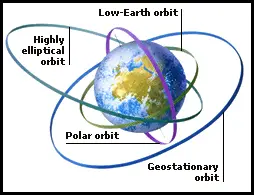
But it's just a guess.
It would take too much energy to de-orbit quickly, it's probably pretty big and unlikely to be fully destroyed in the atmosphere, and there's not much beyond geo for a shrapnel cloud to run into.
And you need to add one more bullet,
> They have excess propellant on board they can't dump fast enough which is the energy source of the explosion (the battery failure is just the trigger)
Normally they don't let satellites in the graveyard with any propellant as an explosion there can add unpredictable amounts of delta-v to the satellite and one or more husks that it connects with post explosion :-).
Personally I'd suggest they just start boosting out of geosync and keep going out until they run out of fuel but not enough time for that either it seems.
This suggestion is complicated by the fact that you can't just boost out of an orbit with one short maneuver. You can turn your circular orbit into an elliptical orbit, tangent to the original orbit; any debris in this orbit can still affect satellites in geosynchronous orbit when those satellites cross the point of intersection. Because the orbital period will be slightly longer than the original, and it is not tuned to any particular resonance, eventually all satellites in geosynchronous orbit will be at risk.
To actually get your satellite into a new orbit that doesn't intersect the original, you need to maneuver again: in this case, after you have followed the new (elliptical) orbit for ~12 hours (half an orbit) to its new high point.
All this is complicated by the fact that an explosion is further acceleration that shifts the orbit of the debris.
(That said, they appear to have ample time to move the satellite, it's a question of rules that would ordinarily prohibit it. The race is with the bureaucracy. Also, since the thrusters are designed for stationkeeping instead of propulsion, it's more of a gentle spiral outward than two fast maneuvers. Finally, some of the complication is about having ground tracking stations that can communicate with it: they have to speed it up by going lower, causing "eastward drift", before they can slow it down by going higher, which will give it westward velocity on the surface.)
Apparently there's plenty of fuel. How much Delta-V is there? Maybe enough for Earth escape velocity?
> Satellites in geosynchronous orbit go through an annual eclipse season when the Earth passes between the Sun and the satellite.
I'm having trouble visualizing this, but this seems to be a good description http://www.intelsat.com/tools-resources/library/satellite-10...
But why not rather deorbit then (as the article questions as well)?
The word "de-orbited" used in the article seems to not be the normal use of the word. Normally if you de-orbit a satellite, you lower its orbit until it either burns up in the atmosphere or hits the Earth. Satellites in GEO don't de-orbit in this way because it would need too much extra fuel. Instead, when GEO satellites are decommissioned, they raise their orbit into what is known as the graveyard orbit.
I was really confused about eclipse season, as I thought the satellites were in the earth's shadow every day.. But that's not the case; due to how high they are, they usually always get sun, except for a few months in the spring and fall where the earths axis of rotation is not pointing towards/away from the sun. That few months is the eclipse season; and the eclipses happen once/day for a max of 72 minutes - which is where the batteries are needed.
http://www.intelsat.com/tools-resources/library/satellite-10...
Rather annoying that this article doesn't address the consequences if they fail in their endeavors and the thing does blow up.
Also, not great timing for Boeing.
Which battery chemistry?
This satellite operates on a Boeing 702HP bus [1], which uses lithium-ion battery cells sourced from Saft. [2]
[1] https://en.wikipedia.org/wiki/Boeing_702
[2]http://www.terradaily.com/reports/Saft_To_Provide_Lithium_Io...
Boeing really can’t catch a break huh.
What’s the cost of just flinging it out into space towards the sun?
To throw some numbers at it:
The sun's escape velocity is about 42 km/s. Earth's orbital velocity is about 30km/s.
To go straight from Earth to the sun, you'd need to shed almost all that speed, meaning you'd need to accelerate by nearly 30km/s. To leave the solar system, you'd only need to accelerate by about 12km/s.
That said, as someone else pointed out, there's an interesting irony: Since objects closer to the sun orbit faster than ones that are far away, the cost to go to the sun is generally higher the closer you are. (The exception is if you're already more-or-less on a collision course.) So, if you've got the time, it's cheaper to go away first. You can think of it as sort of a way of using the sun's gravity to do most the work of slowing you down.
If we replace "toward the sun" with "away from earth", you'd have to get to a bit over 11km/s relative to earth. From geostationary orbit (3ish km/s), that's kind of expensive. Again with the counter-intuitive, it's actually cheaper to get away from Earth from low earth orbit, where you'd be starting from a speed of more like 7km/s.
This all starts feeling really intuitive after a couple hours of playing Kerbal Space Program. :)
That's kinda not how orbits work. First, to get to the sun, you have to escape Earth's gravity, which takes a lot of power. Once you've done so, the sun is actually one of the hardest places to go. It's easier to leave the solar system altogether than to drop into the sun.
Depends on how long you're willing to wait. In rough rounded numbers:
Earth's velocity around the sun is 30km/s.
To directly slow down enough to hit the sun, you need to remove 20km/s.
To leave the solar system you need an extra 10km/s.
But if you almost leave the solar system, and wait for the very peak of your orbit, then you'll be going so slowly that you can turn it into a pure dive into the center of the sun with almost zero thrust. So this plan needs slightly less thrust than escaping entirely. It will just take decades to centuries.
> hardest
The best way to end up as a sun meteor is to boost the orbit to Jupiter and let a flyby of Jupiter kill the remaining horizontal velocity.
The cost is, pun intended, astronomical.
We have launched satellites towards the sun, to visit Venus and such, but they take months to get there, and there is still a lot further to go if you want to get to the sun.
More than the 79kg of fuel it has on board.
A lot. The gravity well is deep and steep and wide. And satellites are placed as far down it as possible.
It's easier to make it chase Voyager.
How much is the battery cell temperature deviating?
just call Walter White. Sure he'd be able to pull something off with Magnets..
Send Clint Eastwood and Tommy Lee Jones