▲ 111 points
back
29 comments
This is the Navy manual. The stitch described here would be called a "running stitch" by a telephone installer, and is just one of several stitches in our repertoire.
This PDF describes several more, including the starter, Kansas City, and Chicago: www.dslreports.com/r0/download/1377481~846610918062e1c57e36f03a5c37b426/lacing.pdf
It does not include the "power stitch" or "H stitch", though this and the others are all over YouTube if you're curious.
Besides the technique, it’s also important to use the right kind of lacing cord. A current standard in telecommunications is nine-ply waxed polyester twine, traditionally in white or natural color.
In aerospace, flat-braided lacing tape is sometimes used, in aramid (Nomex), glass fiber, or other materials suitable for more demanding conditions.
30 years later and my index fingers are still spontaneously repulsed by "NSN 4020-01-208-7645: TAPE, LACING AND TYING". Tough stuff, much tougher than the skin of a person's knuckle joints. Military aircraft are mostly made out of wire.
This was still taught, and tested on when I went through ETMS in 2014.
The problem with these laced harnesses is the same as with zip-tied ones - you can't add or remove anything (without destroying it or making a mess of it, unless you re-tie/lace everything), and that it's difficult to use the simplest and fastest method of wire tracing, which is tugging on it and seeing where it goes.
Therefore the currently best method is IMHO a slotted wire duct. Put the cover on and it's neat and tidy, but easy to pull the cover off, add or remove wires and trace where they go.
That's probably why that method is now industry standard.
Example here, with cover on in the middle and covers removed top and bottom: https://blog.hellermanntyton.de/wp-content/uploads/2017/01/P...
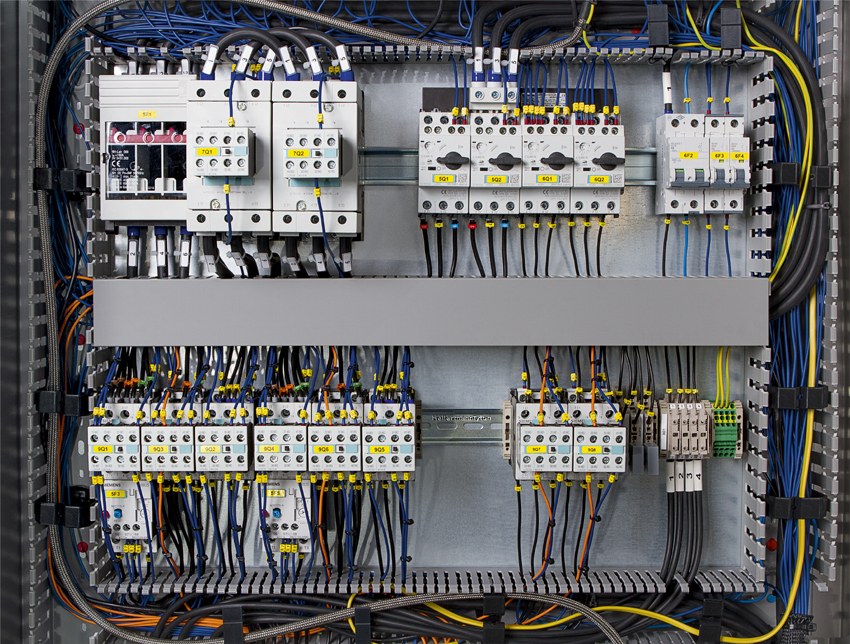
Another downside to it is EMI. tying all the wires tight together increases the odds of any EMI problems vs letting them be loose in the wire duct.
In a previous CNC machine, I zip tied everything together very carefully, but was getting phantom steps in one of my steppers (even with shielded wires). Unclipping the zip ties caused the problem to go away. (after that, I added plenty of ferrites, too, as a measure of safety, but clipping the zip ties killed the only real symptom)
One other way to solve this is to:
- use EMI sheilded conductors (at greater expense), or
- use twisted pairs where applicable.
I believe the CAN standard is based on twisted pairs, and they work very well for other ground/signal based configurations.
I had actually used EMI shielded wires - but, I think I must have had a faulty connection from shield to ground. Practically speaking, EMI shielding is hard to get right if you're not a pro. I only recently got an Oscilloscope and was able to measure what the EMI noise actually looks like on a wire. That helped a lot in getting rid of it, too. VFDs are pretty awful - the one in my machine nominally outputs 8amp,220v, 500hz power, containing that is a matter of extreme care. My previous CNC (now sold) really just didn't make any attempt and just counted on physical separation of wires and software filtering of signals.
CAN uses a differential pair which is the way to go. EMI will drive the pair in the same direction. Also used in USB, RS-485, pci-e, hdmi, etc.
You don't really have to twist them but it is best practice.
Had a similar problem on a stepper motor motion control system in a vacuum chamber. The single electrical feedthrough forced motor and signal cables to be in close proximity. The pwm noise from the motors would couple to the opto isolated limit switch signal and force the limit switches on. I solved it by putting 10k pull down resistors with a bypass capacitor to ground on all the inputs. Phantom stuck limits were no more.
I’ve found recently that ferrites really help with this. The electrical noise from large steppers is really erratic, but responds well to ferrite beads with 2-3 wraps. I put one at each end of the cable, since back-EMF is very real in large steppers.
Also heat. Wires bunched up tight can’t cool themselves down as well.
If heat is an concern, you'd probably want to spec a thicker gauge wire.
Regardless of wire gauge, bundles of wire noticably reduce your heat dissipation ability and therefore reduce your safe current carrying capacity accordingly. That's why electrical code significantly de-rates the current capacity of circuits which run more than just a few conductors in a single conduit or through the same hole.
Yes, but (especially when Cu and Al are pricy) being able to use a thinner gauge can be a big benefit.
Yes, this technique is not appropriate where wires are added or removed frequently. It's appropriate where you need extreme density, or inside portable equipment where wires not secured to each other may abrade each other.
I learned cable lacing in the aviation world. It is not uncommon to add a certain amount of extra (spare) cable runs to a loom for future use, you can also easily add cables to the outside of a loom.
The tug method of tracing still works, you don't want to tie your looms that tight, your lacing (same with zip ties) will cut into the insulation over time.
Schematics show you where a wire begins and ends. Wire ducts with no covers so people can ‘trace’ wires is a sign that either a) they don’t know how or can’t be bothered to read schematics or b) poor maintenance practices such as making modifications and not updating the schematics.
Wire ducts are popular because they are faster to make a bundle and put it in a duct and not worry about exactly how it looks, but our panel shop is still zip tying wires in bundles that behind and end in the same general vicinity to keep the wire ducts tidy in large panel line ups - say 5 cells each 1m wide.
Yes I use velco ties for that reason.
I recently started using this technique. I love it.
It's not too hard to learn how to do it in a functional sense. I don't need to do it well, just tie up some cables.
Whether it's useful depends on how often you are adding or removing cables. It's not a fast technique. I use it for my PC monitors + keyboard + mouse + audio, and it's been much less of a hassle because the wires don't get tangled any more. The real boon is in my audio equipment. For example, I have a (musical) keyboard, and that needs 10' 2x audio + 2x MIDI. Having those cables tied together has made a huge difference, preventing them from getting tangled with other cables, and making it easier to keep them out of the way. I also have a 19" rack of audio equipment, and I use this technique in the back of the rack. Barring equipment failures, I don't expect to change anything in the rack for the next few years.
It's functionally equivalent to using lots of zip ties or velcro ties, and most useful if you have e.g. multiple cables that that traverse the same 10' distance.
For that use, I would get some Techflex F6 split sleeving, or some of the velcro-closure stuff. Not only does it hold them together, it also provides quite a bit of protection from abrasion if you drag the resulting "snake" around the floor or whatever.
The problem with lacing an assembly that might flex, is that the cord keeps the cables from sliding against each other, and makes the assembly very stiff. So any flexing force is concentrated at points where it can overcome that stiffness, and this is bad for the cables long-term.
Inside equipment, lacing is used to keep wires from abrading against each other. In an office, it's used to secure them to frames for density, organization, and seismic reasons. In all cases, every piece of connected equipment is rigidly mounted, and no part of the laced form ever has to move relative to any other part.
That's what I would get if I were "in industry" and had a lot of cables to deal with. I just have my personal equipment, and one spool of string is very convenient to buy and shove in the closet when I don't need it.
Thanks for mentioning the split sleeving, I didn't know about it and that looks quite useful!
Besides the "slotted wire duct" described above, which is OK to "tie" cables to a ridgid surface, the other things normally used in the industry (and that work just fine) are spiral cable wraps, example:
https://t3.lappcdn.com/typo3temp/_processed_/csm_TOOL_616000...

I considered spiral wraps but it's more convenient for me to keep around a spool of string.
One example where cables are laced down is Curiosity rover, as noted in this forum thread: https://igkt.net/sm/index.php?topic=4028
Some days ago I was looking to make a lat pulldown DIY setup for home use, I had hard time finding suitable pulley for the purpose. Most cables and pulley I found got abraded fast.
I'm interested. How does this relate?
Looks like what I learned in scouts, vis. lashing a rope end.