Eminently sensible call by Honda. Knobs, dials and switches work well and do not demand that a driver takes their eyes off the road. I suppose that voice controls would be a reasonably safe tech option, but probably not cost-effective.
back
17 comments
This past January, I rented an Audi Q7. It was brand new and had the Audi Virtual Cockpit which took me a full two days to grasp to the point where I could use it safely and required me to pull over several times to figure something out. Worse, the rental agency had removed the owner's manuals so I was without reference. One of the goofiest things was that the navigation moving map would mysteriously stop moving--allowing the car (me) to drive off the edge of the map--and didn't allow me to move the map, to re-center by touch, while the car was in motion, instead presenting an alert saying that the action was unavailable while the car was moving. As I was driving in an unfamiliar city, this issue forced me to stop several times so that I could see the map surrounding the car, it was simply horrible.
To complicate things, the rental agency had bound the two key fobs together with steel cable. This caused the car to arbitrarily recall the user settings from one key or the other--presumably whichever key it happened to recognize first. This had the effect of making the system behave even more randomly as it unevenly switched back and forth between the two user profiles each time I started the car. Every time I'd think I had tamed the user preferences, the "other" set would get loaded, changing the preferences. I solved this by removing the key battery from one of the keys but even with just a single profile, it was a remarkably trying experience and one that seemed to have been engineered for frivolous, show-offy, reasons rather than solid, task-solving reasons.
Mercedes-Benz has, in recent years, also made their UX very flashy and fiddly even though they are not using a touch screen. Just tuning a radio station is a multi-step process requiring the traversal of several menus but lacking the feedback in the sub-menus that is needed to let the user know they have actually made a selection. The user must come back all the way to the top of the menu structure to see if the selection they made two or three steps earlier has had any effect.
Just give me a dedicated knob.
That keys-with-steel-cable thing car rental companies do is terrible. And there is absolutely no point in doing so. Either give me two separate keys so two drivers can use them, or just give me one key.
You just gave me flashbacks to renting my first Audi and not being able to leave the lot for a good 15 minutes before I could figure out what the hell was going on. Audi sponsored the whole thing but it backfired because I would NEVER drive one again after that, or recommend to anyone - what happened to cars?
Newer Suburus are almost as bad. Tesla is too but at least it's all located on one panel.
Modern time developments: high tech high pace revolution for powerful and automated delivery of making the user miserable.
Showing off without sense, basically.
This is one direction that I never wanted a car dashboard to go towards. The amount of information packed into a dashboard is overwhelming. Most of them is not relevant to the daily commute.
Who wants to know you water temperature measured to a 0.5degC accuracy?
My car has onboard voice controls, but, unlike Siri via the car's audio system, they suck. Recognition is slow and unreliable enough that I never bother, and if I did, the cognitive overhead would be unacceptably high anyway. They'd have done better not to bother implementing them at all and instead just offload that work to the driver's paired smartphone, which for a sedan that listed $32k new, it's very reasonable to assume will be present.
It's interesting, when I had my Windows phone and linked it with my 2014 Ford Fiesta which had Microsoft Sync, it was incredibly fast, responsive and a joy to use. Once you got the format of your queries down, it was super easy to use. They had a button on the wiper knob. Press it, wait for the beep and your're off and running. It synced up instantly. As soon as your phone was connected via bluetooth, you were good to go.
I had a text conversation with my GF back and forth for almost two hours, just by using the speech to text recognition capability of the Sync in my Fiesa, it was really amazing to me how well it worked.
My 2016 Toyota Corolla has something similar and pairs with my iphone and its a total nightmare. it takes literally ten minutes for it to sync up. That's after the phone has already been connected via Bluetooth. The command queries don't often work, you have to repeat them several times, and then after three of four times of saying the same thing over and over, you finally just give up. I'm not sure if its just with the iphone, but it really does suck.
Voice command is unreliable.
Even human to human level, every safety critical application rely on voice commands has to implement very rigid and strong standards and rules on human speech.
>My car has onboard voice controls, but, unlike Siri via the car's audio system, they suck
Using Siri is more dangerous than driving and texting:
"Undistracted drivers typically showed a one-second reaction time. Those who used the voice-controlled Apple CarPlay saw a 36% increase in their reaction time, which rose to 57% when they used the touch interface."
https://appleinsider.com/articles/20/03/20/new-study-shows-u...
Touchscreens should be banned in cars. I bought my car without any for that reason.
Voice control sucks IMO, even though a lot of people now grow up with Alexa and similar and adapt to the technology. Why does it suck, just like some "smart" buttons? Because it's not obvious what it can do. You have to learn the vocabulary it understands and its other limitations (tone etc.). For example, I tried to get my Tesla to text one of my contacts recently and failed. I didn't know whether it just didn't understand me or was unable to. Good UI are obvious and don't require you to memorize secret capabilities.
In a car it's even worse because you have to tell everyone in the car (or on the phone) to stop talking, give your command, wait for the confirmation and then everyone can continue talking.
Voice control is like trying to use a command line interface that comes without any documentation or completions.
not obvious to you. I suspect younger generations won't have much of an issue with this, similar to how millenials learned how to utilize google search easily while it confounded their parents
> I suppose that voice controls would be a reasonably safe tech option, but probably not cost-effective.
They all suck and they’re literally not workable for rentals. Nobody will waste an hour configuring a rental car’s VA on departure.
I always hunt down and hit the “factory reset” menu option on every car I rent, though. If you don’t, you never know what weird settings the previous users have changed.
I also un-pair all the hundreds of paired bluetooth phones, if the reset hasn’t already done that. I often rent cars where the address book is full of names and numbers from previously paired phones.
The previous BMW one is pretty good and requires 0 configuration, at least in Spanish. I haven't tried the new one and my accent is very clear though.
It has few functions like call X or go to Y but in my experience, it doesn't do that many things but makes them very well.
I drive a 2010 Honda Jazz (Honda Fit in the US I believe) and I love it.
Not only does it indeed have buttons, but good buttons as well. Clicky where needed, rubbery where appropriate, with the righ amount of resistance etc.
Just like the iPhone always has the nicest buttons of any phone. It's a little thing that makes using it a pleasure.
Our 2008 Honda Civic (EU-spec) was similarly well-designed. Controls you were likely to use while driving (temperature/windscreen-clearing, radio, hazard lights, etc.) were raised up closer to your eye-line[1]. It was a really ergonomic "cockpit"
[1] https://www.autocar.co.uk/sites/autocar.co.uk/files/styles/g...
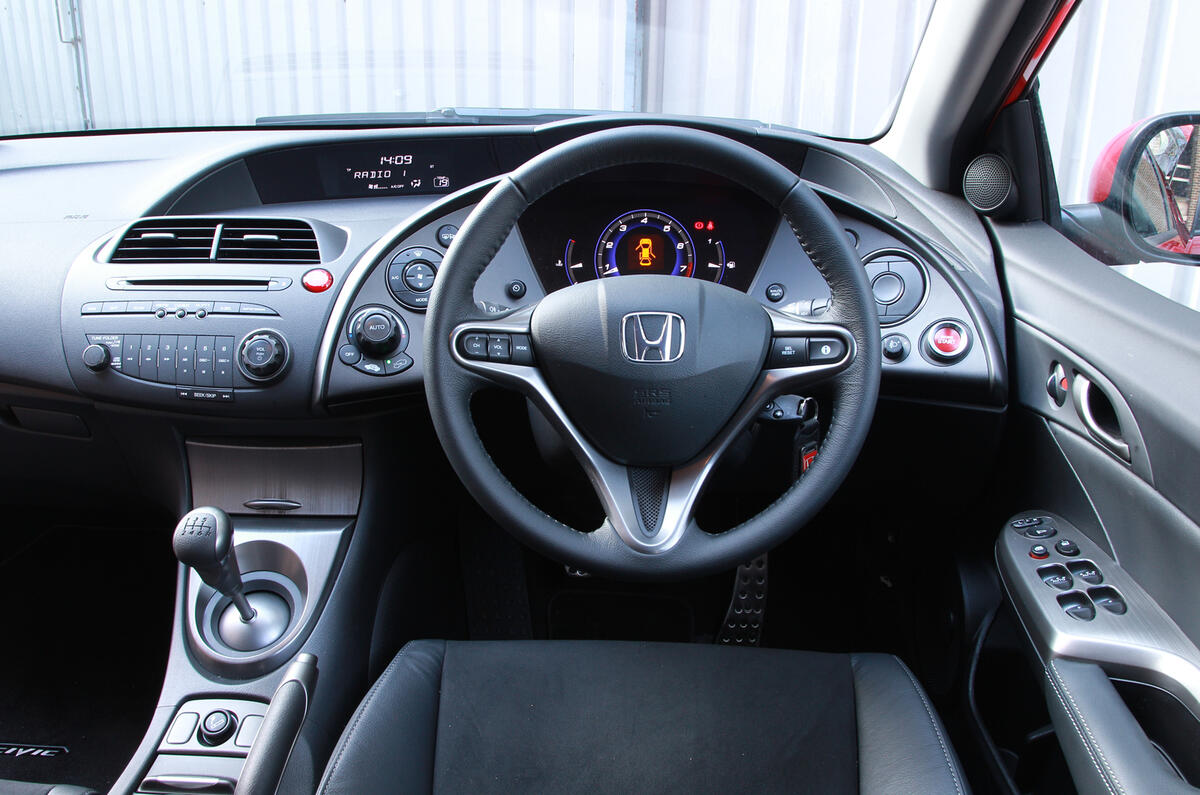
I love the big knobs and switches on my 2013 Honda Fit. They are big and chunky so it's easy to tell the difference between the vent and the temperature on the AC. Everything about it is simple and ergonomic. Although I kind of wish I went with the manual instead of the automatic sometimes.
https://cars.usnews.com/cars-trucks/honda/fit/2013/photos-in...
Thinking of voice-activation in a car in lieu of analog manual controls misses the point - perhaps you weren't advocating for it as a replacement, but the article above seems to.
There are multiple points of failures for a voice-control only interface for a high-speed moving vehicle:
1. Problems with NLP, and needing to adjust oneself to the proprietary format of this particular car's voice recognition grammar/syntax/parsing/etc. (discussed elsewhere in this thread)
2. Loud location (driving by a jackhammer)
3. Female voices [1]
4. AAVE voices [2]
5. Immigrant voices [1]
Some argument can be made that 3-5 could be improved on with larger training sets. Given that we're still working off of much of the same recording equipment that we developed in the early 20th century, this is only true up to a point in regards to #3, since it's difficult to calibrate higher pitched "noise" out and keep higher pitched voices in when they're at a similar range.
Even assuming all the above problems are solved, there are still the cases of someone losing their voice temporarily due to illness, or someone speech-disabled but otherwise able-bodied, and the cases of a computer malfunction in the car itself that causes voice recognition to break. I was in such an incident myself quite recently, where a rented Mini Cooper's onboard computer made it appear that the engine was overheating (red hot engine symbol) and that I must cease driving immediately lest the car explodes. After the car was off, the computer malfunctioned so severely that attempting to turn the car on only resulted in a light-up display of every error message the car had.
All that to say - voice controls are not a suitable replacement for standard knobs and dials, and the latter should always be available as a reliable back-up method for operating a car.
[1] - https://hbr.org/2019/05/voice-recognition-still-has-signific... [2] - https://en.wikipedia.org/wiki/African-American_Vernacular_En...
Is taking your hands off the steering wheel much better?
Ideally, all controls would be available on the steering wheel without removing either hand. Or, as you say, voice controls.
This is a great example of when "perfect is the enemy of good".
Humans have pretty good spatial reasoning (proprioception); the notion that touch controls should replace tactile well-spaced controls is dependent on the fact that both senses (sight, spatial awareness) are uncontested.
I would argue the point that sight is already in-use and must not be interfered with, if there's an alternative that does not use the same resources.
I think of it like hardware acceleration and parrelelisation; the brain has a hardware accelerator for sight, but only one, and has a bunch of cores ready for other tasks, and those other tasks can happen in parallel.
>> Is taking your hands off the steering wheel much better?
Yes. Most drivers are able to drive using one hand for a short period of time. Not so with eyes off the road.
In fact, it's a requirement in most countries where stick shift is the norm.
Taking your hand off the steering wheel isn't so bad. It's loss of attention, even for 1 second, that's extremely dangerous. Touch screens make you look away from the road. Knobs and buttons do not. However, jamming them all into the steering wheel may then cause the same problem, as if there's too many things in the same area you'd have to look down to find what you're looking for.
Having actually used voice controls in a car, it is worse than taking one hand off the steering wheel. It is also worse than a touch screen interface. It really is the worst of all options.
Because they suck at recognition.
I've noticed the mental effort I spend in trying to formulate a voice command that the car (or even phone) will understand is significant - and that almost none of my brain is being used for driving. The likelihood of it not recognizing what I said is not low. With tactile buttons, it's almost automatic. I don't spend any time thinking. I know where the buttons are, and my finger is good at finding it.
On the few occasions where I'm not sure where my finger landed, I can still slowly move my finger to an edge and start counting. I can do this over several seconds. Often while doing this I have to attend to an event on the road, and it's trivial to do so: I pause my finger search, attend to the event on the road, and then resume. So even if it takes 10-30s to find my button (very rare), it can be done with almost no loss of attention on the road. The same goes if I need to pause to listen/respond to what someone else in the car is saying.
Contrast that with voice recognition: If I have to pause to attend to anything on the road, the recognition system assumes I'm done talking. This adds more mental stress (maybe it will execute the wrong command? In any case I'll have to start over).
Now I'll go further and make an even stronger claim: Even if voice recognition becomes almost perfect (better than humans), it will still be a greater cognitive load to use voice recognition. For me, changing stations on the radio or adjusting the volume or adjusting the climate control is pretty automatic. The cognitive load of finding the preset station is virtually none. Whereas just formulating the command verbally - even to another human where I wouldn't worry about voice recognition - takes more effort. Perhaps verbal skills are tied to the vision in the brain and tactile senses are not? I wonder if any studies have been done on this.
When it comes to it, I don't think it's as bad. In a manual car one hand is often off the steering wheel and that's not detrimental.
Voice controls are worse than texting:
"Undistracted drivers typically showed a one-second reaction time. Those who used the voice-controlled Apple CarPlay saw a 36% increase in their reaction time, which rose to 57% when they used the touch interface."
https://appleinsider.com/articles/20/03/20/new-study-shows-u...
Some cars already do. My car has buttons on the steering wheel which allow you to navigate menus, control the radio, etc. As well as paddles to control over functions. The problem is if you are not on a straight road those controls become virtually impossible to use safely. Whereas if I quickly need to change the volume or even mute the radio I can do so one handed without even glancing at the volume dial on the radio and still steer the car safely.
Yes, taking one hand off the steering wheel is much better than taking your eyes off the road. Let's be honest here, we're not driving F1 cars so we don't actually physically need to be with both hands on the wheel 100% of the time, but it can take only second of us not looking at the road and we could be hitting someone/something and be dead (or we could kill that someone that we've just hit).
I really, really love to drive, I think I'm one of the few Europeans who chose to drive from Eastern Europe till the Atlantic Coast and back for his vacation just because I like driving (and wanted to see how Europe actually looks like outside of the big cities), and as such I can tell you that lack of attention (i.e. not seeing where you go and not seeing how the people around you are going) is the number one factor of accidents. I think there's nothing else that comes close to it.
I do not like button on steering wheels. I drive at 10-and-2 so unless I know where the damn button I'm looking for is, I have to move my hands to look under them on the steering wheel. I have a Ford where all the buttons are mostly the same.
If you forced me to have them, I'd prefer something like a d-pad on each side because they are easy to locate without looking and intuitive to select. Critical controls should be stalks, IMHO. I can't use cruise control in the car I've owned for six years without looking at the steering wheel, but I test drove a Subaru, which I haven't owned for like 9 years, and immediately remembered how to operate the cruise stalk.
That's actually the approach Ferrari uses:
Taking one hand off the wheel is nowhere near as bad as taking your eyes off the road. With physical knobs, I can use muscle memory to reach out and adjust them without taking my eyes off the road.
Having it on the dash rather than the steering wheel also allows the passenger to operate the controls, which is probably the safest way to do it.
I'm not at all convinced that voice recognition are better or safer than well designed physical controls.
Steering is a "good enough" problem outside of extreme driving conditions whereas in driver attention every bit of eyes-on-the-road counts.
Hand, not hands.
Also my steering wheel has both. I can do everything by feeling without my eyes leaving the road.
I'm still waiting for the convenient floor-mounted headlamp dimmer switch to come back.
I don't know of any teenagers who re-wired that switch to cut off the license plate lights....no, none.
Now would be a good time, there are very few of us who use the engine disconnect pedal these days.
Voice control still isn't there yet. Siri frequently thinks I'm talking to her when I say "hey [kid's name]" — despite the fact that my kid's name shares zero letters with "Siri", either in English or in IPA.
This is pretty surprising/disappointing, considering that the /s/ sound is pretty distinct, and considering that I did the "hey Siri" training when I got my phone.
It's started working pretty well on my Tesla. I can tell it to set the thermostat, turn on specific heated seats, play music, call or text someone, etc. It's not perfect but it gets better every update and we get an update at least once a month if not more.
Exactly - touchscreen offer no unique tactile feedback you can associate with an individual action. Also when the screen is multi use depending upon options then you really handicap the muscle memory and with that, cause distractions.
However, I do feel HUD display tech is one area in which could do with some love as would compliment and be less distracting over a screen located away from the drivers view of vision.
I like physical controls better, but I don't think that's a totally realistic contrast. Neither touchscreens nor knobs necessarily demand you look. I've known lots of people who looked while using physical buttons, and I can do my common touchscreen tasks in my car (e.g. switch to Bluetooth, hit play or pause) without looking. I suspect most people will look in both cases.
Voice controls are nice. Except when you get a sore throat. I'm not talking about disabled people, people with funny accents (everybody speaks English of course and if they don't, they at least speak one of the five other languages we proudly support) and people with non-standard timbre of voice, also.
Honda cars already have built-in voice controls, plus Siri (and I'm assuming OK Google) if your phone is plugged in.
Voice controls are a living hell with kids in the car.
My 2007 Honda already has voice controls. Never use them.
hondas have had voice controls for ~20 years. they're in e.g. the 2004 acura tl. simple voice controls are cost effective and already implemented.
I'm hoping they take up some kind of googles or periscope like interface.