▲ 73 points
back
20 comments
I used to work with a guy who during his misspent youth was part of a group trying to set a record for the tallest cave systems, so they were looking high in the mountains and for certain geological formations.
The insight he shared with me was that caves don’t form in the softest or most permeable layers of rock. Instead they tend to form above the hardest layers - water wants to seek the lowest level and the only thing to stop it is a layer that’s hard, or impermeable. Whatever is above that is where the water does most of its work, even if there are softer layers further up.
So if I have it right, these dinosaur footprints were made upon a softer layer above very hard material that makes up the base of the cave, and the layer above those two was hard enough that it has so far resisted erosion, leaving effectively a stone cast of a dinosaur foot, rather than a footprint that has somehow been flipped 180 degrees.
> (...) leaving effectively a stone cast of a dinosaur foot, rather than a footprint that has somehow been flipped 180 degrees.
Yes, I also share that opinion. In fact, just by looking at the photo from Nature it seems like the cave's floor is comprised of upper strata that have cracked, broked off and fell down. If just so happened that the layer currently exposed has the imprint of some dinosaur footprints.
Perhaps other visitors didn't noticed it because the previous layer broke off recently?
Do archaeologists use the term 'footprint' differently than we use it colloquially, or is the title just wrong?
To me a footprint isn't shaped like my foot. It's something that my foot fits into.
That's not a misspent youth. Most of the misspent youths I've seen involve some combination of rails of methamphetamine, injectable opiates, or jail.
Here's a link to an article from April 2nd that actually shows a picture of the cave ceiling: https://www.nature.com/articles/d41586-020-00972-y
Here's a higher res (3MP) photo from the paper PDF: https://i.imgur.com/8GUcuuP.jpg

Thanks, here's a somewhat higher resolution image. https://media.nature.com/w3000/magazine-assets/d41586-020-00...
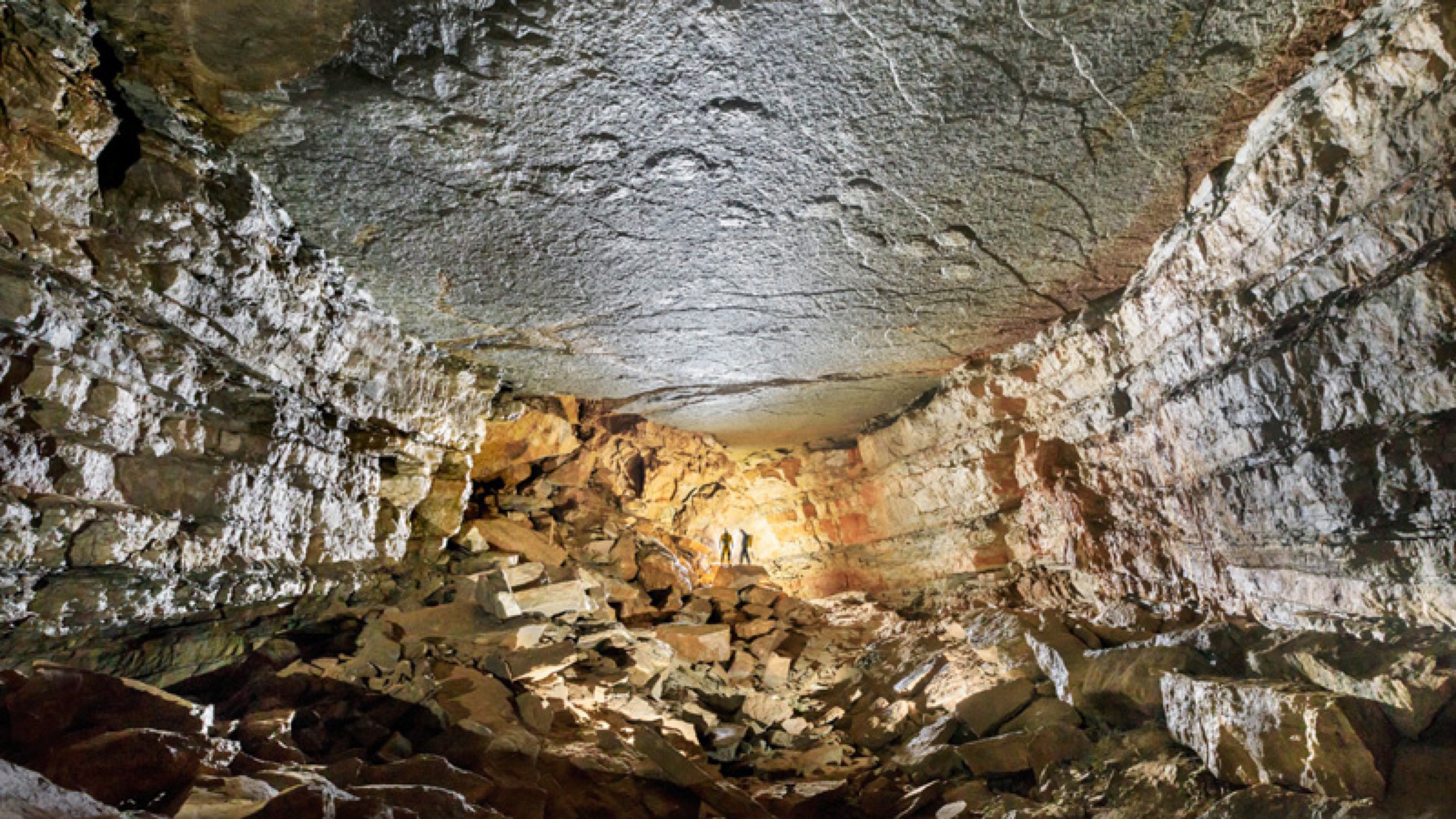
Thanks! After reading the description of how the "prints" (they are more accurately called casts) came to be on the ceiling I really had hoped for some pictures.
That's fair, but on the other hand the graphic of "how did these get to be on the ceiling anyway" is a great addition to the scienceblog piece.
Those prints are pretty big even taking perspective into consideration when you compare them to the people in the far background.
>> Some of the footprints show five toes as well as claws,” the scientist explains. “The largest are 1.25 metres in length, making them among the biggest ever identified worldwide
Thanks, that is why I came here.
Party hard
Apart of that, the presence of the footprints in the upper strata is not particularly strange. Dinosaur footprints are not so easy to spot for a non specialist. Often just a round concavity in the floor that could be done by anything.
This is a really neat discovery. For those in the western US there is a pretty accessible sauropod trackway in Grand Staircase National Monument at a place called Twenty Mile Wash that is well worth checking out.
At first, my mind was blown by the facts dinos could walk on the ceiling, then I read the explanation.
A little disappointed here.
Antigravosaurus was here.
Sounds like top trolling by the dinos in question.
The article describes that dinosaurs made footprints on the ground, it took ages and a number of geological processes for the footprints to appear on a cave ceiling.
Thanks. I have stopped thinking they were lying on their backs and smiling to themselves.
Creationists are going to have a field day with this.