That's cool, but it doesn't really explain _why_ the sound becomes more interesting. It has to do with how the sound is played back, in short, there are no "square" waves. Everything is a combination of sine waves. The more you have it's as if there are more instruments playing on top of each other, in music they're called "harmonics". A "squared" wave is a wave with many many additional sine waves in different frequencies that overlap with each other, if you were to plot it it wouldn't look square, rather it would be wavy. This article shows visually how this effect takes place, if you are interested: http://www.jezzamon.com/fourier/
back
3 comments
> Everything is a combination of sine waves.
No, we hear things as if they were a combination of sinusoidal waves (mostly). That's only one way to represent them; you can just as easily represent them as a series of impulses. Mathematically they're all equivalent models, and none of the models accurately represent acoustic transfer.
You can say we perceive things as if they were a linear combination of sinusoidal waves because we have a series of hair cells in the cochlea. Each bundle of hairs responds to waves within a very narrow frequency range, so that's what we mainly respond to. All of our audio perception is filtered through this process first. Since the hair bundles have a specific audio response, they don't respond to instantaneous frequencies- there has to be a wave of a certain duration for us to perceive a frequency. That's even independent of the mathematical fact that shorter wave pulses are more indistinguishable from white noise. Also, all of this is ignoring the other equipment of the ear, like the eardrum and the bone lever[1] that transmits sound to the inner ear.
We have a lot of brain circuitry that picks out specific features, which means we can recognize things like square waves or impulses. I don't know much about this stuff but it's important for things like cochlear implants. AFAIK it's similar to some optical illusion/visual perception phenomena- things like how we perceive magenta as a single color, even though it's just two colors together, or how we perceive orange as a distinct color from brown even though it isn't[2].
> The more you have it's as if there are more instruments playing on top of each other, in music they're called "harmonics".
Symmetrical clipping and square waves both create odd-order harmonics (3x, 5x, 7x, 9x, etc) which are very unnatural. The brain is good at picking this kind of thing out, and while I find it enjoyable (eg chiptunes), it's not really comparable to normal harmonics in music. It's certainly not something you can simplify down to just the component sinusoids. The perception of sounds has way more to do with stuff happening in the brain than in the air.
[1]: https://en.wikipedia.org/wiki/Ossicles#/media/File:Slide1ghe...

There's nothing more unnatural about odd-order harmonics than even-order harmonics. The brain picks up on both of them because any harmonic sound is good evidence that some living thing is nearby (non-living things like flowing water and falling rocks typically produce inharmonic sounds). The idea that there is something "unnatural" or inferior about odd-order harmonics is propaganda invented by valve-amplifier enthusiasts, because their amplifiers predominantly produce even-order harmonic distortion. A stopped pipe wind instrument produces odd-order harmonics, and they were invented long before chiptunes.
> Symmetrical clipping and square waves both create odd-order harmonics (3x, 5x, 7x, 9x, etc) which are very unnatural.
What do you mean by "unnatural"? A clarinet has mostly odd harmonics[1], for example. Clarinets don't occur in nature, I suppose, but they're not using electronics or anything either.
[1] https://newt.phys.unsw.edu.au/jw/clarinetacoustics.html#harm...
Probably even harmonics are more rounded or pleasing and less harsh. Compare trumpet vs cornet.
Related - I have recently been experimenting with musical effects based on breaking down a signal to any basis function of your choice. You can literally build any signal out of (nearly) any other. Turns out not to be a great audio effect as it tends to morph from one to the other via white noise in the middle in the general case, but with the right basis functions it's not so bad. At the extreme, in the case of sinusoidal basis functions ordered in increasing frequency, you've reinvented the filter sweep.
I plan to share on the blog at some point https://omnisplore.wordpress.com/category/music-creative/
Sounds cool. I always liked how ZynAddSubFX could use different functions for its additive synthesis.
It is a combination of the actual and our perception of it IMO. Even if the wave was a square, our ear hair wouldn't pulsate as square because of the inertia. And as such we wouldn't perceive a perfect square any differently than a "wavy" square, which is why Nyquist theorem/Fourier transform works. My comment was about understanding why the sound becomes richer just by flattening a wave. It is not intuitive that this would be the case but in essence it's as if you are _adding_ more frequencies that didn't exist before to the same sound. More frequencies are interpreted by the ear/brain as more instruments or richer instruments.
>> Everything is a combination of sine waves.
> No, we hear things as if they were a combination of sinusoidal waves (mostly). That's only one way to represent them
Well, but the reason we do our audio processing this way is that the Fourier transform our ear puts out is a high-quality description of the sound. If it didn't work well, we wouldn't do it.
> or how we perceive orange as a distinct color from brown even though it isn't
Why orange and brown? You can say the same thing about red and blue.
Conversely, if orange and brown weren't distinct colors, it wouldn't be possible for us to perceive them differently, and yet we do, very consistently. What exactly are you trying to say by "a distinct color"?
Due to the ear having “hair” in the cochlea, do people with Alopecia have a higher tendency to being deaf? Or fo they hear anything differently?
Hair cells don't actually have anything to do with hair. Not sure why you are being downvoted though, the name is a bit confusing. Jim Hudspeth gives a great talk about the neuroscience of hearing (haven't watched this video but saw him in person ~10 years ago): https://youtu.be/hn8N8p9P5gw
> It's certainly not something you can simplify down to just the component sinusoids.
Anything a human can perceive as sound can be simplified down to just the component sine waves.
> You can say we perceive things as if they were a linear combination of sinusoidal waves because we have a series of hair cells in the cochlea.
No. We say this because any waveform can be reproduced by a sufficient number of sine waves at different frequencies and amplitudes. It's not perception, or the physics of the human ear. It's math.[1]
[1] http://astro.pas.rochester.edu/~aquillen/phy103/Lectures/D_F...
Hah, I graduated from UofR- I was even a TA for Physics 142.
Math does not have anything to say about sums of sine waves being the true form of functions. The wavelet transform is just as physically representative. In fact you can generate any number of Hilbert bases for a given function. They are ALL equivalent.
The Fourier transform has a particular relevance because ears do something similar. Hair cells signal the brain while they are sensing vibrations within their particular frequency range. You could have different ears that signaled when they saw a sharp rise or drop in pressure and worked completely differently, but they would sense square waves just as fine. Or you could have ears that directly sense and measure air pressure. Instead, our ears sense that there are vibrations at 1 Hz, 3 Hz, 5 Hz, 7 Hz etc. and the brain interprets that and realizes it is a square wave.
The concept of a real Fourier transform is just as unphysical as a real square wave. A real Fourier transform requires a perfectly defined sound pressure at every instant; because air and sensors have inertia that is not possible. There will always be lag, so any change in frequency is not perfectly transformed or represented from/as a sum of sine waves.
On a related note, this [1] is by far the best video I've seen on the topic of turning digital signals (like square waves) into analog ones. The bandlimiting and timing section shows what a square wave ends up looking like when it's been converted to an analog signal.
[1] https://xiph.org/video/vid2.shtml It's 24 min long and, imo, does an excellent job at explaining the role of digital sampling frequencies, bit-depth, and the misleading "stairstep" representation of digital waveforms.
That's the video I always share with people spouting the same old clichéd nonsense about how a digital signal can't be as good as an analogue one (and other variant clichés). His presentation style can be a tad annoying, but there's no doubting the utter clarity of his points.
A digital signal can't be as "flawed" as an analogue one. The analog synthesizers exploit these flaws to produce richer and more interesting sounds that you just can't get in the digital world as it's too deterministic and the attempts to randomize behavior are too "white-noisy", instead of natural occuring distortions. There's been some advancements using AI, though, to model these flaws organically, which sound promising: https://teddykoker.com/2020/05/deep-learning-for-guitar-effe...
Record the signal, play it back. It's got the same 'flaws', perfectly. Reproduction is what I am referring to, not the _emulation_ of an analogue sound source.
The difference between digital and analogue gear is that the imperfections in analogue gear make them interesting. i.e. instabilities in VCOs, the addition of harmonics etc. I am a big, big fan of old analogue gear and so I am definitely in the camp of 'we're not there yet' with the emulation of analogue gear.
But, the idea that a digital signal can't replicate it, is nonsense, because obviously an analogue signal can be recorded digitally and perfectly played back. This is often the myth that is propagated, that the 'stair steps' somehow mean a loss of fidelity.
Interestingly, and relevant to this discussion, I am yet to find any digital plugin that manages to do saturation properly. Plugins are often, seemingly, just using random number generators, rather than anything more complex (like the AI models you link to); Nothing comes close to my Thermionic Culture Vulture, or any of my other valve based equipment at creating that 'fatness'.
I think that the AI approach is interesting, it does make me wonder how far we're willing to go to reproduce this in software, when the real thing is a handful of wires, resistors, capacitors, and transformers. It seems like trying to implement the ARM instruction set in Javascript. How much processing would a simple saturation plugin need? How many could one computer run?
I do not agree. I find modern digital softsynths just as "rich and interesting" as analog, not to mention 1,000,000 times more convenient to work with.
Something like U-He Diva for example can sound as analog as anything analog that I've heard. Then if you get into wavetable or granular, you can get sounds that are impossible to achieve with analog, which are in my opinion very "rich and interesting".
I suspect that the people who don't agree may have heard a digital synth many years ago and are unaware that the technology has improved markedly since then, which isn't surprising because there's a lot of money in it.
Just my opinion, but modern analog emulation sounds just as good as real analog.
Nothing wrong with enjoying the workflow of analog though, although personally I dislike that workflow.
There are plenty of good digital and soft-synths for sure. But the Diva isn't close to a real analogue synth. I have several analogue synths (OB-6, Alpha Juno 2, Juno 106, JX-8P, SH-101, Syncussion SY-1) in my studio (and modular too), and also own the Diva plugin. There really is no comparison. I never use the Diva plugin. If it was as good, I'd use it all the time, because it's much more convenient for recall to have a plugin.
Perhaps, for relatively simple sounds, or sounds that have little movement. But, the moment there's any filter movement then it's obvious. The filter really is the key, I think, when a digital synth outs itself. Often there's a 'digital edge' to filters on digital synths that don't come close to the 'smooth destruction' that happens in the analogue realm (really, really hard to describe with words!). But, in A/B tests between digital repros of classic synths and the classic synth, that's nearly always where I can hear the difference. But, it's also a major difference, because often the 'sound' of an analogue synth comes from its filter.
If you're looking for that stand out sound for a track, the one everyone goes "I love the track with that noise in", then analogue is where it will come from, the quickest and easiest.
This obsession with replicating the analogue sounds in software is really tedious though. I prefer digital synths that do stuff that the analogue synths can't do, like Omnisphere - nothing touches that, and it's a perfect compliment to the real analogue sounds. Let's keep the analogue realm, doing what it does best, and then let's advance the possibilities within the digital realm, looking forward rather than back.
I carefully considered whether or not to include Diva by name because I knew someone would shoot it down no matter which VST I named. I'm also a big Omnisphere and Phaseplant fan.
The point I was trying to make is that I feel that digital is definitely good enough to do professional-sounding "analog" performances without people going, "definitely sounds digital" - unless digital is the sound you're trying to achieve.
>If you're looking for that stand out sound for a track, the one everyone goes "I love the track with that noise in", then analogue is where it will come from, the quickest and easiest.
I disagree, but I also recognize that nobody will "win" this discussion, because it's a matter of taste - like asking for a consensus on which tastes better, chicken or fish.
You enjoy your analog synths, and I'll enjoy badly playing my digital synths. I'm more of a modern wavetable fan than analog sound anyway.
We're both music lovers - nobody's forcing anyone to use anything.
> But the Diva isn't close to a real analogue synth
Statements like this need to be prefaced with qualifying disclaimers, like "IMHO". You have to accept that your opinion is completely subjective. I've seen a variety of blind tests over the years in which listeners were unable to differentiate between analogue hardware and digital simulations. I've become increasingly impressed with the quality of virtual synthesisers over the years. At this stage, while I do still often prefer to use my analogue synths over the VSTs I own, that's mostly because the hardware is simply more fun to experiment with.
You can record an analogue synth digitally without losing its characteristics. It's interesting that you can't recreate the sound exactly by generating it in the digital domain.
So you can... assuming you can get exactly the right random bias generated given any possible input - and the bias will depend on both the current input and potentially some recent input. This is significantly harder and more expensive than just going and building the analogue box, so nobody does it.
Nobody does it? There's massive amounts of plugins that aim to do exactly that, along with DSP-based pedals and amps. For analogue synths, the well-designed VSTs are impossible to distinguish from the real thing in an A/B test. E.g. the Repro 5: https://www.youtube.com/watch?v=uFA_B6pP9AA
You're right in the strict sense about analog random bias being hard to reproduce, but those are largely irrelevant when it comes to the important characteristics of the sound. In an A/B test, it is impossible to distinguish a well designed digital audio simulation from a real analog device.
Impressive, both the instrument (Repro5) and the video. Can't believe the A/B voting results were as if they were random, everybody got about half right/wrong.
> if you were to plot it it wouldn't look square, rather it would be wavy
Could you go into more detail on why you say this? A real life square wave is square, possibly with some ringing or overshoot in the flanks (but not necessarily)
There are no real life perfect square waves for the same reason there are no ideal diodes, capacitors etc; you cannot have a perfect vertical cliff because that would have infinite slew, and you cannot have perfectly sharp corners because that implies infinite second derivative, etc.
The best you can get is a tight curve into an extremely steep "triangle".
The amplifier driving the speaker has finite slew. The speaker itself is constrained to move at finite speed and cannot accelerate instantly. The air has a finite slew rate - the speed of sound.
Stackexchange has a discussion on trying to determine a maximum frequency in air here: https://physics.stackexchange.com/questions/23418/is-there-a... which leads to all sorts of useful sub-discussions. Attenuation depends on frequency; the higher frequency harmonics are more subject to attenuation in air, as well as reflecting off surfaces and self-interfering.
I think they are referring to something like this:
http://1.bp.blogspot.com/-WhH0B8mnGhw/UZhL9ehVa8I/AAAAAAAAAH...
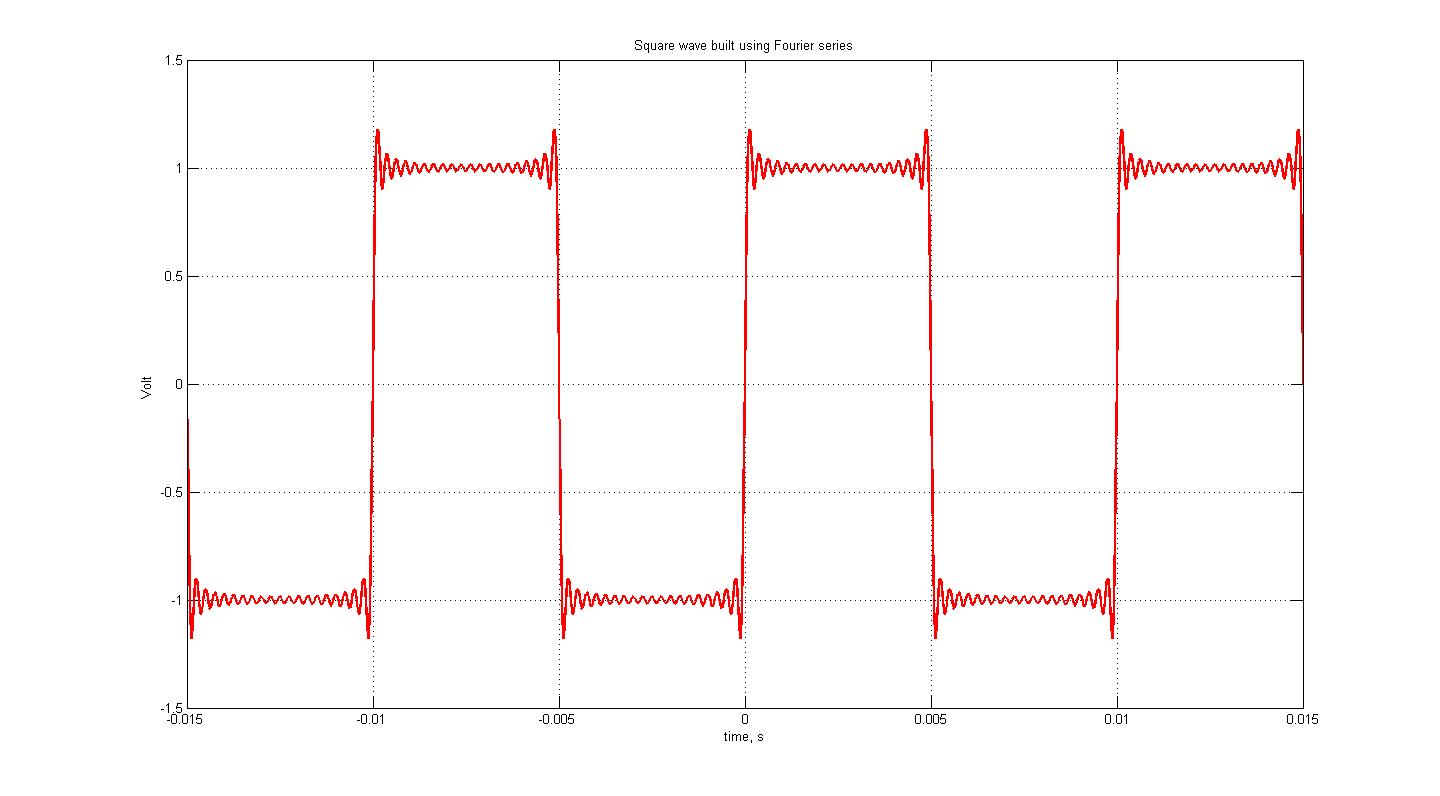
Exactly, what I'm trying to explain (although it's not easy as it's not very intuitive), is that we get more interesting sounds by clipping a signal's peaks to square because it is identical to _adding_ lots of different frequencies to the same sound in a way that their cancelling each other out would be represented as a square in digital audio, because of lack of detailed sampling at that level. The actual signal does not just flat stop at the square peak, the peaks get more signals in different frequencies added to them at playback, so they sound richer. You send a square to the speaker, the speaker isn't doing square, it pulsates in a sinusoidal fashion, nothing is fast or solid enough to produce flat square. Maybe you can find these harmonics in a factory with steel equipment, but they will still be pulsating at very high frequencies, which is why these "real" sounds are so much richer than a speaker.
The square wave signal will move the speaker in a square pattern, but the actual waves propagating through the air are always sine waves. What you get is a series of harmonics indicative of the square source.
The waves can be mathematically described as a sum of sine waves, but there's no reason why air shouldn't support something that "looks like" a square wave (no more as the speaker anyway) within some limitations.
What you might have is that the air might disperse the wave so it gets distorted but still with the same components https://en.wikipedia.org/wiki/Acoustic_dispersion
But think about it this way: if you have a plate moving back and forth in a square wave pattern at the surface of a pool of water, would the waves on the water be square?
Waves in water are surface gravity waves, which air does not have. Because water is pretty incompressible, high pressure causes a water column to rise against gravity. The rate at which the column falls back down is obviously dictated by gravity. The faster the frequency, the more a pressure wave acts like a real pressure wave and less like a surface gravity wave. Since real pressure waves don't rely on gravity for transmission, they travel far faster, resulting in dispersion[1]. You can still have square waves as long as they are 10-100x slower (longer) than normal waves.
Since air pressure does not typically produce a height difference in the atmosphere, standard sounds in air are not subject to dispersion and act very differently from water. There is obviously still a limit to the rise/fall time of a square wave, when the transition is more like a shockwave front, but that's a very square wave.
No, but because surface waves behave differently from sound waves (which are in "3D") https://en.wikipedia.org/wiki/Dispersion_(water_waves) Basically phase velocity changes with the amplitude and the shallowness of the water.
Yes it's easy to think they behave the same, but they don't.
Instead of flawed thought experiments you could try a quick test for yourself: hold your speaker up to your microphone, play a square wave, record sound, and look at the waveform.
I have no experience whatsoever with sound, but I got curious and did that, and got weird results:
(below is the original 440Hz square wave; above is the recorded sound)
The recorded waveform looks nothing like the original, and it sounds very different too: the original is much harsher, although the pitch sounds exactly the same, as expected.
Might be my crappy microphone? Or maybe the sound is being filtered somewhere along the way?
That waveform looks pretty good imo. When I did it, I the signal was very weak so the signal to noise ratio was bad. There were low frequency impulses from me moving the headphones around and regular hums from other sources.
My best guess for the large attack showing up there is not effects from the microphone, DAC, amp, or anything but the actual speaker. Good audio measurements are hard to come by thanks to all the snake oil, but square wave measurements are common when there is data. The physical models of transducers aren’t trivial, but in a single broad stroke the answer is “physics” and “spring-mass-damper”.
https://www.innerfidelity.com/images/AKGK701.pdf
The decay is expected, as the pressure around the microphone can only temporarily increase before the pressure wave disperses into the room. As an extreme example, if you turned an entire wall into a speaker and played a square wave, you would be able to make a much more square shaped waveform. There’s no replacement for displacement baby (see: subwoofers). If you want a more square waveform, try using a headphone pushed right up to the mic and going to a higher frequency (like 1 kHz).
Edit: If you want to skip the trip down the rabbit hole: I think the end-all for audio quality are sealed in-ear monitors (IEMs). Low group delay from short distance from transducer to eardrum, and sealed enclosure for good bass response (see: square shaped low frequency square waves).
What does that tell you? Shouldn't you be looking at the Fourier transform of the waveform?
Visualizing the spectrum of a square wave is so easy, it’s used to teach the concept of the frequency domain. Less square square wave? You likely peeled off some higher harmonics and added some phase noise.
The point of the experiment is to demonstrate that sound waves in air are not at all like water waves and sonic square waves do, in fact, exist.
The sine-ness of the water waves comes more from the mass and "elasticity" of the water, and not from the impulse driving it. If you put the same plate in air (or a speaker cone projecting a square wave) the mass and elasticity of the air permits much more "equare"-like pressure waves.
People focus too much on your water analogy.
But it is true: if there was a plate that could move like a square it would not mean all air in the front and back of it would also move like it.
The air compression would move like a sine instead of a square.
Even if the analogy worked, how do you propose to move a plate in a square wave? You would need to instantaneously move it by the wave amplitude.
Electrical square waves aren't really instantaneous either, they just got a very, very fast rise time.
To produce a square wave, speaker cone should move with infinite speed.
Yeah it's probably limited by the speed of sound at least. 10 mm movement and 20 000 Hz is probably supersonic diaphragm with some really back of the envelope calculation...
Gibbs effect. To sample a signal you need an antialiasing filter in front of the ADC.