▲ 169 points
back
229 comments
My brother had a Archimedes. At the time they were introduced, they were amazing things. 4 million colours, blazingly fast. At the time I was convinced that this would quickly replace Intel-based PCs. That never happened, of course.
Acorn had a tendency to be ahead of its time. Our first home computer, the Acorn Electron, could be expanded with a 3.5" floppy drive. Later, when we got a PC, we moved from 3.5" to 5.25" floppies. That was my first disappointment in having to make a step backwards in tech.
The Archimes' successor, the RISC PC, could even have an Intel processor as co-processor. Or, instead, a card with 4 or 5 more ARM processors. At the time is was probably the cheapest way for a consumer to get a multi-processor machine.
Acorn were indeed way ahead of their time. Especially when it came to flunking software projects. They had the hardware done but the OS was a quick hack job because their proper OS (ARX) was late. So they ported MOS from the BBC series and threw a GUI on top. And it initially sucked terribly. I was there for it.
I bought a fully stacked A440 when they were released, many thanks to the kindness of a deceased relative and much to the dismay of it mother who said I should have bought history books and art materials instead.
Really if they had something RISC OS 2 quality on day one, which would have been a monumental feat like the hardware was they’d have done better. I enjoyed every moment of using the machine after RISC OS 2 came out. Before that I was slightly scared I’d burned a monumental amount of money.
> 4 million colours
That would be 22 bit, which seems quite unlikely. Perhaps you're thinking of 4096 (= 2^12 = (16)^3)? It seems only 256 of them could be shown at once and only 240 could be modified [1][2][3]? If those are correct then it is more limited than VGA, which could show 256 colours chosen from 262144 (= 2^18 = (64)^3). Some Archimedes resolutions were more like low-end SVGA though [1].
[1] https://lowendmac.com/2018/acorn-archimedes-computers/
[2] https://en.wikipedia.org/wiki/Color_depth
Edit:
[3] Original brochures! http://chrisacorns.computinghistory.org.uk/docs/Acorn/Brochu... and http://chrisacorns.computinghistory.org.uk/docs/Acorn/Brochu...
[OP here]
4096 colours. :-)
Otherwise, yes, pretty much. I bought a 2nd hand A310 in 1989 and it easily outperformed the fastest machines my employer sold (e.g. the IBM PS/2 Model 70-A21, a blazing 25MHz 80386DX with 64 KB of secondary cache) by a factor of about 8×.
Given that the state of the PC OS art at that time was MS-DOS 3.3, which very few people bothered to put Windows 2 on top of, Acorn's RISC OS 2 was astonishingly advanced, too.
The acronym "ARM" originally stood for "Acorn RISC Machine." https://en.wikipedia.org/wiki/ARM_architecture
And present-day ARM cores are documented in (among many other) ARM's Architecture Reference Manuals, i.e. the ARM ARMs. They're so funny.
I remember attending a lecture given by Steve Furber in 1985 in Cambridge (UK) on the new chip that he and Sophie Wilson had developed. The emphasis then was on having an affordable 32 bit rather than low power. It seemed incredible that such a small team could have developed a CPU at their first attempt that was faster than offerings from their much bigger competitors.
Anyway much of the commercial success of ARM must be down to Robin Saxby who was ARM's first CEO. His interview with Charbax is fascinating [1]. He inherited a company with two customers, one of whom was failing, some interesting IP but not much else. He seems to have had a relentless focus on providing customers with what they needed - for example providing the Thumb 16 bit instruction set to reduce code size when potential customers such as Nokia were reluctant to move to 32 bit designs.
> He inherited a company with two customers, one of whom was failing, some interesting IP but not much else.
Among the else were those extraordinarily talented and dedicated employees, were they not?
This is great, thank you!
I fired up my Armbook to write this comment. It's just an original Pinebook with a special SD card to boot into RiscOS, but it's quite neat and very fast.
It's also the first true ARM/RiscOS laptop that has been made since the original Acorn A4. That machine was the first portable ARM device ever made.
Operating systems have been born and died between the arrival of these 2 machines.
I still use Samsung DeX despite it falling out of popularity after the inital bump. They even had virtualization for a Samsung and Canonical provided Ubuntu image that you could run in an app called Linux on Dex.
It has clear advantages for video editing, especially on export given the arm chips often just spend time decoding video and encoding is quick cheap and streamlined.
can't speak for other industries, but as a dev most stuff in apt is arm64 compatible and therefore runs fine inside of a container on android (this was disabled with android 10 unfortunately)
Title is factually correct, but is somewhat misleading - it implies ARM arch existed and then the Archimedes was designed around it (and was the first desktop to have that property);
In fact, the ARM was designed for the Acorn Archimedes, and that’s why no desktop, or server, or anything, used it before the Archimedes - ARM stands for “Acorn RISC Machine”.
VLSI made the ARM2 and chipset available in early 1987. I seriously considered using that in a machine I was designing instead of the 68020. But I had been burned by Motorola announcing chips and then cancelling them when almost nobody used them (an update of the TRS-80 Color Computer chipset that could be used with the 6809 or 68000) so I decided to continue with the 68020 until somebody else came out with an ARM product. Acorn launched the Archimedes at the end of 1987 and I bought the chips and the manuals and wrote an ARM assembler and simulator. But the project was frozen and I only actually built the machine in 1992 though the chips were obsolete by then.
http://www.smalltalk.org.br/fotos/casa3.jpg
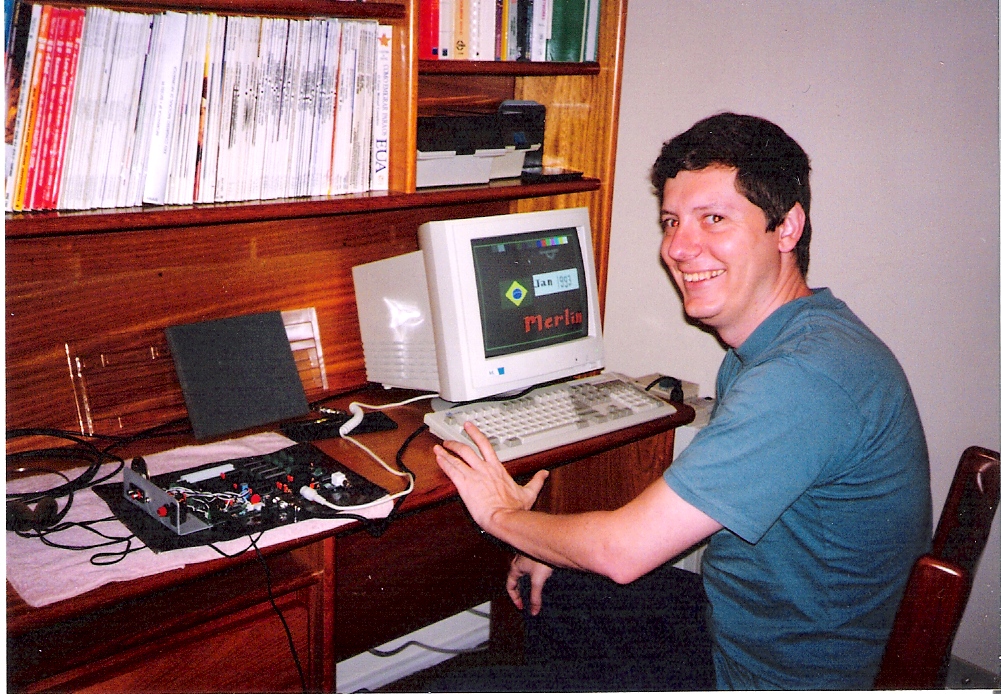
While the chips were indeed created specifically for the Archimedes, it would have been possible for some other company to have made a machine with them before Acorn.
Yeah, perhaps something like, “The Acorn Archimedes was the first desktop using (and original target of) the ARM architecture,” would be more suiting. Or even, “The ARM architecture was originally designed for a PC, the Acorn Archimedes”
Nowadays ARM is just "arm". The acronym has no specific meaning.
I'm very curious to see this transition to ARM play out. There is a lot of software that will now be compiled for ARM that can potentially be used in open-source projects on much more cost-effective boards. Music (VST) plugins come to mind.
The thing about arm that's always troubled me, which I only see talked about infrequently, is the way it's licensed vs x86_64 chips. Arm chips are licensed in such a way that allows for a multitude of different proprietary configurations that all are essentially arm chips, but locked down at the whims of the manufacturers.
I understand power usage is a big concern these days, but I can't help but feel this aspect of arm is greatly overlooked and that the push towards arm devices is also partially inspired by the ability to lock down chip designs to a greater capacity than x86_64 chips.
Just look at the existing fragmentation among arm powered devices as is. I don't really like the thought of what an arm powered future could look like.
I really wish I could remember what video it was, but I remember years ago watching the ceo of arm present a new chip with built in emulation technology, that theoretically, would have allowed multiple operating systems to run at once or something. I remember the person talking to him asked if he forsaw this as the future, and he just laughed and said oh no, no manufacturers would never dream of allowing this and furthermore they'll likely use this technology to further specialize and lockdown their chips.
It may be personal bias, but since then and other things i've learned about arm, I've just had this lingering unease as to what them gaining dominance would mean to general computing.
If I were a user in the music/film industry I would be worried if I depended on Apple.
Apple has shown pretty clearly they see themselves as a consumer electronics and services company above all. If all the "professional" users who rely on Logic or FC or Apple in general jumped ship, Apple wouldn't likely notice it in their bottom line (loss of mindshare not withstanding). They have no vested interest in catering to these users and have produced hardware intended for them as an afterthought. The high cost of hardware and absence of middle tier products that make sense for these users is just icing on the cake.
"Professional" users of Logic or FC have little leverage to affect the course of Apple one way or another (unlike a more focused company whose business model is catering to these groups).
On the other hand Apple pro users do have a long history of being abused by the company so they might be alright with it in the end.
Anyway, I'd be looking for an out if I were them.
Isn’t the music industry still reeling from Catalina? Lots of 32-bit audio software out there not getting updated.
VSTs are already really easy to compile for ARM and iPads have been ubiquitously supported for a long time now.
> There is a lot of software that will now be compiled for ARM that can potentially be used in open-source projects on much more cost-effective boards
Mac software will continue to rely on proprietary APIs. Software that didn't is most likely already ported.
VST3 and AU plug-ins have been running on ARM for a decade.
>Music (VST) plugins come to mind.
There have been multiple attempts to build an x86-based VST host, over and over.
It will be about 1000x easier to do, if everyone builds for ARM.
However! ARM DSP/synthesis is fraught with minefields. One mans ARM is not a SHARC, etc.
It should be noted that there are already mainstream synth manufacturers shipping ARM platforms .. and there is no virulent unruly lunatic fringe like the synth lunatic fringe, btw.
Don't audio applications tend to use a ton of floating point? I thought that was one of the few areas where x86 still has a significant advantage.
You can also buy an ARM-based six-core laptop for $200.
https://store.pine64.org/?product=14%e2%80%b3-pinebook-pro-l...
I love my Pinebook Pro and I would buy it again, but do be advised it's still kind of an early product. Very much worth it but you'll run into annoyances that are the results of not being totally polished yet. If you aren't willing to play with it, might want to look at a cheap Chromebook instead.
That reminds me I want to try the Manjaro build out. I've heard good things. I actually really liked the ChromiumOS build but it did take some getting used to (I'm a ChromeOS n00b)
Really good talk about this computer from CCC last year for those who haven't seen yet: https://media.ccc.de/v/36c3-10703-the_ultimate_acorn_archime....
I have an Acorn Archimedes in my basement. Even though I don't use it anymore, I won't throw it out. I did a lot of things on it back then. It was just miles ahead of anything Microsoft did at that time. Good times.
I made my first ever computer program on an Archimedes.
It was a ‘compatibility calculator’ where you put in the names of two classmates and it gives them a percentage of love between them. We used to do it on paper, taking all the instances of l,o,v,e in each name then adding them to the number adjacent until you just have one number.
It went pretty viral within our class of 20.
Yay Acorn Archimedes. Programming it was such fun after a BBC Model B, like stepping from a cupboard into a cathedral.
Acorn Archimedes was where I learnt to code properly. Our teacher (Bruce Dickson, legend) said that we weren't allowed to play games on the Archimedes machines unless we coded them. I completely transparent ploy, we knew we were played but it worked. I made a game called Stick Fighter and a tanks game.
My favourite app was called Euclid, which was a 3D app like Blender. I built cities, an American semi truck and all manner of stuff. My love of gaming and 3D continues today.
RISCOS still lives! You can easily run it on a RPi (amongst other things):
First of all, the article is very apple centeric, as if the author is completely unaware of anything outside his bubble.
Back to the article: what author kind of missed is that ARM was Acorns spinoff of the CPU business since their computer flopped.
As an owner of one, I found it interesting but the OS was really odd (for example . was the folder sepeator which caused "interesting" problems for C compilers). They also promised high performance x86 emulation using their RISC magic but failed to deliver.
Transmeta was eventually able to deliver what Acorn promised, but that came 5-10 years later.
Anyway, what finally saved Acorn was Nokia and Ericsson picking ARM up for phones due to low power usage.
It suddenly occurs to me that RISC OS will now be a viable alternate operating system for modern PCs.
And I'll be able to run BBC BASIC natively on a Mac.
"Now it’s back to competing on performance, and its ability to succeed will likely depend on how well Apple has matched its surrounding silicon hardware accelerators to the needs of developers and consumers. "
One thing the author seems to have missed is that what sets Apple apart from most ARM based SoC developers is that Apple has an archicture license. They don't use the cores provided by ARM. They implement the ISA by themselves. And they are really good at it. Look at the A12 chips for example.
The ARM A-7x cores are quite powerful. But we can be sure Apple will take full advantage of the higher TDP and incease performance in the cores beyond what ARM provides in their cores.
Also, expect more CPU cores/device than what Intel provides.
The thing about the cores is alo true. Tighter integration with coprocessors for AI/ML, Crypto (and improved ability to shut the down, increase/decrease clock speed etc) will also be a boost compared to x86, where it is either done in SW of using an internal or external GPU.
Interesting history piece.
But to answer the question from the title: Since people wonder about the MacOS experience on ARM. As the article rightfully says phones (thus the probably most used end-user computers) are on ARM as well and are being used for many things desktops were used before ... :)
Apple's investment in ARM when it was originally spun out from Acorn a very far-sighted decision in retrospect.
Another curio, for a while Intel made the fastest ARM processors, after they bought StrongARM from DEC...
RaspPi's don't provide desktop class performance. I've owned several and they could never be my daily drivers. (they're just not very fast, even when running Raspbian)
These ARM servers however.... (32-core and 48-core ARM processors)
I had naively thought the term “Apps” was coined by Apple during the initial iPhone release, as it had been called “Applications” on the Mac ever since the time I had switched (from XP to OSX Tiger).
Seeing the Archimedes screenshot with “Apps” in the taskbar made me realize I was sorely wrong. Does anyone have any interesting history on who was first to start using “Apps”?
Someone should port RISC iX to the Raspberry Pi.
My first paid gigs was software for the Arc while I was still in school (BBC’s and Arc’s were the computer of choice of many U.K. schools at the time). My first HTML was written on an Arc.
Fond memories of the platform. Lander is still hard as fuck to this day...
I would really love to see the macOS 11 beta running on something other than DTK as a hackintosh.
The first desktop to use the ARM architecture was the BBC micro, it was used as the second processor when it was being developed.
The Archimedes was the first ARM desktop computer.
An important distinction I feel.
I would have started infant school in the UK in 1995 and we still had one of these in my classroom until I was in Year 2. Great educational computers.
These felt so futuristic at the time, anti-aliased fonts, nice smooth scrolling/dragging window dragging all while PCs were stuck on Windows 3.1.
This is kind of a dumb article. It's not like those of us in the computer industry don't already know about ARM. Before Apple's announcement you could run Risc OS on Raspberry Pi — It is one of the more prominent install images for RPi — It's not like Risc OS is what Mac OS on ARM is going to look and feel like.
Ugh. These kind of articles annoy me.
It was a magical machine.
Photoshop; Adobe Creative Suite. I also missed Source Tree, but that one didn’t change the kind of work I could take.
Also I think I’m waiting for apple to put a freaking touch screen and keyboard on the same product. (Touch Bar does NOT count)
Then again, I’m an ARM desktop user already!
Why wait for Apple? idk, let’s wait and see.