▲ 184 points
back
94 comments
The structures are gone, but some of the trees are 1800 years old. They didn't get that old by not being able to survive a fire. It's important to accept that fire is a natural part of the ecological cycle in much of California, in fact, aggressive suppression has disrupted the natural cycle and led to more extreme fires.
This is likely true but modern fires are burning much hotter than historical ones due to the accumulation of brush... it's entirely possible some of them that survived 1000+ years were killed by this latest one.
To expand on this from the recent Australian fires[1] causing massive damage to traditionally fire resistant environments:
> We’re seeing recurrent fires in tall, wet eucalypt forests, which normally only burn very rarely. A swamp dried out near Port Macquarie, and organic sediments in the ground caught on fire. When you drop the water table, the soil is so rich in organic matter it will burn. We’ve seen swamps burning all around.
> Even Australia’s fire-adapted forest ecosystems are struggling because they are facing increasingly frequent events. In Tasmania, over the past few years we have seen environments burning that historically see fires very rarely, perhaps every 1000 years. __The increasing tempo, spatial scale, and frequency of fires could see ecosystems extinguished.__
Worsened {frequency, intensity, drought conditions, ...} in fire seasons can be catastrophic even to those environments traditionally considered stable under such pressure.
[1]: https://www.sciencemag.org/news/2019/11/massive-australian-b...
Another part of the problem is many people buying second homes in wooded areas that now prevent controlled burns to clear the extra brush. This has become a big issue in Colorado.
You think that at no time in the last 1000+ years there was a time when brush built up to the levels seen today?
I'm cautiously optimistic. Old growth redwood forests like Big Basin and Muir tend not to have highly dense brush.
I think it's not just a matter of man-made structures being gone. Look at 0:31 of this video[1], the giant bright ember on the left is the iconic tree[2] by the visitor center. Having seen what burning firewood looks like, I would be extremely surprised if that tree managed to survive that. And judging from the extent of the damage, most of the most memorable trails in that park are probably also completely destroyed.
I'm glad I had the chance to visit this park last year, but also sad to see its apocalyptic state on top of everything else that already happened this year.
[1] https://www.ktvu.com/news/californias-oldest-state-park-big-...
[2] https://s3-media0.fl.yelpcdn.com/bphoto/_aLLH1G53QxyzKCleBGw...
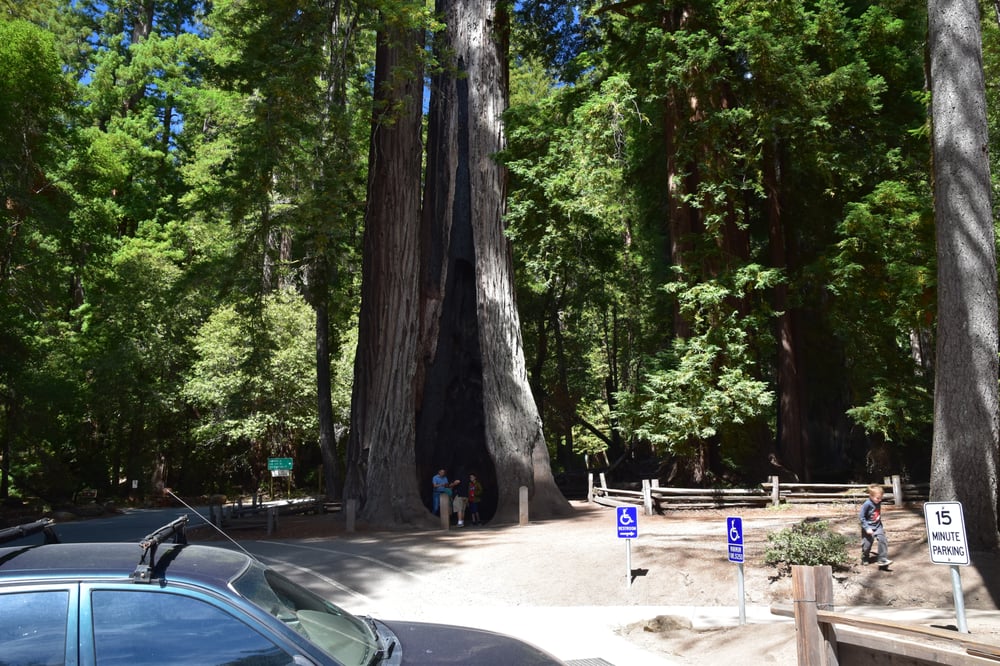
Most redwood tree trunk hollows are completely blackened on the inside - I would hope this tree ends up the same.
Yeah, maybe the main evolutionary advantage Redwoods have is their ability to survive fires.
When other trees are burned away is when the Redwoods multiply and take over abandoned land.
"One very important adaptation for the coast redwood is its thick bark with deep grooves running vertically along the tree. It is this bark that gives the redwoods their fire-resistant characteristic. Older trees are able to survive fires because their bark is so thick and acts as a fireproof shell."
From: http://bioweb.uwlax.edu/bio203/s2009/hemmeric_nata/Adaptatio....
From the NYT article referenced:
"Still, Ms. Barth said there was reason to be optimistic about the fate of the trees.
'They’re meant to resist and even thrive in response to wildfires,' she said. 'If any place is going to be able to withstand this conflagration it’s Big Basin.'"
Fires are an important part of seed germination for some varieties of red woods. With semi rural developments, there has been a huge decline in naturally occurring wild fires and controlled burns. This article mentions nothing on forestry management.
FTA
>Big Basin, in particular, has benefited from the longest, continuous program of prescribed burning anywhere in the state since the purposeful burning done by indigenous people who tended this landscape for thousands of years.
That's the main thing that's missing from modern forest management by most accounts. Reading that gave me a hell of a lot more confidence that the trees are probably mostly safe, even if pretty much everything else has been wiped out.
While fire is a natural part of the lifecycle of these forests, it’s important to note that the specific forest management practices that have been implemented over the last century have drastically changed the character of the fire regime in western forests.
Most of our pine species have evolved to burn every few decades. During these burns, a fire sweeps through the forest floor, killing most of the trees which have cropped up since the previous fire but haven’t had time to mature. The older, taller trees survive because their characteristic thick, flaky bark protects their trunks from the heat of the burn (interestingly, the smoke from the burn causes the cones in the taller trees to open up and fall into the freshly carbonized soil, creating the next batch of seedlings). The younger trees don’t have this yet, and anyway they usually aren’t tall enough to keep their branches out of the fire, which leads to the major issue here.
Fire prevention over the last hundred years has resulted in forests with a wide mix of trees at various canopy heights, which fire ecologists have taken to calling ladder fuels, because the trees are taller than the saplings which would usually be cleared out and shorter than old growth trees, providing a “ladder” for fire to jump into the canopies of older forests. These forests are not in any way whatsoever equipped to deal with canopy burns. All of their fire defenses are near the ground, in the bark, and there’s a high likelihood that once the fire reaches the canopy it will at least kill the tree, if not spread through the canopy and destroy the forest.
It goes without saying that the physics involved here, when the fire is burning from the ground up to hundreds of feet in the air and consuming all of the available fuel, are magnitudes different than a typical brush fire on the forest floor. While these fires weren’t impossible in prior to the emergence of forest management practices, those practices have unambiguously resulted in more and more severe fires by increasing the volume and density of fuels in these forests.
To that end, I wouldn’t be all that surprised if the fire really has consumed all of Big Basin.
https://twitter.com/ethanbaron appears to be in the park right now and is photojournaling some of the destruction.
As he says in one of the tweets, "More redwoods near Big Basin park, appear to have made it but as Mercury News environment reporter @PaulRogersSJMN points out, fire prevention for years means lots of fuel that could threaten even fire-resistant redwoods including ancient ones in park interior" [1].
Clearly a number of the larger trees aren't going to survive this [2][3][4][5].
I see statements about "wildfire being a part of the natural cycle" pretty often but it seems to stem from a misunderstanding about the different scales of wildfire. Smaller, cooler, more frequent brush fires were a part of California ecology in some areas; modern wildfires are far hotter and more destructive and are killing vast swaths of forests that have previously survived for hundreds or thousands of years.
There's an arboretum just outside Eugene, Oregon that does a nice job of talking about fire's historical role in the local ecology, and the Oregon Garden just outside Silverton also has a section dedicated to walking through different kinds of forest ecologies and explaining which plant species flourish as a result of different management strategies. The unmanaged, fire-suppressed forests are terribly vulnerable to wildfire as well as stress from pests and competition.
I also took a few photos just a couple of weeks ago of a once-forested area that had burned over 20 years ago. It's still dead.
My first visits to Big Basin were at least 35 years ago and I don't know how to express how saddened I am by this news.
[1]: https://twitter.com/ethanbaron/status/1296547748259360768
[2]: https://twitter.com/ethanbaron/status/1296640252279312384/ph...
[3]: https://twitter.com/ethanbaron/status/1296640967299063809/ph...
[4]: https://twitter.com/ethanbaron/status/1296641416802656256/ph...
[5]: https://twitter.com/ethanbaron/status/1296643324275593216/ph...
I live on the mountain above Los Gatos on the border with Santa Cruz. Yesterday everything smelled of smoke, and the outside was covered in white ash. Today no smoke smell and blue sky as the wind is blowing away from me towards the fire. Better right, but...the area next to me just went red with evacuation orders, and we are next.
https://storymaps.arcgis.com/stories/f0121f7f2f0941afb3ed705...
We just packed up the important stuff and have it waiting in piles near the door. It is interesting what you think about taking. Clothing for everyone, meds, etc. The FreeNAS box with all the photos and like. The wedding album. The flag from my grandfathers coffin. Books and photos from family that are now 100+ years old. A painting that hung over my grandparents sofa, and then my parents and now mine. My daughter packed a stuffed animal I gave her when she was 6.
There are a ton of very expenses items that do not make the cut. It’s the things that drive happy memories but are of little monetary value that do.
A lesson in perspective I guess.
Maybe prescribed burns once every 500 years isn't enough
http://joannenova.com.au/2019/10/california-maybe-prescribed...
There is a big difference between 'burning off' a couple of hundred acres and 'landscape scale fuel reduction', many reports conflate the two. Burning off 800 acres makes no difference when the surrounding 100,000 acres has high unmanaged forest fuel loads.
I just moved to the Bay Area and visited Big Basin for the first time two weekends ago. I had never seen trees that large in my life.
I'm grateful that I took the opportunity to go and see it when I did. It's crazy to think that less than two weeks later there is so much destruction there.
Is there any reason to believe this will inspire change? My significant other is devastated as much of her childhood was spent in big basin.
> In rebuilding Big Basin, we hope it is a catalyst for a new movement, one in which we learn to coexist with wildfire and deal directly with the impacts of climate change.
The only way I can see us changing the severity of damage is by incorporating fire breaks regularly - but those seem radically unpopular (as evidence by the lack of them in all of California). Maybe more funding for firefighting but I guess that's probably unpopular too... I guess you would have to raise your property taxes.
Would more fire breaks even help with fires like this one? Here in Southern California, fires fairly regularly jump freeways, which are quite a bit wider than typical firebreaks, and our fires are usually just relatively low brush, not entire forests.
Perhaps the solution is not building homes in these areas so we can let the places burn more frequently.
where do our current taxes go? CA as a state has one of the highest (or the highest?) tax burden in US. The schools are still awful and we have to rely on prison populations for fire fighting? WTF?
"Gone" is a clear and strong word, and it is misapplied here, unless the author is omniscient. Fires hot enough to burn these buildings down may still be a cool enough fire to be natural and healthy in this case. Or maybe not. As the article states, no one has even checked the trees yet, and they are what matter here. If it is an average wildfire, of average hotness, then the trees (and forest generally) are fine.
"As we know it" is just as important as "gone" in the title. Even if every single tree survived (almost certainly not the case), the park will not be the same for many years to come, and the loss of the historic CCC buildings would be devastating all on its own.
A fire there was inevitable. Anyone who’s visited would’ve noticed that many of the trees were charred from previous fires.
For people who have never lived in or visited Silicon Valley, you should know that the parks in the area are one of the best parts around here (probably tied for first with the great weather). Big Basin has the biggest trees in the area, but other than that, it can be a little underwhelming. There are a lot of other really awesome parks and preserves (Castle Rock, Portola, Russian Ridge, Skyline Ridge, Monte Bello, Wunderlich, just to name a few) within a 30 minute drive of Palo Alto. I had been trying to go to as many as I could the last few months, but barely scratched the surface. Any of the ones I visited were better than and park I had gone to before moving out here.
It definitely sucks that so many of the great parks have been affected. September and October are pretty great for hiking in the Santa Cruz Mountains, and this will certainly put a damper on it.
I'm a little worried about what's going to happen come winter rains. With so many hillsides laid bare, there are going to be way more landslides whenever heavy rains hit, so a lot more areas than usual are probably going to get washed out.
I love Big Basin. It is one of my favorite places in the world. The meteor trail is the prettiest trail I've found of the hundreds or thousands I've hiked in the Bay outside of the South Bay / Peninsula. The Berry Falls loops is magnificent - I love the sudden, dramatic change of ecosystem even more than the awesome falls.
People have been reaching out to me about the fires.
I understand why we mourn, but why do we think this is a bad thing?
Fires are part of the forest.
Humans have done harm here, both from preventing past fires (which make the smaller number of fires worse) and potentially from climate change (I don't know enough to know how strong the connection of global climate change to this sort of event is), but the basics of it seem clear: forests catch fire sometimes. Such natural phenomena are what gave us the forests we have today.
Another somber event for Bay Area residents. For trail runners and hikers, the Skyline to Sea trail is an absolute gem. Hoping that some of the old-growth trees make it through.
Did Skyline to the Sea with my daughter a few years back. Split across two days, it was our first overnight hike where we carried tent, bags, cookware....
I suspect it will be back by the time she has kids of her own.
https://www.mercurynews.com/2020/08/20/exclusive-look-first-...
Hope the trees or at least most of them survive. Its a special place in the South Bay. Bldgs can be rebuilt. I guess trees will grow back too, but there is a sadness in loosing these ancient trees :( They were witness to the rise of our recent society ... Had a chance to bike to the park in May. It was shut due to Covid .. already eerie and quiet and amazing. Just one Ranger and a Sherrif watching the place. They were kind enough to let me get a pic in front of the huge Redwood cross section hanging there at park HQ ... Have to go back again when things clear ...
These trees have made it through fires before and many of them will make it through again. The forest is a living thing, and this destruction is part of it.
I haven't been to Big Basin since the winter because of COVID -- it was closed for a while, then limited parking, and I just stayed closer to home. I hope I didn't miss a last chance at seeing some of my favorite nooks intact.
I used to live just down the road in Boulder Creek and hiked in Big Basin routinely for years, including hundreds of hours training for the PCT. I really love that place, and hope the damage isn't as apocalyptic as the headline suggests. There have always been big burn areas at least since I started visiting in the nineties. It's an ecosystem built to survive and thrive with fire, if it's not too much of a good thing. I still have family there, I'll be calling for an update soon.
My last visit was a few thanksgivings ago. I took an early morning hike before the feast, and on my way out passed a flock of wild turkeys. They were lucky I didn't have a flintlock blunderbuss with me. I hope they made it through the fire ok.
That really bums me out. I found out while living in the Bay Area that 5 days of smoky skies a year really bother me despite the outdoors being so enjoyable the other 360 days of the year and that's part of why I moved from SF to Miami in 2018. Part of it is that when I reflected on it I just felt worse about it because I thought about the cumulative effect of all the fires. I miss the Bay Area and might move back but I'm glad to not have to deal with smoke in the meantime.
> Wildfires are often the tragic manifestation of our global climate crisis.
This was a naturally caused fire in an area where fire is an accepted part of the ecosystem. The buildings were not natural and were removed just like non-native grasses and other species which interfere with the California native species. It sucks, I get it. Many places I've known and loved have been changed by fire, but they come back stronger when the burns are not too frequent which they often are when caused by man.
Anthropogenic global warming is settled science, but at the same time so is the history of climatic variation in California. CA has long periods of dryness, which is why the native plants are so specialized in dealing with it.
I feel for the people affected by the fires and hope they and their belongings remain safe, but let us not forget the long history of fires in CA and the destruction they cause when not planned for. CA is a state of change, and the storms, earthquakes, fires and other natural disasters have and will continue to cause problems. Plans can not save everyone, but plans should be made. Events like this should be kept in the proper perspective so as to educate the public and build awareness which can lead to preservation of lives down the road.
I'm curious why this is getting downvoted.
This one hurts. I've put in a lot of hours up there camping and hiking. I was just talking with someone about how you used to be able to go up there on a whim and snag a last minute campsite. Even if it was next to some jackass running his TV and microwave it was still fun.
Any area you go into up there shows the fire damage those trees have survived over the years.
I'll miss the old-timey HQ cabin and cafe but I'm counting on a good recovery here.
I don't know the specifics of this fire, but I think the sequoias themselves are pretty resistant to fire, and even require fire to germinate their seeds.
I don’t know about sequoias, but the closely related coast redwood can and does produce seedlings without any fire.
We need some goats to eat all the fuel while it's still growing. Herbivores will also trample dead plants to the ground so grass can grow. Apparently there's too much work for the herders, based on articles published after the last round of fires.
Further reading:
https://www.usatoday.com/story/news/nation/2019/03/30/goats-...
https://www.google.com/search?q=california+goat+herders&oq=c...
https://www.ted.com/talks/bobby_gill_it_s_not_the_cow_it_s_t...
German Public Broadcasting (Deutsche Welle) just published this timely and well rounded two-part overview and analysis of wildfire causes and mitigation.
part 1: https://www.youtube.com/watch?v=cUo2Vs6id7w part 2: https://www.youtube.com/watch?v=5VPWq8LVDtk
It's a terrible tragedy, but forests recover very quickly after forest fires. Although we as humans hate seeing such beautiful places get destroyed, it's a perfectly natural part of history and without these types of fires, we don't get a proper cycle of nature.
https://imgur.com/exSaGup
I took this photo not long ago (in Oregon, not California). The burn scars in the background were burned in 2002 and 2003 (https://imgur.com/wBQhXn3). The tree canopies that were there, that now remain only as burnt, denuded toothpicks in the landscape, have been replaced by chapparal, which will burn again just as hotly. In the intervening almost 20 years, there's nothing growing more than a few feet above the ground and there's still a lot of barren earth.
Many species do benefit from wildfires of a particular intensity. The megafires that we are seeing today are so hot, so big, and so intense, that no species are benefiting from them. These fires are simply destructive. There is no magical renewal afterward. For these burn areas -- and there are more and more appearing around the western states now -- life creeps back in, slowly, from the edges, and when you're talking about 50,000 acres of destruction, that takes a very long time.
I don't want to be frustrated at you specifically, but comments like this one keep getting repeated by people that heard it somewhere once. Our forest management practices must change immediately, and the common belief that all wildfire is totally natural and totally good for the ecology is preventing the critical mass of public support required to make that change happen.
This is simply not true anymore. Modern fires are far hotter thanks to the accumulation of decades of brush as we've refused to do prescribed burns. Modern fires destroy forests. There's nothing natural about them.
Define “very quickly” for trees that grow for 1000 years.
This passage from Against the Grain makes for interesting reading right now:
The case for the use of fire being the decisive transformation in the fortunes of hominids is convincing. It has been mankind’s oldest and greatest tool for reshaping the natural world. “Tool,” however, is not quite the right word; unlike an inanimate knife, fire has a life of its own. It is, at best, a “semidomesticate,” appearing unbidden and, if not guarded carefully, escaping its shackles to become dangerously feral.
Hominids’ use of fire is historically deep and pervasive. Evidence for human fires is at least 400,000 years old, long before our species appeared on the scene. Thanks to hominids, much of the world’s flora and fauna consist of fire-adapted species (pyrophytes) that have been encouraged by burning. The effects of anthropogenic fire are so massive that they might be judged, in an evenhanded account of the human impact on the natural world, to overwhelm crop and livestock domestications. Why human fire as landscape architect doesn’t register as it ought to in our historical accounts is perhaps that its effects were spread over hundreds of millennia and were accomplished by “precivilized” peoples also known as “savages.” In our age of dynamite and bulldozers, it was a very slow-motion sort of environmental landscaping. But its aggregate effects were momentous.
Our ancestors could not have failed to notice how natural wildfires transformed the landscape: how they cleared old vegetation and encouraged a host of quick-colonizing grasses and shrubs, many bearing desired seeds, berries, fruits, and nuts. They could also not have failed to notice that a fire drove fleeing game from its path, exposed hidden burrows and nests of small game, and, most important, later stimulated the browse and mushrooms that attracted grazing prey. Native North Americans deployed fire to sculpt landscapes favored by elk, deer, beaver, hare, porcupine, ruffed grouse, turkey, and quail, all of which they hunted. The game they subsequently bagged represented a kind of harvesting of prey animals they had deliberately assembled by carefully creating a habitat they would find enticing. Quite apart from being the designers of hunting grounds—veritable game parks—early humans used fire to hunt large game. The evidence suggests that long before the bow and arrow appeared, roughly twenty thousand years ago, hominids were using fire to drive herd animals off precipices and to drive elephants into bogs where, immobilized, they could more easily be killed.
Fire was the key to humankind’s growing sway over the natural world— a species monopoly and trump card, worldwide. The Amazonian rain forest bears indelible traces of the use of fire to clear land and open the canopy; Australia’s eucalyptus landscape is, to a considerable degree, the effect of human fire. The volume of such landscaping in North America was such that when it stopped abruptly, due to the devastating epidemics that came with the European, the newly unchecked growth of forest cover created the illusion among white settlers that North America was a virtually untouched, primeval forest. According to some climatologists, the cold spell known as the Little Ice Age, from roughly 1500 to 1850, may well have been due to the reduction of CO2—a greenhouse gas—brought about by the die-off of North America’s indigenous fire farmers.
Scott, James C.. Against the Grain: A Deep History of the Earliest States (p. 37-39). Yale University Press.
So Mr Scott is communicating the idea that the global accumulation of CO2 prior to the 1500s was not only caused by indigenous people but it was so great that their mass "die-off" created a cooler climate for 300 years. Incredible.
I wonder to what Mr Scott attributes the current existential climate crisis. I can only guess.
We know that many man-made structures did burn down but the real treasure is redwood trees. And redwood trees can survive fires as part of their natural life. So let’s hope for the best and better protect this magnificent place in the future.
>Wildfires are often the tragic manifestation of our global climate crisis. While we cannot be certain that is the case here, it seems likely that this global crisis has struck close to home.
Leading with political outrage and then immediately admitting there’s no basis to think so. Forest fires came long before people and will continue long after we are gone.
It’s bad writing and basically propaganda to lead every article about natural events with some bit about climate change. You can’t link individual events to climate change. You might as well lead every article about a fire, flood, or hurricane with some pearl clutching about climate change.
And anyway, the evidence is that well-meaning human attempts to control wildfires are driving the growth in severe wildfire, due to the accumulation of brush that naturally would burn off in small fires without human intervention. This is discussed extensively elsewhere in this thread.
I don't how you go from "we cannot be certain" to "no basis to think so".