▲ 158 points
back
137 comments
I don't understand anything in aerodynamics, so pardon my stupid question: planes are the most wide-spread flying machines because they are vastly more efficient than a rotary-wing aircraft due to the lift generated by wings. Why then a quadcopter is the default shape for smaller drones? Is it because small wings don't generate enough lift for the drone to make a difference? But they surely provide additional stability and won't hurt at a glance.
Drones are usually copters so they can do vertical takeoffs and hover.
They're quadcopters rather than single mainrotor + tailrotor because it greatly simplifies the mechanics.
Single rotors need a cyclic mechanism to vary the blade pitch depending on where the blade is in the rotation and the control inputs. This is VERY complicated with a lot of moving parts that have to maintained and adjusted. (See https://upload.wikimedia.org/wikipedia/commons/thumb/4/4f/Si... for one example)
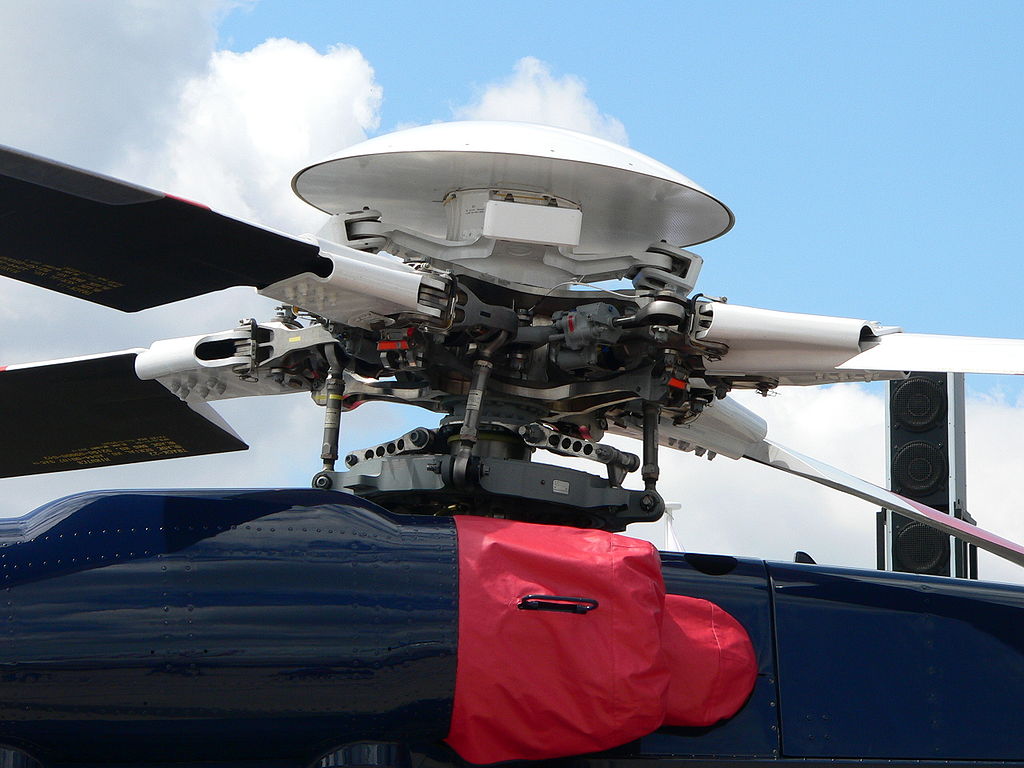
Quads (and hexes, etc) can have full control authority via RPM only, using a simple injection molded constant pitch prop.
Planes with wings, by and large, do none of the following: hover, fly sideways, fly backward, fly straight upon or down, land or take off vertically.
I say by and large because there are exceptions, but they are complex, expensive, and compromised.
Just guessing (in addition to what others already mentioned - btw. I was wondering the same thing hehe):
maybe one big part involves the landing & takeoff:
for plane-like drones both are a lot more dangerous (therefore more difficult to be automated) and need a lot more space than quadcopters (and the likes). Saying this because I remember that, when I was a kid, my RC-plane (which took weeks and $$ to build) crashed 1.8 seconds after the first take-off attempt (damn, I got so angry & depressed...).
I guess that soon or later we'll see mixed designs that can take off & land like a quadcopter but which can increase their range/efficiency by "transforming" in mid-air into an airplane-like form? (something similar to https://en.wikipedia.org/wiki/Bell_Boeing_V-22_Osprey or maybe just a passive design that works by changing the fixed orientation of the whole drone from horizontal to almost vertical, or the opposite depending on the form of the drone?) In any case complexity would increase, therefore more specific demand for long-range capability is probably needed to go towards developing something in this area?
Planes work similarly well at small and big scales. They are more efficient than quadcopters even at small scale.
Quadcopters are just much safer and easier to control. Compare "fall down at random without input" vs "stop without input".
As for why quadcopters aren't used at big scale - moment of inertia scales with cube of the propeller radius. And to control a quadcopter you're constantly speeding up and down each propeller. That's a huge loss of energy when your propellers are big enough.
So instead at big scales we use very complicated mechanically designs like helicopter. It uses a propeller that rotates at constant speed (so moment of inertia doesn't matter), and instead changes the angle of attack to control the aircraft.
BTW moment of inertia is also why nobody in their right mind would build huge mech robots like in sci-fi. Wheeled vehicles move forward without fighting inertia - wheels spin at constant speed and you just add the energy lost to friction. Mechs constantly swing their huge legs back and forth fighting the whole inertia twice with each step. Fine for toys, not fine for big vehicles.
Quantum Systems makes drones that do this, and they get massively longer flight times than standard quadcopters. Their Vector drone can fly for 120 minutes, comparable to this fossil fuel powered quadcopter, on batteries alone:
The wings help for covering longer distances efficiently but make hovering and vertical takeoff tricky, tail-sitters combine positive features from both types of aircraft https://en.wikipedia.org/wiki/Tail-sitter
Controls got easy, batteries got good.
Computer-controlling a fixed-wing plane requires a lot of sensors, and a lot of math, and a lot of space, and forward airspeed.
Computer-controlling a quadcopter requires a lot of sensors, and a lot of math, and a lot of power.
Arduplane exists alongside arducopter, and it's easy enough to build both, but I can't fly a fixed-wing model in my backyard. I can fly a quadcopter just fine.
Fixed wing aircraft must have air moving along the wings in order for them to generate lift. In other words, the aircraft must always be moving through the air. If its speed drops below some minimum value, it will stall and drop out of the sky like a rock. This is also why they need runways in order to take off. They need to accelerate to a minimum speed in order to even get airborne.
https://en.wikipedia.org/wiki/V_speeds
Rotary wing aircraft use their engines to constantly move the wings through the air instead of moving the aircraft itself. So the wings are always generating lift and the aircraft is free to move in much more flexible patterns. A very useful maneuver is hovering in place: the aircraft is able to simply hold its position in the air. Since only the wings need to move to generate lift, the aircraft itself does not need to accelerate in order to take off and therefore a long runway is not necessary.
Civilian drones usually have rotary wings because this allows people to do useful things like having the drone stay in one place in order to film or photograph something. A fixed wing aircraft would have to establish a loitering pattern around an area in order to do the same thing. In other words, rotary wings can just hover in place while a fixed wing would have to fly around in circles.
Fixed wing aircraft are more fuel efficient. Rotary wing aircraft must constantly spend fuel in order to keep their wings spinning. They lose lift otherwise. A fixed wing aircraft would probably be able to glide great distances and even land safely even if it lost all engines in the middle of its flight.
To add to all the other responses, multirotors are the least power efficient setup by far.
And fixed wing the most, and regular helicopter somewhere in the middle.
Several hours of flight time is trivial with a battery powered fixed wing model airplane.
Not an aeronautic engineer, but to compare to a similar mass like a bird, having wings would make the hobby-sized drones quite a bit bigger. I assume there's also the ease of changing direction / altitude that comes from having the paired motors, controlling tiny planes would take tiny ailerons and flaps (which, like you say, may not scale down effectively).
Having involved in UAV development projects for agriculture monitoring and have used both rotary-wing and fixed-wing UAVs, I'm now firmly believe that neither of them is fit for purpose in aerial monitoring.
The rotary-wing UAV is a power hungry gussler while fixed-wing UAV is not that versatile (e.g. for hovering, etc). The best compromise will be Gyrocopter or Autogyro since it is both energy efficient and flexible. It can also easily fly at sustain high speed wind of more than 50 knots.
Not an expert, but I'd guess quadcopters are much easier to pilot. You press a button and they go that way. Taking off and landing on wings is very difficult in comparison, requires more space, more facilities, more organization.
I think there will be a large market for plane-like drones with very malleable wings for exactly the reason you state.
The cost (in terms of both price and structural integrity) of gratuitously dynamic wings (think turning the whole wing 45 degrees to horizontal, bending the wing to 90 degrees at it's half way point) are much smaller for small aircraft.
Such gratuitously dynamic wings give more degrees of freedom for automated piloting software to work with when it comes to optimizing near vertical take-off and landing when compared to a fixed wing aircraft, while retaining fixed wing efficiency advantages during elevated flight.
Small wings are less efficient particularly when things get really small but at this weight there are a lot of fixed wing UAVs. This is also not terribly small at 1.6m long.
> Why then a quadcopter is the default shape for smaller drones?
Because somebody, somewhere published the first opensource autopilot code, and that first code was for the quadcopter.
With wings, you have to be moving forward to stay in the air. With rotors, you can hover if the control circuitry is up to the task
> I don't understand anything in aerodynamics
Same here.
> Why then a quadcopter is the default shape for smaller drones?
Large fixed-wing planes are expensive. Piloting them requires jumping through many high-hanging and heavily regulated hoops. The most dangerous parts of the flight near the airports happen in well-known space, according to pre-defined paths known to all parties.
In many places of the airspace, pilots are guided by data from the ground. Optical from visual approach slope indicator (these weird light arrays around airports which are visible as 0-4 red circles depending on whether you’re too high or too low). Radio from beacons. Most importantly humans, the job title is “air traffic controller”.
For the scale of a conventional airplanes, accurate map data is available. GPS data+SRTM height map is accurate enough for most cases. Also, real-time weather data is pretty accurate at that scale.
None of the above applies to small drones. They’re cheap, most are piloted by amateurs and no licensing is required. They can take off and land whenever. No ground control is available. At their scale, no offline map data is available, and ground-induced wind turbulence is borderline unpredictable.
This might change in a few years.
We might get chips smart enough to reliably do right things based on the limited input data despite the unpredictable factors.
We might get sensors sensitive enough to generate much better data for these chips. E.g. if you have spatial data for 1x1x1km space around the drone, with 1mm spatial precision, and 20ms refresh rate consistent over the whole volume, today’s mobile chips will do mostly OK in good weather.
We might get good enough sensors to cover all airspace with them, and make robotic equivalent of air traffic controllers, a software that detects future collisions and tells the drones to do something about it. Or broadcast current wind conditions at 1m^3 resolution.
Least likely but still, we might get good enough actuators & power sources to combine these two. Birds do OK, many of them can hover, glide, and arbitrarily combine hovering with gliding. When you can stop flying and hover, or land almost everywhere, collision avoidance becomes way simpler. That’s one reason how birds and modern-day small drones are functional.
TL;DR: It's because they can hover.
They have a stable and basically stationary anywhere in 3-space mode (until the juice runs out). Human and automated control is much simpler as a result.
Why the quad set up over the classic single rotor seen in helicopters?
So it can carry 10kg with the 32" propellers basically about 120 miles (call 50km/h for 4 ours so 200 kilometers) and you can refuel it quickly. That is also about $1M weighs in $100 bills. Only about $200K in 20's :-)
So this could presumably deliver goods to remote places where it might be difficult, or perhaps unsafe, to drive to. Seems like there is a market for that.
So it does with quadrotors what Zipline does with wingborne drones (although Zipline is faster and purely electric, so fewer systems to maintain and to go wrong).
We already have Bitcoin to help criminals move money.
Site is down, here is google cache:
https://webcache.googleusercontent.com/search?q=cache:KiJcBe...
Seems to be in a similar product category as Anduril’s Ghost sUAS - https://www.anduril.com/ghost
Less capacity, but longer flight time. Seems similarly marketed towards industrial/military use tho.
Interesting.
It is surprising to me (but probably it is some aeronautics specification/need) that its 2-stroke engine uses 95 octane+4% oil mix, it is years that using synthetic oil you can use 2% or even 1% oil.
Wild guess: The engine is an off-the-shelf part and that just happened to be the specs for whatever fit the size/weight/power/cost requirements.
I think it’s something like the engine of a chainsaw, or similar “gardening engine”, that can use up to 4/5% of oil
It's because of the duty cycle of the engine, we put it at a constant rate of 12000 RPM for hours. It is not the standard setting for that engine.
Could be duty cycle or cost of synthetic, either way 2-strokes are extremely dirty emission wise due to unburnt fuel in the exhaust.
https://www.pegasusaero.ca/
This company designed hybrid engines for retrofitting onto drones
Be nice to get a price on this, I hate 'ask for quote'.
This could serve as an example of the insane energy density that fossil fuels pack.
They do, but one of its selling points is its case "fits in the trunk of a standard car." that suggests it's a pretty big drone and I default to imagining copters that fit in a hand, size in picture[2] more than I understand what 20kg means in drone size. No wonder it can fly a long way if it's massive.
For energy density comparison, check the Wikipedia list of energy density of various things[1], starts with Antimatter highest, then nuclear fuels, Hydrogen[3] at the top of the chemical fuels with ~140 MegaJoules per Kilogram, then all the hydrocarbon fossil fuels hang around 45-55 MJ/Kg, body fat comes in around 38, coal around 30, wood around 18, glucose around 15, Lithium-air battery at 9, household waste at 8, and the highlight of our modern electronics lifestyle Lithium-ion battery at 0.3-0.9, barely ahead of flywheel at 0.3-0.5.
[1] https://en.wikipedia.org/wiki/Energy_density#Tables_of_energ...
[2] https://www.armytimes.com/resizer/-965_SXAhPeD1LTlB-xZuQwJvJ...
/arc-anglerfish-arc2-prod-mco.s3.amazonaws.com/public/BEXU22MH7JEKTPZMAEC3IJH57I.jpg)
[3] the catch with Hydrogen is a kilogram of it is 11 cubic meters, and a lot of that energy advantage has to go into compressing or cooling it to make it usefully dense, and maintaining the infrastructure to store and transport that safely.
Bit rich to call it "low pollution" in their list of benefits. Depends what you put in it and what you compare it to I suppose, but per kilo transported if using fossil fuels, I doubt it compares well to an electric (assuming electric means renewable, which obviously also varies).
Of course it does not compare to electric multirotors in that aspect, but its performance is much more advanced. We aim to replace combustion manned helicopters in first response applications, among others. HYBRiX can provide similar operational flight time with 100 times less fuel consumption per hour. Electric multirotors, with up to 30 minutes of flight time, are not suitable for searching missions for example.
One of the interesting things about this UAV is that it’s using Ardupilot which is quite advanced and flexible and one of the only autopilots (there are like two) that use a copy left license. This means we might see more hybrid drones supported by Ardupilot.
Hi all! thanks for sharing the news! At Quaternium we are very excited to see that our project is raising so much interest! There are already many accurate comments on this thread. But just to give you some context.
Quaternium was the first company in the world to demonstrate a hybrid power system for a drone, with a flight over 3 hours back in 2015. Right now, our latest record is over 10 hours of hovering flight with HYBRiX multirotor (with an experimental setting with more fuel and no payload). A key element of this news is that the drone is <25 kg MTOW, (bigger aircrafts have obviously longer flight times).
The fuel engine acts as a range-extender, it is a series hybrid, like the BMW i3. And we develop the power system, in collaboration with Löweheiser company (https://loweheiser.com/) using a 2-stroke Zenoah engine that we adapt to the drone needs. Our product uses the engine on a very different duty-cycle, comparing to the standard application, so we do a lot of work on it and got a much better performance compared to other competitors.
Multirotors are the most popular drones for several reasons, that some users have already mentioned. They are much more versatile because they can hover, do not need launching platforms and are quite easy to operate. They are also mechanically simpler than helicopters, reducing failure points.
Our goal with HYBRiX is to being able to replace manned helicopters for aerial imaging operations, not to replace planes or fix-wings, which are more efficient for the applications that do not require hovering. As for convertible VTOLS / fix-wings, they are cool but not so versatile, because their hovering endurance is very limited, only useful for VTOL take-off / launch. That makes it possible to take-off from smaller areas than planes, but do not have a performance comparable to a multirotor. Hope this clarifies some doubts mentioned on the thread.
Anyone know if it's a series or parallel hybrid? Looks like it uses electric motors out on the props like most drones which would imply series. If so interested to know the generator setup, usually thats heavy / inefficient vs mechanical drive from engine, but quad copter needs independent speed control for each prop to steer I thought.
I wouldn't be surprised if the cartels were not funding research and development of such machines. I am not saying this particular one, but having an autonomous drone flying over long distance and capable of some more serious cargo seems like a dream come true (for example 100 mile radius should be enough to cross the border).
If they could pair it with autonomous submarines then this opens the world of possibilities when it comes to moving the product across the world.
Also see the Pipistrel Nuuva V300 UAV
https://www.pipistrel-aircraft.com/aircraft/nuuva-v300/
The Nuuva V300 long-range, large-capacity, autonomous UAV can take off and land vertically with battery power, without requiring a runway, and can carry loads up to 300kg (around 660 lb) for more than 300km (around 186 miles)
Any successful flying platform will start with a mission that includes payload capacity, range (distance), operating costs, and weather resilience.
The difference between a hobbyist and a professional is that the hobbyist builds a platform first and looks for a mission/customer after spending R&D dollars. The professional starts with a mission/customer before proceeding to R&D.
Question for an aeronautical engineer: Can you take the engine nacelle of an airplane and rotate it vertically?
So instead of being horizontal, can it be vertical, where the exhaust points down? Or does the engine need the compression and air velocity from the forward motion of the plane to compress and ignite the oxygen?
Their page reminds me a lot of the feature drone sales pages you see over at banggood.com or aliexpress, ebay, etc. But I don't find it that impressive overall. If they want actual range, put wings on it. You'll see that all the delivery drones are doing such a thing.
That's impressive and really futuristic. I don't see the price tag, though.
Would it make sense to use hydrogen fuel to further decrease the weight?
why not just use an airplane
What about using methanol? It has been cleared for use powering laptops. Cleaner burning and quieter than 2-stroke petrol?
https://www.zdnet.com/article/methanol-powered-laptops-clear...
Now if only the webpage could fly at 10 qps for 1 hour ...