▲ 207 points
back
107 comments
The word "effectively" in the title is a weasel word.
Groupon is balance sheet insolvent by definition. Their liabilities are greater than assets.
Groupon is cash flow solvent by definition. They are able to pay liabilities NET60.
In Q2-Q4 2010, Groupon had $669mm with a net loss of $398mm. That is a ratio of about -0.59. In Q1 2011, Groupon had revenue of $644mm with a net loss of $102mm. That is a ratio of about -0.16.
If you are long Groupon, then you are betting that -0.16 approaches zero and then turns positive.
The moral of the story is: haters gonna hate.
I found this link (http://allthingsd.com/20110602/where-did-groupons-billion-do...) to be a scathing indictment of Groupon, to the level where it could attract the label "Ponzi Scheme" or the less harsh "Very bad Investment choice".
Seeing that the lion share of the two recent funding rounds were used to pay back investors, leaving very little on the table to fund their growh (this is when they are bleeding over 100 million per quarter) sounds unbelievably stupid or criminally insane.
Its one for the history books boys!
This was a purchase: the investors bought part of the company. When they signed over a billion dollars, they were not trying to fund operations; they wanted to become part owners. They know that the vast bulk of the money would go straight to earlier employees and investors.
This was a risky investment, yes. But it is neither unbelievably stupid nor criminally insane to make a risky investment. High risk investments can be quite at home in a well developed portfolio.
Now, if Groupon deceived the investors about where the money was going, that would quite possibly be a criminal act. Literally. But that almost certainly didn't happen, or we'd be hearing about it.
I cant agree with that. When I invest, I have some expectations as to how that money should be invested, and for a company that is in desperate need of cash inflow to sustain its growth, thats where it should go. Period. Not to the coffers of early investors and employees. No one has any problem with them cashing out a part of their equity. This however (almost 400 million went to an early investor couple!) was a careless and completely selfish act to line one's pockets.
And now, they are ready for the next round, and only this time, its the public who stand to get scammed.
Cash out early, cash out often!
They're trading that temporary debt for hypergrowth, as the article says.
"For the remainder of the year they had $669 million in revenue (simply staggering), but had a net loss attributable to Groupon of $398 million. This year, Q1 results showed revenue growth continuing to soar, with revenues of $644 million, but a net loss attributable to Groupon of $102 million."
So the time periods were different, but the revenues were the same. They went from losing $400mil to only losing $100mil... That sounds to me like they are getting close to being profitable again... And in a very short timeframe.
As for it being like a Ponzi scheme, it's not. Ponzi relied on lying to the investors and telling them the money came from good investments. It wasn't sustainable, and nothing could fix it. Groupon is sustainable and hasn't lied (that I know of) to their investors, new or old. It doesn't even need fixing as it looks like it's already on the fast-track to profit, based on the numbers provided.
I'm glad you said this. I gave up on a reply yesterday to the initial story for lack of time, but basically it said "anyone that thinks that Groupon is like a Ponzi scheme doesn't understand how a Ponzi scheme works".
You can say all you want about their lack of differentiation from competitors, there huge debt levels, their dicey use of the series G funding, and what appears to be a poorly scaling business model.
You can intend to short them, sell puts.... whatever. But stop calling them a Ponzi scheme. It's an insult to them, it's hyperbolic, and it's ignorant.
I disagree. The heart of a ponzi scheme is continually securing new investments to pay out earlier investors--which is exactly how Groupon has operated up to this point. They're not alone in this concept; it's becoming increasingly common in the tech industry.
The only argument to say that they're not a ponzi scheme is that there's actually a legitimate business with revenue associated with it. It's a somewhat compelling argument--but I'd personally contend that the business, in this case, has really been nothing more than a front for the scheme (at least, historically speaking--though unlikely, Groupon may yet prove out to become a profitable business). No one has made a dime of profit off of the business that is Groupon--yet several early investors and the founder have made an absolute killing based on the "ponzi" side of things.
Dress it up however you want, people have made money hand-over-fist operating a de facto ponzi scheme; having a "real" business along with it has shielded them from the ire of the law.
Doesn't this all fit into the category of a leveraged buyout?
Their strategy reminds me most of the telecom strategy in the 90's. Since as many have pointed out there are few barriers to entry, one possible strategy is to get so big so fast that your the 800lb gorilla before anyone realizes the opportunity.
That said, their losses do seem to be coming down relative to their revenue which would imply they have some idea of the 'recipe' that would make money in this space and are spending capital on growth.
But the really egregious thing that stands out, is that if the "early investors" had taken only a third of the billion dollars off the table, rather than the 80% or so they did take, we probably wouldn't be having this discussion. Rather they would have enough money in the bank to fund this growth rate and converge on an operating profit (see point above) at or just before going public.
If this kills them, and startups are full of the 'one decision' that in hindsight took them from the launch rail to the fail rail, they will have no one to blame but their investors.
The major difference is that telecoms have at least some kind of user lock-in, so it makes sense to go after hypergrowth to get that user before your competitor does. Groupon has zero such lock-in - a user actually has an incentive to sign up for as many deal sites as they can, because a good deal could come from anywhere.
"Ponzi relied on lying to the investors and telling them the money came from good investments."
It seems like a more crucial aspect of a Ponzi scheme is that you tell new investors that their money will go into the business, when in reality it's just paying old investors.
So, did the investors who put in a billion dollars realize that most of it was going to old investors?
I think it's generally accepted that yes, they knew where their investment was going. It would have been incumbent on an IPO, in which scenario they then hand off their stake in the company to the public with the expectation of making first-day LinkedIn profits.
If Groupon does go through with its IPO, expect those new investors to dump hard on day 1.
Personally I find the booking of the face value of their coupons kind of questionable or at least unsustainable. Yes it is revenue, but a typical "coupon" business would probably only count the fees received from merchants as top-line revenue (because the merchants would collect the money directly). So it makes the business look more viable than it really is. I can't see merchants continuing to accept that, and I bet larger deals (i.e. with Expedia) don't work that way.
This is an issue that doesn't seem to be getting much play in all of the discussion about Groupon's financials - for every $2 that comes in the door as revenue, $1 of that immediately is booked as a liability as well. I am far from an accountant or all that familiar with GAAP but it seems somewhat disingenuous.
But if you take a look at their SEC filing, $203 million of their 2010 expenses were one-time acquisition related. So the operating loss isn't being reduced as quickly as one might think.
Other warning signs. Working capital deficit was larger at the end of Q1 '11 by about $32 million and free cash flow is going down.
Plus, since all the costs are sales & marketing related, they're not boxing anyone out by building large-scale infrastructure (Amazon, Google) or making customers sticky (Facebook).
I would hazard a guess because they own ad-delivery systems, Facebook or Google could reach the number of people Groupon reaches for a lot less marketing dollars.
You won't see me saying that I think Groupon is a great value or anything, but I think that you have to acknowledge the difference between the people Groupon is reaching and the people FB or Google is reaching: Groupon's audience is people who are actively looking to spend money, whereas most of the people who see Google or FBs ads are doing something else entirely (and would probably not notice if they just went away).
Groupon is sustainable
I'm curious what you base this assertion on?
I think it probably translates to "Groupon is sustainable relative to a Ponzi scheme", which, even as a big Groupon skeptic for a long time now, I wouldn't challenge. A Ponzi scheme has no business other than selling ahead; Groupon does have a model for revenue. It may not work, but it really isn't fair to call it a Ponzi scheme. Bad business maybe, but not a Ponzi scheme. Ponzi schemes really ought to be reserved for actual Ponzi schemes and not be reduced to a mere financial insult.
Based on the numbers provided. While they were doing their 'hypergrowth', they managed to improve their income/expense ratio. That's pretty impressive to me. When they stop spending so much money on growing, it should be easy to show a profit.
Don't roll your eyes, but this is exactly what Reagan did to the Russians. Basically, spend more and faster than the other guy until he cries uncle.
Groupon is raising money, spending like crazy to be the top dog. When the other "coupon" companies can't keep up, Groupon will buy them, retaining their #1 position. Once all of the others are gone or reduced to a tiny size, they'll go back to a sustainable model. This explains why they have a focus on hyper growth.
What do you think?
Think about that for a second: Is "I'm going to be stupid and hope it convinces my enemies to be even stupider" a winning strategy? Wouldn't "I'm going to be smart" be a better one?
The Russians were done before Reagan was even elected. Google "Brehznev", or "Afghanistan". The rest of the line is just stupid hagiography from people who loved the way Reagan gave a speech.
And the reason they lost Eastern Europe was because of artists and hipsters in East Germany.
It wasn't from reverse-psychology mind control forcing them to spend money, it was because they had a crap economy and needed a military to suppress internal dissent.
>this is exactly what Reagan did to the Russians.
So Reagan decreased the price of oil in the mid-80ies? :
http://www.wtrg.com/oil_graphs/oilprice1947.gif
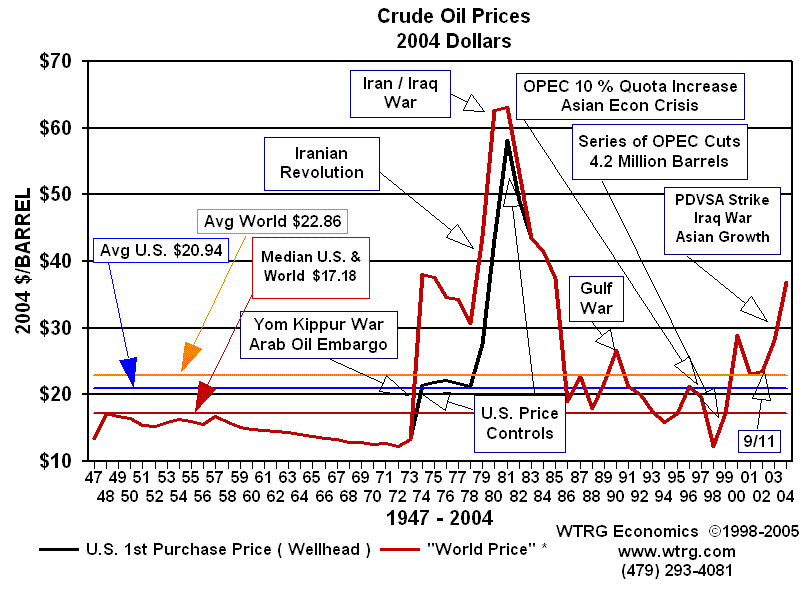
Calling an evil empire an "Evil Empire" has especially dramatic effect when the evil empire is just plain running out of money :)
"Don't roll your eyes, but this is exactly what Reagan did to the Russians. Basically, spend more and faster than the other guy until he cries uncle."
Has that really worked out for us so well over the long term? Certainly we can't pin our all of our current economic issues on Reagan as we've done a lot of spending and borrowing long after he left office, but once you get the snowball rolling down the hill very fast it becomes increasingly difficult to slow it down or stop it even after it has served whatever its original purpose was.
I think Groupon won't have enough money to acquire competitors because they have to give half of their revenue back to the merchants AND pay back all these other investors.
The "other" coupon companies probably have profitable business models, not based on market-share, but profitability.
It depends what each company's exit strategy is.
The barriers to entry to this type of business are not that difficult, particularly on a local level (which is where the business activity takes place). Show a deal of the day, take payment, print coupon, have a way for merchant to verify coupon, and have a sales guy getting new deals of the day.
This is probably the type of business that does worse at scale.
Here's the key: Make the deal relevant to the city you are spending a shit-ton of advertising in, not some business 40 miles away.
... Reagan Russia deficit spending comparison. Is this what Bush II and Obama are doing to China, too?
I always thought Reagan single-handedly ended communism, simply by saying, "Tear down this wall!"
Who knew deficit spending was they key to defeating communism?
It must be working in China. We finally have the youth engaged in free-market capitalism, selling their own human organs to purchase iPads.
U S A!
The hypergrowth strategy worked well for pets.com and webvan. What could go wrong?
Perhaps. It took Amazon 6 years to turn a profit, and a mere $5m on $1bn revenue at that.
To save people having to fight with that sites asshole design, here's the text:
I'll start by tipping my hat to Andrew Mason. He caught social mood just right, creating a coupon/local/flashmob hybrid business model at the perfect time, and has created the fastest-growing company on a revenue basis in American history. That being said, it's operating like a Ponzi scheme that needs constant infusions of cash to stay afloat as it's hemorrhaging money.
We'll start by looking at the balance sheet, which is typically a waste of time for hypergrowth companies. However, for Groupon there are all kinds of red flags. They have $290 million in current assets ($208 million in cash) and $520 million in current liabilities -- current assets minus current liabilities puts them $230 million in the hole. This wouldn't be a problem except for the fact that they're wildly unprofitable, which we'll get to in a moment. Another concerning part of their current liabilities is that $290 million of it is "accrued merchant payables" -- in the US they take up to 60 days to repay merchants. So that $290 million is merchants who have rendered services waiting to get repaid by Groupon. Not exactly the best merchant experience. Oh, and by comparison, LinkedIn (LNKD) has current assets well in excess of current liabilities, and isn't losing money.
The income statement is even worse. In Q1 of last year they had net income of $8.5 million on $44.2 million in revenue, for a profit margin of nearly 20%. Not bad! At some point around that time, they decided to abandon a profitable growth strategy and went for the hypergrowth revenue strategy. For the remainder of the year they had $669 million in revenue (simply staggering), but had a net loss attributable to Groupon of $398 million. This year, Q1 results showed revenue growth continuing to soar, with revenues of $644 million, but a net loss attributable to Groupon of $102 million.
They lost $49 million in Q3, $313 million in Q4, and $102 million in Q1, with revenue leaping from $185 million to $396 million to $644 million, so it's incredibly difficult to have any idea what Q2 will look like let alone what the business will look like 6-12 months from now. That being said, the most likely reason why they're going public now is because they desperately need the cash, plain and simple.
There are all kinds of questions about the business. How can they possibly sustain this kind of revenue growth? Can they get costs under control? What about merchant and customer fatigue? How about deep-pocketed and savvy competition, either doing exactly what they're doing (LivingSocial) or coming to the table with a ton of customer data, i.e., Facebook and Google (GOOG)? The Daily Deal I got offered today was for a restaurant 30 miles away: how does that make sense either for the customer or merchant? How can you possible build a sustainable business by going from 0 to 8,000 employees in two years? Why did the COO and CTO both leave the company in late March, barely two months ago? How do you value a business that could do $3 billion in revenue this year but might not be able to keep the lights on in 12 months?
Most concerning of all, however, might be how their most recent capital raises have been handled. Their Series F and G capital raises, which occurred in April and December of 2010, raised a combined $1.08 billion. Of that $1.08 billion, $150 million went to the company for working capital purposes. The other $930 million? Paid back to founders and early backers by buying their shares from them.
So a company that owes $230 million more than it has, and appears to be burning through $100 million or more a quarter, is using money raised from later investors to pay back early investors? Sounds vaguely familiar. I'm not accusing Groupon of doing anything illegal or unethical. Ponzi, Enron, and Madoff all swindled their investors by misleading them about the financial health of their enterprises. As Minyanville's Todd Harrison likes to say, "The only difference between intervention and manipulation is communication." Groupon is telling you exactly what they are in their filing forms and by their actions. Invest at your own risk.
When I click the link all I get is "Error establishing database connection", so thanks for copy/pasting.
In case anyone is curious, the design aspect of the site that pissed me off is that it blocks resizing the text. I found it too small to comfortably read, and hitting my browser's "make bigger" button just makes all the other elements on the page bigger, not the text.
When I click the link, with javascript disabled by NoScript, I get:
>JavaScript for Mobile Safari is currently turned off.
Eh? I'm running Firefox 4 on Windows XP...
What is it with everything being described as a Ponzi scheme these days? Groupon, Bitcoin, Subprime MBSs, Social Security, etc.
At least 2 of those things are actually Ponzi schemes, sir.
I'm not sure what an unknown lady or gentleman thinks is wrong with this, but I wish he or she would tell me. These things (subprime MBS and Social Security) are Ponzi schemes in the sense that they are paying out more to participants than the participants put in, and not providing anything of value or performing any investment by which to make that process sustainable. In the case of subprime MBS this action is obscured by the fact that some participants have collected "promises" on the parts of borrowers who cannot possibly meet their obligations. Social Security is much more straightforward, however.
Maybe we need to have a Godwin's Law for Ponzi schemes.
Can anyone explain how these guys spend money on the business, how can cost of running Groupon be so high?
"Listen, here's the thing. If you can't spot the sucker in the first half hour at the table, then you are the sucker." - Rounders
So, after they stop investing in expansion and reach a stable level, what is the realistic value of Groupon? Or does nobody really know enough to speculate?
Well Amazon is a high volume relatively low margin business which is valued at a bit over two times revenue. So if they stablize out at a revenue of $4 - $6B/yr it might make sense to value them at $8 - $12B.
I was very young during the dot com boom, but this sounds awfully familiar. Someone (PG?) described the approach of the era as burning investment to create revenue, profits be damned, then looking for a huge IPO.
Presumably Groupon has actual plans for becoming profitable, but big IPOs of companies with dubious fundamentals does sound like a description of a bubble to me. (Linkedin's stock was briefly over $100 - crazy!)
The balance sheet my not give an accurate picture of the value of a business.
Google was willing to pay $6 billion more than the book value of the business. Google aren't that stupid - I'm guessing that Groupon owns billions of dollars worth of intangible assets which are not listed on their balance sheet. (The biggest such asset is probably their email list).
I doubt Groupon will bankrupt any of hacker news readers' portfolio; I bet most of them are licking their chops to short this thing (just like they are shorting LinkedIn).
Effectively, all these IPO/overvaluation bubbles are meant to steal from (mostly public) pensions of older investors. So the next time you see your uncle or grandpa, buy them a nice bottle of wine! They're paying for your startup (while losing their retirement money), don't you know.
quoted from http://shortlogic.tumblr.com/post/5834390772/right-now-our-d...:
"Right now our desk is seeing something they’ve never seen before. It currently costs roughly 100% annualized to short LNKD. So put in monthly terms, if you borrowed $20,000 of LNKD to short, each month you would have to pay an 8.3% borrowing charge (100% / 12 months = 8.3%) or $1667 per month. That is absolutely unreal.
Of course this charge amount can change, and it probably would decline if/when LNKD becomes easier to borrow. But right now is virtually impossible to borrow, so the charge is off the charts."
Although I'm not investing directly, my concern is what the fund manager in charge of my 401k thinks of this.
For possibly the most serious concern about GroupOn,
the article came close with its statement:
"The Daily Deal I got offered today was for a restaurant 30 miles away: how does that make sense either for the customer or merchant?"
but still did not score the points:
The statement is a starkly clear illustration of a big, HUGE fact about GroupOn's business:
It's heavily just a LOCAL business.
So, even if they are in Chicago, New York City, San Francisco, and parts of Argentina and Australia doesn't cut much ice in Podunk. Instead, to make it in Podunk, they just have to be the best in Podunk, and the rest is irrelevant.
For the best 'coupons' in Podunk, customers and merchants in Podunk can go to a GroupOn competitor in Podunk who can be someone on the bank board and the school board, a former mayor, and known very well to all the merchants and most of the customers. This competitor in Podunk can be trusted in Podunk much more than GroupOn by both the merchants and the customers and, thus, get more deals and revenue, can have much lower overhead per dollar of revenue, and can undercut the GroupOn prices.
Such a local competitor has close to a 'geographic natural monopoly': In Podunk, the local guy can sign up several leading merchants just because they know him and trust him (and maybe invest with him); then he can get a lot of local customers signed up because he is well known and has the leading local merchants signed up. Then the rest of the merchants sign up not to get left behind. Then all the customers sign up because all the merchants did. Then all the merchants keep offering deals because all the customers are signed up. And there is no competition more than 60 miles away.
E.g., maybe the guy in Podunk also runs the popular local shopping center based on much the same mechanism of a 'geographic local monopoly'.
A Web site for the Podunk competitor? If that is a problem, then HN developers listen up: Develop a suitable general purpose Web site and lease it to the competitors in each of Podunk, Peoria, Poughkeepsie, Pleasantville, etc.
For the guy in Podunk, maybe there is another little town, Parsonville, 15 miles away: Okay, the guy in Podunk can use his success to expand to Parsonville.
More generally, if there are competitors in other surrounding towns, then he can, one town at a time, use his earnings from his natural monopolies in Podunk, Parsonville, etc. to undercut the prices in these other towns, buy out the competitors, raise prices, and repeat. Relevant terminology includes 'predatory marketing practices' and 'roll-up'.
I don't see how GroupOn can be successful for long with their current business model.
I am in complete agreemnet with you.
All of these giant companies trying to serve individuals at the local level seems a bit complex.
A franchise model for a local operator would be a win-win situation.
The franchisee doesn't have to worry about servers or infrastructure, only sales and marketing.
I feel this web franchise model can be applied to many online "social" business models.