▲ 64 points
back
38 comments
The theory which most fascinates me is that it's not a planet at all, but a primordial black hole with a diameter of ~5cm.
I love the fact that the paper which introduced that theory had a 1:1 illustration of that black hole in it.
"Exact scale (1:1) illustration of a 5M⊕ PBH."¹
I love that this is still a topic-- along with 'is glass a fluid', this is one of the few questions I recall from childhood that turns out to still be relevant serious physics.
(Re 'is glass a fluid', my condensed matter professor said something like 'if it is, it flows too slowly to observe significant movement in the lifetime of the universe'.)
Why does a mirror reverse left and right, but not up and down? and does it have something to do with us having two eyes?
Physics girl explains it well: https://m.youtube.com/watch?v=vBpxhfBlVLU
This explanation makes sense to me until (as seppel mentioned below) I think of a webcam. A webcam (minus any software) isn’t flipped at all—but looks like a mirror if you flip it along the x axis, as many programs do by default.
Take a camera and point it at a friend, now turn it around and point it at yourself.
How did you turn the camera?
You could have turned it towards you by turning it bottom over top and then you would have to vertically flip the image, but you probably would have never even thought to do it.
So instead you chose to turn it left to right so to get a mirror image you have to flip the pixels left to right.
You’re human so flipping a camera upside down seems quite silly but that’s just an artifact of your environment.
That was a really good explanation. In particular the part that we don’t flip left-right, but rather forward-backward and how she illustrated it with the glove.
A mirror reverses front and back. Because we are (more or less) horizontally symmetrical, we reduce the discrepancy by rotating the image around a vertical axis, resulting in a left-right reversal. If we were vertically symmetrical we would see mirrors as reversing up and down; if we were front-back symmetrical (a pushmi-pullyu) we would see mirrors as they are.
It's not reversing those, it's reversing the forward.
Look in a mirror at what's behind you, then rotate your head upwards until you're looking at the behind. Look back at the mirror.
As you can see, the mirror is reversing up and down, not left and right.
Because a mirror doesn't reverse anything. The only reversed part is our perception because we compare it to how a person actually standing in front of us would look.
> Because a mirror doesn't reverse anything.
Well, a mirror gives you a different picture than a webcam and a computer screen (unless the webcam software flips the picture along the x axis).
Now why is that, that the software needs to flip along the x axis? It is actually because a mirror mirrors around the the z axis, so it switches front and back.
It's the webcam that is flipped.
The software of the webcam usually flips the video, so that it looks like a mirror to you.
That's not true, that would mean that webcam video by default would flip any writing and make it unreadable.
Draw a straight line from every point on your body onto a wall and that's a mirror. To reverse up and down you would have to draw those lines in weird ways.
A mirror is not reversing right and left. If you point to the right(East) your mirror image is also pointing to your right(East).
Because when you turned from facing away from the mirror to facing towards it, you rotated around the z axis and not the x axis (assuming a coordinate system where x is horizontal, y is into the mirror, and z is up).
This article doesn't give either the for or the against, as we currently stand.
I'm not really sure how it's debatable, either their evidence was correct or not. Surely a respectable third person can look and tell us? The mathematics has been out for 6 weeks.
> “It is important to note that our work does not explicitly rule out Planet X/Planet 9"
I find this annoying. If it disproves their evidence, which I assume was the only known evidence for a 9th planet, then it does.
Add to this "Planet X" is tied to the original article, so if this kills all their evidence they also lose naming rights.
The linked blog post at http://findplanetnine.blogspot.com/2021/02/is-planet-nine-fi... has some more detail, though it's from the proponents of the theory rather than someone trying to be neutral.
It looks like there are two things going on:
- With the current set of observations, the evidence for clustering is fairly strong, but well short of strong enough that it can't just be chance.
- The new survey was including one data point (which doesn't fit in the 'cluster') that Mike Brown doesn't think counts [1]. With the numbers involved, it seems to me that one additional data point is likely to be making a big difference.
[1] « there is one additional object that Napier et al. include that was never reported to the Minor Planet Center; we restrict our analysis to objects whose detection history we can track; that one unreported object is down in the lower left of the lefthand plot »
Kevin Napier (First of the 50 authors on the against paper) talks here - https://www.youtube.com/watch?v=e-6OrCJ9ZEU (32 mins)
It addresses the above a bit and its interesting in its own right talking about Kuiper belt stuff.
Planet 9 is the cloaked alien observatory platform that’s here to keep an eye on human interstellar development.
It's called Pluto and it's a planet - Jerry
I think your counting's off: if you want to count dwarfs then Ceres would be "Planet 5", in which case "Planet 9" would be Neptune most of the time, since only a small part of Pluto's orbit crosses inside Neptune's.
Pluto's number would also depend on the current location of at least Quaoar, Haumea and Makemake, since I know their orbits cross inside Pluto's. Pluto may also swap numbers over time with others, like Sedna, Eris, Gonggong, Orcus, Salacia, Varda, Ixion, 2003 AZ84, 2002 MS4, 2002 AW197, etc. since they have quite low perihelia (30 to 40 AU) so may also cross inside Pluto's orbit.
Dwarf planets seem to be lucrative business for those who sell wall posters of the solar system. I would hate having to learn all of their relative locations and interactions in school!
> Dwarf planets seem to be lucrative business for those who sell wall posters of the solar system. I would hate having to learn all of their relative locations and interactions in school!
That seems to have been the main reason the majority in the IAU voted to make dwarf planets not considered actual planets. Can't really say I agree with the mindset - it overly simplifies our solar system, as well as making the rocky planets appear more similar to the gas giants than they actually are (a problem in a lot of images of the solar system as well).
It's funny to see the number of people who believe the definition was just following scientific facts, when the vote came down to personal preferences over nomenclature. It's one of the more common examples you run into where modern day scientism has trouble distinguishing what is and what isn't science.
Parent quoted a line of a Rick&Morty episode and was probably not serious ;)
Personally - even if the comment wasn't serious I am glad it received a serious answer which redeemed the original comment. Most of the time I choose to downvote low effort comments like semi-relevant quotes from pop culture, because it triggers my post-traumatic ticks from past reddit experience.
It is a joke related to the episode 9 of the first season of Rick and Morty, where Jerry (the dad of Morty) does not want to change his belief concerning this fact he learned in highschool and make a big fuzz about it.
Pluto is an order of magnitude larger than Ceres, so its perfectly possible to define planet in such a way that pluto is a planet and ceres is not.
This is what I was thinking. Setting the minimum size to 2000Km diameter, and excluding satellites/mooons, we'd just have had to add one planet, if my reading is correct.
It's hard to justify counting Pluto without counting Eris:
- Eris is more massive than Pluto (1.6e22kg versus Pluto's 1.3e22kg)
- Eris is only slightly smaller than Pluto, at 2326km diameter (more than your arbitrary 2000km cutoff)
- The orbit of Eris crosses Pluto's, so it may be closer to the Sun part of the time https://solarstory.net/img/articles/big/orbit-of-eris.jpg
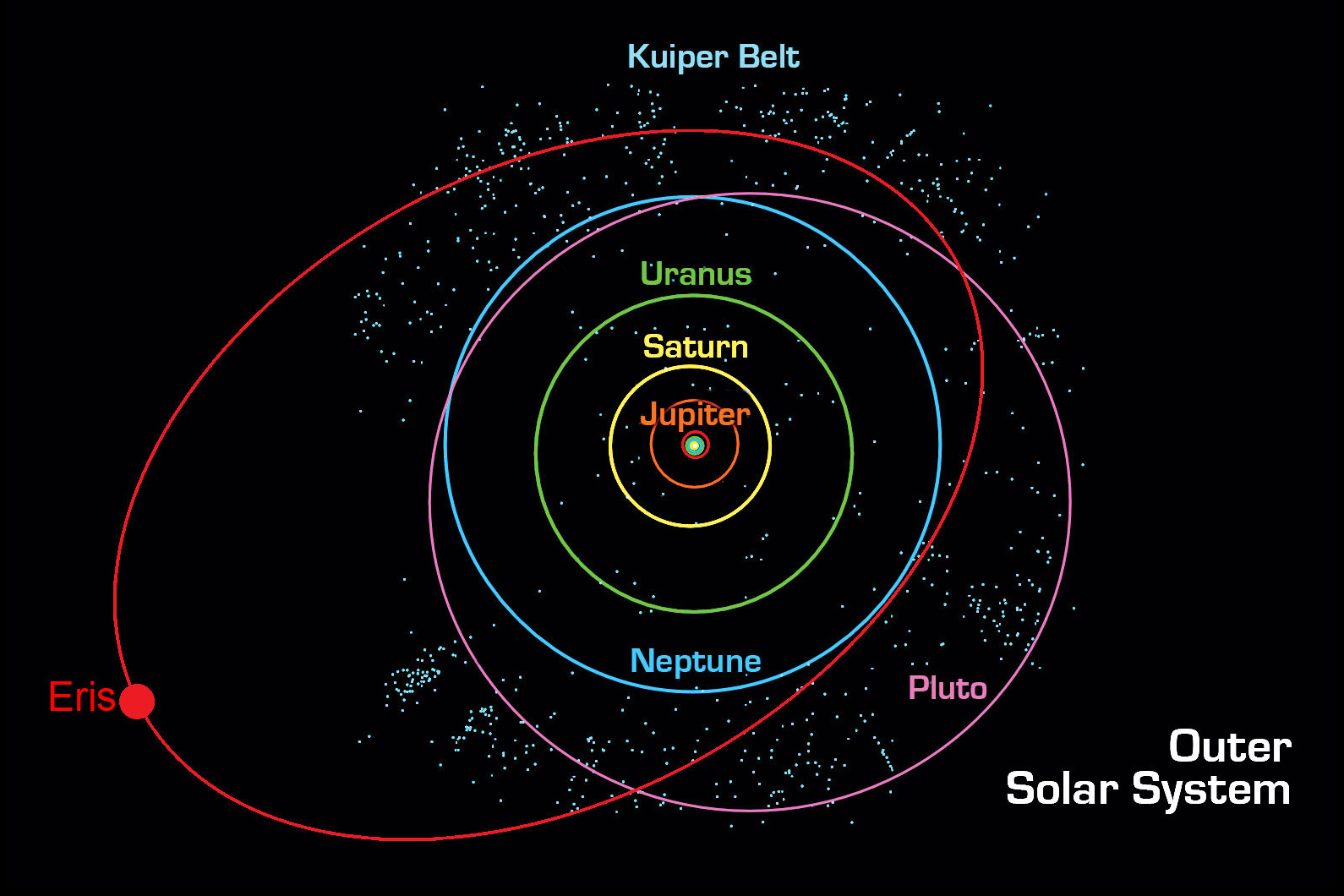
Agreed. Eris is the one I was referring to in my comment. Instead of removing Pluto, just add one planet(Eris).
On reread that probably wasn't clear, since I still think of Pluto as a planet.
Pluto got re-categorized as dwarf planet because there were now more like it. Therefore, if you still want to call it a planet, it definitely wouldn't be the 9th one.
This comment is probably going to go under most people heads.