▲ 49 points
back
35 comments
> First, a thesis: Americans driving cars kill Americans riding bikes for the same reason that Americans in pandemics refuse to wear masks, and Americans who love assault rifles get panicky at the mention of gun control, and Blue Lives Matter types freak at any suggestion that cops should try to kill fewer Black people.
> Before I elaborate, a word about where I’m coming from: progressive politics, obviously ...
Obviously. And a big turn off to this non-progressive from reading the rest of an article that doesn't have to relate to political valence at all, let alone lead with it.
Outside publishes some truly outstanding writing. Orthogonal political rants don't add to that, even the ones I agree with.
Why do you believe America's high death rate for cyclists is totally unrelated to politics? It seems pretty connected to me.
If you want to have a discussion about bicyclists and road safety, that's perfectly fine. If you want to pass laws, that's political, of course.
But many people - myself included - don't like it when authors drag in disparate references to hot button topics from the national discourse. For example....
>> First, a thesis: Americans driving cars kill Americans riding bikes for the same reason that Americans in pandemics refuse to wear masks, and Americans who love assault rifles get panicky at the mention of gun control, and Blue Lives Matter types freak at any suggestion that cops should try to kill fewer Black people.
For an article about that's supposed to advance the cause of bicyclist safety, it's not only inflammatory, it's also outlandish and hurts the credibility of the author.
I understand some people don't like it. But I'm not asking what you like. I'm asking why you assert it's unrelated to politics.
I genuinely do not understand what you mean. I agree that changing road safety laws is political - politicians will have to pass legislation - but I still don't see why the author needs to wrap so much of this debate within the framework of progressive politics by making allusions to gun control and police officers killing African Americans.
We both agree you don't see it. The question is why you not seeing it proves the two are unrelated ("orthogonal") and therefore shouldn't be mentioned together.
From my reading, he clearly makes the case that they are connected through the balance between freedom to endanger others and freedom from endangerment.
So to me you seem to be claiming that what "freedom" means in America is entirely unrelated to politics. When as far as I can tell, that question has been central to American politics from 1776 to the present.
Out of curiosity, would you draw a large distinction between using the word "politics" or "culture" to describe the connection? I suspect that what some are describing as "political" may thought of by others as a disconnect and disagreement between cycling culture and driving culture. Solving this disconnect through political force may indeed be one solution, but it is far from the only solution. Just speculation on my part.
I would because culture is a pretty broad thing. "Driving culture" includes all sorts of things. E.g., road trips, Route 66, long commutes, drive-through restaurants and cupholders.
It becomes politics when the needs of different groups conflict. When a group asserts, implicitly or otherwise, "My privilege to get somewhere quickly overrides your right to get somewhere alive," that's just not on the same level as cupholders.
What would a good article look like to you if the root cause was in fact political? How would that be different than this one?
It would treat the people it disagrees with respectfully, rather than insulting them three times in the first sentence and equating them with killers.
Would you say this standard is applied equally?
Today i nearly hit a bicyclist. They didn’t have the right of way, were riding their bike on a sidewalk across a crosswalk with a don’t walk sign when the light turned green and i was turning right. I started to turn and noticed the biker about a second before impact. I wouldn’t even call this a close call.
This cyclist wants legal vengeance and to exaggerate the responsibility of the driver.
Two additional things share a lot of fault as well. One the infrastructure is dangerous. Well separated bike lanes are pretty safe, lines on pavement on the side of the road aren’t. Bikes have much different size, much different speed and acceleration characteristics, and often don’t follow traffic rules and lighting visibility rules. It also obviously takes a lot less to kill a bicyclist.
Humans make mistakes, we all have to be more accepting of that.
Biking on streets is dangerous. It’s relatively rare, you’re small, less visible, and in close proximity to large heavy fast things.
Bikers also have the habit of acting like they are invulnerable as long as they have the legal right of way. I grew up around farm machinery and it’s something that got burned very well into me. These tractors are moving around and i’m walking or operating other equipment in the same space, i know when they can see me, when they can’t see me, and when they might not look, i know what i think they’re going to do, if they know where i am and know what i mean to do, if they have seen me recently, etc etc. There is a ton of knowledge and thinking about others mental state there, also a sense of who would have right away, what is “polite” or legal, but if you just go on living like what is expected to happen will always happen... you die.
Many bicyclists and motorists get to the point of “right of way” and stop and just act like there’s no need for additional thoughts are necessary. If there was no law they would be much more aware, careful, and respectful of others, but because standards of behavior were cofofied, they blind themselves to any reason beyond “this is legal” and get into trouble,
Infrastructure in the US just doesn't seem to care about biking as a valid mode of transport.
In most of Europe, right turns on red are illegal unless indicated otherwise -- that's very much an American thing. Bikes often have their own traffic lights [1], and sometimes their own roads (especially in the Netherlands and parts of Germany).
On major roads in China [2], bike lanes are massive (often 2-4 meters wide) and separated entirely from the streets by a median (and sometimes even a fence) and that alone greatly reduces the possibility of an accident with a car.
> It’s relatively rare
That's another big problem with biking in the US. Biking is generally much safer in countries where biking is not rare, and people generally assume there are bikes everywhere you look.
That said -- I'm a cyclist, live in California and I hate it when other cyclists run red lights and don't stop at stop signs. It spoils it for the rest of us who want cyclists to be accepted rather than hated.
[1]
https://bicycledutch.files.wordpress.com/2016/06/vri-05.jpg

[2]
https://assets.unenvironment.org/s3fs-public/inline-images/c...

https://www.thebeijinger.com/sites/default/files/styles/larg...

https://www.thebeijinger.com/sites/default/files/styles/larg...
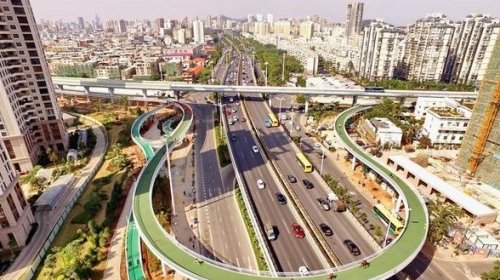
The tractor example is great, and many cyclists make brazen moves as a result of this right away.
Interestingly, I feel more brazen when riding a bicycle than my (very slow, non-freeway) motorcycle. Maybe the satisfaction that I’m legally in the right when it comes to such things as right-of-way gives me a false sense of confidence?
In any case, I wish the US would do more to create safe, adequate options for bike travel.
A better world is possible. Cyclists and car drivers agree: sharing infra is not the solution. Cyclists need dedicated bike lanes with physical barriers separating them from cars.
Right, but:
- the easiest way to create a separate lane for cyclists would be to repurpose the lane that's currently used for parking
- most car drivers see on-street parking as a right
Exactly. I live in a suburb of New Jersey and almost all of the roads have zero bike lanes with no shoulder or a shoulder that is supposed to double as a bike lane. At many points while driving, I need to swerve to the left of the double yellow line to give bikers leeway.
I used to live in New York City and even there I am amazed at how few bike lanes there are. 7th avenue south going past Penn Station has no bike lane, yet the road is seven lanes wide. Plenty of room to put in a protected bike lane.
Shortening infrastructure to just infra is extremely annoying imo.
It's not about cyclists. It's about the legal protections that drivers have against non-drivers.
About a hundred years ago there were auto clubs across the US that lobbied for things like raising speed limits, making newly-minted "jaywalking" illegal, blaming horses for being frightened by those contraptions, and making it more difficult for drivers who killed with their vehicles to be charged for killing someone.
Frankly, this makes the NRA seem harmless with their popguns.
It is unfortunately the case that when a bicyclist gets killed by a car, the driver does not suffer the same consequences as if the driver shot, poisoned, or bludgeoned the bicyclist.
Bicyclists can and do behave more unsafely, can and do break traffic laws. When I bike, if I’m doing something not in full compliance with the laws, I do not expect the full sympathy of the legal system. I don’t roll a stop sign if there are cars at it, because I don’t want to get hit. Bicyclists acting like dicks or acting unsafely, may have themselves to blame. That’s not what this article is about, though.
A highly politicized article for no apparent reason.
It's clearly political, but claiming it's "politicized" requires evidence.
And it's not political for "no apparent reason". The reason is cyclists dying just for trying to go from place to place. The common default notion that cars are privileged and cyclists are assumed to be the problem is deeply political, so talking about it will also be political.
For example, take the case of Amelie Le Moullac: https://www.kqed.org/news/10402248/verdict-in-wrongful-death...
In SF, one of the most bike-friendly cities in the US, she was killed by a negligent driver. The police just swept it under the rug because they assumed cyclists are at fault. Eventually, thanks to some detective work by a local non-profit, the truth was uncovered. The police chief ended up having to apologize.
As an SF resident who's done a lot of cycling in the city and has followed the issue for years, I promised that this was politicized a long time ago, and it wasn't the cyclists who started it.
It doesn't take long on the internet to see that the conflict between bikes and motor vehicles is highly political.
A problem with politics is especially evident here.
Most people don’t really care and would be happy to come together and agree to make progress or leave it to others to figure out.
A few people really care and are toxic, entitled, and really loud about it.
So what do you hear? Few reasonable people because most of them don’t think much of the issue at all, fewer because of the attacks of toxic people.
As with most “political” things, the people saying the most and the least valuable things said go hand in hand.
And we're incapable of talking about bikes and motor vehicles without mislabeling semi auto rifles as assault rifles?
what about this is politicized?
I assume you at least read the first paragraph?
it seems like a description of reality
Those comparisons seem relevant. You may make an argument that the article would be better without them, but they were used explicitly - not as random filler to create political noise. I.e. not "for no reason".
Just because you agree with them doesn't make them relevant.
Stiffer fines and penalties are not the right tool to resolve this.
If you want to resolve this, the key is encouraging bike riding by, for example, infrastructure improvements like wider shoulders that make biking easier and safer.
The problem is that there aren’t that many bikes on the road so people don’t learn to look for them. Nobody wants to kill a bike rider. But if you only have a bike rider nearby .01% of the time you are on the road, it’s going to be very hard to learn to spend the extra time to look for them the other 99.99% of the time, when doing so constantly feels like a wasted effort.
Flagged. Needlessly political. You want to talk about bicycles, talk about bicycles. No need to bring in every red/blue tribe talking point along the way.
Everything is political. Sometimes the reason we're in a bad situation is because we choose to do nothing, not because we don't know the answers.
"We" is not a singular mind with singular objectives. Politics is often a consensus (real or otherwise) enforced through violence, and to that extent some people may justifiably interpret "everything is political" as "everything is violent, and I'm okay with that."
Either way, low-minded application of brute force to others to carry out a political goal is not interesting. Any two-bit dictator could post soldiers in the street to outlaw cars and trucks, or bikes, or both. Any hollow politician can promise to be "tough on crime" and throw an even larger percentage of the population in jails and prisons. Those don't require insight into how these situations came to be.
Instead of complaining that not enough violence is being threatened, this article could have been a thoughtful reflection on the state of transportation with insights into increasing safety and cooperation— which would have been interesting.
I am a cyclist who has been nearly hit. I have also hit one cyclist with my car (at night, pulling out of a hospital, he rode out in front of me on the sidewalk going the wrong way, dressed in black without a light; I apologized profusely and gave him a ride home). In none of these situations did third-party penalties enter my mind in the least. What would have been interesting is why a young guy who worked at a bike shop chose not to have a bike light at night. What's interesting is why he was on the sidewalk to begin with (which, for motorcycle rides feels like closing your eyes before riding through an intersection, or perhaps going around a curve with eyes closed for drivers). A discussion around fixing the design patterns that lead to these choices is something that would be interesting and helpful. Trump bashing, while assuredly deserved in other contexts, is simply not.
As much as many people don't want to admit it, everything is political. We know the right answers for society's problems in many cases, but the mere appearance of infringing on individual freedom for the benefit of society means we don't do anything.