▲ 30 points
back
32 comments
I wonder why haven't they used aluminum instead of steel. The Cosmic Muffin is doing fine even after many years
Because it was 1960 and making large sheet metal stampings in aluminum was still expensive enough to mostly only be justifiable in the aerospace industry or if the stamping were very simple such as canoes/skifs and step vans. All of which you will note are made with riveted construction that would be an extra quirk you don't necessarily want if you're selling an already quirky automobile.
Plenty of early vehicles DID use alumininium, for example the Landrover. The story goes that after WWII there was no shortage of aluminium sheets or the tooling to work with it.
I don't understand why amphibious vehicles never seem to take off. There are regular attempts but the companies usually close shop after the first few years.
Why is that? Is it that people aren't interested? I would love to own an amphibious car!! Or is it that it's not feasible to make one for a reasonable price? Will the electric engine change anything, maybe?
They are probably just a bad combination. What with a limited consumer market, road safety regulations, boat safety regs (no doubt), emissions standards. I assume that in addition there are many engineering problems which makes mass producing an amphibious car impractical. And they would probably have horrible, disastrous road manners, not to mention limited boating pleasure. Just buy a trailer.
>Steel bodywork rusts, and to prevent rust requires conscientious maintenance. After use in water the Amphicar required greasing at thirteen points including one that required the removal of the rear seat.
Freshwater rust is a non-issue compared to what they put on the road in the winter in some places.
That's from the article, which describes the vehicle used by Pres. Johnson. One could hope some progress have been made since then.
Seriously though, why?
What use is it other than novelty?
I mean if you live in Venice maybe?!
>> Venice maybe?!
Or Vancouver, Seattle, San Francisco, New York, London ... basically any city with a harbor and big bridges crossing it. The ability to bypass the line for the bridge and drive a relatively strait line across the harbor to your destination is very appealing. The concept of hundreds, thousands, of tiny commuter boats crisscrossing a busy harbor is not. TopGear staged a race across London, with Clarkson driving by boat. It looks like lots of fun, so long as you are the one rich guy with the fastest boat on the river.
San Francisco may have a harbor and bridges, but it's hard to drive right into the water. After 911 they added balusters to prevent vehicles from leaving the roads, so you would not be able to access the water near a bridge from a car. Just because you have water next to land does not mean you can actually drive off a road into the water. For that you need a boat ramp, and while there are a few (maybe 3-4) such ramps in San Francisco, you will find that using them is a lot less convenient than driving across a bridge and you will need to go far out of your way to do that.
It is about 9 times faster on land than on water, so unless the bridge was quite congested it would still likely be faster. If the bridge is so congested that it is faster than taking that car in the water, the roads after the bridge are probably also congested so all you gain is jumping ahead in the congestion.
The situations where the bridge is very slow but past the bridge is not are probably sufficiently rare that it is not worth the extra complexity of an amphibious car for most people.
It might be more interesting and attractive in places without bridges. Depending on the speed and frequency of a ferry service, it is possible that the car on water would be faster.
Ferries will usually travel faster (the Seattle car ferries are around 2.5 times as fast as the Amphicar, and the fast passenger ferries are about 5 times as fast), but the Amphicar could still win if you have to wait a long time between ferries.
For example, the car would take about 2 hours to go from Seattle to Bremerton via the water. The state ferry on the same route would take about an hour, but the ferries are almost 2.5 hours apart so it would take you from 1 hour to 3.5 hours by ferry depending on how your trip aligns with the ferry schedule. (The car could do it in 90 minutes if you went by land instead, but that route goes through Seattle and Tacoma, so you could hit a lot of traffic which could slow you down considerably).
A car that can fly would be cool to use anywhere, but amphibious vehicles require a boat ramp or a private beach/lake with direct road to water access, which dramatically reduces the usefulness of pulling James Bond-style stunts.
I live near Paris and there are many ramps to put a boat in the Seine. It would be absolutely extraordinary to cross Paris on the river and then come back home and park in the street. (Also, freshwater.)
I'm surprised that there isn't a mention of "HalfSafe", a WWII amphibious jeep which made it's way around the world, and is now on display in Perth, Western Australia.
https://www.google.com.au/search?q=halfsafe&tbm=isch
and see: https://en.wikipedia.org/wiki/Ben_Carlin
There's a wonderful book of halfsafe's adventure, https://www.stellabooks.com/storage/images/stock/1317/131777...
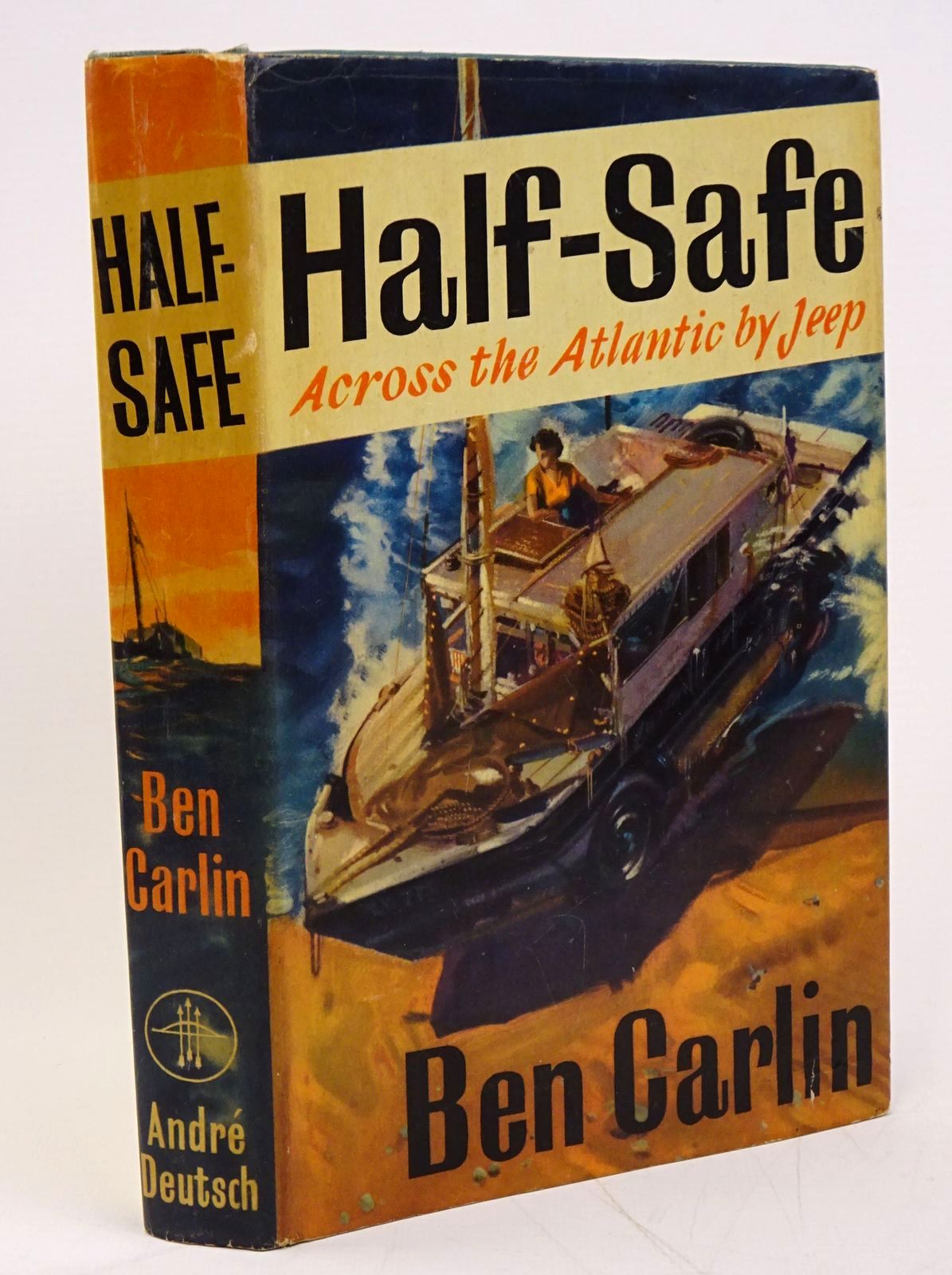
As a Triumph car enthusiast, I've always had my eye on Amphicars since it uses a Triumph engine. But they seemed to languish unloved for many years. It's nice to see them finally noticed as the interesting bit of engineering that they are and their values rise dramatically in the last few years.
Triumph cars don't languish unloved. They enjoy the affection of a disproportionate amount of rust. One thing my dad taught me was to avoid any English cars - especially older models.
That cutaway drawing is very nice. Is there a site where all such 60s-70s cutaway drawings are listed?
There are a lot on reddit.com/r/ThingsCutInHalfPorn
This reminds me of the duck tours of sf. I never took one but always saw these behind the ATT stadium!
I just looked up and looks like they closed permanently!
I loved the ducky tour of Montreal, driving through the historic old city and into the St. Laurence River for the second half of the tour. Other than these bus-boats I have never seen a civilian amphibious vehicle.
Those things are notorious death traps.
What are people expecting? They're 75yo vehicles who's capacity and seaworthiness were defined relative to very different cultural norms regarding safety and a national emergency that necessitated acceptance of some additional risk. Heck, the base truck chassis would be a workplace injury lawsuit waiting to happen by modern standards.
Other than the one that capsized in Missouri a few years back the Wikipedia page listing fatal accidents is surprisingly devoid of sinkings.
> What are people expecting?
A safe experience. There is always risk involved but floating things are a solved problem.
> They're 75yo vehicles who's capacity and seaworthiness were defined relative to very different cultural norms regarding safety and a national emergency that necessitated acceptance of some additional risk.
Duck boats are antiquated military vehicles which are modified by their owners via cutting them in half and extending them. One owner did the work himself with little to no experience in that area with zero engineering oversight. Basically the guy winged it and people died.
I'm not a car enthusiast, but I certainly can understand the appeal of a car with a silly / fun gimmick like that.
> One of the trips across the English Channel encountered a Force 6 gale and the plucky little Amphicar and her probably not fearless crew found themselves dealing with twenty foot waves.
I am pretty sceptical, looking at pictures of it? It sits very low in the water, and presumably is very heavy
Back when Presidents could drive.
Or go shopping at a major grocery store...
It’s more like they are not allowed to for the good of the country. I mean they are no longer living for themselves but are the human manifestation of the office of the executive, so there are some things they are not allowed to do, unless they insist which would irritate their handlers.
Anyone know how the seals work around the rotating parts (propellers and axles) to prevent water from getting inside the chassis?
You have basically three options for that kind of thing, single/multiple lip seals, prop shaft packing and machined grooves to pull the water out (as the shaft rotates, it will leak when not moving). Those options can be employed individually or together single or multiple on a given shaft. For example a commodity submersible sump pump may have 2-4 seals stacked in series to keep water out of the motor and an engine crankshaft typically uses a lip seal paired with machined grooves. Also I'm probably forgetting something so you probably actually have four options.
A quick google search doesn't make it clear which ones the amphicar uses where.
> Also I'm probably forgetting something so you probably actually have four options.
I looked into this some more and there is a forth option! A dripless shaft seal (there are different names for this as well) uses a collar that rotates with the prop shaft and a graphite or carbon stator that presses against the collar. The graphite stator is self lubricating (seawater works as a lubricant as well) so its supposed to require very little maintenance. Here's an article that explains it pretty well: https://www.passagemaker.com/technical/troubleshooter-unders...
Thanks, this is very interesting.