▲ 100 points
back
72 comments
> With Apple and Google continuing to make changes via their browsers and operating systems, and with the changing privacy regulatory landscape, it’s important to acknowledge that digital advertising must evolve to become less reliant on individual third-party data.
Nothing in there about the users at all. Just “we’ve been forced to do this by others.” Facebook truly believes privacy is just an obstacle to their revenue, not something good for the people who use their product.
If there were any signal that Facebook is really, truly a net negative for humanity it’s that opening paragraph. Christ.
I mean, they published an op-ed arguing against Apple's changes so I'm a little surprised that them admitting they've lost this battle is what has really done it for you.
>With Apple and Google continuing to make changes via their browsers and operating systems
Firefox not even mentioned
Btw, when FB and the like say "we value our users" they really mean "we maximize average lifetime value of our users".
I agree with you but there were so many cases already in the past, that its for a long time just a fact of life that won't change, nothing revealing.
Trying to spin their amoral business setup in any other way is just an exercise in (self)lying.
Glad to see privacy being made into another black and white issue people froth at the mouth over.
How soon before we declare a war on it? We need to spend trillions to fix it like we did WMD, terrorism, drugs and communism.
Since we're on HackerNews, I also can't wait for millions to be poured into dozens of blockchain_crypto_privacy_big_data_new_company.
> Just “we’ve been forced to do this by others.”
Well, because they were. Apple poked them with a stick, Facebook responds in the most blithe, un-entertaining fashion possible. No surprise there, since everyone in the privacy community knew this was a pissing contest from the start. If we want real change, we should be holding people accountable and forcing transparency everywhere possible. Until then, it looks like the corporate interests-that-be are more concerned with slowly destroying one another using their liquid assets than improving the "user experience".
> Without personalized advertising, businesses would be harder to start and grow, new products and services would be harder to discover and would cost more, and people would see less relevant, less timely and less interesting ads.
What about having control over our own minds? What about spending our moments in the present? When did life become about discovering "new products" and not just living in the world?
Here's a city that banned advertising: https://99percentinvisible.org/app/uploads/2016/04/london-be...
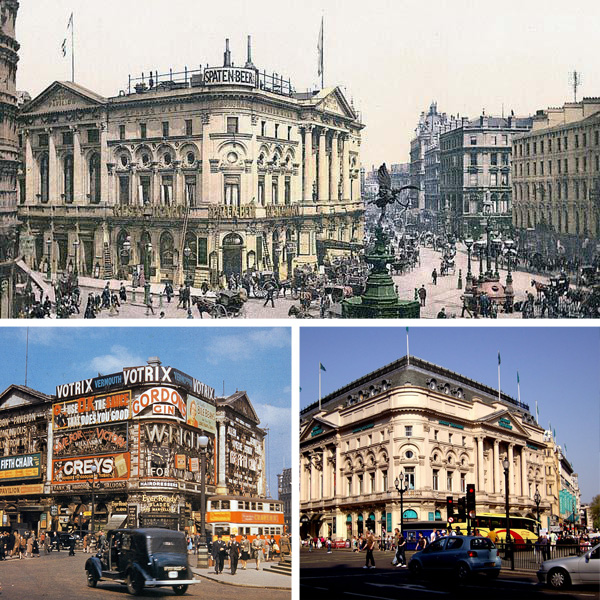
Are we seriously going to claim that the citizens are deprived now that those ads like barnacles are not covering these historical buildings? Think of the products they could be discovering! It's time to realize that ads are a net negative for society.
I agree with everything you say, and some cities have banned advertising.
However, the pic is a bad example: if you look just a little to the left there is currently a HUGE screen[1],
Piccadilly Circus in London has been known for it's adverts in lights, then later screens for decades.
[1] See pic on google maps:
https://www.google.com/maps/@51.5097908,-0.1348659,3a,75y,30...
More info
Would be cool for a jurisdiction to implement a $0.01/impression advertising tax on all ads served to their citizens.
Could probably make millions before ad networks become compliant.
This policy alone would make me consider moving to parts of the country I've never wanted to even visit.
They didn't ban advertising. They banned billboards and certain signage. There's a huge difference.
Agreed, I am strongly for a VAT on all digital advertising revenue. Let's make ads more expensive so people have a real choice to pay or not. Plus, we can use the money to fund something that helps people.
Might be a unpopular opinion but I'll take free services funded by ads over paid services any day of the week.
Ads are fine in a certain, very limited scope. For example, the newspaper, back when it held a prominent role in society, had an "ads" section. You could go directly to it to "discover new products"
Whether or not we want to admit it or not, we've all had a a product we have bought as a result of advertising that has provided us a good amount of value/joy/utility. There is clearly some utility for society in companies, especially newer ones, being able to reach new audiences, especially if they are making good products/trying to do it in a more sustainable way/changing the status quo in some net positive way. You can't rely on just word of mouth alone.
Sao Paulo was really the first to ban public advertising, back in 2007[1].
It makes think of G.K. Chesterton's quip "What a glorious garden of wonders the lights [of Broadway] would be to anyone lucky enough to be unable to read."[2]
1: https://www.theguardian.com/cities/2015/aug/11/can-cities-ki...
They make it seem like personalized advertising is the only way to make products and services cost less. What if those products and services were made by a company that didn't make quite as much money, but still made enough to stay in business?
"World-renowned arsonist announces new squirt guns for personal fire safety"
Really Facebook sees the writing on the wall that Apple and Google are about to cut off the firehose of data Facebook collects via mobile devices, and is scrambling to find a way around this by pretending to give a damn about your privacy.
I was aware of Apple's recent moves to "cut off the firehose" for FB but I hand't heard of a similar move by Google. Is there an Android update coming will have the same effect? I feel like I may have missed this.
Facebook's entire business model is completely dependent on mining your personal data for the benefit of advertisers. There is no other major component to their business.
From that perspective alone, it would be utter lunacy to believe that they have your "privacy" in mind. If so, then the definition of privacy has become so perverted as to not mean what it actually is meant to mean: keeping things to one's self that are not meant to be shared with anyone.
Then again, people freely share on Facebook that which should remain private in any case. We've devolved to the point that we're now worrying about privacy on a platform that depends on sharing things that shouldn't be shared and we're worried that it will get shared beyond what we want. Social media is such a rats nest.
I’d sooner trust Bernie Madoff to manage my money honestly than trust Facebook to manage my personal information honestly.
I've been digging through this in an effort to understand exactly how it preserves user privacy. I'm at a bit of a loss, probably because I lack domain expertise. From digging through their docs[1]:
> This adds a new privacy concern, however. Revealing that a person is in a treatment or control group is just a random value, but revealing the fact that they had an opportunity could reveal much more information, such as demographics used for targeting of the advertising campaign. (Note: revealing a person’s treatment/control group assignment isn’t entirely private, as it could reveal membership in a group, which we often want to avoid in general. Opportunity logging, though, can reveal much more information.)
I understand that if I were to see that Johnny Individual was served ad campaign X, and X was targeted towards 35 year old male identifying individuals in Colorado, I would know that Johnny Individual fit the bill according to the ad network.
What I can't understand is: Who are we trying to keep this info from? The ad network needs to know this to properly run the campaign. In the example they provide, I believe the ad network is running the lift test and reporting aggregate results.
Could someone please point out what I'm missing?
[1] https://github.com/facebookresearch/fbpcf/blob/master/docs/P...
... If I had dug just a bit deeper before posting :)
> Today, this type of reporting requires at least one party to learn which specific people made a purchase after seeing a specific ad. With MPC, say one party has the information about who saw an ad and another party has information on who makes a purchase. MPC and encryption make it possible for both parties to learn insights about how an ad is performing, without the need to entrust a single party with both data sets.
https://about.fb.com/news/2021/08/privacy-enhancing-technolo...
> Without personalized advertising, businesses would be harder to start and grow, new products and services would be harder to discover and would cost more, and people would see less relevant, less timely and less interesting ads.
The years prior to 2010 or whenever they jumped into advertising would argue "You're wrong, Facebook."
> We are optimistic that new privacy-enhancing technologies will prove that personalization remains possible and effective as our industry evolves to become less reliant on individual third-party data.
"Evolves"? Or "Was shoved off the cliff when people actually found out what you were doing and were given the option to push?"
> We’re also exploring applications for on-device learning, a technology that could improve a person’s ad experience by processing data locally on their device rather than sending individual data to a remote server or cloud.
And back around to the PC era (local computation) from the mainframe era (most recently cloud datacenters)... and the cycle continues...
> As we work with the industry to answer these questions, we know businesses — especially small businesses — are counting on us to help them navigate through these changes. Many of them don’t have large marketing budgets — or even marketing teams — so they use our tools to deliver and measure their ad campaigns efficiently.
Would these be the small businesses that, during the pandemic, figured out that "paying to get someone to your site when they search for your company name is more expensive than people simply finding your site as the first hit when they search for your company name"?
The whole "Facebook, we care about small businesses!" shtick is getting pretty old and transparent. Facebook in advertising trouble? "Oh, but this will hurt small businesses!" Bravo Sierra.
> New technologies take time to develop, but we’re confident that through our ongoing work and engagement with the broader industry, we can build solutions that will support a free and open internet.
Uh huh. Long as you sit in the middle, profit, and make sure that people think "free and open internet" means "Load Facebook."
I admit I was hoping that the article was just a redirect to the "Delete your account" page. :(
TL;RD: Facebook wants to announce in the future some privacy enhancing ideas, nothing concrete yet.
But don’t worry, they still want to track you enough to tailor ads to users (their words).
This is a distraction to wash their reputation after
https://news.ycombinator.com/item?id=28063637 (Facebook bans researchers who were investigating Facebook ads)
Does every post about Facebook have to result in a massive circle jerking of comments? These get tiring to read every time. Almost none of the comments right now offer any substance at all, just mindless sound bites and jokes.
This link may be more relevant:
What Are Privacy-Enhancing Technologies (PETs) and How Will They Apply to Ads?
https://about.fb.com/news/2021/08/privacy-enhancing-technolo...
I know it's a tangential thing but I was surprised by a privacy feature I encountered on Facebook earlier. I went to sell something on Facebook Marketplace as everyone uses it around here and I noticed it had a toggle to "not show the item to your friends". After taking a few seconds to think about why this feature existed, it struck me as a kinda clever real life application of when we might want privacy.. when we're selling gifts we don't like :-)
What's next, Purdue announces Life-Saving Technologies for chickens?
Basically Facebook wants to lead the privacy conversation to steer it away from their cash-cow or/and their future positioning strategy.
> With Apple and Google continuing to make changes via their browsers and operating systems, and with the changing privacy regulatory landscape, it’s important to acknowledge that digital advertising must evolve to become less reliant on individual third-party data.
Wow, facebook kinda admits that it hates the privacy measures, but are helpless and will have to abide.
That sounds like "Philip-Morris announcing Health-Enhancing brands".
Needs a /sarcasm tag.
In other news, the fox has declared the hen house to be a very safe place indeed.
Under the false justification of 'personalization' they want to capture all your data and sell it to advertisers. Don't buy into their false narrative folks.
If you could subscribe to Facebook for $10/month in exchange for being shown no ads in their app, and not being tracked by them across the internet, would you do it?
Privacy-enhancing here means that your privacy has been changed in some way.
In other news, foxes announce hen-enhancing technologies.
privacy washing
The mouse offers to guard the cheese.
"OPEC Pivots To Renewable Energies"
Oh no, ads shown to me might be “less interesting.” How could I live in such a world??
Please call it "Spying-reduction" . Although i somehow doubt that's what's happening