▲ 360 points
back
70 comments
Interesting that "broken access controls" made it into the top spot. Not sure if this anecdotal but recently I've seen many "hacks" of apps built with external BaaS & auth providers that rely on some kind of token-based authentication, either via JWT or opaque tokens. What happens is that often the providers offer good support for role-based access control but developers just plain ignore it and e.g. include tokens with global read permissions into the app code, or do not properly restrict the permissions of individual tokens, making it possible to e.g. read the whole database with a normal user token. The researcher collective Zerforschung [1] e.g. has uncovered many such incidents. That might have to do with the fact that in my experience those BaaS frameworks and other low-code tools are mostly used by teams with a strong focus on product and UI/UX, which don't have deep security expertise or the right mindset. I think overall outsourcing of aspects like authentication can be beneficial, but only if teams adopt or retain a healthy security awareness as well.
I worked on an identity provider platform and this was always such a huge problem. Many application developers treat authentication as an all or nothing proposition: either a user is authenticated or they are not, but the reality is that authorization is truly hard part and often completely overlooked. This is especially true in Oauth2/OIDC schemes where JWT bearer tokens are issues. At that point you are delegating token validation and access control out to all clients. Even if you are using opaque tokens to prevent basic token verification issues, you still just end up doing the token validation for the client. They still are responsible for access controls on specific resources.
> the reality is that authorization is truly hard part
Not only is it under often estimated, but in many orgs it's also reduced to a single checkbox item on someone's go-to-market slide. ":thumbsup - we're secure now!". Instead it needs to be a constant part of the culture, in every feature from the first, and ongoing thereafter.
Out of topic, I use oidc provider (keycloak). I fetch the public key from oidc provider then verify the bearer token with it. Then use the permissions field to authorize users based on their permission. Does my approach correct / suffice?
Maybe this stems from newbie developers thinking that authentication == authorization
> That might have to do with the fact that in my experience those BaaS frameworks and other low-code tools are mostly used by teams with a strong focus on product and UI/UX, which don't have deep security expertise or the right mindset.
I've had the same experience. Often these are teams who experience being asked to think about access controls as a roadblock on their way to product Nirvana. Security quickly becomes something to be avoided, often right up to the point where something goes rather embarrassingly wrong.
I can tell you exactly why this happens in many companies, and it's two part.
1) These teams are usually sponsored and beholden to business instead of IT. Consequently, they care about business needs first, and good coding practices second. You can imagine how that goes, given limited project time.
2) These teams usually have poor relationships with the keepers of the IAM keys. This adversarial relationship generally takes the form of (a) IAM is asked to create an appropriate permission, (b) IAM doesn't think the way things are being done is correct and doesn't want to spend the time to correct them, (c) team just throws up their hands up and asks for a standard (overbroad) permission set.
In many places, it's easier to get an exception and admin permissions than it is to get something more specific created.
The left hand (business) saying "No one will solve this problem for us" and the right hand (IAM / security) saying "You shouldn't have to do this, so we're not going to help you" is the cause of most glaring security holes.
IMO, the rise of microservice, SPA, mobile apps or api based apps also contribute to this. It's far easier (and more easily detected / spotted) to restrict access from monolith, server side rendering based web applications.
It's far easier to enforce information Access control in a services oriented architecture.
In a monolith, a developer doesn't even have to use an access controlled API. They can simply access sensitive data through underlying access mechanisms and return it through an inappropriate endpoint.
I've seen a fair bit of this with Firebase apps, where devs don't write enough rules, or have collections that mix non-sensitive and sensitive fields. It's tricky, because the whole query-the-database-from-JavaScript model causes your app to fail open. I wrote a tool that acts as a generic Firebase datastore client to help find these sorts of flaws.[1]
The former category for XML External Entities (XXE) is now part of [Security Misconfiguration].
Insecure Deserialization from 2017 is now a part of [Software and Data Integrity Failures] [...] focusing on making assumptions related to software updates, critical data, and CI/CD pipelines without verifying integrity.
These seem like nonsense statements. XXE's aren't misconfiguration (in any sense that a myriad of other vulnerabilities aren't "misconfigurations" of libraries), and deserialization bugs aren't software update bugs (I don't even know what CI/CD is doing in that description).
The OWASP Top 10 is rapidly losing coherence.
It's important not to take it too seriously. For all the pantomime about survey data, there's not much real rigor to it. It's mostly a motivational document, and a sort of synecdoche for "all of web app security".
The best part of this is the end, where they say "we have no data to support having SSRF on the list, but 'industry people' tell us it's too important not to". Gotta side with the industry people on that one. But maybe you can cram it into "Insecure Design" next year and be rid of it!
> The OWASP Top 10 is rapidly losing coherence.
Do you have any recommendations of better resources for web application developers needing to learn about security?
I had to go to the github then to https://owasp.org/ to figure our what the heck OWASP even stood for!
For those stumbling onto this:
The Open Web Application Security Project® (OWASP) is a nonprofit foundation that works to improve the security of software.
Every (software engineering) job I've had has had OWASP trainings, if not explicitly listed knowledge and integration of OWASP principles as a job responsibility for levels above entry. What sort of security principles do you follow?
on desktop, I see About OWASP in the sidebar: https://owasp.org/Top10/A00-about-owasp/
For the "broken access controls", "cryptographic failures", and "bad design" categories, I've been working on an open source project to help mitigate those.
It's still early and I haven't released it yet, but I have the docs[0] deployed now. If anybody feels like helping us test this early, I'd love some feedback. We're going to be pushing the code live in a week or so. (It's been a lot of building for a while now)
I've been thinking about these problems for a while now (as a security engineer) and it's cool to see that my intuition is roughly in line with what OWASP is seeing these days. It's always hard to know if the problems you see people struggling with are representative of the industry as a whole, or if you're just in tunnel vision.
Note: We're building this as a company so that we can actually afford to continue doing this full time. I'm still learning how to find the line between open source and a viable business model. Any thoughts would be appreciated[1]!
0: https://www.lunasec.io/docs/
1: email me at, free at lunasec dot io
> "To understand how data is encrypted at rest with the LunaSec Tokenizer, you can check out How LunaSec Tokens are encrypted."
It seems to me that all you're doing is providing encryption-at-rest-as-a-service. Why shouldn't your clients simply skip the middle-man and encrypt the data at rest themselves (entirely avoiding the traffic and costs incurred with using your services)?
Moreover, why should clients trust you with their sensitive customer content, encryption not withstanding? What are your encryption-at-rest practices and how can you guarantee they are future-proof?
And finally - your API is going to be a major single-point-of-failure for your clients. If you're down, they're down. How do you intend to mitigate that?
The whole thing is full of really strange and dubious promises, like this one:
> "In the LunaSec Token crypto system, information for looking up a ciphertext and encryption key given a token is deterministically generated using the token itself. A signed S3 URL configured to use AWS's Server Side Encryption is used for when uploading and downloading the ciphertext from S3."
What if an attacker figures out how the decryption key is "deterministically" derived? This attack vector would be devastating for you actually - since you can't just change the derivation algorithm on a whim: you would need to re-encrypt the original customer content AND somehow fix the mappings between the old tokens your client keeps in their database, and the new ones you'd have to generate post changing the algorithm. This is an attack that brings down your whole concept.
Then, there's issues like idempotency. Imagine a user accessing a control panel where they can set their "Display Name" to whatever they like. With your current design, it looks like you'll be generating new records for each such change. Isn't that wasteful? What happens to the old data?
Also, what happens if your clients lose their tokens somehow? Does the data stay in your possession forever?
Lots of big holes in this plot. I suggest you guys to get a serious security audit done as early as possible (by a reputable company) before proceeding with building this product. Some of this just reads like nonsense at the moment. CISOs (your main customers) can smell this stuff from miles away.
Good luck.
Can you tell me how the limitation of the creation of read grants in luna is done?
New to the list is Server-Side Request Forgery (SSRF), where you trick the remote server to fetch a sensitive URL on an attackers behalf (eg, internal service or cloud metadata URL from the context of an internal server), a language-agnostic defense is using something like Stripe's Smokescreen [1] which acts as a SOCKS proxy your app connects to when requesting URLs that should be quarantine'd, and it does the enforcement of access to internal/external IPs or not.
This hit home for me. On a recent penetration test (via an external auditor), an app I'm responsible for was found to have a pretty bad SSRF vulnerability via a server-side PDF rendering component.
Luckily it was a bit obscure to find, had never been exploited, and we patched it within a few hours, but it was the most significant vulnerability found in anything I've been involved in.
Not come across Smokescreen (very cool) but this would have been one of a number of additional measures we could have put in place to avoid our vulnerability. I'm going to seriously consider using something like that going forward for all outbound server initiated requests.
I'm glad SSRF is getting more attention. It's incredibly potent, especially in cloud/k8s/micro services eras.
Some good examples: - From screenshot service to Kubernetes account takeover at Shopify: https://hackerone.com/reports/341876 - SSRF and the Capital One breach: https://blog.appsecco.com/an-ssrf-privileged-aws-keys-and-th...
SSRFs are great fun and used on pentests a lot. One of my favourites was where you could hit the cloud metadata service from an application and potentially get credentials back.
Would the exploit of Google's thumbnail service count as this, where you could ask it to provide a thumbnail of someone else's private document?
We put together an HTTPS MITM proxy so we can log and filter also HTTP methods and URLs (or even content) for egress access from our infrastructure. An HTTP connect proxy only sees host names and the IPs they resolve to.
It not easy to prevent data exfiltration if you allow connections to, say, S3 and the attacker can just send arbitrary data to their personal bucket.
We built something similar at both Uber and Snap. Thanks for sharing this link to an open source equivalent! I wish it had existed a few years ago when I had looked. Oh well!
Interesting, it's worth noting that the scheme can sometimes also be used to cause SSRF to a different protocol which might not use http, like ftp or gopher, s3,...
SSRF are fun, sometimes the leak credentials directly also - when server is based on a trusted subsystem the auth headers might leak outside.
> "https://github.com/stripe/smokescreen"
I don't understand why they built this.
The problem described here is solved by using a firewall, where certain machines/processes are either allowed or disallowed to communicate with other machines/processes based on a set of rules. What else is there to it?
Some interesting changes in the Top 10 this time around and in general, I think they're good changes.
It does suffer a little bit though from some of the entries being quite wide ranging and non-specific, which I think could leave people scratching their heads about exactly what's involved.
I'm glad to see that monitoring and logging is still included as, in many years as a web app pentester, it was really common to see no application level detection and response to security attacks.
Speaking of non-specific, what exactly is A04:2021-Insecure Design supposed to be? That category sounds almost circular in its reasoning: Your software isn't secure because... it's design is insecure?
https://owasp.org/Top10/A04_2021-Insecure_Design/ elaborates slightly, but this still strikes me as such a catch-all, it's not going to be easily actionable.
The homepage does a very poor job of giving any context, so for those who (like me) who have no clue what they're looking at: This list represents a broad consensus about the most critical security risks to web applications. See https://owasp.org/www-project-top-ten/ for more details (OWASP = "Open Web Application Security Project").
Just to give some more context; this is a list that has been updated every 2-4 years since around 2004 or so. A lot of orgs treat it as the minimum a developer needs to know in terms of security, so it's time well spent looking through it (IMO)
On the home page: https://owasp.org
"The Open Web Application Security Project® (OWASP) is a nonprofit foundation that works to improve the security of software. Through community-led open-source software projects, hundreds of local chapters worldwide, tens of thousands of members, and leading educational and training conferences, the OWASP Foundation is the source for developers and technologists to secure the web."
About the OWASP Top 10
"The OWASP Top 10 is a book/referential document outlining the 10 most critical security concerns for web application security. The report is put together by a team of security experts from all over the world and the data comes from a number of organisations and is then analysed."
Seems pretty spot on to me. And OWASP should be very well known by anyone working in the web field.
I'm not sure server-side request forgery needs to be its own category where request forgery covers things from all sides.
Server-side attacks are more common as systems get more complex and have many moving parts that need be able to trust each other (in microservice architectures for instance), but failing to account for forgery at all levels is more a security-in-depth failure (fitting in the new very vague “insecure design” category?).
Unless I'm misunderstanding what is being meant here, which is far from impossible!
I mentally bucket Server-side request forgery separately from Client-side request forgery because of who it impacts.
- With SSRF, I'm tricking your server-side system into requesting and returning to me something it shouldn't (local/intranet files, local/intranet network responses, the EC2 instance metadata endpoint). As a developer, SSRF can leak my app/infra/data/secrets to an outside attacker
- With CSRF, I'm tricking a legit user into performing an authenticated action an existing application allows. Much closer to automated click-jacking.
Notice the Venn Diagram at the bottom of the page. If you were going to put money in a security solution you would do your best work if you made sure your security related configurations were correct and remained in place. (Least privilege configuration and Change Control). It affects every other category except injection and known vulnerabilities. So then you would make sure you had good life cycle management and patch management to address the issues with software vulnerabilities and then make sure you use Prepared Statements (with Parameterized Queries) or properly constructed Stored Procedures. This is where your focus and money should go before you start doing anything else.
Seems like this is still a draft and release will be later this month. Still specially design and CI/CD seem good points to include from security professional's perspective.
Another data point referenced in InfoSec circles is the "Verizon Data Breach Investigations Report"
It says "CWE" a lot, but does not say what a "CWE" is. Anyone know?
Common Weakness Enumeration - like a public bug report related to security, which is not managed by the developers of the software / hardware.
Nice, thank you for this list!
It is now possible to import these items in the MONARC security assessment software:
I'm honestly happy I see "Insecure Design" into the list. With all the buzzwordy Agileness people often forget that (at least) high level design is important and brings a lot of value if done early on.
I wonder which one the "REST endpoint just JSON serializes and spits out the whole database row" problem falls under now? I previously thought sensitive data exposure included this case.
Is there a hi-res version of the "2017 vs the 2021" image? I'd like to share it with my colleagues.
[Edit] Same goes for the other images such as the Venn Diagram.
They're pretty big images if you open/download them directly —
https://owasp.org/Top10/assets/image1.png https://owasp.org/Top10/assets/image2.png
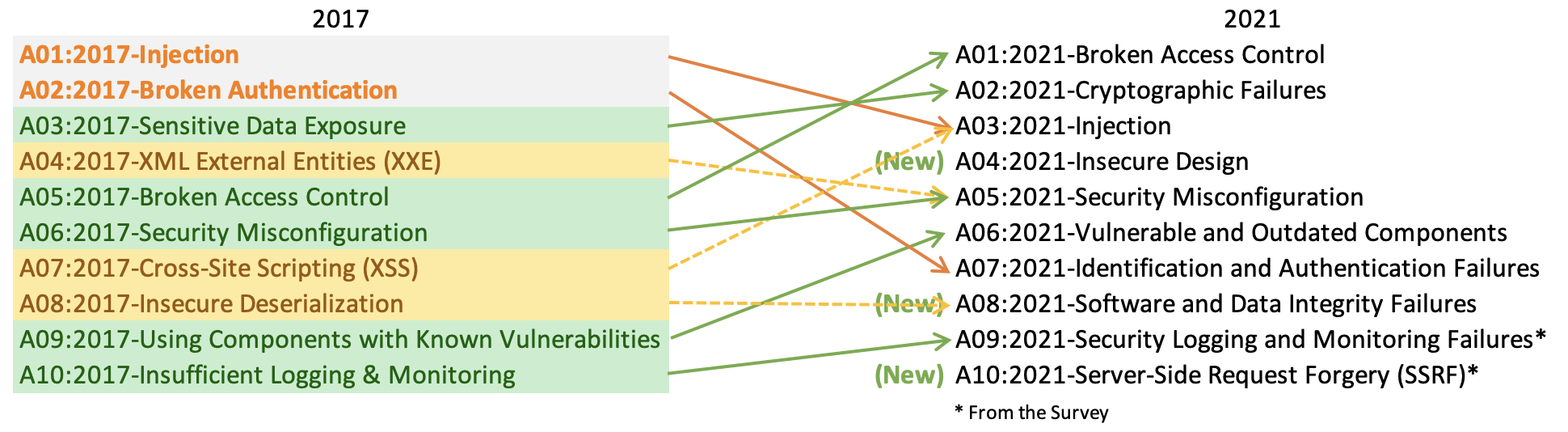
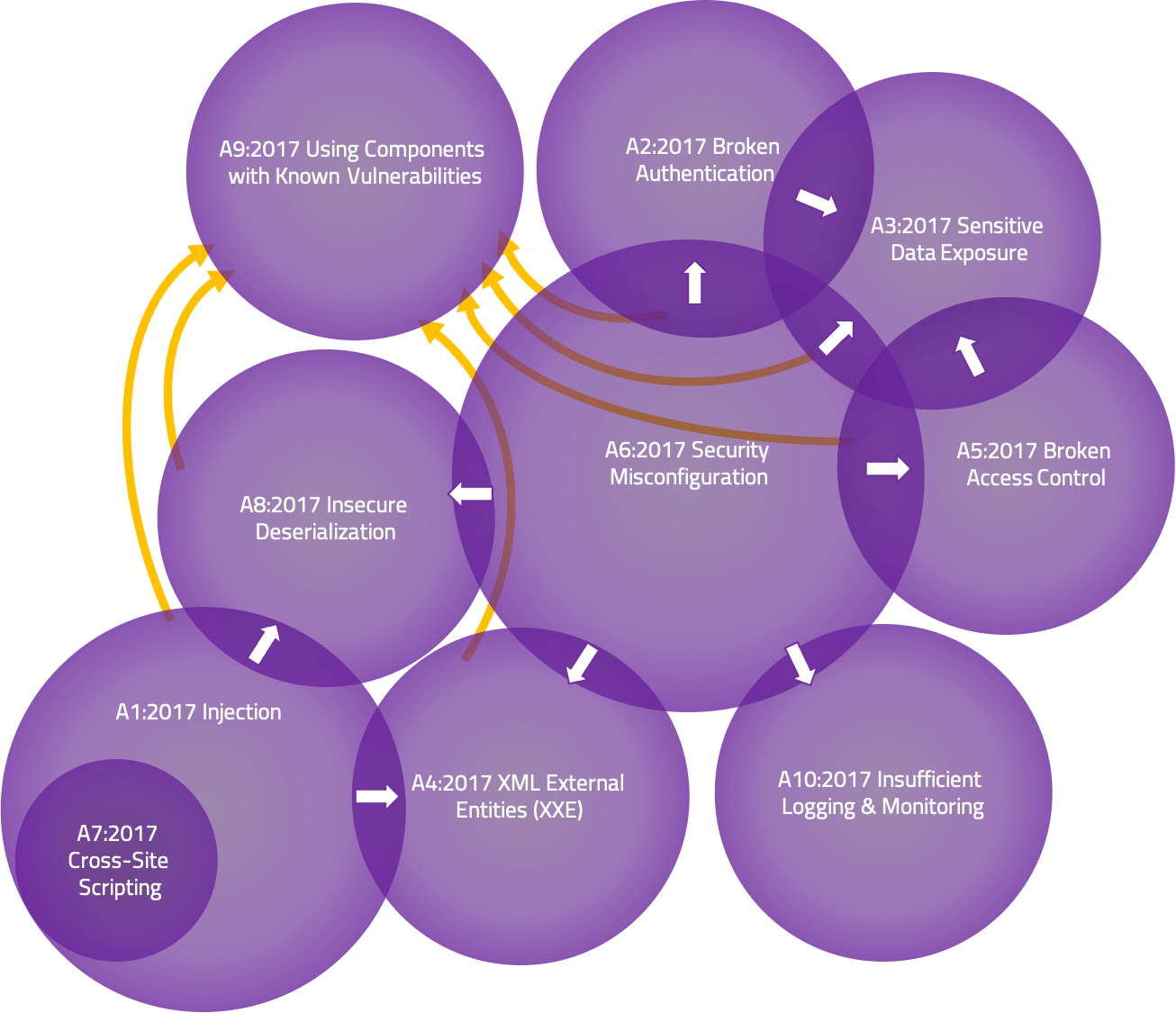
Not print quality (when you say hi-res, not sure) but definitely readable
Wow! Great job! Readability is extremely important! By making it easier to see what the current major threats are will make us more focused and secure in the long run!
Should be the full title: "Introduction to OWASP Top 10 2021", because it's specifically about the new top 10 this year.
Fixed.
Authentication and Broken Access Controls are two separate categories. I would have put authentication as a subset of Broken Access Controls. At saas pass we see authentication and mfa as a subset of identity and access management and the access controls.