▲ 84 points
back
293 comments
I realize this is somewhat tangential to the topic, but related questions:
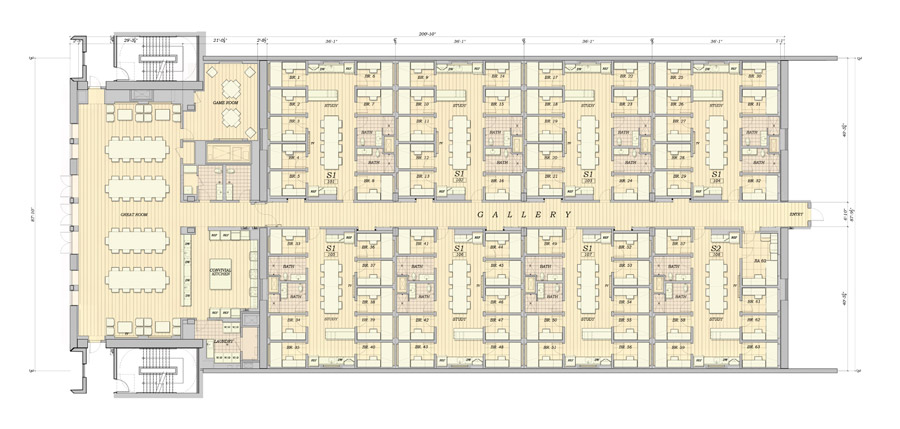
1. The whole project is expected to cost $1.5 billion. Does that strike anyone else as insane? That's like 330k per room, and these rooms are really tiny with no windows. I get the point is to have tons of more inviting common spaces, but 1.5 billion just seems nuts to me. Especially since Munger decreed much of the building will be assembled off site in "pods".
2. All the beds are at the back of the room, essentially "walled in" on 3 sides. I'm too tall for a normal twin or full size mattress, which is what these images look like. Normally that's not much of an issue because I let my feet hang off the bed. I would feel super squished in this bed.
UCSB is very close to the Pacific Ocean and much of the ground is sandy cliffs that frequently fall into the Pacific Ocean. The university is trying to build for the long term and is very concerned about the possible impacts of climate change that might accelerate erosion. Those factors contribute to increase building costs.
> 2. All the beds are at the back of the room, essentially "walled in" on 3 sides.
The rooms are 10x7 so these beds would need to be twin longs like (all?) US dorms.
It is around $1k square foot, which seems about double what houses would cost, but universities have a lot of requirements. I.e. stricter fire safety adds costs all around.
The room is $70k, the shared space in the module per room is about $70k. The other $90k is convertible classrooms, a Costco, etc which would normally be entirely separate building projects.
> Does that strike anyone else as insane? That's like 330k per room
As someone who lives in California, not really, no.
I think this building has more than just these pods, eg. open space, the shop he is talking about etc. So much more real estate than just rooms get covered with this money.
> Does that strike anyone else as insane? That's like 330k per room
It is expensive but Room & Board is 16.5k for 9 months at UCSB, so it will break even in 30 years or so depending how you model it.
College construction and the related contractors and unions in the US are really effective at extracting money from even "small" projects. The goal is certainly not to be efficient.
I posted a comparison to UC Berkeley's new proposed dorm. TLDR; this is cheaper per sq ft by $360.
Munger is something else. His opinions are almost that of a child. One could wager that it's due to his age, but he actually seems pretty sprite, so to speak, for his age, so I think he's just like that. Since the resignation article came out, I've watched some interviews with him, and he has unbridled confidence that the thing he's saying is right, and all the comments fawn over him. It isn't hard to understand how he's gotten to be this way.
Some quotes of his:
> “You’ve got to get used to the fact that billionaires aren’t the most popular people in our society,” he told MarketWatch. “I’d rather be a billionaire and not be loved by everybody than not have any money.”
I honestly struggle to understand what he means by this, but I have a hunch it's not good.
> “Everybody loves light and everybody prefers natural light. But it’s a game of tradeoffs,” Munger said in an interview. “If you build a big square building, everything is conveniently near to everybody in the building. If you maximize the light, you get fewer people in the building.”
Ahh, the maximal packing version of architecture.
> “What I learned was how stupid I was. Imagine taking years to decide that the kids should get their own bedroom.”
Plenty of designs allow students their own room. The fact that he considers this a design leap is problematic.
> “If this building fails, it will be the first Munger building that fails."
No introspection.
I think what is the sickest thing is the UCSB Chancellor's comment:
> UCSB Chancellor Henry T. Yang has called Munger’s proposal an “inspired and revolutionary” design that will offer “an unprecedented residential experience.”
What a sycophant.
This is the original source of the interview:
https://www.cbc.ca/radio/asithappens/as-it-happens-the-tuesd...
Some quotes:
What would you say to [Denis McFadden] if you had the chance?
Well, if he knew more about it, he would have had more correct conclusions.
What else does he have to know, in your view?
The reason this building is the way it is, is because there are enormous advantages in having a lot of undergraduates conveniently near one another and conveniently near everything else they like to be near.
The logical way to do that is to make a building in a big footprint and devote the top floor of it — which is a penthouse floor normally given to rich people, you know, for condos — and give that to the students as their common space, and to put a certain amount of academic space into that gigantic top floor with all the light and air and so forth.
And so it's just that it was so novel, he's never seen that done, and he doesn't like it when it's different from what he's used to.
This monstrosity totals at around 1.68 million square feet [1], which places the cost at around $900/sq ft.
New York City for various reasons has some of the highest construction costs in the world. Residential high-rise construction costs are estimated at $562/sq ft [2]. Obviously there is variance in building costs based on the quality of finishings, ceiling height, facilities, etc. I guarantee you, you'd prefer to live in a modern residential high-rise pretty much anywhere in the country rather than in these windowless cells (sorry, "rooms").
Why is this so high? Doesn't UCSB already own the land so this isn't a factor?
There are a ton of problems with this building. I mean windowless is fine until the AC fails or is inadequate or there's just a power failure.
These are I believe arranged in suites of 10 that are "private" with some common facilities. 10 is rather high. I know people who had a similar arrangement with groups as small as 4 and it was a problem.
This just strikes me as pure ego from someone who is never told "no" who wants to enforce his view on the world so that even more sycophants can tell him how amazing he is. And then there's the university that doesn't care about anything other than the donation check clearing.
Student housing simply shouldn't be this way.
[1]: https://www.nbcnews.com/news/uc-santa-barbara-mega-dorm-mung...
[2]: https://www.constructiondive.com/news/construction-costs-in-....
I worked at a startup where the CEO thought everybody wanted "light" and put windows all around the offices. It was terrible. Everybody who worked on computers all day had a hard time. When I was in college, I would have killed for a simple room where I could close and lock the door and have no external light pollution.
As much as it would be incredibly funny for Munger to be wrong after talking so much shit, I really don't think that he is. There's a lot of whining about "muh windows" and "you live in a cell". That's cool, but there's plenty of windows available to you when you leave your room, and a lot of people would rather have a small room without a window that's properly private than a marginally bigger one that you share with an asshole roommate.
It's not perfect, but it's enough for this job, and I would take it in a heartbeat over a lot of the options that were available at the university I went to.
> But Munger didn’t return the favor. He said McFadden “reacted with his gut like an idiot. He didn’t look at the building intelligently.” In particular, he said, McFadden didn’t examine the models, which, he said, the chancellor would have happily shown him. “Everybody who sees the models goes ape-shit for them,” Munger said.
Incredible. This is the language of someone who has been surrounded by yes-men for so long that they’ve completely lost touch with how to be persuasive.
He can’t understand how anyone would disagree with his windowless dorm proposal because everyone in his near orbit has showered the idea with praise.
My main thought is that with 150,000 Californians sleeping in the streets tonight, all new housing is good housing.
Also, the outrage here happened to go viral, which makes the discussion turn stupid.
I didn’t see “introvert” mentioned, but having 8 people stuffed together means that the loud ones win until the introverts just flip out. Guess they want such undesirables going to a different school or living somewhere else. Mixing people with different level of academic rigor will be messy and inserting anybody with a stereo or musical instruments will lead to physical harm.
> Once he decided that every student would have a single room, he realized, “We had a window shortage. So we just copied what Disney Cruises did. The way Disney does it, the window is really a television set. Those work beautifully on the ships. But I wanted to have a spectrum of sunlight, so with a curtain hanging over it you couldn’t tell if it was artificial or real. I figured out how to do that. Programming the lights to copy the sun was too expensive. So we will give the students knobs, and they can have whatever light they want. Real windows don’t do that.”
So just to recap: The rooms neither give you a sense where you are in the building, nor any sense of time of day.
You wake up and literally are unable to tell if it's day or night.
One of the things that I'm betting is true here is that most of us don't have any _detailed_ information about the building. Charlie Munger says: I never allow myself to have an opinion on anything that I don't know the other side's argument better than they do.” Whether he always adheres to this or not, I don't know, but as someone who has become one of the wealthiest men in the world, I have to believe he has excellent judgement.
As for windowless rooms: Monastics live in windowless rooms. Teenagers sometimes prefer shutting out all natural light. Most of the work environments I worked in for 40 years didn't have windows where I could look out. Everybody that lives in this dorm will have some level of choice as to whether to be there or not. The building is not windowless, it has (many) windowless rooms. Part of the tradeoff is that each student gets a room of their own. Sharing a space with someone you don't like sucks, I can say from my own experience.
Munger has clearly been very involved with this project. I'm not gonna try to wade into the windows vs not thing. I can see how there's a trade-off especially given that having a single-person room is something of a luxury for college students.
But I do want to question whether it's appropriate for philanthropists to be so involved in what they fund, or whether it should still be considered philanthropy at that point.
Economists sometimes talk about the inefficiency of gift-giving. Compared with the amount expended, perhaps substantially less value will be captured by the receiver. This seems like the billionaire equivalent of giving someone a painting you did, if you're not especially renowned as an artist.
If the UC system had received an equivalent amount of funding from another source would they have chosen to spend it all on this building? Or perhaps, would some have gone to scholarships, and some to more faculty, and some to a misguided new institute for whatever? Even if they had wanted to build a dorm, had Munger not been involved, would they have preferred to go in a very different direction?
Munger gets to put his name on this thing, but it sounds like he also enjoys getting to play architect or designer but without having to compete on the merits of his skills in those fields. He gets to build a thing the way he wants, put his name on it, and put it on UC land. And if we're having a conversation about how in this specific instance it may be out of line with actual benefits to the future residents, then can we also talk about how it's maybe in general a bad idea to keep congratulating rich people for pushing their personal vanity/hobby projects onto the public and calling it benevolence?
Meanwhile, Munger has been vocal in opposition to the idea of introducing a wealth tax, or a tax on corporate stock buybacks, and has suggested that the capital gains tax is too high rather than too low. To Munger, even at a public school, private entities should decide how much to spend and how to spend it.
How is it that the US with some of the highest tuition and rent in the world can't deliver half the quality of Danish public universities?
For example: Tietgenkollegiet. It has great shared spaces, great rooms, amazing green spaces and water features, and has bike infrastructure and public transit readily available.
> He said (...) "Nobody minds going into a basement restroom and peeing because there’s no window".
We don't mind peeing in a windowless room because we spend so little time there. Why does he think restrooms and bedrooms are the same? Being disingenuous on this level is just being stupid.
I actually agree with him here. Windows are nice, but by eliminating them he was able to provide many other amenities. These are dorms, not luxury apartments. Better than the bunk bed and concrete walls you usually get in college.
People want the standard of living everyone had in the US decades ago, it costs much more now.
There are more people, more competition, and things are much more expensive. He’s bringing a realistic solution given today’s capacity problems and a bias towards not wanting to share rooms.
He’s 97 with nothing to lose and it sounds like he doesn’t care about his legacy.
Honestly I think the solution is realistic and people don’t like it because they don’t want to acknowledge their quality of life is in decline when it comes to housing for themselves and their children.
The building has all the charm of a temperature-controlled storage facility, which sadly, is what it seems to be.
After reading his interview, I feel much better about what Munger says about bitcoin. If he is so wrong here...
He also paid for the dorm at the Stanford Law School 15 yrs back. He insisted that the single occupancy rooms for the law students will be very large. The University pushed back saying that neither Stanford, nor students who will pay larger rent, will be able to afford that. Munger said that you could cut these rooms in half later, if you so desire. His argument was that the smaller rooms would be harder to cut in half later. I suppose that’s right.
There are windows at the ends, so not entirely windowless[1]. The layout is brilliant to be honest and I would have preferred my own space (especially as an introvert) than a traditional dorm room.
[1] https://www.architecturalrecord.com/ext/resources/news/2021/...
Christopher Alexandar listed IIRC "light on two sides of a room" as a design pattern.
He also went into detail about the need for "intimacy gradient" in housing designs -- another design pattern.
Room for tradeoffs.
If you want to talk about harm reduction, he also suggested a case against high-rises with million-dollar views. Apparently above the ca 12th floor or so, occupants mental health began to suffer. Perhaps too removed from ground-level experience.
> But Munger didn’t return the favor. He said McFadden “reacted with his gut like an idiot.
Actually taking a place of a qualified professional when you don't know shit, being infatuated and calling a professional who is showing you the mistakes you made, an idiot, makes you look like an idiot.
I wouldn't actually say that Munger is an idiot, I don't think an idiot can make that much money. Idiot no, infatuated yes.
I hadn't been following this too closely but now looking at the designs it looks more like an office building then a traditional dorm. I can see the logic and efficiency in the design.
A lot of dorms I've seen would end up with long interior hallways with bathrooms and shared spaces at the ends. While each room had a windows and an exterior wall the amenities would be far away. Some even only had common areas (kitchens etc) on the ground floor.
Rooms with immediately shared common areas make them more accessible. Multiple shared areas makes for less overcrowding at busy times of the day. Kitchen areas close by rooms also means students aren't overheating their rooms with small refrigerators to keep their beer cold.
The common rooms at the end of the hall on each floor also makes for more easily accessible non-room space to live in. So long as the dorm rooms themselves are kept single occupancy there's always a private study space available in addition to shared study spaces like in the library and wherever.
If you wanted to get a similar number of rooms in the same areal footprint but give everyone a window it seems like you'd need a central courtyard. But then the building couldn't be more than a few stories tall or the lower floors would be in constant shade except for noon a few days a year. So you'd fit fewer students in the same plot. Central common spaces with dorms lining the exterior walls would also have lower density and the large common areas would still need a bunch of interior walls for sound abatement lest the floor have a constant din of noise.
A gruff billionaire and soundbite headlines are the only thing driving this "story" in my opinion. The design looks sound and can pack a lot of people comfortably into the lot available for the building. I'm not an architect so I don't know if there's some big detail I'm missing.
> he expects the 4,500-room building to be copied all over the country
Incredible move to make huge claims like this and then, presumably (he’s 97), die before you have the chance to be proven wrong.
It's easy to criticize what someone ELSE is doing - much harder to do it yourself.
To me it seams like Munger has offered up a nice solution given the incentives and constraints that exist in this particular case. This doesn't mean it's perfect, or that it would be best in all other scenarios - just that it's a very reasonable compromise that optimizes overall good for the students in this particular case.
Perhaps someone else, rather than criticizing, would offer up a detailed alternative, and then subject that to the scrutiny of students, faculty, environmental and zoning boards, finance, etc - and see where that gets them. My guess is not very far. It's likely that all of the "better" options folks are suggestion have already been thoroughly considered and rejected for good reasons in favor of this option.
Why weren't light courts or courtyards considered here?
Someone asked rem Koolhaas a while ago what his residence looks like and while he tried to dodge the question he ended up answering "a 19th century victorian apartment" seems like the same sort of ego at work here
Actually not a bad idea tbh. Of course that many students can’t have windows. The fact each student gets their own room is pretty sweet
As a hundred-thousandaire with an architecture degree and my own don’t-give-a-rat’s-ass ‘tude, I’m here to say: this building is not fit for human habitation, Charlie Munger is a fool, and the UCSB chancellor will be lucky to get part of his tongue back out of Munger’s sphincter.
For a billion $ he could have built a lovely ‘academical village’ with every kind of amenity and a wide variety of rooms for every preference. This is a tenement, a warehouse for living people, in the worst 1900 Lower East Side sense, minus some of the fire and sanitation risk. Suitable for vermin, not scholars.
See also Jacob Riis, How the Other Half Lives, 1890.
A citizens’ movement resulted in the organization of a Board of Health and the adoption of the “Tenement-House Act” of 1867, the first step toward remedial legislation. ... The dark bedroom fell under the ban first. In that year the Board ordered the cutting of more than forty-six thousand windows in interior rooms, chiefly for ventilation—for little or no light was to be had from the dark hallways. Air-shafts were unknown. The saw had a job all that summer; by early fall nearly all the orders had been carried out. Not without opposition; obstacles were thrown in the way of the officials on the one side by the owners of the tenements, who saw in every order to repair or clean up only an item of added expense to diminish their income from the rent; on the other side by the tenants themselves, who had sunk, after a generation of unavailing protest, to the level of their surroundings, and were at last content to remain there.
> Munger said he based the dorm’s design on the Unité d'Habitation in Marseille by Le Corbusier.
Ugh, that is one of the ugliest, soul crushing building I've ever visited.
I went to see it on a trip to Marseilles, dragged there by my art major girlfriend of the time who was into Le Corbusier big time, including his furniture designs.
Much like his sofas which - while stylish - are entirely unfit for any kind of sitting on longer than a minute, Le Corbusier's buildings are the ultimate exercise in not caring for the people who will live in it.
> Munger said he based the dorm’s design on the Unité d'Habitation in Marseille by Le Corbusier.
Well there’s your problem. Le Corbusier’s designs were beautiful dystopias.
I like Munger but I am certainly not one of those worships him nor one of those who calls him Bill Gates' lawyer (those who knows knows).
Reading through the article and the comments, I can only say it is his money and it should be a wakeup call for the college and the state of California. He has a vision of where and how he wants to spent his money and you can either accept it or not. Super rich people don't donate, they invest in social causes where their views are reflected in the long term and the goals are often not obvious. This is a very long discussion but that is how I see it.
Nothing is stopping the college to move around funds and having a tighter grip on the administrative expenses so they can invest not wisely but rather opinionatedly into projects. The mounting student debt on one side and the hypocratic song and dance to please billionaires for handouts is simply ridiculous.
Here's my question: For an interior windowless room, what's the expected CO2 concentration after someone's been in there for 8 hours?
I'd bet $1000 their HVAC system will be inadequate.
Risk $1.3b on an unproven design by an eccentric amateur that has some pretty clear shortcomings in "user experience" for the *vast majority* of users? I can't believe UCSB leadership is still seriously considering this rather than seeing what a risk this is. Pro tip: build some condos with windows.
His proposed building looks like an American Kowloon Walled City lol
Has anyone asked students, current or prospective, what they think?
> “It’s all about the happiness of the students. We want to keep the suicide rate low.”
If he's trying to come off as not out of touch... it's not working.
Mr. Munger has clearly read J. G. Ballard's "Highrise" and taken it as an inspiration instead of the social critique it is.
This is the architectural equivalent of Soylent.
Those are prison cells, period. The fact that they don't have natural sunlight means Munger doesn't have the first clue about circadian biology and how light affects the brain,mood, wakefulness, and sleep. This is a great example of how people with extreme wealth are given carte blanche simply because they have money, and no brains. As a former architectural student, albeit, high school, and professional sleep researcher (12 yrs), I hope this never gets built.
They could do this a lot cheaper just by stacking some of the glut of empty shipping containers in a huge block.