▲ 103 points
back
83 comments
“Everybody in England was brought up believing in brown Windsor soup,” says Glyn Hughes, author of The Lost Foods of England. “What is really, really strange is how deep this is into the British psyche. Walk up to anyone in the street and ask them about brown Windsor soup, and they’ll say that it was terrible and horrible but everybody ate it in the Victorian era.”
I have never heard of Brown Windsor soup until today. An article that's debunking a myth itself contains a myth.
I suspect from the fact it was mentioned in the program "Hancock's Half Hour" in the fifties. you probably have to be 70/80+ to know about this.
it's totally new to me
I'm Scottish, in my sixties, and can remember seeing brown Windsor soup on menus, almost certainly while on holiday in England with my family when I was young, so 1960s or early 1970s. I can't remember if I ever tried it though. I'm in my sixties.
A web search turns up this pre-decimalization advertisement: https://englandspuzzle.com/wp-content/uploads/2020/12/Batche... . Just plain "Windsor soup", but dark (dare I say brown?), and so clearly not the Francatelli recipe mentioned in the article. It's also on a 1926 menu in the Hartlepool Northern Daily Mail, shown here: http://www.foodsofengland.co.uk/brownwindsorsoup.htm . Binns was a department store in Sunderland, England.
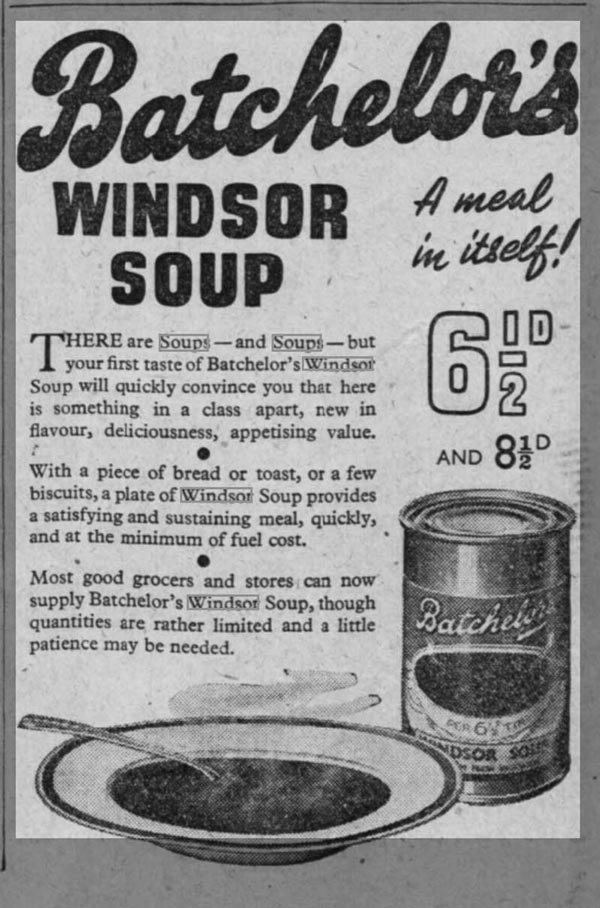
So it definitely existed, but appears to have fallen out of fashion decades ago.
Another Brit who's no familiarity with it. I have listened to a few of the Goon show episodes but it didn't ring a bell. I don't think my parents were fans, so perhaps I'd have heard it referenced if they were.
On the other hand, I rescued my late mother's recipe books when we cleared their house and I can offer up a recipe for "Brown Stew" if anyone's interested. Still not "Windsor" though.
I concur, lived here for a long time and I've noticed stuff like Spotted Dick, Toad-in-the-hole, Haggis, and Faggots (which are a kind of meatball).
If I were to point at a dish that was probably more popular in the past it would be fried eel, which you can still find in certain places in London.
BWS, never heard of it, family is British and they've not heard of it either.
I'll just add my voice to the growing list of "British people who has never heard of brown windsor soup".
It made an appearance in the 2021 series around the world in 80 days
https://en.m.wikipedia.org/wiki/Around_the_World_in_80_Days_...
Same. Nearly 60. Familiar with plenty of less than appealing “traditional” Brit food but never heard of this.
One of the Top Hacker News Posts Is a Hilarious Lie
Yeah, can confirm as another Brit this is definitely not true—as of the present day at least. Never heard of this.
Never heard of it either.
UK native and have never heard of 'brown Windsor soup'.
Ditto, never heard of it.
Yup, never heard of it.
Interestingly if you search for "Brown Windsor Soup" in 19th century books on google there's quite a few hits. Click through and view the highlighted text - and its always "Brown Windsor Soap" - SOAP not SOUP. Presumably Googles AI enhanced OCR has misread.
1. https://www.google.com/search?q=%22brown+windsor+soup%22&biw...
The article mentions the soap: it was real, it was popular at the appropriate time period, and it's possible the "brown Windsor soup" was a combination of Windsor soup (a white soup) and brown Windsor soap to make it seem more horrible to the audience.
Interestingly, as a Brit I've never in my life heard of "Brown Windsor soup". Admittedly I've never watched the Goon Show but it's hardly "deep...into the British psyche". Perhaps it's a generational thing (I'm in my 30s)?
I'd never heard of it (42) but I asked my wife and she figured it must exist because the Major orders it in Fawlty Towers.
I've done a small straw poll from a range of ages (20's to 70's). Only the older people (60's+) seem to have vaguely heard of it but none knew what it is or had any particular reaction to me mentioning it.
Note though that my sample size for older people is very small due to the lack of 50's+ in my immediate vicinity (one person in their 60's and one person in their 70's).
As an American, I'm pretty much on my own for even knowing what the Goon Show is, let alone Brown Windsor Soup. I even met Harry Secombe once in the late 90's at a hotel in Bournemouth, and nobody knows who the heck I'm talking about when I mention it.
> Admittedly I've never watched the Goon Show
Being a radio show, you could watch it with your eyes closed.
As radio shows go, it was actually very visual.
I've never watched the Goon Show either, but I've listened to most extant episodes. Perhaps that's why the name seemed so familiar.
1. create a myth
2. debunk it
3. everybody click and complain
4. profit?
Yup, same, I'm 45 and I never heard of the stuff.
At a guess, you had to be in the generation that actually watched the Goon Show.
50, UK born and bred (southern). I think I have heard the name, but no idea what it's like or ever eaten anything that claimed to be it.
Same, I've never head of it either.
I'm in my early 40s and have never heard of it either. Maybe it's a Southern thing.
Ok, so this peaked my interest, so I did some googling. If this soup were to be genuine, references to it should exist.
In the 1968 'Report on soups' by the British Ministry of Agriculture (https://archive.org/embed/op1268165-1001), there is a reference on page 19 to this exact soup (called 'Windsor soup', 'Brown soup' or 'Eton soup'). It even lists the a basic list of ingredients. So this means this soup indeed exists.
Now some further digging. Are there old references to either 'Windsor soup', 'Brown soup' or 'Eton soup' in non-fictional media?
The 1892 'The encyclopædia of practical cookery' does not list this soup, although it is quite sparse on soups.
The 1844 'A New System of Domestic Cookery' list a large amount of soups, none even vaguely hinting at the same name.
However, the 1906 'High-class cookery recipes' (https://archive.org/embed/b21528597) lists a 'Windsor soup' which should have a 'brown colour' as the basis. I think that should qualify as a 'brown roux' basis which at the very least lends some credence to a brown 'Windsor Soup' although I cannot verify the color myself.
Anyway, that's the result of about 15 minutes of googling. At the very least, it makes me a bit sceptical of the article.
No love for the Toast Sandwich?!
Yeah I mean I unironically like doing this at times. Texture contrast is great!
The highlights for me:
“People don’t like it when you challenge their beliefs. … It’s so small and unimportant, you don’t bother to investigate it. It makes you wonder: how many things do we believe that if we were to look into them, we’d find they were complete nonsense?”
They/we really don't! :)
A guy I used to know was telling about a British children's TV show where all the characters names were actually double entendres.
It just so happened that I had recently read the fascinating story about how this wasn't true at all, despite the press writing that it was and so on and it was just a successful urban legend.
He said no it's really true, he'd seen it himself on TV. I later sent him over email the article describing the legend. Anyway he got really mad at me for just saying that and went round telling people I was an asshole for destroying this story for him. I was really surprised that someone could be so upset by that.
Additional context (some of which Hughes might disagree with) on Wikipedia: https://en.m.wikipedia.org/wiki/Windsor_soup
The initial edit of the page, in 2013, had this:
Brown Windsor soup is a hearty British soup that is said to have been popular during the Victorian and Edwardian eras.[1]
It was one of the starter dishes on the menu at the fictional Fawlty Towers
It is unclear whether this often-written-about soup is indeed Victorian, or was invented as a joke in the 1950's - perhaps conflating the well-known White Windsor Soup with the equally famous Brown Windsor Soap. There do not appear to be any references to it before about 1953.
https://en.wikipedia.org/w/index.php?title=Windsor_soup&oldi...
Edit. The current version says:
> Windsor soup or Brown Windsor soup is a British soup that was popular during the Victorian and Edwardian eras.[1][2][3] The practice of calling it 'Brown Windsor' did not emerge until at least the 1920s, and was usually associated with low-quality brown soup of uncertain ingredients. Although originally an elegant recipe among famous chefs of the 19th century, the 'Brown Windsor' variety became an institutional gruel that gained a reputation as indicative of bad English food during the mid-20th century and a later source of jokes, myths and legends.
So, given that the author of the article "tried to update it" I don't know what they were trying to update it to?
The relevant part from the article:
> Hughes has spent years challenging the Victorian roots of brown Windsor soup—“I keep trying to correct the Wikipedia page, but I’ve given up”—and has faced considerable fury for his efforts.
Once Wikipedia decides something is a fact, it can be hard to alter it; no matter the sources you bring. If something stood there in an article for over a decade and the article is guarded by a certain type of editor, just give up.
Sounds like a case of Mandela effect: https://en.m.wikipedia.org/wiki/Mandela_effect
The "Mandela Effect" is the dumbest of all meme "Effects." It should be renamed the "I didn't pay attention to apartheid or notice when or how it ended" effect. Until you linked me to the wiki page, I hadn't realize it was coined by a "paranormal consultant."
This seems like a general issue with how information travels without modern internet.
IMO, its just a matter of multiple groups of people around the world making similar dishes and with multiple sets of definitions of what that particular dish is. And at some point, it all collided and mashed together individual histories.
Maybe it was just their version of a meme.
For anyone interested in a great cookbook of classic American desserts with meticulously researched background and origin stories, I highly recommend “Bravetart” by Stella Parks. Some of the recipes can also be found on the Serious Eats website, but the historical background material is largely reserved for the book.
If you invented a soup that has thoroughly-researched period-appropriate ingredients and a much older cooking method, then the only lie is the name, right? If Britons at the time would just have called it "soup", then...mission accomplished?
First thing that came to mind about food lies is city chicken. Obviously wrong time frame and location, but definitely seems like a big food lie, and possibly problematic for people of some religions if they actually think it's chicken.
Elvis did not have bananas on his bacon sandwich, but blueberries? I will never believe such poppycock.
Actually I have never tried either, so maybe either works!
Every time I play Civ VI, Sean Bean tells me, “History is the version of past events that people have decided to agree upon.”
Is this article an early April fools joke?
In 80 days around the world, the main character Phileas Fogg, eats it all the time. Serie is now on the BBC.
> It’s really, really weird, this mass hallucination going on.
Honestly, all things considered, it's not that weird.
Imagine if we brought a Spartan back to life and he told us Black Broth was a similar made up soup.
Never heard of it, and whoever Glyn Hughes is, is talking poppycock, balderdash, utter claptrap, absolute piffle when he states,
“Everybody in England was brought up believing in brown Windsor soup,” says Glyn Hughes, author of The Lost Foods of England. “What is really, really strange is how deep this is into the British psyche. Walk up to anyone in the street and ask them about brown Windsor soup, and they’ll say that it was terrible and horrible but everybody ate it in the Victorian era.”
Complete bollocks.