▲ 74 points
back
83 comments
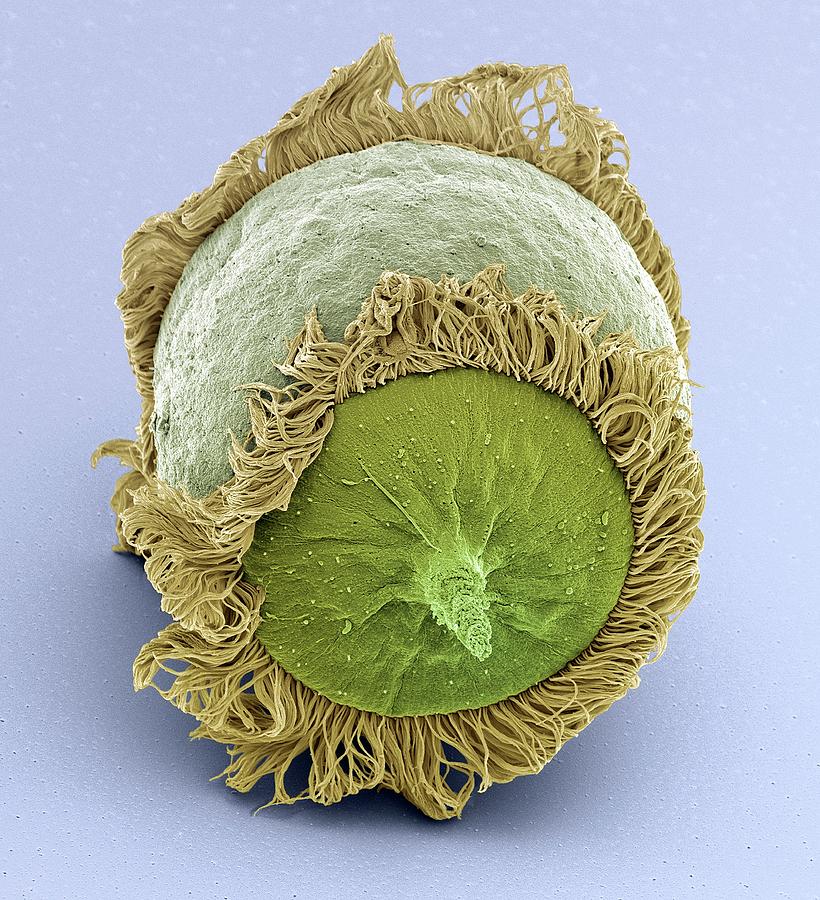
Looking at a single-cell organism [1] that shows many attributes of animal behavior, I readily believe in the intelligence of a praying mantis.
[1] https://images.fineartamerica.com/images-medium-large-5/didi...
Out another way the difference in complexity between a single cell (the LUCA) and humans are about the same as the complexity between that cell and the base organics we know are needed for all life (and can make in a lab “trivially”.)
I see it as the LUCA were the humans of pre-cellular life. As the solar system calmed and mass/energy from the protostellar disk became increasingly expensive, our grandcell and it’s siblings were able to sustain themselves (perhaps at the expense of whatever non-cellular “life” filled the oceans at that time.
There’s a whole tree of life that paves the way to the cell. Unfortunately we’ll almost certainly never be able to study these exact paths as we have with cellular life.
Humans are dramatically more intelligent than the next smartest species. We've built spaceships and number two on the intelligence list (however you order it) has barely managed to rub a stick and a rock together.
Whenever a species has a property that is that strong of an outlier, it usually implies some evolutionary positive feedback loop. For example, a single cone snail has enough venom to kill 20 adult humans. Why would a little snail that eats small fish and worms need such insane toxicity? It's because it's an evolutionary arms race with its prey species that are building up tolerance to those same toxins. That feedback loop leads to stronger and stronger venom.
Humans are a tribal species. Through most of our evolutionary history, we were completely unable to survive when solitary, and our primary competitors for resources were other tribes of humans. In other words, our most valuable friends and more dangerous foes are the same species. This means that to successfully navigate our environment, we need to accurately recognize individual humans, remember who they are, understand their behavior to figure out the underlying intent, and use that to decide if they're on our side or not.
Of course, any evolutionary mutant human who can obfuscate that intent and appear to be a friend while actually being a foe would be able to take advantage of others. So we have also needed to evolve to detect dishonesty.
To accomplish that, we need a theory of mind: a mental picture of the mental states of the people around us. And, in fact, we need a higher order theory of mind. Each of those simulated minds contains further simultations of other minds. I know that Jan knows that Fred knows that Abby knows that...
That iterative process, I believe, led to humans having the most amazing social minds of any species, by a large margin. We understand social interaction they way birds and fish understand fluid dynamics.
That level of social cognition is so fundamental to what it means to be human that I think we often don't even see it for what it is. We take for granted that most people have a an "inner monologue" and that thinking in solitude still involves some sort of simulated auditory communication. We anthropomorphize animals and inanimate objects constantly. And when we do that, the properties of humans we impute on to them are almost always around talking and thinking socially like a human.
If you accept that, then one theory of what "consciousness" is is simply a theory of mind applied to oneself. If I know Fred then I have my own simulation of his mental state. But I know that he knows me, so my simulation of his mind includes an inner simulation of mine. Thus, it's natural for humans to have both direct cognition but also be able to observe it at a level of remove. We can "watch ourselves think" because we must be able to watch others think.
I don't know if that's what consciousness actually is. It's just a wild conjecture. But if that is where it arises from, then we should expect that few other animals have anywhere near the level of consciousness as us. Some more social species appear to have some theory of mind, but it's fairly rudimentary compared to ours.
If our perception of consciousness rests on that same social reasoning hardware, then in other animals, it will be comparatively lower fidelity.
I have a different take on our spaceship-level intelligence.
What makes the human species unique and supremely powerful on our planet is not individual intelligence, rather the systems and tools we invented to persist knowledge, tools, improvements and automation across generations.
This creates a system intelligence thousands of times more impressive than any single individual can reasonably produce.
To make this point, a thought exercise. Take a modern human being out of the system and dump them on an island with plenty of natural resources. They'll die. They can't hunt nor do they know agriculture or have the time to "try it".
Pretty crazy that this critical survival skill isn't even passed on, right? All the other species on the island know exactly what to do, and none require 20 years of education just to function.
Suppose somehow these individuals do survive. Could they now go on and recreate modern society? No. Because no modern human being has any idea about how anything works. They just tap a button and the next thing you know some product is on the doorstep.
Yes, the average human being is more intelligent than the next dog, primate, etc. But we're not rocket ship intelligent, none of us could even produce a single component of a rocket ship or have the faintest understanding of how it works. The additive intelligence of our system is what makes us unique, at an individual level we're very much "meh".
I think it's both.
You are correct that no individual human could build a spaceship. Our ability to aggregate intelligence across brains and across time is our superpower.
But that superpower is open to exploitation. When working together as a group, you can't blindly assume all other members are good faith participants. Doing so would open the species up to being exploited and destroyed by an evolutionary offshoot that parasitized or otherwise took from the group without giving as much in return.
In order to aggregate our intelligence across the tribe, we also need a lot of individual level brainpower that we can put to use determine which other humans around us are helpful versus harmful.
That same brainpower can also be harnessed to let us solve problems individually. Sure, lots of us would die on a desert island, but that's because surviving on any isolated microclimate is hard. Plenty of animals die on them too!
But a solitary human would survive better than you give credit for across a whole range of environments. Any given animal might have some honed instincts to survive in a single climate, but none of them is as plastic and creative as we are.
If you have not read the famous essay “I, Pencil” (and the invisible hand), you’d enjoy it. As I recall it is only 10-15 pages and in the public domain.
I agree with almost all of your points, especially regarding humans as a fundamentally social species, however I disagree that technology really proves our intellectual superiority. When we developed writing we created a way of compounding our intelligence. Without this compounding action we wouldn’t be so much better tha other animals. Our achievements are certainly far greater, but thats because our species has developed a unique organizational structure, not because we’re so much smarter. In studies chimpanzees out perform humans on not just short-term memory but game theory![1]
I also think that high functioning Autistic people, who absolutely lack the sort of social cognition you seem to think set people apart, also work against your claim. Unless you really claim autistic people aren’t conscious or don’t meaningfully contribute to society.
[1] https://www.science.org/content/article/chimps-best-humans-g...
> I also think that high functioning Autistic people, who absolutely lack the sort of social cognition you seem to think set people apart, also work against your claim.
High functioning autistic people don't absolutely lack social cognition, they just aren't as strong at it as neurotypical people. I believe this reinforces my point. We are so used to our fellow humans being incredibly good at intuitive social reasoning and theory of mind that even a relatively minor reduction in that capability is perceived as a deep flaw.
When someone has a shitty sense of direction or poor spatial reasoning, we don't think of them as having a mental disorder. But weaker social functioning seems more fundamental to personhood.
This is how I've thought about the issue, put much better than I could say it. We are conscious because we need to think like other people, and to do that we need to understand (as best we can) why we ourselves do what we do.
Interestingly this leads to consciousness as simply an awareness of our own mind, rather than necessarily being in control of it as most people believe. However, many studies provide evidence that our conscious mind is not the only or primary decision maker in our heads.
Well I agree that human versus human arms race is a big part of it, you also have to consider the advantages that intelligence brings two carrying capacity. Evolutionary biology has demonstrated huge amount of evolutionary progress when privilously untappd biomes become available. Intelligence allows humans to make inhospitable environments hospitable and this scales with intelligence. Look at the carrying capacity in inhospitable environments have been available to chimpanzees and other primates and compared to that of humans. Cooperation technology and intelligence required to do so is a huge evolutionary driver in its own right.
Wow, I really like this line of thinking. Never thought about it from the perspective of a competitive feedback loop.
> and number two on the intelligence list (however you order it) has barely managed to rub a stick and a rock together.
Corvids can solve pretty complex mechanical puzzles. They can use tools. They haven't yet had the evolutionary pressure to do anything more elaborate than that. They don't have hands. They can communicate but it's unclear how much bandwidth that communication has.
Octopi are also excellent problem solvers and they even pass the mirror test. They have the next best thing to hands but they don't have access to many materials. I don't know how well they communicate.
Our main advantage(other than our habitat and our appendages, which other primates share) is not raw intelligence (whoever you define it). Instead, it's the ability to pool multiple brains together and communicate as we are doing so. That means that tiny improvements in cognitive ability have a dramatic amplification factor even over small populations.
More recently, we developed the ability to use brains that are long dead through writing. And even more recently, we have been able to use brains that are not even in the same physical location. We are augmenting our brains with machines now (indirectly, for now).
None of this would be possible without increasingly complex language. It probably evolved with our brains.
fwiw I do not really see how problem solving intelligence correlates to consciousness. I think it is a bit of a stretch to think we only evolved consciousness to guess how other people will react. I don't think our theory of evolution or theory of neuroscience points to that strongly at all.
I think children are conscious, mentally slow people are conscious, and I am conscious when inebriated even though a large group of people in any of those categories would never be able to solve large engineering problems.
I used to have a viewpoint more similar to yours but after spending more time around animals (at least birds and mammals) they honestly seem to have most of the same instincts as humans.
That was a great exposition with some very fascinating insights.
"I think, therefore I am"
Maybe not, there is no way to prove that thoughts require an "I" or existence. "There are thoughts" is more accurate.
this quote is widely misinterpreted https://www.youtube.com/watch?v=s0SaqNeFf3Q
Since consciousness is a proven successful survival attribute, I expect it would have evolved independently several times.
I can't help feeling that consciousness and more generally an "internal world" arise in a gradual manner as the brain gets more complex.
Unfortunately it seems like an impossibly hard nut to crack...
> Since consciousness is a proven successful survival attribute
Is it?
There's a work of fiction on this topic that I really like. Without going into spoiler territory the author argues that it's actually a handicap, and we might be better off without that layer.
https://en.wikipedia.org/wiki/Jumping_spider
Some of these critters are far too bright to be that small.
On the aspect of being small, small spiders' brains actually spread out a bit into the legs, due to lack of space in their heads.
https://www.nationalgeographic.com/animals/article/111219-sp...
Aliens that come visiting might be as superior to us as we are to the inhabitants of a meadow. Might we be judged based on how we treat lesser creatures ?
Imagine a drone with the navigation based on the brain of a fly. It would be practically un-crashable.
Just started reading on basic drone aerodynamics. It's not that simple, IIRC. Static stability (the innate ability to immediately remain in equilibrium after a gust of wind, collision, command or other sudden stimulus) is inversely correlated with maneuverability. Intelligent control implies dynamic stability (the ability to eventually return to equilibrium, such as through complex algorithms) but that is correlated with maneuverability and reduced static stability. In other words, to be un-crashable you don't take off, to be stable you aren't intelligent, and to be maneuverable you are intelligent but also delicate.
Flies are uncrashable only because they are small enough to survive most impacts. I've also seen uncrashable drone toys, you can throw them on ground, pickup and they will fly again. I've also seen flies hitting into things.
Flys crash all the time, fail on various maneuvers they attempt, like landing on the ceiling. However for the speeds they fly at they are durable enough to survive those encounters.
There are some who reduce consciousness down to simple response to stimulus. DD Hoffman has defined a simple 'conscious agent' as a system with an input such as a switch and a counter for how many times it's been stimulated, as a simples elementary conscious system.
For me that's basically saying conscious beings are information processing systems, therefore all information processing systems are conscious. Panpsychism does the same thing, but it's just like saying a tank is a vehicle, therefore all vehicles are tanks.
For me, consciousness is more than just perception, it's more like the awareness of your own thought processes. It's understanding and being aware that you are a conscious being. That's not a novel view, there are dictionary definitions that are consistent with this.
[Dictionary.com] Consciousness - the fact of awareness by the mind of itself and the world.
Hoffman's conscious agents clearly don't qualify IMHO, and I'm pretty confident insects don't either. I'm less sure about some mammals like cats and dogs. It does seem like some animals, including some birds, do have a sense of self even if it's fairly rudimentary.
> For me, consciousness is more than just perception, it's more like the awareness of your own thought processes.
That is self-awareness, big difference. Consciousness is required for self-awareness, but you are placing the bar too high for consciousness. Anything that has brain (in any form) that experiences and can feel pain is conscious, whether it is self-aware or not. A 1yo baby is not self-aware, but I'm pretty sure it is still conscious. It is a pretty good bet that all animals are conscious to some extent, including insects. It isn't a terrible bet that even plants have their own plant-consiousness, fungus has its own fungus-consciousness, etc.
There are also some who confuse consciousness with intelligence. The word consciousness isn't even defined in the western culture: people see it as a some woo that makes them different from a chair. In sanskrit, the word consciousness means just perception; "consciousness arises from interaction with matter". The definition from dictionary.com is a mishup of related things: consciousness somehow turned into awareness, then into self-awareness and then even gained rudimentary mind. That's a whole evolution in one definition.
OED: "The state or fact of being mentally conscious or aware of anything" ( (https://www.oed.com/oed2/00047729, #3).
This jives more with my intuition that a toddler is conscious, even if they aren't really aware of themselves as a perceiving entity (aside, I wonder if such self-awareness is even binary or more continuous). And given this framing, it's very reasonable to ask whether insects may be conscious.
While I think this is a worthwhile topic, the article mixes moderately strong evidence with extremely weak evidence in a way that makes me kind of discount anything else it has to say.
Just a minor nit. Though widely believed, Descartes never wrote cogito, ergo sum. I'm not sure who came up with that, but what Descartes wrote was je pense, donc je suis, and the meaning is subtly different even if we define "so" (donc) as "therefore." What Descartes intended was not a logical proof of existence. What he meant was, "I am, I exist, whenever I think it." There is no "therefore" or quod erat demonstrandum involved.
Just a minor nit, he wrote Cogito, ergo sum, in Latin in Principles of Philosophy in 1685. See https://en.wikipedia.org/wiki/Cogito,_ergo_sum
when the aliens come, will our shouting that we're worth not killing / experimenting on be supported by our level of consciousness, enlightenment?
Our shouting will sound to them like the buzzing of bees sound to us. Why would they pay any attention?
“ My cat almost certainly has a sense of what it’s like to be a cat”
Is this true? I always thought this was anthropomorphism. I have dogs and I thought dogs more just “are” rather than self aware.
The weirdest thing about these studies to me, is they always latch on to the most basic idea of “consciousness” and then extrapolate that to see we’re all the same.
In a philosophical/spiritual way I’m all about the idea of modesty and we’re all connected and I’m/we’re not special. But in practical way I don’t see the “actually insects are just like people.”
> I always thought this was anthropomorphism. I have dogs and I thought dogs more just “are” rather than self aware.
I'd consider it more from the perspective of Occam's razor and prior probabilities. You have a brain, you are alive, you have goals, make plans, learn, perceive the world, make predictions about the behaviour of other agents, and eat food. You are also conscious.
My default assumption would be that anything else that does the former things would also have the latter trait, until I encounter some particular evidence that they don't.
Not just like. The article says as much. Bat consciousness would be different from human consciousness, in part they use echolocation to navigate. Insects would be even more different, if they are conscious. Consciousness being some subjective experience of self and the world. Seeing color, feeling pain, being something more than an automaton with an inner life. That subjectivity could be alien to us. Or it could be similar in some ways and very different in others. A cat isn't going to experience the world quite the same as we do, but they are mammals and more closely related than bees.
"I have dogs and I thought dogs more just “are” rather than self aware."
I think it depends on how deep we are trying to go. Most people are downright terrible at true self awareness and self evaluation.
> Is this true? I always thought this was anthropomorphism. I have dogs and I thought dogs more just “are” rather than self aware.
I don't know. Dogs certainly know when things relate to them, when we are talking _about_ them and not _at_ them. It seems clear to me that they have an understanding that they are an entity. The question that we might not be able to answer is whether or not they can or do introspect about themselves.
> and then extrapolate that to see we’re all the same.
As our understanding grows, we have seen more and more evidence of behavior that we didn't really notice before (elephants mourning their dead - their version of it). It does not seem logical that humans suddenly develop 'consciousness' out of nowhere, and that there's a discrete jump between 'conscious' and 'not conscious' and that humans are somehow completely unique.
It would not surprise me in the least to learn that insects have their own version of consciousness. Even if it means they will forever be incapable of developing philosophers in their particular evolution tree.
Maybe our neocortex just allows us to communicate to others something that had been there for millions of years.
It's easy to fall into the anthropomorphism trap though.
> Agitated, anxious honeybees, on the other hand, responded with pessimism when researchers shook them
Sorry, all credibility out the window right here. They seem to be more interested in being literary than in being accurate.
In the text, the word "responded" is a link to this study:
https://www.sciencedirect.com/science/article/pii/S096098221...
> A pessimistic cognitive bias is manifested in an increased tendency of subjects to classify stimuli as likely to predict punishment (or a reward of less value). We were able to use the same approach to test for cognitive biases in honeybees because bees are capable of associative learning and can base judgments about novel stimuli on previous experiences [24, 25, 26, 27]. Using an olfactory learning protocol for conditioned proboscis extension, we trained honeybees to extend their mouthparts to a two-component odor mixture (CS+) predicting a reward (e.g., 1.00 or 2.00 M sucrose) and to withhold their mouthparts from another mixture (CS−) predicting either punishment or a less valuable reward (e.g., 0.01 M quinine solution or 0.3 M sucrose; Figure 1).
What did they get wrong?
> “Humans are no longer seen as at the pinnacle of creation,” Catherine Wilson, a philosophy fellow at the Institute for Advanced Study in Berlin, told me. “There’s a greater modesty and awareness in which we are just one species — and maybe not even the most important species.”
Now there's a loaded, unqualified, and treacherous statement. Especially when the article started off euthanizing "lesser species" for scientific research.
EDIT:
> Eating crickets... Animal rights...
> ... We lose little by elbowing humans out of the center of every decision-making process, instead asking how...
There you have it. I hadn't finished the article when I started this comment, but... Now I'm glad I did.
People who degrade the value of human life so easily will end up committing atrocities. And I suspect the author will find himself quite shocked when he is "elbowed out" of the decision making process, and relegated to a diet of crickets or subjected to some experiment... Little to lose, indeed.
I'm still not sure what your issue is exactly. Can everybody here try to actually verbalise their issues with the article instead of assuming that everybody else shares their interpretation and view?
> People who degrade the value of human life so easily will end up committing atrocities.
You have the tenor exactly backwards. Those statements don't demean humans, they question whether we have in our arrogance are not giving other animals the consideration they might deserve.
You think it degrades human life to seek a deeper understanding of the abilities and experiences of other species? What kind of twisted idea is that?
And when we consistently learn that we underestimated them, and researchers suggest to be less self-centered and more empathetic to other life, the only logical response you can produce is that the end of times is near?
You're an excellent data point to support the study.