back

by andsoitis·4y ago·view on hn ↗
> to murder their unborn children

It seems to me that if you truly believe that an abortion is murdering a human, then the penalty should be the same as the murder of a human who is already born. In other words, a very long prison sentence or the death penalty (depending on locale).

However, if you think that penalty is too severe, then do you really believe it is murder when you have an abortion?
8 comments
Well and more important: all the rules that kick in when someone is born should kick in at day one of the personhood. Tax breaks, social support, etc.

But it is not about personhood, it is not about murder — this is about sex and giving the state the power to enforce prude religious ideas. Which is why there are open discussions about banning contraception as well.

The idea: Sex should only be had for the purpose of generating offspring. It should never be enjoyed. This is the believe, and anyone has to follow it, so it needs to become law.

>But it is not about personhood, it is not about murder

It's about taking an innocent life.

Let's say that I agree that abortion is wrong (which is true enough).

Under what circumstances should a miscarriage be investigated as a criminal matter? In this question I include any involved parties. Prosecuting a woman's relatives or loved ones is tantamount to prosecuting her.

Under what circumstances should a healthcare decision be investigated as a criminal matter?

If it is about an innocent life, then which states added funding for healthcare and child care as a part of their abortion trigger laws? Which states restored planned parenthood funding?

I don't think abortion is GOOD. I also don't think it's any of the government's business. Making abortion illegal does not make anyone any more moral. Making abortion illegal does not change anyone's mind about the morality of abortion. Making abortion illegal will not save anyone's soul from damnation. Making abortion illegal WILL increase the number of kids born to mothers in poverty.

> Under what circumstances should a miscarriage be investigated as a criminal matter?

Under what circumstances do we investigate the death of a newborn as a criminal matter today?

> If it is about an innocent life, then which states added funding for healthcare and child care as a part of their abortion trigger laws? Which states restored planned parenthood funding?

I don't understand the line of thinking that says you can't care about stopping intentional killings unless you also want to give them a bunch of free stuff. Example: Able-bodied adults need food to live. I don't want murder of able-bodied adults to be legal. That doesn't mean that I should have to pay for every other able-bodied adult's food for them.

> Under what circumstances do we investigate the death of a newborn as a criminal matter today?

Are you absolutely sure you want to apply the same standard? Do you know how many pregnancies end in miscarriage?

> I don't understand the line of thinking that says you can't care about stopping intentional killings unless you also want to give them a bunch of free stuff.

It's not about the free stuff. When the power of the state stepped in to force the pregnancy to continue, they took responsibility for the life of the person.

You care about "intentional killings of babies". I believe that. I believe that you can imagine the life of the potential person when you see a pregnancy. Do you believe that people should be able to have sex without getting pregnant? Is preventing the fertilization of the egg an acceptable way to prevent the "intentional killing of a baby"? Should the power of the state enforce your belief about contraception? Is preventing the fertilized egg from implanting in the uterine wall acceptable? Should the power of the state step in here?

At what point in the act of intimacy should the power of the state be enforced?

> When the power of the state stepped in to force the pregnancy to continue, they took responsibility for the life of the person.

If the state stops someone from killing me, do they take responsibility for my life from then on too?

> Do you believe that people should be able to have sex without getting pregnant? Is preventing the fertilization of the egg an acceptable way to prevent the "intentional killing of a baby"?

I think both of those should remain legal.

> Should the power of the state enforce your belief about contraception?

No.

> Is preventing the fertilized egg from implanting in the uterine wall acceptable?

No. Once the egg gets fertilized, it's too late for contraception to work, and anything from then on that appears to be contraception is actually just a very early term abortion.

> Should the power of the state step in here?

Yes.

> At what point in the act of intimacy should the power of the state be enforced?

Once conception (i.e., fertizilation) has occurred.

> If the state stops someone from killing me, do they take responsibility for my life from then on too?

Do you really believe this is equivalent? You can't see any distinction here?

> Once conception (i.e., fertizilation) has occurred.

Do you know the percentage of fertilized eggs that make it to the uterine wall? That make it through the first week of pregnancy? That make it through the first trimester?

Should couples register their fertilized eggs with the government so they can be tracked?

That doesn’t follow. The law applies differing treatment at different stages of life in many contexts. We have different social programs that kick in for young people versus old people, for example. And we do have social programs specifically for pregnant women.

As to the sex argument, do you really find it persuasive? Because it makes no sense to me. Religious conservatives view babies as a blessing, not a punishment—for having sex or anything else. What they reject is the premise that destroying a human life must be legal to maintain the fiction that sex is without consequences. (Note that the vast majority of republicans support legalized contraception, at about the same rate as democrats: https://news.yahoo.com/poll-most-americans-will-balk-if-cons...)

> As to the sex argument, do you really find it persuasive?

The argument is of course completely bonkers, but this is the thinking behind it — and I grew up in a deeply catholic area: You just need to talk to those people and ask them "Why" a few times and you will end up there. The church seeing itself as a torch of morality in questions like:

- when do people have sex?

- what do women wear?

This is nothing new and not limited to catholics. If they control your private life they control your life.

IMO church should limit itself to questions of spirituality and be kept out of the state, law and private lives of the rest of us at all cost.

> Religious conservatives view babies as a blessing, not a punishment—for having sex or anything else.

They view it as both depending on what suits them. They view it as a punishment for promiscuous sex, and a reward for people trying to have children. More realistically, they view it as a blessing for the father, who gets the valuable possession of a child, without any of the pain or risk to life and limb of bearing a pregnancy to term.

My favorite thought experiment is to follow the belief in the soul of the hypothetical person in the womb into the hypothetical afterlife to explore the consequences of abortion (and miscarriage, which is when the supreme deity performs the abortion). Do these hypothetical people go to heaven? If so, heaven is full of souls who never experienced life at all, they just woke up in heaven. There are millions upon millions of happy souls in heaven who never had to endure a single trial or make a conscious choice to get there. This seems like an amazing hack! Indeed, you could operate a fertility clinic and singlehandedly dominate the demographics of the afterlife. Furthermore, if hypothetical people who never become real automatically go to heaven, abortion would seem like the best thing you can do for them. There's no chance they'll ever be tempted into sin and end up in hell.

However, some Calvinists will tell you that predestination means that the terminated pregnancy (which, remember, the divine hand has personally performed in majority of cases) has derailed the divine plan, and some of the hypothetical people were going to make choices that landed them in hell. So they arbitrarily come into existence and spend eternity in endless, vicious torment, placed there by the deity who allegedly is a being of pure love. This is even more dark and mind-twisting! It means that there are millions upon millions of souls in hell, suffering eternal torment and they have no idea why they're there.

> They view it as a punishment for promiscuous sex, and a reward for people trying to have children.

Why don't you try to steel-man the opposing view? E.g. (a) children are a blessing; and (b) the desire to be free of the natural and predictable consequences of sex does not justify destroying a human life, especially given (a).

This formulation explains the opposition to abortion, and is internally consistent.

> More realistically, they view it as a blessing for the father, who gets the valuable possession of a child, without any of the pain or risk to life and limb of bearing a pregnancy to term.

If you aren't aware that religious conservatives (like nearly everyone else) view children and motherhood as a blessing for women, I don't know what to tell you. Maybe spend some time in Africa or Asia and you might realize that it's not just something the GOP made up to piss off Democrats.

> If you aren't aware that religious conservatives (like nearly everyone else) view children and motherhood as a blessing for women, I don't know what to tell you.

I don't think it's safe to conflate religious fundamentalists with 'everyone else.' For everyone else, a wanted child is a blessing. An unplanned pregnancy ranges from a major misfortune to a potentially fatal crisis. Furthermore:

> the desire to be free of the natural and predictable consequences of sex does not justify destroying a human life, especially given

Pregnancy isn't really a natural and predictable consequence of sex, in fact it's a pretty unusual outcome of intercourse. Humans, compared to other primates, must engage in a relatively huge amount of intercourse to end up with a pregnancy. There's also the minor detail of those being most opposed to abortion also being the most opposed to birth control. You'd think if reducing abortion was the goal, birth control would be foremost on everyone's mind. So no, it's not internally consistent in this framework. It is internally consistent with a framework where women are chattel and their autonomy over their bodies to decide the outcome of their pregnancy is viewed as theft from their owners.

There is another position: that in principle the penalties should be the same, but that in practice the culture doesn't yet see the lives of the unborn as as valuable as the lives of the born, and that putting the punishment too far in front of where the median voter stands is counterproductive to the cause. As the rights of the unborn gain more universal acceptance, the penalties for violating them should be increased.
That assumes that the fringe theory of “pro-life” will gain popularity.
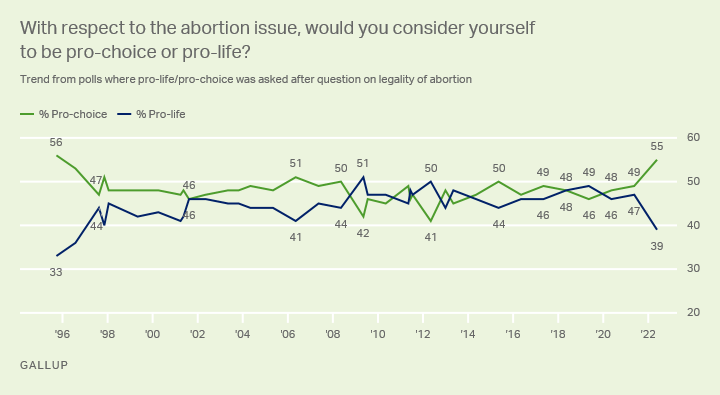
Fringe? At several points in the last 20 years “pro life” has edged slightly ahead of “pro choice.” https://content.gallup.com/origin/gallupinc/GallupSpaces/Pro...
Fringe; from ethics point of view “pro-life” is no different from flat earth.

Many countries legalized abortion over the past 20 years; very few went the other way.

> Fringe; from ethics point of view “pro-life” is no different from flat earth.

This facts are all scientifically indisputable:

1) A fetus is a genetically distinct and unique human life from the moment of conception;

2) By 6-8 weeks, an embryo has a four-chambered beating heart;

3) By week 12, a fetus looks recognizably human, has a face, fingers and toes, internal organs, etc: https://www.mayoclinic.org/healthy-lifestyle/pregnancy-week-...

All of these comprise scientific bases for the range of "pro life" positions.

> Many countries legalized abortion over the past 20 years; very few went the other way.

So what? Eugenics was seen as a progressive advance in the early 20th century, before humanity reversed course. "Progress" doesn't happen in an arc, but hits dead ends.

>This facts are all scientifically indisputable:

They are also all irrelevant. We don’t force parents to donate organs for life-saving transplants; why would we have a different rule specifically for uterus?

Worth pointing out you’re comparing the idea of bodily autonomy, one of basic human rights, with eugenics, because it opposes a certain religious superstition.

I’m pro-choice, but this is a bad argument.

In the case of abortion, the default (inaction) means the baby lives, whereas having an abortion is an active action which ends the “life” (I don’t entirely believe it’s a life up to a certain point, but just conceding it for the sake of argument).

In the case of forced organ donation, not donating unfortunately results in the death of the other person, but that’s the default state (inaction).

For those with agency, we place greater moral weight on active actions than on the absence of action.

I'm curious, do you not agree that the life in the womb is valid, or is it that you don't even agree it's a life?

In other words, is it that you acknowledge what is inside _is_ a life but you reject the validity of its right to be alive ? or do you _not_ agree that it is a life in the first place, therefore it couldn't possibly have a right to be alive?

Why not? The slippery slope tactics used by "pro-choice" can be used by the other side, too.
That doesn’t follow at all. The law recognizes numerous degrees of culpability even for intentional killing of another human (e.g. premeditated versus not). In Texas, second degree murder carries a penalty of 2 to 20 years.
In most states, first-degree murder is defined as an unlawful killing that is both willful and premeditated.

So, it comes back to my first argument - if you really think that an abortion is the murder of a human, then it is in the first degree, right? And if so, the penalty would be pretty high. Are you OK with that?

> So, it comes back to my first argument - if you really think that an abortion is the murder of a human, then it is in the first degree, right?

Why would that follow logically? Willfulness and premeditation are two aggravating factors that make first degree murder “worse” than lesser degrees of murder. That doesn’t mean that those are the only factors that can be used to distinguish different degrees of culpability for killing a human. The law of homicide is extremely sensitive to context and circumstances.

It’s entirely consistent to believe on one hand that abortion is murder (intentional killing of a human being), and to believe on the other hand that the circumstances are mitigating factors that lessen the gravity of the offense.

It’s even consistent to believe that abortion is murder, but doesn’t warrant any punishment at all—like killing in self defense. Under German constitutional law, for example, abortion is deemed a deprivation of a right to life that begins at conception. But the German constitutional court has held that, nonetheless, the state doesn’t necessarily need to criminally penalize it.

The penalty for murder is highly variable. Murder of small child is often a pittance compared to an adult.

There are other arguments involved. Was the murder brutal? Did people depend on the victim? Children have no dependents, though this is offset by the vulnerability and future life of the victim.

Moreover, if abortion is murder, then there ought be no exception for rape, as killing children for psychological relief ought be a repugnant exchange.

And the insurance companies, doctors, and medical groups involved are basically in an industry of assembly line baby murder for money. The culpability of doctors cannot be the same.

Pro-choice people seem to want it both ways when it comes to exceptions for rape. If there is an exception for rape, they say the pro-life law is bad because "see, it's not really about the lives of the children, it's just to control women's sexual choices". And if there's not an exception for rape, they say the pro-life law is bad because "look at all these really young rape victims who will now be forced to bear their rapists' children".
Thanks for reminding me why the only correct person to decide whether to terminate a pregnancy is the mother, no matter how much you may dislike the outcome.
My point is that if you're against an exception for rape victims, then any arguments you make against pro-life laws that only apply when such an exception doesn't exist should be completely discounted.
Huh? I am against such "exceptions" because I don't think there's any good result where the government has the right to force women to remain pregnant even when they have compelling reasons to not want to do so. Abortion should be criminal when it can't done safely or is not done by a suitably trained professional, that's the only case I do accept a law is needed. And the US is going to see a lot more of such abortions in coming months/years.
>It seems to me that if you truly believe that an abortion is murdering a human, then the penalty should be the same as the murder of a human who is already born.

I fully agree with it. The punishments for murdering unborn children are too mild. They should be more severe.

Yet another victim of Catholic hate preaching.
Ask people who think that a pregnant woman is carrying around an unborn human if they agree that all the other laws that apply to humans and children should apply to these "unborn humans".
American conservatives are utterly hypocritical and self-inconsistent. The things they believe don’t even pass the sniff test with their own rhetoric.

It’s not based on logic. It’s based on emotion. America was founded by the Puritans.

It’s not about life, it’s about control.