▲ 25 points
back
34 comments
Living close together does not seem to be optimal for mental health. Quite the opposite. Physical proximity to other humans is not the same thing as community. One can be very alone and feel anxious whilst been surrounded by other humans.
Absolutely this. I was a huge fan of living in cities ages 18-24ish (Chicago, Vancouver, Seattle) and couldn't picture myself elsewhere - but the pandemic, my own mental health, and just generally a desire in life to be at peace while the world around me gets crazier, drove me out to the woods and (soon, for a change of pace) the sea. I have a few close friends I see when I need in-person interaction, I volunteer with an important education-adjacent org when I need to feel connected to a deeper cause and community, and otherwise, I am so tired of constantly having to hear other humans, be subjected to unending car pollution (air quality and the less-discussed one: tire and engine noise pollution), pay exorbitant and extortionate rent, and many of the other concerns that come from living in dense places.
There's no right answer for everyone. Some folks will only thrive in one environment or the other, and that's fine. But as for me? You'll catch me continuing to peruse listings for acreage in far-flung places where I can be left alone.
Almost all mammals studied (and other vertebrates too) show stress (e.g., elevated cortisol levels, abnormally aggressive behavior) when exposed to high population density. This is true even when the population density is faked (e.g., studies placing pictures of con-specifics in the wild or playing animal sounds).
Obviously, there is also a lower bound for density, too (gotta find a mate). I think this explains why young people like cities, but once a person has a mate and progeny they move suburban or rural.
Close together != closer together. People usually don't deal well with isolation as proximity. It is thus not opposite, but a function with a personal optimum. I can certainly see how for some people some more proximity would be instructive and thus beneficial for them.
To all people scared of density on here: Paris is one of the highest density cities in the world [1], and we're doing just fine. We even have a lot of room for tourists. A large portion of us don't even have a car, and don't need one. We can rent one for vacation, and the public transportation complements well our walkable and bikeable city.
It doesn't have to be Karachi or Manila.
[1] https://en.m.wikipedia.org/wiki/List_of_world_cities_by_popu...
The city of Paris is tiny and covers just a small portion of the total "Paris metropolitan area". The metropolitan density of Paris is lower than most US suburbs. The city of Paris would not work at all without the significant "Regional Natural Parks" right outside, but also without the significant suburbs.
The chart you cite is flat out wrong. It claims to be "metropolitan areas", but Paris' entry is only for the City of Paris. The comparable wouldn't even be New York city, which is very nearly as dense - It would be Manhattan Island.
Paris' metropolitan area density is 690/km2, which is less than the not-dense King County[1] that I live in, and comparable to the mostly-rural Snohomish just to our north.
People need room. A very dense city center is a great place to be for a few days, a few months, a few years, and it's not as if nobody ends up living their their whole life, but most people move to places with space because they want space. Paris is significantly less dense than it was 100 years ago[2]... for precisely that reason.
A strong city core with suburbs is a good way to live. We need more of them - More large cities with a 10^9 people surrounded by a suburb of 10^10, not megacities with 10^11 people cramped in endless rows of tenements.
[1] https://archive.ph/20200213233400/http://factfinder.census.g... [2] https://en.wikipedia.org/wiki/Paris#Demographics
America historically hasn't done very well with moderation or restraint. When most Americans hear "we should have more density," they immediately think of Kowloon's high-rise buildings, or New York City everywhere. With good reason! If there were no limits at all, that is certainly what developers would build, as it's very efficient in terms of revenue per area of land.
There's a middle ground that is available in many places around the world, in which zoning allows for much denser building, but at a higher standard of noise reduction and stability, and not so dense we all live in high-rise apartments.
I don't think we should build high-rises everywhere, and I hate American-style wood frame apartment buildings with nothing but drywall separating apartments, even as I like the zoning changes that have allowed the "5 over 1" buildings to spread. Retail on the ground floor with apartments above is great! A variation on "5 over 1" that required concrete walls and better windows would be welcome, I think, although developers would always choose the wood-frame buildings if allowed to.
Overall I'm saying: think less of Shanghai and Manila, or Manhattan and Chicago, and more of Barcelona and Paris, of a sort of area that doesn't seem to exist in the US: with minimal roads and "soundproof" apartments.
I dont know, the frenetic rebound of tourism this year tells me that people don't want to live closer together unless they have to
It's been noted that American tourists absolutely love the charm and density of European cities when they visit but somewhere over the Atlantic, they forget that they could have that at home too, if it were legal to build.
Would American high density look like charming antique cities, or would it look like China's modern made high density? Shanghai was cool to visit but I definitely wouldn't want to live there. Or would it look like something else? Changing zoning is not going to suddenly create charming 300-1000 year old walking cities highly curated and subsidized by tourist dollars to make tourist destinations but that sure gets pushed on every one of these HN stories.
American's go on cruises (a super high density vacation) that are very communal. Do you want to recreate the 'cruise' experience in every American city? American's go to Disneyland for vacation, does that mean American's love waiting in long lines and we should design cities around long lines and overpriced fast food?
Plenty of Europe is brand new and still high density and walkable. It’s not a historical accident, but an actual urban design preference.
I live on the very edge of the city. The farms start right after my townhouse. The urban environment stops at my doorstep, but I am fully in the city and have a convenient electric trolley bus line, walkable shops and restaurants and a great bike infrastructure. A new neighborhood of flats is going in, replacing the farms across the street which is about 800 units in 40 densely packed buildings, similar density to the city center. You would have to be in the center of NYC to see that density in the US.
So much this.
I'm american and have been living in Europe for almost 15 years, and it still shocks me how unbelievably poor american cities are, almost universally. The modern trend of "re-densifying" has really only ended up building out load of expensive yuppie bullshit housing that no one will live in past the age of 35, much less raise a family in.
I think it's safe to say that city planners in the US just don't really get it.
No kidding. Safe walkability in the US is a premium luxury good. If you want to raise a family in a nice walkable neighborhood, basically anywhere in the country, expect to pay exorbitant housing prices. That same neighborhood in the EU would be a dime a dozen. Small Eastern European cities have better urban design than the US capital or anywhere else.
>Changing zoning is not going to suddenly create charming 300-1000 year old walking cities
No, nothing is sudden. It's always transitional; everything is a gradient. You have a gradient that starts at least dense all the way up to most dense. The problem is polarized American thought that immediately imagines mixed zoning to be someone building a mega skyscraper next to a single family home. In reality, someone will build a duplex. Further down someone might build a multilevel quadplex. Further down someone might build townhomes, then further down residential on top with business on bottom. This takes decades on time scale, but this is what people are advocating for.
>Do you want to recreate the 'cruise' experience in every American city?
Sure, in some places at the end of the gradient where things are most dense (and land is most expensive) it would make sense. There are people who absolutely want this experience for every day life.
>American's go to Disneyland for vacation, does that mean American's love waiting in long lines and we should design cities around long lines and overpriced fast food?
In my suburb, people love to wait in long drive-thru lines for overpriced fast food, so based on my experience, yes. But to answer your questions, should we design cities around one specific way of building and make it homogenous? No. There is a whole variety of different structures to be built before the cruise ship: https://missingmiddlehousing.com/wp-content/uploads/2020/07/...
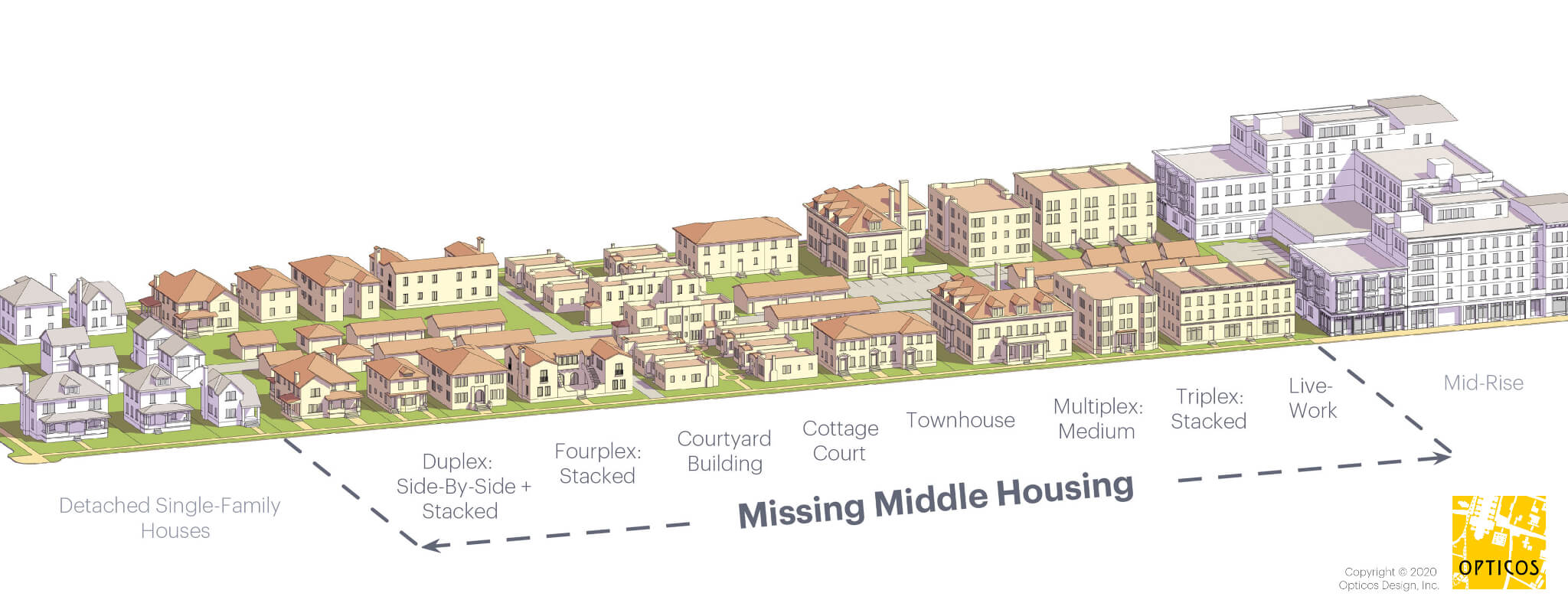
Only a person living on a farm would have enough straw for that strawman :). Again people view this as a choice of suburbs or Manhattan, with nothing in between. Removing zoning allows for choice, freedom, and possibilities, where there is currently none. What happens after that is going vary too much to summarize in an HN comment.
The straw man I was replying to you mean? Zoning allows my to build a house and know there won't be an asphalt plant built down there street(something I had to fight being granted an 'acception'). Zoning gives me the stability to know that THE LARGEST INVESTMENT I will make IN MY LIFE will be suitable for my intended purpose. Without stability you will end up with nothing.
Or perhaps they realize they only enjoy visiting such places because they couldn't have their larger houses, yards, cars, and whatever else they want.
There are plenty of places that would I would be interested in visiting but have no interest in moving to.
Different people have different tastes. The high price of dense areas in the US shows a demand that is currently impossible to meet due to zoning.
Eh, everybody wants to blame zoning. Yet that ignores the preferences of the population - many people want single family homes with a yard. You can build a bunch of condos and apartments, but it'll will only help until you hit a certain percentage. Nobody wants to build a ton of apartments if their competitors can too, as it would drive down the cost. Even then you run into the preference problem - people want to buy eventually. So yeah, changing zoning can help, but land, especially with specific geographic areas, is still a finite resource in high demand.
Why don't you sing the praises of Egypt, Thailand or the myriad of Caribbean islands? Tourists love those places, hell they love anything as long as you keep the ugly out of view. I grew up in a first world tourist town. It was a meth ridden dump full of swindlers and was absolutely no place to raise a family unless you had some tourist business your kids were keen on inheriting and running. "Tourists like it" is completely and totally tangential to whether somewhere is nice to live.
Disneyland has a sign that says "The happiest place on Earth". If it was just because of the crowds, then we would see the same sign at most major airports.
I live in a terraced house. It's a good compromise. I have a small garden, a front door, I actually own the land and can work on my own house, and I have walkable public transport and metros.
There is literally no reason for me to live in a flat other than if society does that silly thing where they don't build enough or let hoarders buy everything. It's race to the bottom BS.
Just don't let that happen and there you go, problem solved.
Given all the urban unrest and pandemic in past couple years, this reads like a reactionary or PR piece to discourage even more people from moving out of cities.
Cities are completely unaffordable right now. If you raised concerns about a sudden glut of empty and available homes, you'd be laughed out of the room.
Not if that room was full of REIT managers. They sometimes hold empty units to boost the prices of the others. Essentially constricting the supply side for larger margins.
It seems prices have risen just about everywhere. Even rural raw land has gone up substantially in the past couple years (what I'm interesed). It should be no surprise with inflation, the increase in the money supply, and some increase in wages, that real assets are "expensive".
Housing vacancy rates are lower than they have been in a long time. That’s not it.
https://www.census.gov/library/stories/2022/05/housing-vacan...
"...characteristics of units available for occupancy."
Those numbers don't include unavailable units, such as the one's REITs might make unavailable.
I was curious so I clicked through to the Census definitions:
> Vacant Housing Units. A housing unit is vacant if no one is living in it at the time of the interview, unless its occupants are only temporarily absent. In addition, a vacant unit may be one which is entirely occupied by persons who have a usual residence elsewhere. New units not yet occupied are classified as vacant housing units if construction has reached a point where all exterior windows and doors are installed and final usable floors are in place. Vacant units are excluded if they are exposed to the elements, that is, if the roof, walls, windows, or doors no longer protect the interior from the elements, or if there is positive evidence (such as a sign on the house or block) that the unit is to be demolished or is condemned. Also excluded are quarters being used entirely for nonresidential purposes, such as a store or an office, or quarters used for the storage of business supplies or inventory, machinery, or agricultural products. Vacant sleeping rooms in lodging houses, transient accommodations, barracks, and other quarters not defined as housing units are not included in the statistics in this report. (See section on "Housing Unit.")
Unless they’re actually demolishing the houses (and they’re not) then it counts regardless of whether it’s currently on the market or not.
EDIT: Though sure, those might not be reflected in the rental or homeowner vacancy rates. So I looked this up and it has indeed not dropped lately... it also hasn't particularly gone up lately either though: https://fred.stlouisfed.org/series/EOFFMARUSQ176N
Depends on the room. A glut of empty and affordable homes would also signal a downturn in the housing market which would probably upset some people.
I have some half formed thoughts on this.
Once, I lived in a small rural college town (land grant - the U of Idaho). I could walk or bike anywhere I needed to go. Cars were required in practice if leaving the city.
I used to live in outer ring Seattle proper (Roosevelt/Ravenna n'hood junction). It was a drive to the store, but an easy walk to the bus. Buses got me where I needed to go, mostly - if I needed to go to specific zones. Most of the surrounding blocks were SFH, with a business corridor nearby.
Later on, I lived just outside of the 'urban core' of Seattle( Lower Queen Anne ). This was a full mixed use zone. I could walk to daily needs, but busing was frustratingly constrained to specific target areas (Downtown, Capitol Hill) in practice.
In both of the Seattle scenarios, I lived in an apartment building. Neighbors were deeply uninterested in talking to each other, as a rule. While I could get to know some of the baristas, in general, social behavior was limited to organized clubs, not place-based friendships (unlike the usual predictions). This is a known thing about Seattle.
Now I live in a smaller city (Spokane), in a 1900-1920 era neighborhood, and I can walk to my daily needs still. I live here in a SFH. The local culture is much more welcoming than Seattle.
One of the angles that I personally ran into and found frustrating is that apartment buildings _as they are built_ are not set up for families with children. Things from outside decking (painful to fall on) to railings (easy to fall over for climbing kids), lack of adequate play space, etc. LQA in particular was _remarkably_ unfriendly to children, and most families I encountered in the daycare seemed to be on the road to moving out - as I did as well. Part and parcel of increased density thinking - for it to be successful as a long term strategy - has to incorporate design elements that address the full human lifecycle and experience: children are a pretty fundamental part of that, that is _left out_ of much (most?) urban buildouts in the past 1-2 decades.
There are other issues in density - if you hold crime, drug abuse, and homelessness constant per capita, when you have more people per sq mile, you have more social issues per square mile, and _that_ seems to be a problem the United States hasn't solved in its cities at all.
This is PURE FOLLY. Really. Cities always have problems but in the past they also have many advantages, being dense means having sewers problems, who led to health problems, but also being many skilled in different things, able to defend against enemies, able to communicate in a world without powerful transportation means etc.
Nowadays cities are needed:
- by dictatorships since very few can control very many, making them dependent on city services and so unable to revolt;
- by surveillance capitalism to keep people surveilled and as above dependent from ton of services since there is not enough space to be autonomous in any case.
MARGINALLY cities are needed for having enough people together to meet interesting people from any cohort of interests, but that's now marginal thanks to TLCs and IT development, not from today in the era of the anti-social networks, but already in the past in the usenet/BBS era.
MARGINALLY cities are needed by certain cohorts like elder people to being able to live well while being not able anymore to travel and not interested anymore in different activities in nature.
To being able to evolve, just toward the flying cars McKinsey want [1], just toward a retail-delivery economy, just toward renewables, just toward resilience we damn need FAR LESS dense areas. Single family homes mixed with small buildings for various working/service purposes with enough space to evolve, to have room for p.v., drone landing, delivery of large stuff etc. Modern smart-cities are just old capitalism factories fusioned with their old slums to keep a handful of slaves ready to work in slavery condition.
[1] https://www.easa.europa.eu/sites/default/files/dfu/uam-full-... and
How do you think the carbon footprint per capita compares between urban and suburban areas?
Take a look at this study by UC Berkeley [1]. It is quite clear that we need to be reducing our carbon footprint, and living in cities is the responsible choice unless the global population begins to plummet.
Compare in what time frame? Cities can't evolve. You can now build a new tall building full a small apartments with the best insulation etc "A class". In 10 years it will be far less efficient and there is no way to improve it. Similarly you can build single-family homes and re-made them when they change owner. The scale and amount in involved peoples permit that. As a result if you compute the "carbon footprint" (witch have normally NO ecological meaning, it's just a means to munge money BTW) of a hypothetical new city vs an equally hypothetical new riviera you can state the city is better. If you enlarge the timeframe to 50 or 100 years the result reverse.
Similarly if instead of computing a hypothetical new city you compute a REAL present city and the "needed investment" to improve it keeping the density at a similar or even more dense scale than you obtain horrific results for ALL cities, especially for the big and dense ones.
Carbon footprint concept is just a classic management game, meaningless in scientific terms, but dressed as science to be sold to a receptive public. The reality is that we know we need to evolve and we know cities can't evolve. UN New Urban Agenda was made as a way to force people in factory-cities, like nazi interment camps or soviet union gulags, to use them to produce a new society for some others.
Capitalism simply have reached a point John Maynard Keynes and Rosa Luxembourg both predict a century ago: now that the entire world is run by capitalism there is no one to steal we need to create one. That means enslaving a vast cohort of population to try replicating a classic colonialism development model. Carbon footprint as a social score is try to classify people by census, since of course if you are poor you likely live in an old building, typically an apartment, your score is then horrific. If you are wealthy you likely have resources to build a new house, with p.v. and co to improve the score computation as a result your score is good. Since your score is good you are obeisant (in the sense that you use your resources to enrich those behind the Green New Deal, and you still been able to pay more in the future) you are allowed to live in a luxury building profiting from the poor's who work in the modern smart-city.
Oh, you might state that that's an ideological position, but in that case try to design a new society from the present to a projected 2030+ future. Try to be honest in the simulation and see the results. Similarly see the Toyota Smart City demo https://youtu.be/p-9X8Z2kJt8 and read about https://www.theguardian.com/world/2021/sep/19/why-greeces-ex... try finding similarity and differences. Go ahead and imaging a new modern city made to be ecologic, compute how many things are needed to make it and once built how can or can not evolve. Do the same for a vast riviera of small buildings where general infra (like roads, water, electricity, ...) are reduced to the minimum. Try to see what McKinsey publish in their future vision, like https://www.easa.europa.eu/sites/default/files/dfu/uam-full-... and try to imaging how such vision can work ONLY for VERY FEW on top of all others simply because of density scale.
It's quiet clear, at least to me, the future some want for humanity, and it's also clear most humans do not even have tried to imaging a realistic future based on their public agenda.