▲ 43 points
back
139 comments
Reminder that the US use more electricity for its domestic-use AC than the entire African continent for its global energy consumption.
Source: https://e360.yale.edu/features/cooling_a_warming_planet_a_gl...
That’s a fun fact. The US also roughly produces as much renewable electricity as total African production. Total African energy production is projected to grow faster than renewable conversion in the US, though.
How is it remotely fair to compare a highly developed first world country with third world energy usage?
The implied unfairness there becomes a bit more fictional when you consider that an electricity user in Washington state isn't exactly competing with an energy user in Gash-Barka region.
Where such a comparison does become intensely valuable is when the EU says things like "we will do whatever it takes" in relation to energy and food. The implication there is "we will out-bid anyone" and "anyone" happens to be Africa and much of Asia. That's quite a horrendous way of using your currency to export the famine and freezing that you deserve to people who had no say in your bad policy decisions.
What is the call to action, or how is this useful? Can we shut off USA ACs and package the saved electricity to send it to African nations?
What if this said, "Reminder that the US use more electricity for its domestic-use TV than the entire African continent."
Electricity consumption is an indicator of economic success. FWIW, I own neither AC nor TV.
That is actually a mind blowing comparison. I knew heating/cooling is energy intensive but damn.
And?
It's funny that air con is seen as a wasteful luxury, but nobody blinks at a heating bill, even though the average household spends 4x more on heating.
The negative externalities are interesting though: using air con inside makes your outside that much hotter on a hot day, whereas in winter, nobody worries about waste heat leaking out.
Thank you! I find the opinion that AC is somehow a decadent luxury but heating is essential to be a very Northern US/Eurocentric view.
From a pure energy usage perspective, it may make more sense to live in a warm climate that never needs heating versus a cold climate that never needs AC.
It's not a wasteful luxury. It's critical. But more attention needs to be paid to overall efficiency. Better home insulation and building materials, and better AC unit placement and better units themselves.
France as a policy to reduce heating energy in households aswell.
It's even seen as a primary mean to reduce energy waste.
People are more and more conscious that you don't need to heat your house at 70F+.
It's ok to live with a sweater on.
> The negative externalities are interesting though
They're not interesting, because they're absolutely negligible. You're moving heat that was outside, back outside. Your house cooled the outside, and you're just undoing this insignificant amount of energy transfer. The only additional heating is from inefficiencies, which aren't so bad these days.
Also when A/C cooling is needed is very linked to when PV generates energy.
I’m surprised it hasn’t been increasing faster. The US is in the midst of drive to replace heating systems of all kinds with more efficient heat pumps, with massive effort behind it, including restrictions on other kinds of heat, significant tax returns for upgrades of existing systems, etc… and they are lumping heat pumps into the figure.
> 88% of U.S. households use air conditioning (AC). Two-thirds of U.S. households use central AC or a central heat pump as their main AC equipment.
The cost of central air has been dropping (it was something like $3k add-on to a furnace replacement) and so rarely do you install or replace a furnace without A/C, and once you have central air, you just set it and forget it. Even a fancy thermostat is going to use more energy than a loud window unit that you turn off whenever possible.
If you use a heat pump in winter you do actually make outside colder. So there is that analog.
I wonder how this may relate to all the pandemic WFH. Where I live, many residences don't even have AC though it's common in offices. However, if you're home during the hottest part of the day and have to wear something that covers your shoulders for video calls, it becomes a lot more necessary.
The article describes growth from 87% in 2015 to 88% in 2020. If there's an impact from covid it's either tiny or this data was collected too early in 2020 to show it.
Fan blast away
But where I live we still need AC, fan just allowed me to put it at 80 instead of 75.
I find it difficult to imagine life without air conditioning.
I'm generally hot and without it ... can't imagine how I'd make it.
I sometimes think I"m not far from living life like the people in WALL-E, tied to my machines (in their case chair) unable to manage otherwise.
I'd have to move way North to be able to sleep OK without AC. Or maybe to a desert area with high elevation, for those nice, cold nights.
Discovering how much better I sleep when the temp is in the 62-66F range has made a big difference. I'd hate to go back to trying to sleep with temps over 68F, certainly. Over 72F and I basically can't sleep. I mean I'm sure I'd acclimate to some degree, but it's not like I was already used to sleeping in colder temps before I tried it, so I'm pretty sure that range is absolutely better for me, regardless of what I'm accustomed to or able to tolerate.
It's not your fault, it's your house's. Modern houses are designed to be mechanically ventilated. Older houses were designed to have better thermal mass and better airflow. I have a friend who lives in an 1800s-era "summer home" (designed specifically for the wealthy to live in during the summer). It is quite comfortable during the summer without the AC on.
Just spend a couple of weeks without it, you’ll be fine and come out the other side much more tolerant of heat.
This is the case of most “I can’t imagine” situations, just do it for a bit and your fear will prove mostly unfounded.
I grew up in San Jose without AC. But it didn't regularly hit the 90s in the summer, it was a dry heat, and we had cool nights.
I used a fan. On especially hot days I would have a bowl of water with a wash rag to help cool me down.
My grandmother grew up just down the road from where she lives now. They didn't have electricity when she was little and remembers clearly working outdoors in the heat. Summers used to get cold enough that when they'd go fetch the cows in the morning they'd run barefoot through the grass to the back pasture and their feet would be so cold that they wanted to cramp and it was a race to see if you could get the cows up and moving (so you could stand in the warm spot from them sleeping) before your feet cramped up. A handful of nights a summer they'd sleep outside because it was too warm inside (there was a banked wood stove running of course) for comfortable sleep. It would be cold enough overnight that they still needed blankets outside.
Now its so hot that she can't imagine not having air-conditioning. An elderly woman (you know how they love the heat) that worked in the fields and cannery her entire life thinks its too hot outside.
Window ledge air conditioners weren't invented until 1932. There are still living seniors (like my grandmother) who for all practical purposes grew up in a time before air conditioners were affordable and generally available.
I'd prefer going without heat... And I'm in the north!
Other than the certainty of frozen pipes
I never had A/C at home until I moved to the US Midwest a few years ago. In a hot and humid climate, you just have to design buildings and communities for the climate and adapt your lifestyle so that you're avoiding the heat. In a tropical climate, tree cover and designing for capturing the prevailing wind does most of the work. Urban heat islands are a challenge to be sure, but my apartment was fine. Once your body is used to it, you feel fine going outside and doing things without feeling like it's unbearably hot.
Living in the Midwest in a climate controlled house has definitely changed my tolerance for the heat, and I find it difficult to sleep in the heat when I travel back to my hometown.
It is extremely location dependent. I don't have A/C, just use fans for a few days a year.
I grew up in the inland swampy portion of north Florida. My dad didn't believe air conditioning was necessary and I grew up without it from birth to 18 when I went away to college and then from 22-24 when I moved back home. He designed and built our family home to essentially be one very large room (with bedrooms off the main room) with a huge number of screened windows and ceiling fans.
I assure you, in that climate, it's miserable. After a few years though I guess you just get used to it. Take a shower and never get dry. Sleep with every window open and still sweat constantly and be covered in bugs, too. I remember during a hurricane the power went out and stayed out for nearly a week in mid-August. We pretty much spent that time in our neighbor's swimming pool.
Our refrigerator couldn't handle the heat or humidity and more than a few times we'd pour the milk and it would come out solid.
That said, I survived. You'd be surprised what you can get used to and live through, even if it's unpleasant.
Before AC, Americans mostly lived in cold parts of the country, and heated to get to a comfortable temperature. AC allowed comfortable temperatures in warmer areas, and there's been a huge migration to the sun belt. This process has decreased our energy needs, because the average American now lives in a place where the climate is, on average, closer to a comfortable living temperature than they did a century ago.
There's lots of anti-EV FUD / hand wringing on social media about "how will the power grid handle all those electric cars?!"
Meanwhile... few similar statements about air conditioning. Which in my house -- and that of everyone else I know with an EV -- uses many times the amount of energy that charging a car does. Even when I was commuting 100km a day.
Air conditioning is the cause of pretty much all brownouts where I live here in southern Ontario.
Grid resiliency is obviously important on both fronts. And AC is critical. But it's also really expensive from an energy POV.
Hmm that's weird I haven't seen any anti-ev fud. If anything it should stabilize the grid especially if they're smart about when they charge each night, and can feed a little energy back when needed.
If the power grid can't handle everyone running AC, how will it handle everyone running AC and also charging cars?
EVs adoption adds stress to an already overstressed power grid. The grid needs to be improved if we want EV charging to be available to the masses. It's not FUD, it's just obvious.
TIL I live in a marine environment. When I first moved here many decades ago, everyone said you don’t need AC. Nobody says that anymore. The winters have noticeably gotten wetter and the summers have gotten hotter.
I guess I am in the minority because I don't run an AC unit in my bedroom office here in Ann Arbor, Michigan. The humidity can get a little miserable during the height of the day, but it's completely tolerable as your body adjusts. For the few days each year when we get into the 90s, I strap a couple of reusable ice-packs from my ice chest to my back, neck, and seat. This method works exceedingly well for affordable cooling until the night temperatures bring everything back into comfortable territory.
I visited Texas this summer and the consistency of the 100+ degree days turned me off from ever considering that part of the country. I find that it's just too hostile to life; heaven forbid you experience a power outage for a week causing your AC to become a useless heap of metal; what then?
Edit: Does this data count heating as well? Whenever I hear "AC" I typically think cooling, thus my main comment is focused on that aspect. Heating here really only needs to be enough to keep pipes from freezing, beyond that, it's very easy to stay warm with enough clothing, blankets, and body movement.
I just sent my kids to their first day of school on a 97-degree day. In Portland, Oregon, which is about 100 miles farther North than Portland, ME. My AC has been on pretty constantly all summer. There, of course, is no AC at the school. Why the heck would their be? It's not even in session during the summer in a mild climate.
I remember when we moved in to our current house in 2015; we did the first summer without AC, but had it installed for the next year. Felt like a comfort/luxury thing. We had a bit of cash and thought it would be fun to have central air for the first time. Now I honestly don't know what we'd do if it broke.
My partner and I go without AC for most of the summer unless we have company or if it gets to 100 F. It is difficult at first, but your body does acclimate after a week. I usually have a fan blowing next to me while working from home, since my office room doesn't have any AC anyway. Take away my fan, and I'm screwed. Of course if go to a movie or restaurant I have to bring a long sleeve shirt, because it will feel too cold. :)
The "need" for AC has to be subjective.
One century ago no-one had AC, and even today I suspect that billions of people live in hot climates without AC. Sure you may argue that some of them may not have running water or toilets, either, but I think AC has to be on the 'luxury' side of the scale and also something really 'needed' when people fight the local climate instead of adapting to it.
This is likely simply due to the fact that more homes have AC now:
... "By 1980 that number had risen to 63%, and in the 40 years since then air conditioning has grown exponentially and is now present in a whopping 95% of homes in the US according to the most recent US Census." https://www.fixr.com/blog/2021/06/22/presence-of-air-conditi...
You might say that this is because we need it more now, but I think it's actually just that we can afford to install it now in every new home and so we do. It's just considered standard equipment.
One significant improvement in energy expenditure would be to continually increase the standards for insulation and air sealing. Many folks could cut their bills for heating and cooling in half by making substantial upgrades here.
I have a evaporative cooler and it works well until the temps hit 100F (which has been a more frequent occurrence in the last few years). My neighborhood seems to be slowly converting to mini-splits.
I think there's still a lot of low hanging fruit to pick to keep structures cool that we just aren't utilizing because of aesthetics/tradition/fashion. Solar reflective paint, retractable sun shades, etc. "Low-Tech" solutions to knock a few degrees off of the structure's internal temp could make a lot of difference.
Takeaway: more people in California and the Southwest want AC.
https://www.eia.gov/todayinenergy/images/2022.05.31/Chart2.s...
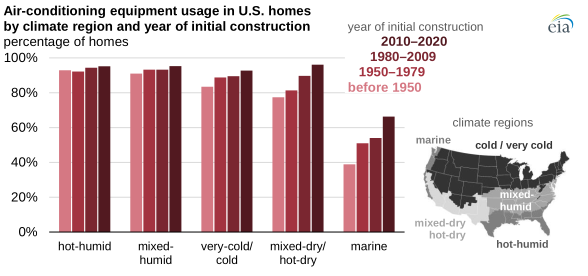
My AC is on 24/7 during the summer months.
Come at me, bro...
I wonder how much we could reduce A/C usage by changing how we build. Contractors seem ignorant of traditional practices that used to help in part no doubt because they think they can throw A/C at bad design.
For instance, what if we used masonry instead of wood frame houses (masonry tends to insulate better; look at infrared pictures of American wood frame houses and European masonry). Also, orienting houses in proper relation to the sun and arranging rooms in a way that facilitates better air flow (embrace the summer draft). Also, evaporative cooling. I am not proposing we eliminate A/C, only find ways and build in a way that allows us to cool houses for cheaper or even for free.
The world is warming. Even if we do everything we need to starting now, it is too late to prevent it from getting warmer for the near future.
We will have more deadly heat waves as a result.
We desperately need to install even more air conditioning.