▲ 127 points
back
18 comments
Higher resolution[0], and another subject from similar angle[1].
My grandparents lived in Brooklyn, and when I was pretty young, they took me to the roof of one of the Twin Towers, the Empire State Building, and across the ferry and up the Statue of Liberty, probably in 1975/6. I still remember bits of that visit, that it was an overcast day and very dark, and from the roofs, I couldn't really see anything because I was probably still under 4' tall.
In 2001, I was working at a startup in Austin. I saw the second impact on television, and the rest of it. I followed my boss home, and in his mail that day (had arrived the day before) was a piece of tourism marketing from New York. It was a postcard with an image of the Twin Towers from an angle above, and written across the image was the enticement, "Get up! Get out! Get away!" Surreal.
[0] https://cs12.pikabu.ru/post_img/big/2021/04/20/10/1618940061...
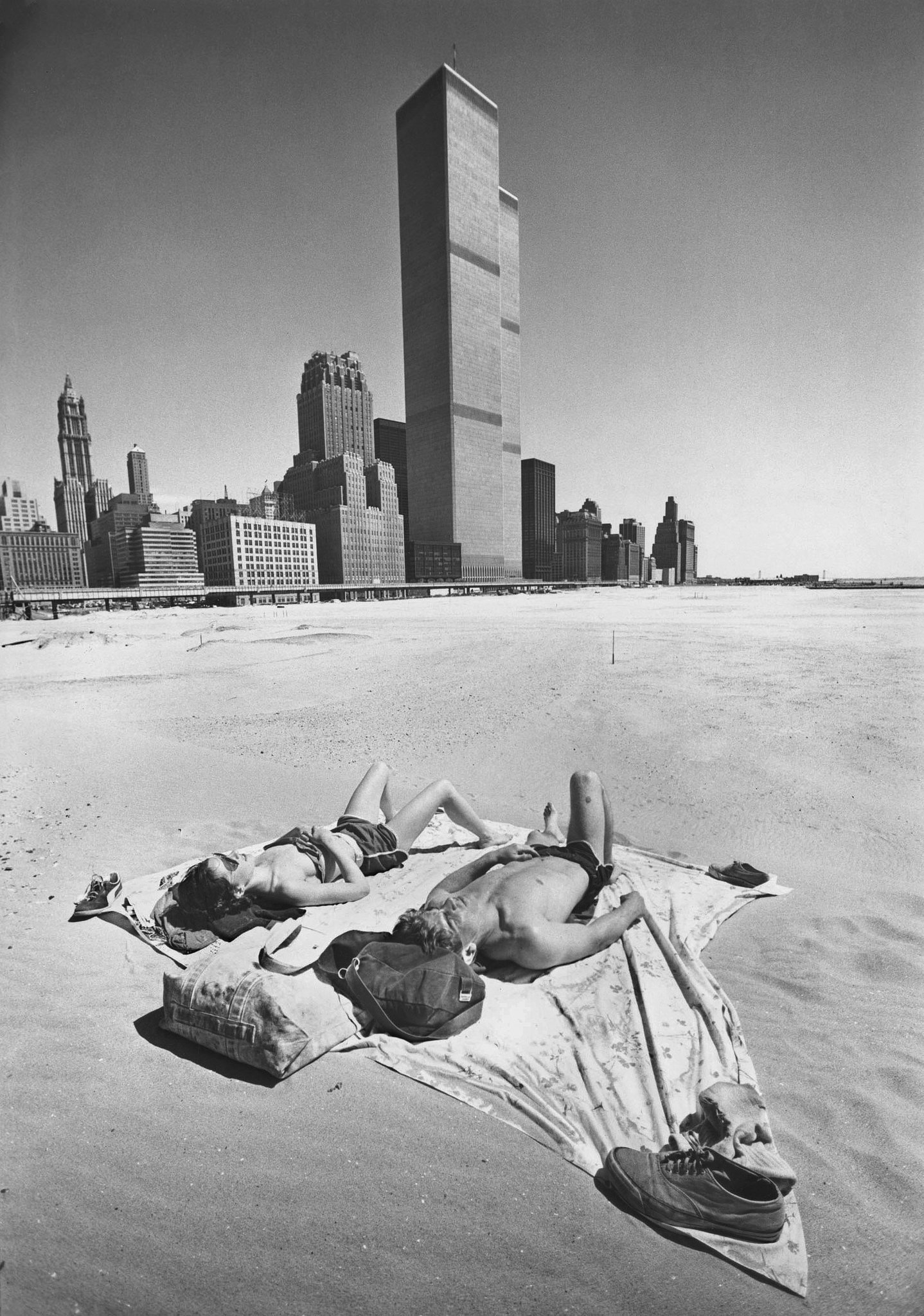
[1] https://static01.nyt.com/images/2019/03/30/lens/29-photograp...

https://www.nytimes.com/2019/06/17/nyregion/battery-park-cit... (https://archive.ph/gTVgM)
It’s a Beach if We Say So: Lost Scenes From Downtown’s Hipster Landfill
Before Battery Park City, artists and sun-seekers made themselves at home.
Great photograph, and awesome right up.
But I feel the whole thing could do with a map for context.
What are the reclaimed portions? I agree with you about the need for a map, but that map does not show what was reclaimed from the sea.
This project from the NYPL has pretty good information: http://spacetime.nypl.org/the-changing-shoreline-of-nyc/
That site is horrible, I couldn't navigate it. Thanks, anyway.
It also doesn't show the landfill under the WTC itself.
these might be useful:
http://2.bp.blogspot.com/-XabzkD02Sqw/TyLIsZvsPgI/AAAAAAAAWF...

https://www.smithsonianmag.com/history/interactive-map-compa...
It's definitely not complete, if it were basically the whole lower half of the island would be highlighted.
This is awesome! THIS is (one of many reasons) why we need libraries in the world! Thanks for sharing!
It's easy enough to navigate (just scroll downward), but the text could use a lot of editing for grammar and clarity. Fascinating nonetheless.
Amazing quote:
  > The World Trade Center officially opened on a rainy morning in April 1973. Then, that
  > fall, the members of OPEC declared an oil embargo against nations that supported
  > Israel during the Yom Kippur War and the price of gasoline skyrocketed, sending the U.S.
  > economy into a tailspin. Economic stagnation combined with plummeting tax revenue resulting
  > from an exodus of wealthy (and largely white) residents left New York in an intractable
  > financial crisis. By 1975, the city had run out of money to pay for normal operating
  > expenses and faced the prospect of defaulting on its obligations and declaring bankruptcy.
OPEC is basically toothless. When the price of oil is above around $50-70/barrel there are too many different sourced that can produce it profitably.[1]
1973 was a surprise (no one thought the countries involved could stick together).
The major countries in OPEC (in particular Saudi Arabia, which can produce oil at around $10/barrel) still have power, but since the development of shale oil in mid 2000's even that power is diminished.
[1] https://www.statista.com/statistics/597669/cost-breakdown-of... (Note that this doesn't include distribution costs which are significant)
Just a footnote: oil shale and tar sands were considered too dirty when I was in high school in the early 1990s, because they require the same order of magnitude of energy to extract as the oil itself contains.
The Bush v Gore Supreme Court decision in 2000 was largely about if we were going to double down on fossil fuels or transition to renewables IMHO. As usual, the US made the.. let's just say not progressive choice.
Tons of documentaries talk about these sorts of unforced errors that get buried under revisionist history:
I recommend the documentary Hypernormalisation for further background and commentary about these events.
The United States does not depend on OPEC any longer and in fact the US is a net energy exporter. If needed the US could be entirely self sufficient in terms of energy.
Europe chose a different path and now they’re beholden not only to OPEC but also to Russia.
However, energy is an international market and being “independent” is more of a political idea than something that could ever exist in reality.
Policy-makers have in the main one primary concern which is that they remain policy-makers. Everything else is secondary to that.
> Economic stagnation combined with plummeting tax revenue resulting from an exodus of wealthy (and largely white) residents left New York in an intractable financial crisis.
For context, in the 1970s the US was ~83% white (57% today) [1], and New York was ~62% white (30% today) [2]. So you could append "largely white" to most things at the time.
[1] https://en.wikipedia.org/wiki/Historical_racial_and_ethnic_d...
[2] https://en.wikipedia.org/wiki/Demographic_history_of_New_Yor...
:/ ...that took some digging: https://metropolismag.com/profiles/sandfuture-justin-beal-qa...
Jane Levere: What does the title of your book mean?
Justin Beal: The title is willfully ambiguous.
But the article was pretty cool. I always liked the twin towers. But I'll admit architecture as art is subjective.