▲ 25 points
back
47 comments
This reminds me of a theory that some of the linguistic features shared between the extant Celtic languages and Semitic languages may be due to the existence of a semitic population in the British Isles that lived together with early Celtic-speaking groups. It seems that the British Isles has always had multiple co-existing populations due to ongoing migration waves, from the ancient past, to the arrival of Germanic speakers in the late first millennium, to more recent migration of subjects from across the former empire.
Yeah that is a pretty laughable theory that has been thoroughly debunked. Not that it really needs serious debunking in the first place with the most basic knowledge of world history.
Same sort of people also came up with that line of thinking when first making contact with the Japanese: https://en.wikipedia.org/wiki/Japanese-Jewish_common_ancestr...
Some folks just really want to be one of the lost tribes of Israel. Incidentally and unsurprisingly given you know, history, the actual people of Israel do not find this flattering at all.
By "Semitic population", I was referring to speakers of a language in the Semitic language group, which includes Arabic and other languages of the Near and Middle East. These groups would have migrated before the formation of the kingdoms of Israel and Judah, and may not be closely related to the population groups that founded those kingdoms. As such, I fail to see the relevance of your comment.
Please stare at this timeline: https://upload.wikimedia.org/wikipedia/commons/3/3f/Semitic_...
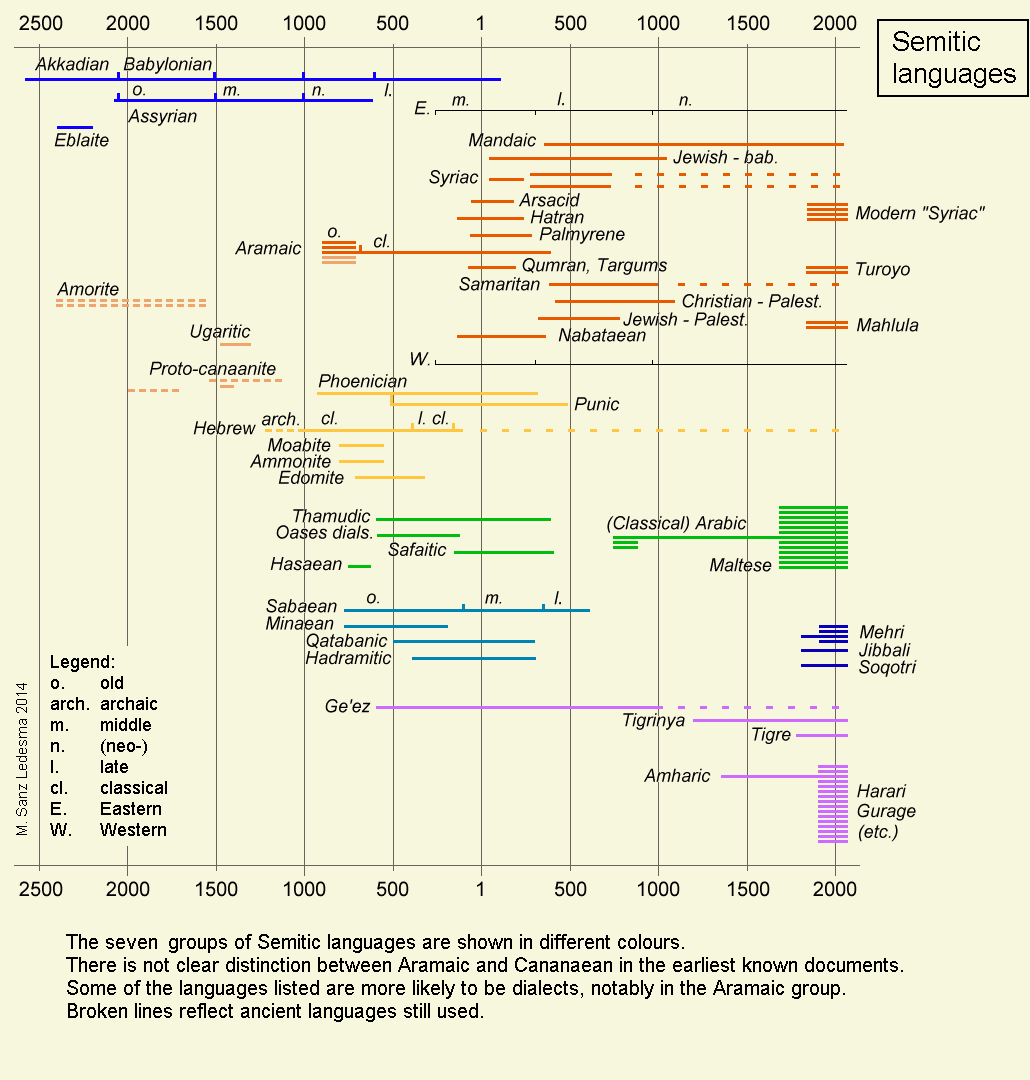
> As such, I fail to see the relevance of your comment.
By all means, Celts are actually Arabic speakers who have splintered off during the Bronze Age - some 3500 years ago prior to the Kingdoms of Israel and Judea - and the genesis of your theories revolving around the lost tribes of Israel is irrelevant. That bit is just an inexplicable coincidence.
Obvious, my bad for being confused.
I never made any claim about ancestry, I was referencing a theory about Celtic languages in the British Isles being influenced by Semitic languages. And I don't think the lost tribes of Israel stuff is relevant, both because I'm not sure if the theory I referenced is actually derived from such ideas, and because it is so different as to be functionally distinct.
Quite the theory that explains 35 centuries of linguistic evolution but whose own origin itself is lost to the mists of time. Perhaps you should solve that mystery first, you know, if only in the interest of proper scientific attribution.
Maybe one of us could be enlightened if you look up and provide citations of the author. Surely you'll agree at least that is relevant.
It's not "lost to the mists" of time. I just don't think researching it to satisfy an argumentative and presumptive person on a link-sharing website would be a good use of my time.
We do know that there were multiple waves of settlement into Europe including a wave of farmers from the near east and finally people from the steppe. I don't think that says anything about linguistics though.
So what do you make of the scythian connections to gaelic/gaulic cultures? They share the same brass work and distinct styles of jewelry. How's about the fact that the anatolian steppe herder genetics that spawned celtic culture are found in the Caucus mountain area, and have been confirmed to be shared with present European populations? What's to make of the fact that Europe is named after a Phoenician goddess?
All of these listed are indo-european peoples/languages (except Phoenician), so similarities are to be expected. Europe we can credit from the Greeks, also indo-european.
The 14th century Declaration of Arbroath repeats the claim that the Scots came from Scythia:
"They journeyed from Greater Scythia by way of the Tyrrhenian Sea and the Pillars of Hercules, and dwelt for a long course of time in Spain among the most savage tribes, but nowhere could they be subdued by any race, however barbarous.
Thence they came, twelve hundred years after the people of Israel crossed the Red Sea, to their home in the west where they still live today."
Ex post facto rationlizations. The original theories are of the nature described in my link.
> They share the same brass work and distinct styles of jewelry.
Are there in your view no other examples of such parallels between different pairs? And if you can find such examples do they all match up towards similar conclusions as what you are pushing here?
Does the DNA of Britons and Mediterraneans of the Levant and surrounding areas support that theory? (I don't know the answer)
Those ancient Britons get darker brown with every pop science article. Pretty soon they will be actively bending light and absorbing photons from their surroundings. Can anybody point me toward a scientific basis for the ever darkening skin color of these ancient peoples?
There is none. It's pop-archaeology influenced by politics. Especially since this article is drawing a comparison with Neanderthals, which is the ancient hominid literally responsible for blue eyes, red hair and pale skin...
Also funny that the artist's rendition kind of looks like a dark Michael Jackson...
These comments are super confusing in light of reading the article which is quite mundane if an interesting write up of a comparison between finds on two sites and much less politically charged than they make out.
Look at the artist's rendition of the hominid. Then read the article where they're talking about likeness and genetic similarity to Neanderthals. Then consider what we know of what genes Neanderthals passed along, especially relating to skin tone, eye and hair colour...
There's a constant attempt in the British archaeology sphere to paint 'indigenous' Britons as dark-skinned even though all the evidence points to them being very light-skinned (as you'd expect at their latitude). It's not just this article but many articles.
This seems like you injecting your own political hobby horse into the arena. It’s an illustration not a diatribe. The article doesn’t mention skin colour and casts doubt on the link to Neanderthals.
> The article doesn’t mention skin colour
Which is why the article picture is so confusing and misleading. Why not show some bones? Why not show the researcher? It's intended to mislead...
Or it’s just there to make people tell on themselves in comments sections. Both seem plausible.
I personally think it’s a nice illustration in a relatively banal if interesting article.
Confusing or just hurtful to the overall agenda? It's perfectly sensible.
Are we now complaining that an artist's depiction of a hominid that lived 480,000 years ago (not even an anatomically modern human) does not look like a proper Englishman?
What is it missing? An umbrella?
[0] mentions the "Cheddar Man" from 10,000 years ago as having dark skin and blue eyes, whereas originally he was depicted as having light skin - and that was probably just an assumption. I don't think there was as much awareness before that there was a time in Europe where people were dark skinned, and it didn't spread over night. The article from the post is talking about fossils from between 400,000 to 500,000 years ago, and uses the word ancient, but it's not something you can compare in timescale to say ancient Egypt, which may evoke images of the pyramids or something. Humans were drastically different and wildly more diverse.
https://www.smithsonianmag.com/smart-news/ancient-briton-had...
And one of the scientists involved in that study says they don't know the skin colour...
https://www.dailymail.co.uk/sciencetech/article-5453665/Was-...
The article says
>While her computer model shows being black is his 'probable profile', DNA testing is not advanced enough to say for certain.
>The model came up with 'black' or 'dark black' skin for Cheddar Man based on his DNA.
>Some, particularly on the far-right, have questioned whether there was a political agenda behind the claims.
So it seems like, yeah, they are not absolutely positive (and the tabloid article sensationalizes this point), but so far the science shows dark skin, and this ruffles the feathers of the far-right.
The science doesn't show dark skin, it doesn't show any skin colour. Saying X might be true != X is true.
According to the article you posted, X is probably true - the scientists' model shows it being true, "focused on 36 points of comparison in 16 genes" and compared to "genetic data taken from more than 1,400 people". That is science - developing a model, experiments, etc., whatever you can do and studying the results - a continuous process of refinement. Science is not a set of facts we know are absolutely, 100% true, but hopefully that's the end result. So I think it's fair to say the science shows so far, to the best of their knowledge, it's true. It could be wrong, but I think it's reasonable to depict the Cheddar Man as having dark skin if to the best of anyone's knowledge including scientists' models, he was dark skinned.
Well on one hand, moving further north creates a pretty strong pressure for early humans to evolve lighter skin, so naturally the first early humans to move northward to a place would on average have darker skin than their descendants down the line.
Though presumably some of that would have happened before those early descendants got all the way to the northern shores of France and Spain to move to Britain, so even granting them some benefit of the doubt, this does seem a bit much.
I dislike the language 'pressure to evolve'. There is only a selective bias towards whatever produces more healthy offspring. Evolution is not teleological, it is merely pruning whatever sprouts but doesn't work.
The Wikipedia article on human skin color (https://en.wikipedia.org/wiki/Human_skin_color) seems to think consensus is that all humans were still dark-skinned up until 100,000 years ago or so, which is far more recent than this picture is meant to depict.
As recently as a few hundred years ago many Europeans had dark tans because they spent their few decades alive working long days in the sun. But that was tanning and long term skin damage, not genetic.
There was an anthropological time period in early humanity when people migrating out of Africa hadn't yet genetically adapted to having lighter skin tones. I don't know if the pop science is actually trying to depict that period accurately, or if it's an anachronistic cargo cult phenomenon.
The ancient Briton in question is around 480,000 years old.
White skin appeared 22,000 to 28,000 years ago.
Why should the skin colour need questioning?
The extreme whiteness of modern Europeans is thanks to the Gulf Stream, which was not necessarily working at the same level of intensity in the distant past, especially during periods of glaciation. As such, the skin color we should expect to see in Britain, for much of the Ice Age, would be a level of brown on par with people who live in the far north of eastern Eurasia -- think Mongolians and American-Indians.
It's an interesting theory that temperature leads to skin pigmentation however all research points towards it being an adaptation to UV rays.
Your response is incoherent. Are you saying that a person in France, at latitude 48.0, gets less in UV rays than aboriginal people living north of the Arctic Circle, up north of latitude 67.0? A simple explanation based on UV rays would suggest that everyone at a certain latitude would have the same level of pigmentation and so, to repeat myself, the default a priori assumption has to be that the first people in Europe had the same level of brown skin as the other people living at similar latitudes. Again, Mongolians and Eskimos and other aboriginal people, including early American Indians, would form a reference point. And, indeed, there is evidence that Europeans were exactly this brown as recently as 8,000 years ago:
https://www.ancient-origins.net/news-evolution-human-origins...
So if you want to explain the whiteness that is unique to Europe, you need to look for an explanation beyond a simple mapping of latitude and UV rays. You need to look for something that could have been altered by the arrival of the first forms of agriculture, and the Gulf Stream -- the warm weather provided by the Gulf Stream would have allowed agriculture further north in Europe than at any other place on the globe for a given latitude. That would have lead to the unique situation of people having enough to eat, very far north, but not necessarily getting what Vitamin D and E that they needed.
Of the Eskimo and other aboriginal groups: "People who eat a lot of raw meat or oily fish have somewhat less desperate need of the vitamin D that sunlight provides, and so don’t end up as pale as those who rely on agriculture."
> Eskimo and other aboriginal groups
You do realize they only migrated to the far north within the last 4000 or so years right? They're also significantly paler than related groups that live closer to the equator (such as indigenous peoples in Mexico).
Again, your dates are badly wrong. You might want to research this subject before you comment on it. In terms of the Eskimo and other aboriginal people who migrated into or across Beringia, the relevant dates would be:
"It is believed that a small human population of at most a few thousand arrived in Beringia from eastern Siberia during the Last Glacial Maximum before expanding into the settlement of the Americas sometime after 16,500 years Before Present (YBP). This would have occurred as the American glaciers blocking the way southward melted, but before the bridge was covered by the sea about 11,000 YBP."
https://en.wikipedia.org/wiki/Beringia
This is extremely far north, as far north as 78.0 latitude, so again, you cannot put together a coherent theory that maps skin color to latitude in any simple way, therefore you need some additional theory, beyond UV rays, to explain the unique whiteness of northern Europeans.
First of all, the date people first crossed the Bering straight isn't the genesis of the Inuit people. The rest of the Americas were colonised first, probably because the arctic is so inhospitable. Proto-Inuit culture only appeared a few thousand years ago: https://en.wikipedia.org/wiki/Thule_people
The two big evolutionary pressures are believed to be a balance between protection against skin cancer vs. enough sunlight for vitamin D production.
And maybe a little bit about the calories needed to actually produce melanin.
For Britons, if it was hotter it's likely there would less cloud cover, but that's just a guess.