▲ 65 points
back
22 comments
FWIW a few years ago I worked on a video of 3D slices of a 4D platonic solid (a hyperdodecahedron):
https://www.oilshell.org/recurse/120-cell-bathroom.original....
It's all in Python (and shell scripts), which IMO makes it easier to experiment with than C++.
I completely forgot how it worked until I went back and looked just now ... there is this bit of 4D polytope code we borrowed, and the rest is 3D math and integration with rendering, stitching frames together, etc.
https://github.com/wwwaldo/pbrt-video/blob/master/schlafli/s...
If you’re really interested in polyhedra and how to code them, you might want to check out this resource: https://polyhedra.tessera.li/
This is missing the 6th platonic solid.
https://assets.nautil.us/8516_6a12d7ebc27cae44623468302c47ad...
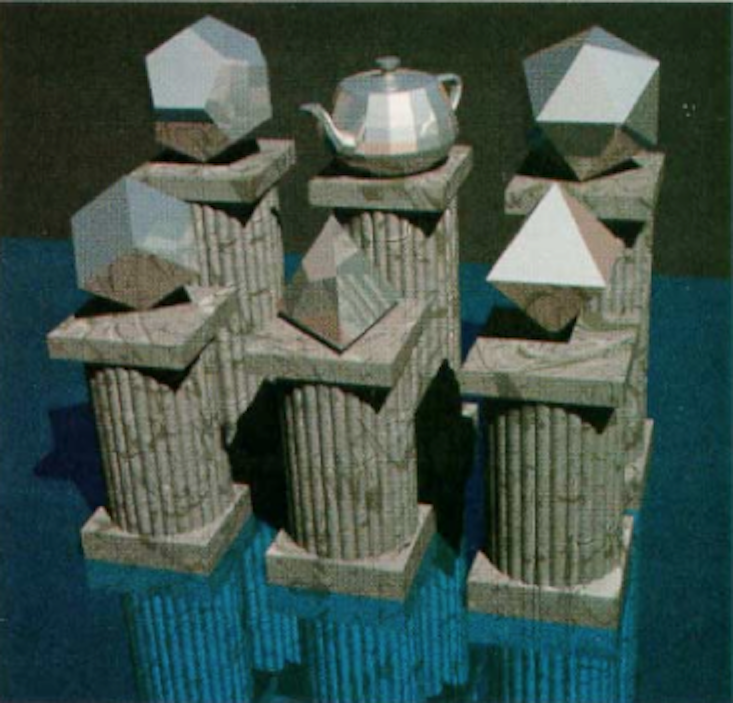
The real 6th platonic solid is the 24-cell, which only exists in 4 dimensions: https://www.youtube.com/watch?v=oJ7uOj2LRso
If it could actually exist in 3D, it would fit somewhere between the https://en.wikipedia.org/wiki/Rhombic_dodecahedron and https://en.wikipedia.org/wiki/Tetrakis_hexahedron.
I maintain a Rust crate for this and more operations like the 'dual' mentioned in the article:
“To earth, then, let us assign the cubical form; for earth is the most immoveable of the four and the most plastic of all bodies, and that which has the most stable bases must of necessity be of such a nature. Now, of the triangles which we assumed at first, that which has two equal sides is by nature more firmly based than that which has unequal sides; and of the compound figures which are formed out of either, the plane equilateral quadrangle has necessarily a more stable basis than the equilateral triangle, both in the whole and in the parts.”
Timaeus
Doesn't include the last one to be discovered: the teapotahedron.
Cool. Did similar thing years ago for a game and hve to say: it's not the mesh that gives nightmares, it's the texturing :))
Oh, so the library does most things for you. Okay...
Very cool, thank you!