▲ 237 points
back
63 comments
This can happen accidentally as well. For example, the default Windows 10 wallpaper was created using a physical model, an array of projectors, and a smoke machine. Alas, the end result turned out to be indistinguishable from CG. [1]
I think for building anything (art, code, furniture) the tools help you find the result. Building it a second time is much easier and requires a lot less sophistication.
Yes, I don't know what to say. I just want to emphasize what you say, because it's apparently an alien concept to many people. Tools and process inform the art. How could it not be that way, really?
"Cool C64 demo you have there buddy, I could do that in Unity in an afternoon". Yes, but would you? (Edit: and even if you did, it would be a copy of a unique style born out of specific circumstances.)
Similarly the Windows XP hill, which everyone thought was just pretty CG until it turned out it was a pretty photo of a very real hill.
Wait, did people really think it wasn't a photo?
A winery, no? During a few years where the vines were disease ridden or something like this.
I'm genuinely shocked this wasn't CGI. TIL.
That's nice and all, but isn't that a huge waste of time/money/resources? What is the advantage of doing it this way over just creating a wallpaper digitally?
With products like Windows, there's a chance that the desktop background, the startup chime and suchlike will end up as iconic as the Coca-Cola logo.
The designers would have told the CEO that this is going to be seen by 100x more people than a Superbowl ad spot, and 100x as many times per person too. So getting the perfect image/sound made for the cost of a single superbowl ad is a great deal.
Of course, whether they've succeeded at producing the perfect image is another matter.
The Windows 95 startup chime was composed by Brian Eno, so MS are used to paying for this stuff.
Why, you might ask? Because why the hell not?
This kind of maximal efficiency attitude is precisely why programs aren't "fun" anymore. Oftentimes, taking the scenic route instead of the highway is how you awe and inspire people; I know I was.
If anyone reading this remembers the 90s and early 00s with Easter Eggs and other fun programs with character, y'all know what I'm talking about.
In this case specifically it deals with light going through a pattern and into mist, which is going to have a lot light scattering inside an uneven volume. This still takes a lot of time to render and will be more difficult to match to a photograph than other things.
Big old corporations suck at efficiency. Much like the government does.
Wow I never knew this, thanks
That reminds me of a real world experience I had a few years ago, where a real engine in front of my eyes looked like CGI.
I was on a small cruise on Switzerland's PS Gallia [1], the fastest lake steamboat in Europe. When you're on it, you can look down the center of the main deck to watch the engine at work. The engine is perfect. Perfect casing with diffuse white (IIRC) reflection, perfect golden metallic joints with glossy reflection, perfect little vials of oil on top of each moving part, to constantly oil them. It felt too perfect to be real, and really looked like it was animated CGI, yet it was there, 3 meters away from me, moving and powering the boat.
[1] https://www.lakelucerne.ch/en/your-cruise-experience/explore...
It doesn't help that steam engines are surprisingly not all that noisy either. For the sheer amount of force a steam engine creates basically the only real noise is the exhaust steam, which if piped elsewhere you won't hear much.
https://www.youtube.com/watch?v=BVRZ_jxYPPY
Shots of the engine
I'm actually quite curious how come not a single person, especially a child, fell into this open meatgrinder.
The reason it looked like CGI, in part, is because the engine is unexpectedly big, shiny, and COMPLETELY INAPPROPRIATELY PLACED.
We usually witness such stupidity only in sci-fi, where it's all made-up, so it's OK.
People climb over rails in zoos because they want to pet the kitty. They don't do it in the ship because they know it'll kill them.
If somebody is as curious as me now:
https://youtu.be/ohk40f7v8Lw?t=110
Ah yes! I came from a 3rd world country. The urban planning is chaotic and pollution everywhere.
Whenever I travel to a 1st world western country, both city and suburb, I see the clear blue sky and sceneries (buildings, roads, layout) that make me feel like I'm in a 3D FPS or city sim game.
Places that seem like surreal 3D renders have attracted the name "liminal space" if you want some keywords to find similar material, although the aesthetic tends to veer towards solitary and slightly creepy environments
I felt the same the first time I came to Europe (from South America). I thought I was in a Truman Show set. I eventually ended up living here.
The "logo teaser" / title announcement for the Lord of the Rings - The Rings of Power show also made lots of people think it was some form of CGI, since they felt it didn't look believable. Turns out it was actually filmed with practical effects.
The teaser: https://www.youtube.com/watch?v=QhqGCPMfkNM
Behind the scenes: https://www.youtube.com/watch?v=OC_yTMST7mw
This is a pet peeve of mine, as someone who does CG art among other things. The popular narrative is that CGI always can be spotted and it always looks bad when in fact it's the other way around. Bad looking things are attributed to CGI regardless, and good looking things are assumed to be practical.
Reminds me of the making of a pre-CGI HBO intro -- looks CGI but is entirely physical models, motion controlled cameras, and clever compositing: https://www.youtube.com/watch?v=agS6ZXBrcng&t=310s
There is a youtube channel which does a whole variety of mechanical contraptions, and it is absolutely impossible to tell if it is real from the videos.
I cannot remember it unfortunately, but the youtuber had to show some background footage to convince people those weren't fake.
edit: Found it - https://www.youtube.com/@OleksandrStepanenko
That's what the original global illumination papers for path tracing did: They built a physical Cornel box and then compared photo and render [0].
I love this!
I've always said a retoucher always tries to stray away from what a cgi artist looks to achieve. i.e. they want what each other have. perfection, and a lack of it.
These are beautiful.
Yet... I know this sounds arrogant, but I feel like I would eventually realize they're real photos if I stared at these long enough without being told. i.e. If I saw them framed on a wall and walked past them every day.
The image noise, surface imperfections, chromatic aberrations, etc. are clues, and yes a raytracer can reproduce that, but not usually this well. That's precisely why I think these are beautiful.
I think the main thing that gives away the shapes image is that the glass surface has thickness. You can see that there are 2 layers of reflection visible on horizontal edges because of it. You could do that in CGI, but nobody does - they make the base surface slightly reflective.
I don't think I would notice it out of context though...
In VFX at the high-end (the smaller studios do often take shortcuts) we do model full layered materials with thickness, at least for mid to hero-level assets, so we would do the glass with proper volumetric thickness, with fully-correct inter-reflecting/refracting dielectric BSDFs modelling the glass, with correct IOR and total internal reflection.
It is slower to render than using "thin glass", and lighting the checkerboard surface underneath the glass isn't as efficient (you can't do naive Next Event Estimation through the refraction of the glass volume, but you can do manifold walks to solve that), but we do it at that level of fidelity often enough when required and have been for years. There are times when it's not required though, so approximations can be acceptable in more forgiving situations.
RTX does it in real time, in some settings. And then DLSS can infer on top.
Perhaps McDonalds menus, IKEA catalogues, and Playboy shots are real photos as well? They just make an extraordinary effort and spend tons of money to make make it look fake.
McDonalds menus are real photos, just not of the things they are supposed to portray. There are lots of tricks to making burgers look good in photos, and the end result isn't edible, even if you take out the cardboard slices that make it look bigger.
Aren't there laws against this sort of thing? I have distict memories of learning in high school that food advertisements have to use real food and can't use trickery to make it look different. I seem to remember watching some with Rick Mercer in it, but hat might be wrong.
I've seen behind-the-scenes stories of how those burger shots are made. They are very real photos of very real burgers, what isn't real is how the burger is assembled for the shot as compared to the burgers we eat.
Related: I followed a link on PetaPixel at the bottom of TFA and got April fooled: https://petapixel.com/2015/04/01/these-cgi-images-are-so-rea...
I think people are trying to do this as well with face filters; make the real more artificial to attain the appearance of perfection.
In 2018, when launching the first real-time raytracing GPU, NVIDIA made an exhibition [2] at SIGGRAPH honoring "Figure 7" from Turner Whitted's original Raytracing paper [1]. It consisted of a forced perspective floor and some suspended spheres. Lighting was a nightmare to get right.
[1] https://www.cs.drexel.edu/~david/Classes/Papers/p343-whitted...
[2] https://techgage.com/wp-content/uploads/2018/08/Rob-Posing-W...
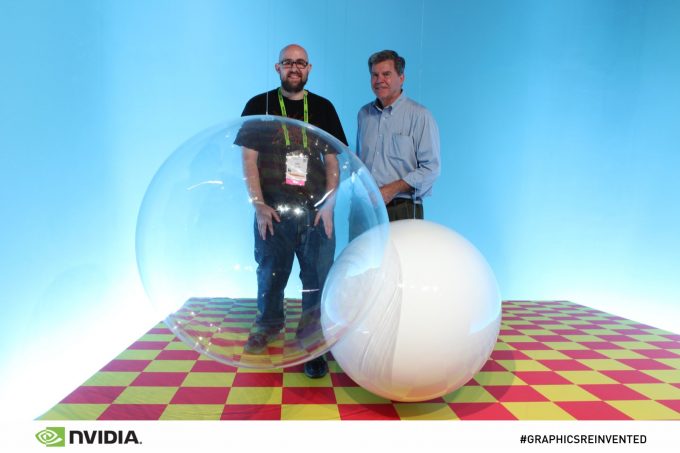
[2017]
I imagine the most annoying part of making these photos is making sure there is absolutely no dust to be seen anywhere...
Clickbait, real title should be "THESE CGI "Renders" Are Real Photos (2017)"
I think HN automatically removes certain words like "This" and "How" from the start of titles. But this only happens on initial submission - the user who submitted it can then edit the title to fix it if necessary.
Yeah, cutting the 'these' completely changed my expectations for the article. Without it, it sounds like it'd be a rant about the relative artistic validity of photography and CGI.
Was a bit sad to discover the current studio website at this point. Everything is coerced to the past state, it's a pretty bold and artistic move. Appreciate it.
Does CGI actually get the subtle shadow details right? Last I checked they were close but a trained person could spot the difference.
Depends on the CGI. With a combination of ray tracing and radiosity, it can be insanely good.
obligatory xkcd: https://xkcd.com/331/