▲ 77 points
back
81 comments
Toxic chemicals abound in the US military. There are many civilian regulations that were/are flagrantly ignored because USMIL is largely a law unto itself. This includes:
- unproven, risky, and experimental medications, vaccines, and medical procedures
- direct exposure to toxic chemicals
- toxic pollution of air, water, and soil (numerous superfund sites are former military land) https://en.wikipedia.org/wiki/List_of_Superfund_sites
- environmental damage
There are also some well-known historical incidents:
Gulf War-era (1st GW)
- GW syndrome likely from pyridostigmine bromide nerve agent prophylaxis pills ("WMDs" was a Cheney hoax.)
- exposure to partial combustion of hazardous oil well fires
Vietnam-era Agent Orange exposure led to in in-theatre troops years to decades later:
- AL Amyloidosis
- Chronic B-cell Leukemias
- Chloracne
- Diabetes Mellitus Type 2 (and also adult-onset Type 1 where insulin production essentially stops)
- Hodgkin’s Disease
- Ischemic Heart Disease
- Multiple Myeloma
- Non-Hodgkin’s Lymphoma
- Parkinson’s Disease
- Peripheral Neuropathy, Early- Onset
- Porphyria Cutanea Tarda
- Prostate Cancer
- Respiratory Cancers
- Soft Tissue Sarcomas
https://www.publichealth.va.gov/exposures/publications/agent...
In the Vietnamese population, it lead to:
- ~ 400k injuries and deaths
- ~ 500k birth defects
- ~ 2M cancers
- (presumed 100k's) still births and fetal abnormalities
recent research indicates that GW1 syndrome is caused by Sarin exposure that was caused by US warplanes dropping bunker busters on storage facilities. the sarin then drifted onto US fighters far away.
no study was made of the iraqi civilians that were nearby other sites that were hit. i guarantee you the toll there is much higher.
https://www.utsouthwestern.edu/newsroom/articles/year-2022/s...
I wonder if or when the USA will ever reckon with what we did to Vietnam.
Seeing as Kissinger is still alive and a free man, my money's on no.
"Once you’ve been to Cambodia, you’ll never stop wanting to beat Henry Kissinger to death with your bare hands. You will never again be able to open a newspaper and read about that treacherous, prevaricating, murderous scumbag sitting down for a nice chat with Charlie Rose or attending some black-tie affair for a new glossy magazine without choking. Witness what Henry did in Cambodia – the fruits of his genius for statesmanship – and you will never understand why he’s not sitting in the dock at The Hague next to Milošević." ― Anthony Bourdain
My subjective experience was that Vietnamese were rather friendly to Americans, while they did not have a lot of love for Chinese. "Americans killed us and committed atrocities, but China wants to take our things, dominate us, or erase us" was kind of the sentiment I got. I was surprised that in many parts of Vietnam signs are in Vietnamese, English, and Korean, while Chinese is suspiciously missing.
Now America is the main pressure pushing back on China in the south china sea. I'm starting to see "made in Vietnam" on all types of items in US stores. Half of Vietnamese that live abroad live in America...
We have incredible amounts of media that are very anti Vietnam war and the general sentiment that I grew up in is that we (the us) were the bad guys. The sentiment I saw in north Vietnam was that they won by attrition and manipulating US public opinion.
Going to Vietnam and seeing the agent orange museum was pretty shocking and dreadful. There was a general understanding we massacred women and children, but agent orange might have been a paragraph in a textbook taught clinically rather than emotionally. Bourdain's episode on Laos might have been the first time I heard about all the unexploded ordinance and mines. It's a pretty bad feeling.
My entire experience with public education, there was no justification or defense of the war. There was one message. We were bad.
All things considered, I don't think we have done/are doing as much as we should, but I also don't think we completely flouted any responsibility to Vietnam.
I suppose my opinion doesn't matter very much, and it would be nice to hear from someone from Vietnam.
How? What would/could that look like?
In the Netherlands there was a huge debacle in relation to Chrome VI used in camouflage paints on tanks and fighter jets. The paint is carcinogenic.
Since I don't think anybody's linked it yet, there was a lot of press about the anti-fire foam the airforce uses in drills (and actual fires) being toxic and leaking into the water systems in every base.[0]
They said they'll phase it out by 2024,[1] so if you're planning on enlisting, you should wait to enlist until then so you can be part of the next cohort for this study. Also, if you live near an airbase, you might want to wait to have any future children until then too, as it affects people around all the bases, as well.
[0] https://www.military.com/daily-news/2019/02/26/residents-nea... [1] https://idahocapitalsun.com/2023/03/16/pentagon-to-halt-use-...
You probably shouldn’t enlist if that’s your concern.
You’re effectively the property of the state and they don’t really give a shit about your health.
In the Netherlands there's also been a big scandal about Chrome-6-based paint used on F-16s. Apparently the Dutch DoD knew this could cause serious health issues but they just continued to use it with inadequate PPE. I wonder if this applies to the US as well, after all these are American fighters (though the ones in Holland were built locally at Schiphol airport)
And there's of course the high use of depleted uranium in the US, for bullets and armor.
Could it because pilots spend more time in the upper atmosphere than the general population, so they aren't as protected from cancer causing radiation as people at sea level? As for ground crews, they probably spend more time in the sun - again, potential cancer causing radiation. I wonder how the ground crews would compare to outdoor construction workers.
This is phase 1 of a multi-phase study. Analyzing the role played by ionizing radiation exposure due to high-altitude flight is planned as part of phase 2.
I doubt it. Commercial pilots and air crew spend a lot more time in the upper atmosphere.
What are their rates of cancer compared to the general population?
Does the metal fuselage of a jetliner protect better than the canopy of fighter?
I personally know three AF aviators who were diagnosed with brain cancer. The story I heard was that C-130 aircrew had raised the alarm, the Air Force did a study, and determined that statistically AF aviators were no more likely to get these cancers than the general population. Many were suspicious of the findings.
After that, two more aviators, close friends of mine, were diagnosed with brain cancer, one of whom has since passed away. My thoughts are that it probably has to do with the airborne radars in use.
> My thoughts are that it probably has to do with the airborne radars in use.
If this turns out to be the case, it would call into question the now-decades of arguments that what "EMF fog" is safe for humans in general, which would have implications beyond just the military.
People who argue such points tend to be screwball conspiracy theorists in general, and I hate to give them even a shred of validation. But I've always been skeptical that the human body would be completely unaffected by higher doses of non-ionizing radiation beyond baseline, for extended periods of time. Meanwhile there is a growing body of research that electromagnetic fields can affect the human body, especially the central nervous system, e.g. https://pubmed.ncbi.nlm.nih.gov/33945157/ and https://pubmed.ncbi.nlm.nih.gov/34043892/. These both seem like reputable albeit smaller journals, and the researchers seem to be working in good faith, although I'm not connected to this field and I would be a poor judge of that.
Based on what I've been seeing in the research above, I'd hope that brain cancer is unlikely, unless you can get cancer from having weird electrical signals induced in your brain (anything is possible I guess). But it probably isn't good to get blasted with high doses of microwave radiation on a regular basis.
> But I've always been skeptical that the human body would be completely unaffected by higher doses of non-ionizing radiation beyond baseline, for extended periods of time.
Well, what would you consider to be baseline?
The overwhelming majority of the non-ionizing radiation that we experience comes in the form of visible and near-visible light. If you sit near a window all day, your baseline is going to be much higher than someone who sits in a gloomy, dark office. No amount of EMF fog from nearby electronics is going to come close to making up that difference.
According to NASA, the amount of energy reaching earth’s outer atmosphere from the sun is about 1360 W/m^2 for the portion of atmosphere directly facing the sun.[1] Most of that is non-ionizing, and some of it is filtered out, but that’s still a lot.
Another great example is a smartphone. If you use your phone for a few hours each day, the overwhelming majority of the non-ionizing radiation emitted comes from the screen, not the radio.
While you could theoretically exceed that dosage per square meter by, say, sticking your hand in a microwave oven, doing so would be fairly uncomfortable.
If we were to find that non-ionizing radiation causes problems at low doses (below where we perceive it as heat), it would have to be specific wavelengths, not just non-ionizing radiation in general.
[1]: https://earthobservatory.nasa.gov/features/EnergyBalance/pag...
This was the study: https://apps.dtic.mil/sti/pdfs/ADA522424.pdf
Radar does not cause cancer because radar do not emit ionizing radiation. Afaik ionizing radiation (gamma rays) are in the exahertz range and would have very high absorption by atmosphere. Modern radar systems are millimeter wave or microwave at most.
I think that spending a lot of time at very high altitude means they will absorb more radiation over time than someone who spends their life on the ground.
That’s what they tell me, but could RF heating contribute? I found this too which was interesting: https://www.iarc.who.int/wp-content/uploads/2018/07/pr208_E....
How much time do USAF pilots actually spend at altitude? Commercial pilots I've talked to say it's generally well-known that military pilots don't have many flight hours. If you want to study pilots with the most high-altitude flight hours, just look at the pilots for big commercial airlines. Military aircraft are expensive per flight-hour so they don't fly them more than they really need to; commercial aircraft are losing money when they're not in the air, by contrast.
Not surprising. I recall the story about the Miles Teller being taken to the hospital due to getting rashes while filming Top Gun Maverick, they found tons of chemicals including jet fuel in his blood.
Does anyone know how many annual hours Military pilots log and at what altitude? A regular flight from NYC to LA is similar to getting a chest x-ray: https://www.cdc.gov/nceh/radiation/air_travel.html
I flew about 14 years out of my career and I had 2800 hours flying fighters, and was anywhere from surface to 50,000+ feet. This is low-time compared to the people who flew heavies (tankers and transport). My cancer was not diagnosed until shortly after I left the service by the first doctor I visited, but I'd began getting increasingly unpleasant symptoms 5 years prior (about the time I quit flying and went to a non-flying duty "for career progression").
I wonder how the rates compare with heavies v fighters. The heavies fly a lot longer, but aren't sitting 6-9 ft behind a radar, or breathing MSOGS.
It's not cosmic rays. It's fuel and oils. Benzene is the OG carcinogen.
Military machines are like working with farm equipment, heavy dangerous and with ok-ish ppe which is usually not enough.
Just look at the burn pits fiasco.
Ground crew increased risk is probably coming almost completely from exposure to carcinogens in the materials they're working with.
However, the gap between ground crew rates and air crew rates, plus known similar effects in civilian airliner crew (https://www.cdc.gov/niosh/topics/aircrew/cancer.html) indicates that it's likely that a significant component of increased risk for pilots and aircrew may be related to high altitude.
This doesn't rule out something like... increased exposure to flame-retardants (or something) (fabrics, other materials, or maybe off-gasing into air supply) that may be carcinogenic.
The study found that aircrews had 87% higher rates of melanoma and 39% higher rates of thyroid cancer. Men saw 16% higher rates of prostate cancer.
I don't think Benzene is the main risk factor for those type of cancers . Benzene causes blood cancers, lymphomas.
The problem is, cancer frankly isn't the Pentagon's problem, because it usually develops after service members leave active duty. They kick this problem down the road to the Department of Veteran's Affairs instead.
Radar too for fighters. (Sidelobes)
I bet it's more about the toxic chemicals than the radiation...
tl;dr: yes, it is similar, but it's also about the same amount of radiation as you're normally exposed to in 4 days. For most people I'd guess that isn't a concern, but the parent's question is apt -- how much time do military pilots spend actually flying?
looking here (https://www.wsj.com/articles/us-flying-aces-need-more-time-a...), it seems the average is 10-60 hours, depending on whether deployed or not. I don't know about altitude, but if that's not a significant factor, then deployed pilots are getting ~10 NYC-LA flights per year, or 40 days of extra radiation per year. Honestly this doesn't seem too bad to me.
I was surprised by the claim, so I looked into the linked source: "You would be exposed to about 0.035 mSv (3.5 mrem) of cosmic radiation if you were to fly within the United States from the east coast to the west coast. This amount of radiation is less than the amount of radiation we receive from one chest x-ray."
I note that it says _less than_ in the source, so let's compare the actual numbers -- it's 0.035 mSv for the flight (from the first source) and 0.1 mSv for the chest x-ray (from https://www.cancer.org/treatment/understanding-your-diagnosi...). It does seem fair to say they are similar. The cancer.org source also notes that you'd normally be exposed to about 0.1 mSv naturally over the course of about 10 days. So we can say the flight from NYC to LA is ~4 days of natural radiation exposure.
From the study:
> This study found that compared to the U.S. population after adjusting for age, sex, and race, aircrew had an 87 percent higher rate of melanoma, 39 percent higher rate of thyroid crew had an 87 percent higher rate of melanoma, 39 percent higher rate of thyroid cancer, 16 percent higher rate of prostate cancer, and a 24 percent higher rate of cancer for all sites. Ground crew members had higher incidence of cancers of brain and nervous system (by 19 percent), thyroid (by 15 percent), melanoma(by 9 percent), kidney and renal pelvis (by 9 percent), and of all sites (by 3 percent). However, aircrew and ground crew both had lower or similar cancer mortality rates for all cancer types when compared to the U.S. population.
That last bit is presumably related to the VA providing free health care for any service-connected condition.
Hopefully this is gonna make it easier for veterans to prove that their cancer is because of their service.
I seem to recall people working on aircraft catapults in particular getting all sorts of skin issues. Not cancer specifically but rashes etc
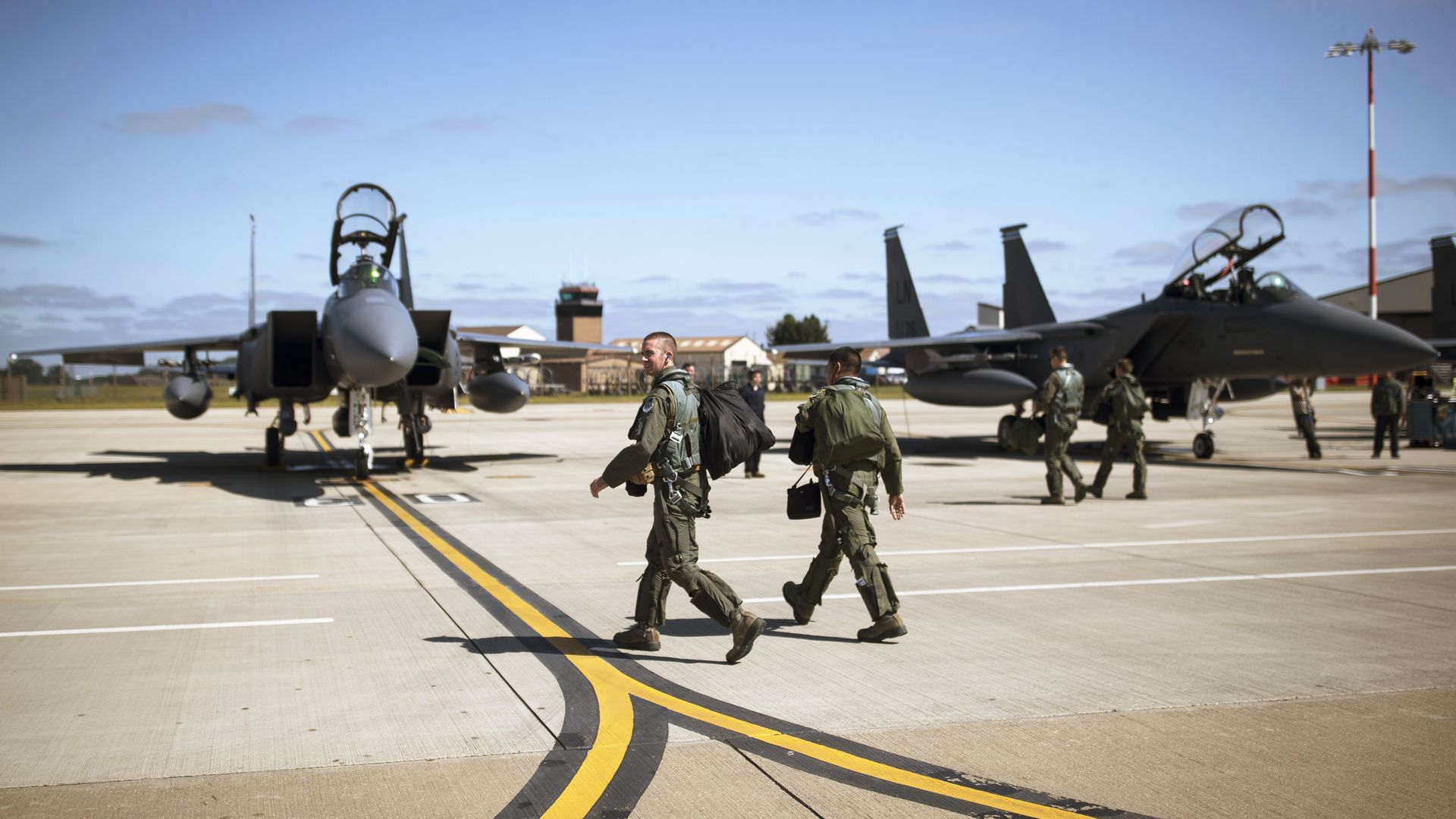
Re melanoma: USAF loves the dessert. Vegas and the Mid East are v popular destinations to go for certain airframes like the one pictured in the article.
I'm sure they love their desserts, while hanging out in the desert.
I was thinking there's no way that picture was taken in the UK. Way too sunny.
Definitely the UK, more specifically, RAF Lakenheath, a well-known F-15 OCONUS base.
From the pic[1], "LN" tailflash is telltale, but if your confidence is still waivering, this is the precise location[2] that the pic was taken from: you can see spot "03" painted on the flightline and tower in the background.
[1] https://images.axios.com/7Kz2FLdbEv-I_Pr-GjkRXdriQSM=/0x254:...
[2] https://www.google.com/maps/place/52%C2%B024'02.2%22N+0%C2%B...
They don't care https://www.reviewjournal.com/news/area-51-burning-revealed/
Brainstorming hypothesis: time spent in landing g strips and airport areas leads to contact with fuels. Smelling them for long is not advisable.
My brother (c17 maintainer) currently has melanoma.
Pilots aren't surprising, but ground crews I didn't expect. Exposure to fuels and volatiles?
Well, where else do you think they get their guinea pigs from?
Next headline - Pentagon study reveals US government does not properly care for its veterans, the VA is a joke
Instead of downvoting perhaps provide evidence the VA is anything but terrible