▲ 379 points
back
676 comments
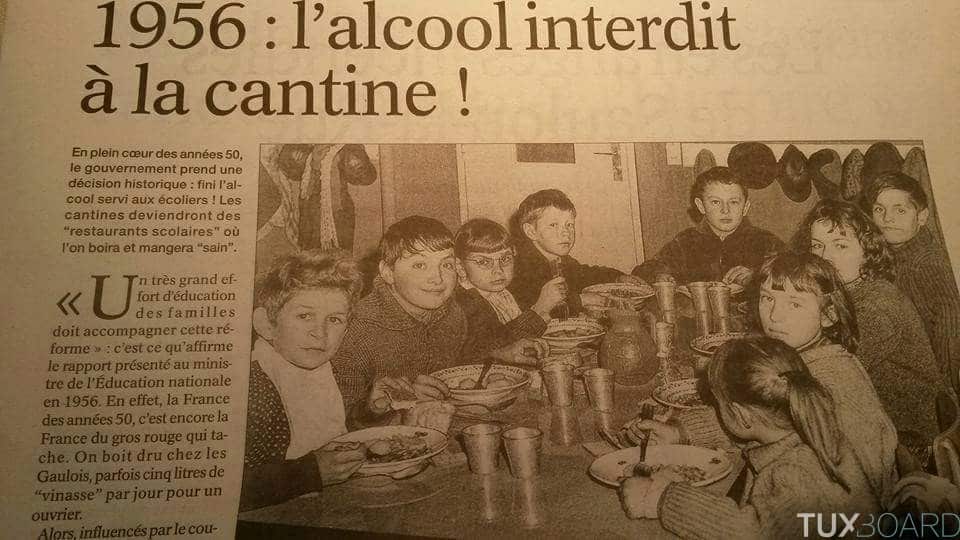
Modern people drunk a lot, event recently. In France, 80 years ago, kids would drink wine at school.
Drink and driving prevention and repression certainly played a big part in it.
But I think other factors came at play:
- Science. We know now better about the effect of alcohol. This drove the public opinion into a certain direction. Having the general acceptance this was a bad idea created policies to prevent things like having wine in schools in 1956: https://expat-in-france.com/wp-content/uploads/2022/02/wine-...
- Hygiene. If you can drink water safely from the tap, it helps.
- Moving to a service based society. If you don't have to work in a mine, you drink less.
- Other drugs came around. The ones you identify as such. And the one that are more innocent, like sugar, tv shows and social medias.
A big shift was also coffee. Works much better for focus work, and also gives a slight high (big in the beginning).
The coffee & alcohol cycle is also an interesting one in the West
High paced work environment & coffee jacking up your nervous system, and then in the evening using alcohol to calm it down (or other calmers like weed or painkillers).
Depends on your definition of "children". France only banned alcohol in lycées in 1981... only 42 years ago.
Otherwise, you are right. The main ban (children under the age of 14) was in 1956, or 67 years ago.
Depends on your definition of "innocent". Sugar is Satan-incarnate (and I am its slave )
Cost as well; water is dirt cheap (for now anyway, there's potable water shortages in plenty of places and that will become a worldwide issue soon enough), anything alcoholic has become more and more expensive for various reasons, including but not limited to taxes + extra "discouragement" taxes, at least where I live. Drinking is an expensive hobby, to the point where weed is cheaper and has less side effects if the purpose is to alter your state of mind a bit.
I am not sure if science as we understand it had so much to do with it.
To my experience, society changed enough to no longer tolerate--or at least accept as normal- drunken family members. There was a point where the always-drunken-grandfather was suddenly considered ill and no longer just a little weird. A noticed this in my own family when I was still young. There was a point where constant-drunkenness was suddenly frowned upon with a certain vigor. And the younger generation sort of got the message: "I dont want to be like grandpa, he is actually a poor devil..."
> If you can drink water safely from the tap, it helps.
It's worth remembering that alcohol sterilizes many otherwise dangerous things. Being drunk all the time can easily be better than being sick all the time.
In Spain kids drank "quine" 70 years ago.
https://elpais.com/gastronomia/el-comidista/2015/11/11/artic...
In Spanish, but if you are a French speaker you might get some hints.
Ad from 1961:
https://verne.elpais.com/verne/2014/10/13/articulo/141317743...
"If you don't have to work in a mine, you drink less."
Uh...if you have to work with the public, or incompetent people, you may be driven to drink more. The people who work in infosec seem to be the drunkest I know. They do mostly leave it for after work though, because it has gotten quite easy to do sobriety tests on people that are more than subjective.
Currently, alcohol consumption is quite unevenly spread: an 80/20 rule applies I think (and in my country, it's the higher educated who drink most). I wonder if this was true in the past, where beer might have been the only way to drink uncontaminated liquids.
Raised by alcoholics during the Mad Men days so in reaction I never drank at all. My parents didn’t set a great example. I spent many an hour with a bag of library books outside bars while they boozed it up.
But I often think about the framers of the Constitution drinking vast quantities that fateful, blistering summer of 1787: http://johnjayhomestead.org/wp-content/uploads/In-the-Cups-o...
They were, and remain, literally some of the most functional human beings in history.
Fascinates me to see these two extremes in behavior.
Given the importance of the "gnôle" (a french word for a often home or clandestinaly made strong spirit in France) in rural parts of France to this day [1][2], I am pretty sure the author is underestimating the importance of spirits in history.
[1] usually mixed with coffee several times during the day, and very often a shot glass in the evening
[2] I've never seen a sober postman when I visited my grand parents as a kid in the 80's and 90's. Back in the days they weren't timed and would be invited for a coffee at every single farm they visited to talk about the news of the day. He really served as a local and vocal newspaper for all of them. The coffee itself wasn't strong in cafeine, but was almost always served with "la goutte", a small but significant amount of spirit.
I don't like writing the obvious things that everybody always says, but here we are, nobody has said it yet:
there was a book or paper out like 25 years ago that speculated that as the Age of Enlightenment coincided with the start of European tea and coffee drinking, the general uptick in the usage of stimulants instead of alcohol must have contributed to the intellectual flowering through to the Renaissance, at least for the literate classes.
So that's when one group of people stopped being drunk all the time.
Industrial-revolution machines were often very angry dragons, requiring constant supervision and attention to avoid explosions or loss of limbs. That must have played a part.
Also, industrialization saw the rise of the skilled workforce. People started earning more the more they could use their brain. It makes sense that they wouldn't want to numb it as much as they did before.
Life was harsh, lots of work was physically taxing (no machines to do the heavy lifting), and there was not much in terms of relief for any sort of chronic or recurring pain, like back pain, tooth aches etc.
Alcohol helps endure, as it made you more numb to such pains. It might also help you sleep at night, when otherwise your aching body might have kept you awake.
In some physical jobs like the construction business, workers used to rely on alcohol to make through the work day until very recently. In some countries they might even still do so.
I can confirm from my own experience building a house and doing heavy lifting on the construction site, that after 10 hours of taxing work, an evening beer works wonders to relax your strained muscles and regain some feeling of comfort.
It's no surprise to me, that the reduction in alcohol consumption coincides with a switch from more hard physical labor, to more sitting jobs.
I would like to see a comparison with Asia, where people discover earlier that you can boil water to kill dangerous pathogens, even if they didn't know what pathogens were yet.
For me it was when I moved from the UK to Silicon Valley.
From a German perspective there was the “branntweinpest” in the 19th century in Prussia triggered by cheap and available liquor (Branntwein). This indicates to me that before the availability of cheap liquor alcohol consumption was more limited. Anecdotally I live in a wine growing region but the older generations would drink wine diluted with water, the local wine was a already produced in a way that it wasn’t entirely dry, I.e. more sugar less alcohol in the wine that then was diluted.
So I find it reasonable to believe that people used to be for most centuries consuming alcohol but moderately affected. As in, they would not have appeared heavily intoxicated. Of course it would have affected their health and increased risk to become an alcohol addict, but then, it seems alcohol was actually not so cheap until cheap liquor from grains and potatoes became available.
Beer used to be a seasonal drink due to lack of cooling, or without engineered yeasts it’s alcohol content low.
There's a passage in Benjamin Franklin's autobiography when he is working in a printing factory in England, and he astounds the other workers by his productivity. He credits it to not being drunk all the time, and eventually managers to convince the other workers to try it too. That was 1740s I believe.
Recently, I was drinking with a (Russian) friend who commented that I'm the only one he struggles to keep up with while drinking and that he goes home blackout drunk every time we hang out. We don't drink that much, and decided maybe we're just getting old.
We both noted how we used to drink a lot more, meaning we're just as cool and fashionable as The Kids These Days, who are according to several news reports drinking less than college kids were a decade or so ago.
A few days later, he said he figured it out: for each of the ~3-4% ABV beers I drink, he's drinking a ~7-8% IPA. Him "catching up" (round for round/pint for pint) was consuming twice the alcohol as I was. I said I'd noticed that myself, when moving to a major city where most beers were $8 IPAs - having a couple beers at lunch would make me tired, if not drunk, and I'd need a cup of coffee on the way back to get going again.
I'm too lazy to do The Math, but I can't help but wonder how the "Kids These Days Drink Less Alcohol" charts line up with the "Kids These Days Seem To Prefer IPAs" chart. (It seems ABV has little to do with the historical trend presented here, though)
> Wine is taken to be 0.12 alcohol, the same number is used in modern estimates of alcohol consumption. The amount of alcohol consumed by drinking historical beer brews is between 0.62 to 0.107, the % of alcohol in “small beer” is taken to be around 0.05 and the % in “strong beer” is taken to be around 0.135, the relative consumption of small and strong beer is depended on whether we use the numbers from “Vandelint 1734” or the estimates in the studies mentioned in table 2.1 in “Alcohol, Sex, and Gender in Late Medieval and Early Modern Europe”
I found this article a bit hard to follow, though it's an interesting topic.
The constantly changing units of consumption, historical timing, changes between daily and annual rates of consumption and similar made it difficult to understand exactly the point that was being made.
The author dug up a lot of data and put it together, but didn't going the extra step of unifying things in a way that's easy to understand.
I kept having to convert the units they were using to units I could understand, and since those units weren't constant, it's difficult to get an overall impression.
But, a few examples I did convert to amounts of drinking I understand:
* In Florence in 1455, someone (IDK if this is an average, an individual, a certain class of people or what?) drank 250L of wine in a year. That's about .9 modern size bottles of wine per day. A good amount, but I expect if you were practiced at it and drank it fairly evenly throughout the day, you certainly wouldn't appear drunk.
* In the medieval city of Ghent, the apparent average per person annual consumption was ~40-liters wine and ~1300-liters beer. That works out to basically 7.5 pints (16oz, or the size of one of the tall cans of that craft beer often comes in in the US) of beer every day, and a quite small glass of wine. Depending on how strong the beer was (doesn't specify if this was small ~5% or strong ~12% beer), I expect even a practiced drinker would be quite tipsy after close to 8 pints and a touch of wine every day.
* Sailors got a ration of 8 pints of strong (13% ABV) beer a day, which would have me absolutely knocked off my feet. 3 pints of what I think of as strong beer (~6-8%) in any kind of close succession and I'm definitely feeling tipsy, and shouldn't be let anywhere near something so complex as rigging. Though, after reading a few books on naval life aboard 16th century British sailing ships, perhaps being totally out of it for as much of the journey as possible would be a solid survival tactic.
* The "historical average" (IDK what period of history, or how average) beer consumption was around 380 liters per person per year. That's just over 2.2 pints per person per day. A long way from "being drunk all the time", even if it was higher ABV strong beer (and it certainly wasn't all high ABV).
Certainly, people seemed to have drunk much more in the past than they do today, but it's hard to make clear conclusions when the units are all over the place.
FWIW the beer people used to drink in antiquity had a rather low ABV.
A better contemporary comparison might be be something like kombucha.
I remember a story about the dome on the Cathedral of Saint Mary of the Flower (the Duomo in Florence) -- the first and largest unsupported dome in the world in over a thousand years, built before the discovery of the Americas and on a structure that had been otherwise completed for over 130 years at the time (and which had taken 100 years to get there). In the telling, the architect, Filippo Brunelleschi was hired to solve the "how to build the dome" left by his predecessor, Arnolfo di Cambio in around 1300. Cambia had specified something that was basically science fiction at the time, a majestic dome, built without buttresses, using technology nobody knew how to create. A design competition in the mid-1300s reinforced the Florentine's desire for this incredible dome that nobody knew how to build.
The problem? The fucking Pantheon in Rome. It existed, and at that time built over a thousand years prior. It demonstrated that it was possible to build domes and that the technology had been lost to humanity. Artists and architects worth their salt all spent time in Rome learning architecture and design from the ancient ruins, by then nearly a thousand years old.
Brunelleschi, and his best friend Donatello, were no different, having visit Rome sometime in the early 1400s to study. Rome at the time was a decrepit, dangerous, insecure, place to go. However, based on what he learned, Brunalleschi developed concepts of architecture, light, balance, and other ideas, which garnered him commissions back in Florence. Based on his work and excellent delivery, the Medici (THE Medici family) hired him to build various things including the Basilica of San Lorenzo in Florence. Which, if you've been there, feels like a frustrated first draft of the Duomo. The Basilica of Santo Spirito is the second draft.
Along the way he started working with vaults, then domes (very important!)
There was a competition, Brunalleschi's friend, Donatello, provided an absolutely incredible scaled demo of Brunalleschi's concept, and he won the competition against rival Ghiberti.
Once he won the commission, he set to work figuring out how to actually do it at scale. The "dome within a dome" architectural idea he inherited from prior work (technological debt!), but set out to create several new management and construction innovations which included:
- a maturing of the "dome within a dome" concept
- new hoisting machines
- new designs which eliminated legacy concepts such as flying buttresses and strengthened traditional bricklaying concepts
- entirely new management concepts:
1. Workers stay up in the construction site, going up and down hundreds of stairs was a waste of time (e.g. context shifting).
2. Resources, such as food and wine were to be brought to the workers in-place to save time and improve productivity.
3. The wine was to be diluted with water, similar to the quality of wine brought to pregnant women, this prevented drunkenness, as well as water-borne illnesses, which made the workers more productive.
The dome, the lantern on top, and the four surround mini-dome took from 1420-1445 (with the dome completed in 1436). Remember, this was to build something had been lost, science fiction, technology of the ancients, merely a hundred years prior.
Lessons for today:
1. Study what's come before
2. Honor your predecessors, but invent anyway
3. Focus on worker productivity, don't waste their time with context switching and perks that provide "nutrition-free" benefits.
Other observations:
1. Humans had identified alcohol as both a way to make water safer to drink, and a problem for pregnant women. Fetal alcohol syndrome had been observed and a reduced intake of alcohol had been identified as a way to reduce the problem.
2. It was possible to negotiate worker relations in such a way that they didn't hate, offered them benefits, and improved productivity.
3. Everybody competes, killer demos and prior work win future work.
Is it just me or does this read like a highschool paper with wikipedia sources?
I always thought "Water, water, everywhere, / Nor any drop to drink" didn't refer to alcohol at all, but was simply pointing out that sailors can ironically die of thirst on a ship literally surrounded by water, because salt water isn't drinkable.
One point the article is missing is that when you do hard physical labor you won't even notice a couple beers drunk across the day. Which is not what happens when you sit on your ass in an office and have 3 beers in quick succession right after work.
When Benjamin Franklin went to London to apprentice as a printmaker, his English peers in the print shop were impressed with both his industry and productivity. One other significant difference was that unlike his coworkers, he didn’t drink on the job.
The first (iirc) Connections follows this and the changes that come from the introduction of coffeehouses (buzz vs blitz) through to the present (at least, 1970's) day.
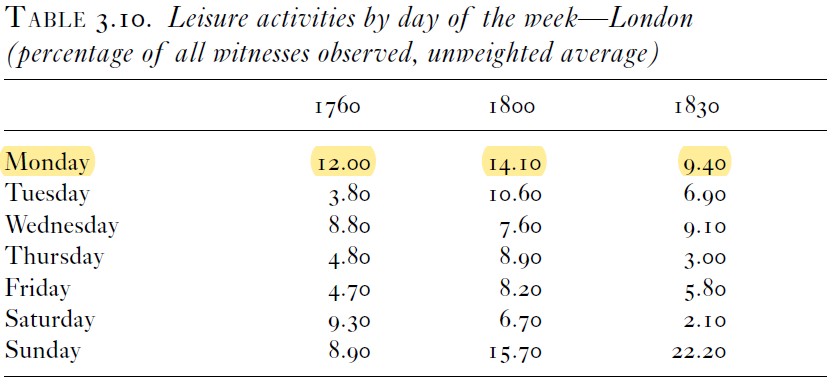
> the elimination of “sacred Monday” as a day in which time is taken off work
According to the table 3.10 [0], leisure time was greater on Monday than on Sunday.
Do I understand it correctly? Monday was the previous Sunday in Christian societies?
[0] https://substack-post-media.s3.amazonaws.com/public/images/9...
I remember reading somewhere that historically, the alcohol content in beer was considerably lower (as low as 0.5% IIRC) than it is today. I'm not sure if the article takes this into account - I might have missed that detail.
Not sure if the author is here, but small typo at the end:
> The amount of alcohol consumed by drinking historical beer brews is between 0.62 to 0.107, the % of alcohol
I think you meant “0.062” not “0.62” am I wrong ?
Cheers for the informative article :)
> When did people stop being drunk all the time?
When did people have ever been drunk all the time?
People drank more because there was a lot less alcohol in the alcoholic beverages on average, but it was some people drinking a lot more (really, an awful lot more), not the average person drinking more than today.
A person drinking a bottle of whisky a day would count as 22 drinks, the average today is around 1 drink per person per day, so that one person alone would count as 22 people.
You don't see many people drinking that amount of alcohol today, but it wasn't uncommon in certain jobs in the recent past.
Beers were similar to fermented milk they drink in Mongolia[1], wine had a similar alcohol content of today only for upper classes products, the average had higher alcohol content to preserve it better or it would spoil and taste like vinegar, but it was mostly drank mixed with herbs, honey and diluted with water (vinification was much different back then, the final product often reminded a syrup more than a liquid).
For a lot of time in many places alcoholic beverages were also banned by religions on public health grounds.
But the most important reason is that the "industry" of beverages (soda, juice, energy drinks, etc), advertising and marketing had not been invented yet.
And probably the amount of stimulants and sugar we get from these "non-alcoholic " beverages are more damaging to our health than alcohol alone.
For optimal health, the World Health Organization (WHO) recommend consuming no more than 6 tsp of added sugar daily. By drinking just one serving of cola a day, a person will easily exceed this amount. A 2015 study attributed 184,000 global deaths each year to the consumption of sugary drinks.
this is sugary drinks alone, notice that when you look at the stats for alcohol related deaths, they also include incidents or accidents where someone had some alcohol (> 0) in their system, the same stats are not kept for sugar/caffeine/stimulants in general.
Michael Pollan claims that alcohol was safer than water, then coffee came and boiling water stopped people from being drunk all the time, fueling the industrial revolution. There are still pockets of old habits where kids are given wine assuming it gives them strength, in Georgia and Abkhazia, where it is a big problem now.
https://www.youtube.com/watch?v=WD6cYabx0nk
Some of the numbers seem unreal. Earlier this week I drank 3 beers (1,5L) which is an exception (i mostly do not drink at all) and the next day I had to take sick leave.
For Austria I can assure that it happened somewhere between 1995 and 2000. It was a combination of many things though: Social ostracism of smoking; Gaming consoles and Internet which kept people in their flats/houses; Ubiquitous availability of alcohol measurement devices which effectively supported enforcing workplace security and liability of drunk driving.
I've always been curious about the evolutionary implications of this. Something that big in diet for that long will have evolutionary impact.
And since it's mind and behaviour-altering, I often wonder if human minds had to evolve to compensate for constant drunkenness. Are we all more obsessive and intelligent to make up for constant drunkenness making us sloppy and dumb?
My parents never did! Hahahaha <sigh> :-(
When you do the math on the historical average, it comes out to 2-3 beers per day, hardly drunk all the time.
https://lefineder.substack.com/p/when-did-people-stop-being-...
There is a word for 0.62 alcohol beer: whiskey.
Axes not labeled. Come the fuck on.
In the 70s as a teen in KY a neighbor family had a Manhattan dispenser in the kitchen. Like those juice machines at fast food restaurants. Had to hold a couple of gallons, at least, of brown liquid. No matter the time of day, they always had a glass nearby.
Some people in the US were all torqued in the 80s when you could no longer drink and drive.
https://twitter.com/historyinmemes/status/166851023189728870...
"You can't drink when you want to, you have to wear a seatbelt. Pretty soon we'll be a Communist country".
Does that echo, or what?
When the transition of the population from consenting adults to productive livestock (consumists) took place. I.e. during the industrial revolution, and much more extremely nowadays.
I learned that water was quite untrustworthy, and that people drank (wine, mostly), in order to not die, evacuating from both ends.
Probably it has to do with the huge shift to non alcoholic beverages like coffee and tea which is a modern day drug?
Pub houses are abbreviation for Public houses in Ireland. And that is where people drank.
Aren't modern drinks more alcoholic? 5% by vol beers, 12.5% wines.
After college.
Sorry. Couldn’t resist. I’ll show myself out.