▲ 295 points
back
118 comments
Amazing feat. Yet it's not the first time that I've also felt bitterness pondering such past achievements.
I can't escape the feeling that we used to be so much bolder and unconstrained in setting goals for ourselves and actually pursuing them. I feel like 1900 people would have fixed global warming, unaffordable housing, universal healthcare etc.
Engineers in the 19th century would be amazed that we can build mechanisms with thousands of moving parts — functions, classes, packages — just by typing on a keyboard. Not only that but they also spin around in the order of millions to billions of times a second and every computer in the world can talk to any other computer. Most of these machines are the size of a bar of chocolate and a huge amount of the software is given away for free in an ecosystem of OSS, applications, and programming languages thriving on competition.
I see your point about a lack of modern day gumption in the physical world but I sleep at night knowing that what we do with software more than makes up for it.
> Engineers in the 19th century would be amazed
Would they?
https://publicdomainreview.org/collection/a-19th-century-vis...
People in 1900 effectively had two world wars that lead to a massive number of deaths, thinking it was some golden age of unlimited accomplishment without terrible costs would be a mistake.
My great grandparents fled Mussolini's Italy, despite the trains running on time. And I daresay, many if not all of our environmental problems are due to the bold and unconstrained development of technology.
I think this is accurate, a cynical comment mentioned the two wars, but more practically, those wars and pandemics killed a lot of people, ending design trends before they could take hold. people from all walks of life as both civilians and military patriots and conscripts, from so many countries across Europe all at once
cities that werent firebombed were on somebody’s list to firebomb. Vienna could have met the same fate as Dresden, Dresden could have the charm of a Vienna or Paris. when you put it in perspective there are plenty more trends that are just lost through that dark age.
there are a lot of things from the 1890s to 1910s that I think would be appreciated today if people knew of them.
You’re not the only one: https://patrickcollison.com/fast
This is somewhat still this way in China, as we can see in architecture and infrastructure projects that are often bold, ambitious, and which happen rather quickly once decided.
In Europe, especially, it is very difficult nowadays for good and bad reasons.
Note, though, that this was for a temporary exhibition so being bold and forward-looking, with a level of showing off, what the whole point.
i drive on the interstate highway system way more than i like, and i'm often struck with the thought that, if we didn't have our interstate highway system now, we wouldn't build one.
> unaffordable housing, universal healthcare etc.
They had a chance to (both were huge problems at the time), they decided to spend massive amounts of resources killing each other instead..
1940s and 50s people on the other hand had a fairly decent run at it.
Most of these problems are artificially created by governments via regulations and their support of corporations and their monopolies.
> fixed global warming
Sir, the correct term du jour is "climate emergency". "warming" is not to be used anymore since expected natural developments started to contradict the yearly proclamations made by Gore et al.
Well this is actually still very common in Paris!
A number of subway stations have adopted them for long corridors connecting platforms of different lines within the same station.
They move people at 4km/h on average, but the one in Montparnasse station goes up to 9km/h (used to be 11!).
They’re mighty useful to hurried Parisian commuters.
The 11km/h central lane was wicked fast. It was really exciting as a kid... But always broken.
I was especially impressed to see that this was rolled out on an entire 3.5km-long loop, rather than some small localized attraction.
It's interesting not just because of the engineering that was done, but because it shows what 1900 people thought "the future" would be like. I'm guessing they expected moving sidewalks to become common around cities by now.
I suspect the scale was necessary because the mechanism only works as a loop, and only allows limited curvature unless you make it a perfect circle, in which case it's just a rotating platform.
> to become common around cities by now
Mass production of cars changed many things and directions.
Heinlein's "The Roads Must Roll" posits a network of very fast, very long moving walkways which could be used for mass transit (you'd ramp up speed on slower ones then hop over to a fast one). Wikipedia says that moving walkways had been in sf for decades by that point, but Heinlein also almost incidentally invents the Segway in the story -- just a little treat.
I love peoplemovers (like the Hong Kong Central-Mid Level escalators and the delightfully bouncy SFO walkways) and always wondered what would have to be different for us to get super-fast ones for transit.
In Boston, IMO they would be at least as good as the Green Line :)
Asimov introduced me to this concept in I robot.
In his version there were multiple levels of speed for entry/exit of transit so the main highways were going really fast.
IIRC it required some dexterity to use and sounded a bit dangerous...
Moving walkways have a big power efficiency problem over a distance. While you can make a train track longer without decreasing the efficiency of the train, a moving walkway has to move that whole walkway. Can you imagine the friction on a 10 mile long moving walkway? You would need massive motors just to budge it.
Mid level escalators have a very definite purpose as people wouldn't walk up that steep slope before.
Moving walkways along flat surfaces though? Its very hard to make them attractive. Most people like to walk a little, certainly we are built for it genetically and most people don't walk as much as they should in any case. In terms of mass transit nobody has ever got the safety and space issues to work. They only really have tended to work in airports where there are sometimes very large distances to traverse, and you need an (actually pretty slow moving for safety) solution for the elderly etc. who aren't as mobile. Even at an airport unless distances are massive and people have giant luggage most will prefer to walk, or only take the moving walkway for novelty value.
Getting out and walking was frequently as good as the Green Line when I lived there...
In Heinlein's books, do the rolling roads come before or after the establishment of American theocracy ?
Asking for a friend.
I seem to recall this is also a thing in "the city and the stars" by Clarke (1956), including the fact that it's faster towards the middle. I imagined a river of asphalt and it was kinda cool.
> In Boston, IMO they would be at least as good as the Green Line :)
Yeah, but the E line down South Huntington would be downright perilous :-D
There's a video at the bottom of the article apparently shot by Thomas Edison in August 1900.
YouTube has a couple more of them
https://www.youtube.com/watch?v=BjpCVQgKZsc
Here's also an AI-upscaled/-colorized video which contains a bit of the boardwalk.
The video appears to show adult men punching children. I’m guessing the children were making a nuisance of themselves. Different times.
I don't understand why moving walkways aren't called slidewalks.
Doesn't work for Brits with their pavements ;). Maybe "movements" then.
I call them notscalators, but yours is better :p
They are in some old SF. I like the term too.
Pure genius.
I love the concept of moving walkways on large airports and always wondered why there are non with multiple speeds like this one. Is it a security aspect?
There is however an accelerating one at YYZ in Toronto [0].
[0] https://en.wikipedia.org/wiki/Moving_walkway#ThyssenKrupp_AC...
there used to be a quicker (9 or 11 km/h depending on sources) walkway in Paris metro, but apparently too frequently broken https://fr.wikipedia.org/wiki/Trottoir_roulant_rapide
Alas, those have been drywalled over and closed for good at YYZ.
A real bummer, especially since it seems I have to traverse those passageways every time I return from the US or Europe.
Accelerating escalators are both fascinating and absolutely terrifying to me.
My dude, that is the coolest thing I have seen. The engineering and design required to make it reliable and safe. Thank you for sharing.
Anybody here go through the DFW airport about 20 years ago? That airport has had moving walkways for 30+ years that I’m aware of.
In 200X, there was an IR sensor at the end of each walkway that would trigger a male voiceover warning about the end of the “moving walk”.
There was a Starbucks in one of the terminals, right at a dogleg where a section of the walk ended. I had to listen to that announcement fifty to 100 times in a dozen or so minutes, and between recording, playback, and audio compression quality, my partner and I both swore he was saying “the wooing walk”. Like a ventriloquist trying to not get caught subbing out consonants - and failing. The Wooing/Mooing Walk was a running joke the rest of our relationship.
Don't most large airports have moving walkways? I've seen them quite plentiful abroad.
Interesting that the exposition map[0] has the Eiffel Tower labeled as "Tour de 300 Métres." I wonder when it became known as the Eiffel Tower in common parlance?
[0]https://upload.wikimedia.org/wikipedia/commons/b/be/P._Binet...
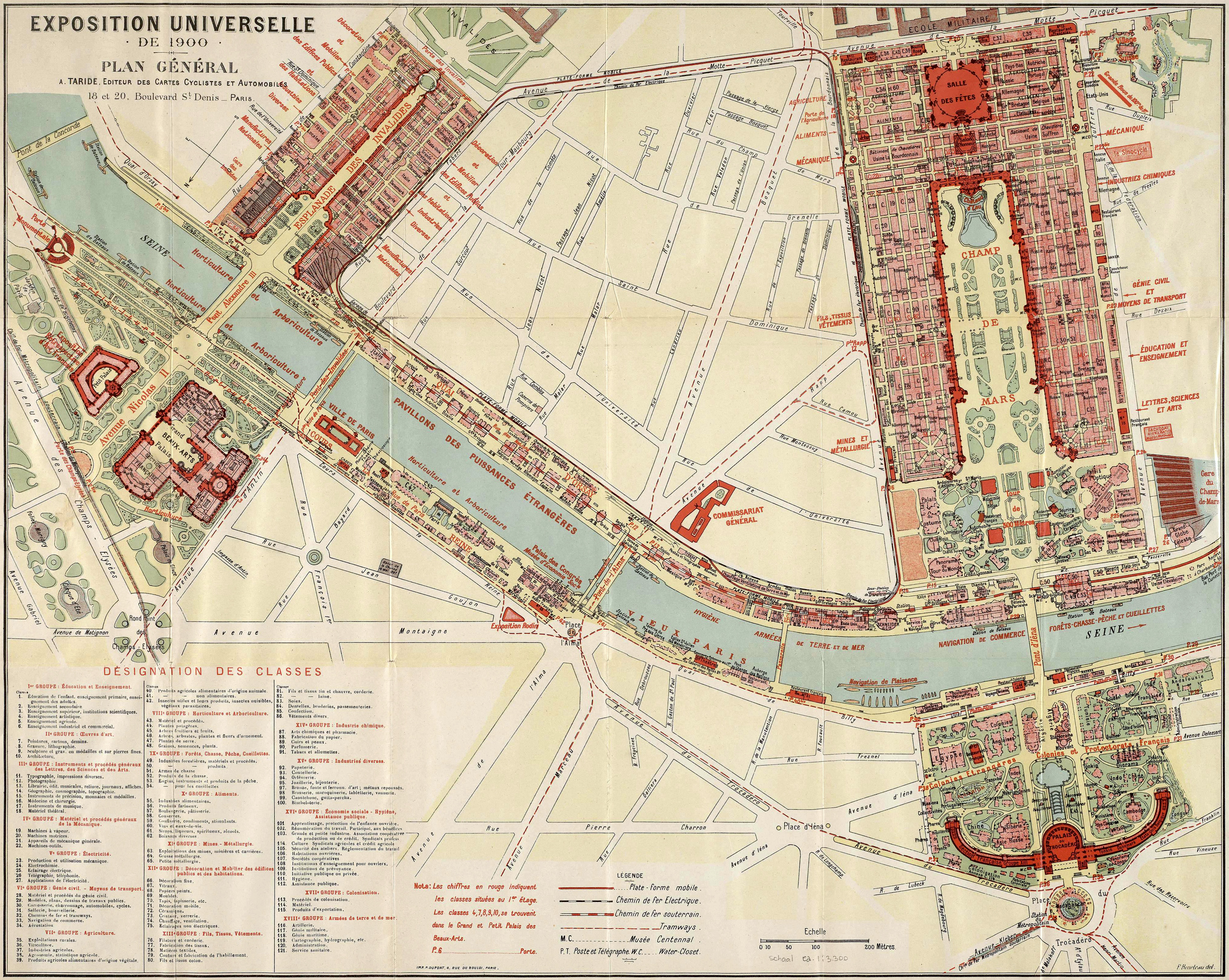
It was called the Eiffel Tower informally even before it was built: https://en.wikipedia.org/wiki/Eiffel_Tower#Artists'_protest
The Edison film at the end of the article is just fantastic.
So, this is a very long, slow-moving, open train.
Advantages I see:
- you can hop on and off wherever you want. That makes them useful for short trips
- no waiting time; you can hop on whenever you want. That likely makes up for lack of speed on short trips.
- if built at ground level, pedestrians can cross the line fairly easily wherever they want (hop on, hop off on the other side), so these wouldn’t split cities in half the way railways do, but only for pedestrians.
Disadvantages I see:
- slow for longer journeys
- power inefficient if there are few passengers (trains are, too, but this is a really, really long train. Imagine moving these 3km of track to move 10 persons). You can’t scale down capacity for less busy hours.
- all maintenance requires shutting down the system (in contrast, with trains, you take off the train and put another one on for most maintenance)
- ¿safety?
You can scale down for less busy hours by just turning it off.
Hazards to pets and sandals/Crocs wearers, perhaps.
Over a hundred years ago, and if built today it would still be impressive. Technological progress feels very fast and very slow at the same time.
I wonder how long it stayed in operation, how much it cost, and if it kept running for a while what parts of it broke most often.
I'm amazed at how large the Exposition was. And consequently, the moving sidewalk.
The Edison video is amazing