I wonder through what mechanism they were able to fine them for bard/ Gemini, since it's not really clear that training an LLM is a copyright violation. Is it through those prior commitments made in 2019 or whatever?
back
3 comments
Its because the EU has something called "neighbouring rights" which are an additional right to the usual form of copyrights.
> To tackle this, the EU created a form of copyright called “neighbouring rights” that allows print media to demand compensation for using their content.
In some EU countries, like Austria for example, there are royalties to pay on non-volatile storage memory[1], who's funds go to the local mafia...errr I mean music/movie rights holders association, because get this, storage can be used for storing reproductions of copyrighted content, so if you buy anything from external HDDs to phones with flash memory, then you're automatically a potential pirate and you owe them money upfront to compensate them for the piracy induced losses.
It's a tax that started from the 1980's first on audio and VHS cassettes, and kept getting updated over the years to include MP3 players, flash memory, smart phones and smart watches.
I expect the exact same thing will happen to LLM bots. The juggernauts like Ringier or Axel Springer will lobby in their respective countries or at EU level to get their pound of flesh whenever people use something like ChatGPT, because they'll claim it was trained on their copyrighted data and so they deserve to get their cut, otherwise the service will have to be banned in the EU.
[1] https://www-wko-at.translate.goog/oe/handel/maschinen-techno...
  | Integrated memory in mobile phones:                                                            EUR 2.50 |
  | Integrated storage in tablets:                                                                 EUR 3.75 |
  | Integrated memory in PC, desktop computer, notebook, subnotebook, ultrabook, netbook, laptop:  EUR 5.00 |
  | Hard drives as individual storage media:                                                       EUR 4.50 |
  | External memory cards:                                                                         EUR 0.35 |
  | Digital picture frames:                                                                        EUR 2.00 |
| Smartwatches: EUR 1.00 |> In some EU countries, like Austria for example, there are royalties to pay on non-volatile storage memory[1]
In France it's the same but with an even more insane version. The tax is so high that it's skewing the EU average and you have to take France out of the data.
As an example, taxes on mobile phones are at 14EUR for a phone with a drive greater than 64GB (so most of them nowadays)
I notice Austria an France seem to have a lot of such dumb taxes in common. I guess it must be to feed those generous welfare systems. But these taxes are basically robbing Peter to pay ... Peter.
That's the idea yeah, the economic strategy in France is very simple: if it works then tax it, it if doesn't work then give more subsidies.
That's a terrible long term strategy because the good companies are subsidizing failing ones, destroying the reward function of the market.
The second terrible side effect to this policy is that the subsidies system is too complex for small companies to handle so the small companies have an increased failure rate compared to a normal economy.
Because laws are "just your opinion, man" and their opinion is that they violated their laws.
This seems unironically the best answer.
There are a lot of laws that are seemingly universal like patents, copyright, privacy (right to your own likeness etc) but the details can vary widely internationally and even between EU countries.
As an example: it's infamously prohibited to commercially publish photographs taken of the Eiffel tower at night because the light installation from 1990 onward is protected by copyright law as a work of art (as is the glass pyramid of the Louvre btw). HOWEVER it's legal to take and use pictures of permanetly publicly displayed works of art in some European countries like Austria, Germany and Switzerland ("Panoramafreiheit"). So you could sell post cards of unlicensed photographs of the Eiffel tower lights in those countries but not France. But if you commercially use them on a Germany-based website available in French you might still get sued from France.
Here's a German map of this specific law across Europe to illustrate the point. You don't have to speak German to understand that the laws vary wildly despite all being based in copyright: https://www.parismalanders.com/wp-content/uploads/2022/06/Pa...
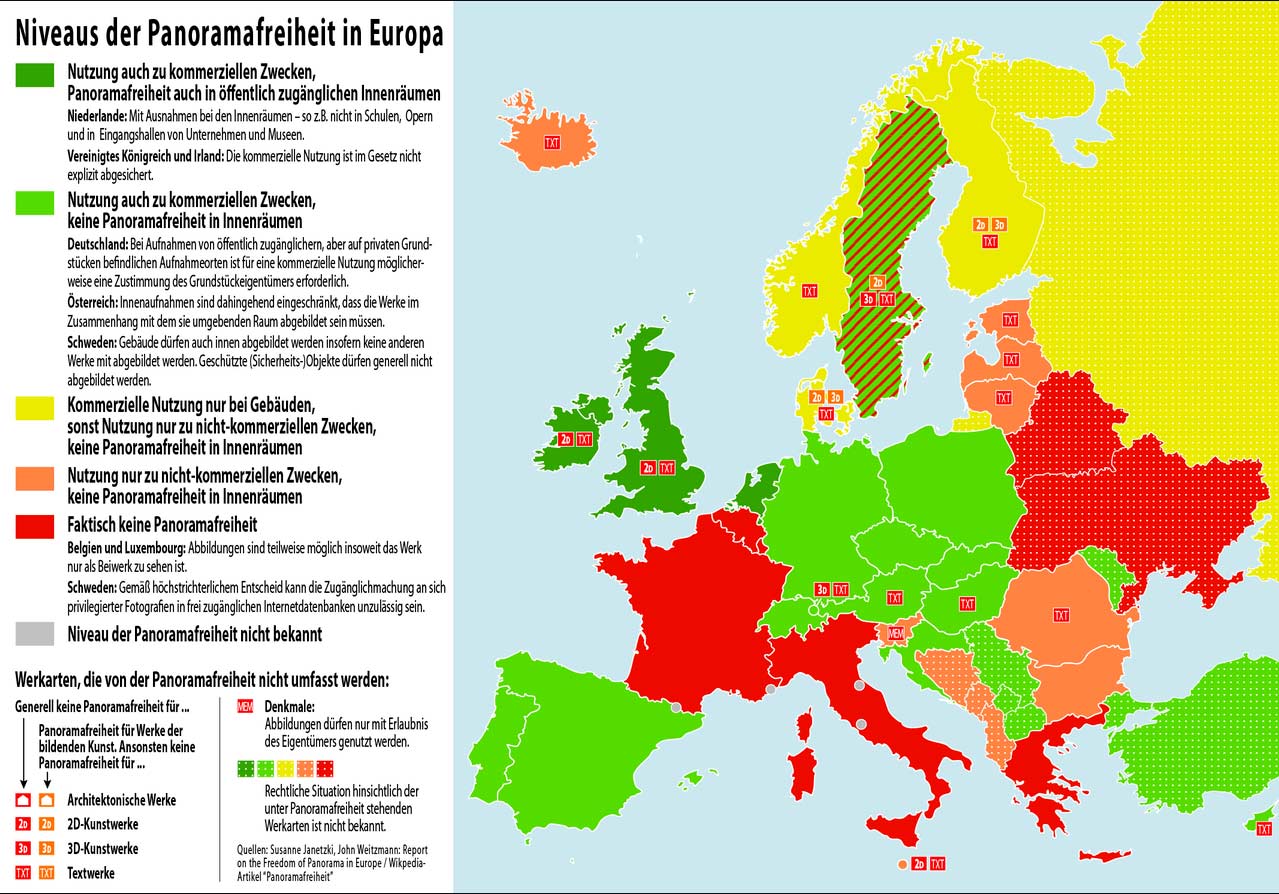
It's easy to see how one could argue that using copyrighted data as "training material" for a commercial LLM is commercial use. It's also easy to see how one could argue that this is not "reproduction" of significant portions of the copyrighted work and therefore copyright law does not apply. But it's also easy to see how one could argue that this still qualifies as "citation" the way Google regurgitates snippets from news sites and is thus covered by the "citation" provision for protecting newspapers. But it's also easy to see how one could argue that's not the case. Different jurisdictions will interpret these things differently.
Imo the definition of piracy is rather clear - illegally copying of protected content that infringes the owner's copyright.
If not training, then possession perhaps?
How do you define a copy? Is the data sent over HDMI to your monitors memory a copy?
Were LLMs trained on a data processed via HDMI? Are you sure you're not confusing copy with processing?