▲ 525 points
back
279 comments
I went to school at a relatively late age and started in community college. The school/state had a policy where any independent income earners making less than 35,000/year would not pay tuition. A single dollar over that would require paying full tuition of ~$60/unit or about $750 a semester. One year I worked a little more overtime during the holidays than usual and realized with a week to go in the year that I'd go a few hundred dollars over, so I called out of a few shifts and nearly got fired over it. I barely squeaked in under the limit, and if I hadn't, there was pretty much no way I would have been able to continue school. It's not like I could suddenly afford it now that I made $35,001 vs $34,999. I have never understood why things like this don't use some sort of sliding scale, rather than absolute dividing line.
An instructive image of the welfare trap: https://en.wikipedia.org/wiki/File:Welfare_trap.png

People making $30K on welfare would need to make $81K at an actual job to have the same income after tax.
More info: https://en.wikipedia.org/wiki/Welfare_trap
> I have never understood why things like this don't use some sort of sliding scale, rather than absolute dividing line.
Because it's easier to pass a law that sets up such welfare when it has a simple threshold, or at least it was.
Last time this article came up, someone referenced a group of lawmakers in the US who were working at smoothing out these awful discontinuities, but I can't quickly rustle up the link.
> I have never understood why things like this don’t use some sort of sliding scale, rather than absolute dividing line.
They often do use sliding scales, but that’s more complex (and expensive) to administer, and (because of multiple interacting programs) ends up not actually solving much of anything. Also, because of the way things (including available funds) work, but even ignoring budgeting for the increased admin cost, a sliding scale probably would start stepping down from full benefit where a sharp cutoff is, that would probably be more like the middle of the sliding scale, so if you “barely squeaked in under the limit” on the sharp cutoff version, you’d probably get far less benefit under a sliding scale system.
I changed career paths post age 40 via a coding bootcamp.
Despite being a terrible student when I was younger, I found had a great time learning, and I've really enjoyed my job ever since.
I found myself in a strange position though, lots of services offered benefits to students, discounts, internships, storage / compute time etc. I was not enrolled in a traditional university (although they were administering it), and so I didn't qualify, for much of any of those kinds of offers. Most of the systems in place thought of students as a typical 4 year university student and frankly ... younger. One internship I applied to did not seem to clearly indicate they were only really interested in younger, and more traditional students until the second interview.
Some of these rules I get, they don't want someone abusing their free / discounts for other reasons and they have systems in place for dealing with traditional students.
With people changing jobs and seemingly continued potential for the need for job market retraining and related disruption and etc ... it feels like it's time to make some adjustments as far as what a "student" is and so on.
Frankly, because many people think that any kind of welfare or assistance is, at best, a necessary evil—and more often just evil—and they want to make it painful, complicated, and hard to access.
It's because the people who make such rules are both innumerate and if not lazy then uncaring.
Not to condone the school's policy, but could you have donated the excess income to charity to get your taxable income back under the limit?
>I have never understood why things like this don't use some sort of sliding scale, rather than absolute dividing line.
Try translating your idea of a sliding scale into a piece of legislation which matches your intention.
A similar fun example is the distribution of Elo ratings on a chess site, e.g. here's the weekly distribution on Lichess for Bullet games (less than 3 minutes):
https://lichess.org/stat/rating/distribution/bullet
It's easy to understand why this happens:
- Player ratings will fluctuate by small amounts as they win and lose individual games.
- People are happy to stop playing when their rating is at e.g. 1503, but if it's 1497, they'd rather play just one more game than leave it that way.
- At any given time, most accounts are not playing, so the distribution shows a bias towards values just over a 100 Elo threshold.
The other neat thing is that you can see this effect reduce as you look at longer time controls:
Blitz (less than 10 min): https://lichess.org/stat/rating/distribution/blitz
Rapid (less than 30 min): https://lichess.org/stat/rating/distribution/rapid
Which makes sense because the time and effort of gambling just one more game to get the rating back over the line is higher at the longer time controls.
Or you can look at the cut off date of competitive sports players and athletes. If January 1st is the cut off for age there will be a disproportionate number of players born in December. If it's June 1st many of the players will have birthdates in May and April.
>One reason people were looking for ways to lose money was that, in the U.S., there's a hard income cutoff for a health insurance subsidy at $48,560 for individuals (higher for larger households; $100,400 for a family of four). ... That means if an individual buying ACA insurance was going to earn $55k, they'd be better off reducing their income by $6440 and getting under the $48,560 subsidy ceiling than they are earning $55k.
I had the opposite problem for the 2022 tax year: I turned out that, with investment losses and no earned income, my adjusted income was below the poverty line, which ... means your ACA healthcare subsidy is cut off entirely!
https://www.irs.gov/affordable-care-act/individuals-and-fami...
The "logic" there (from reading discussions of the cutoff) is that, "well, if you're below the poverty line, you should be on Medicaid and not on the ACA exchanges at all, silly!" Okay, but if you have wildly varying income, and a high income from previous years, you don't know that you'll be "in poverty" this year, and won't qualify because of the past year.
I was tempted to update my taxes to claim phantom income from my imaginary cash-based business, which would then get me the subsidy, but that feels ick.
(Which, I know, being retired on crypto, I also feel ick about taking the subsidies to begin with, but that's a different issue.)
At least in the government, there should be a law that any hypothetical scenario where someone making more money before government taxes/incentives would cause them to earn less after, must be quickly resolved by replacing hard cutoffs with gradients.
No benefits should apply 100% for anyone making under a certain amount and 0% for anyone making over. Instead there should be a range they slowly decrease, so that if you make $1 more before the benefit you still get less than $1 after. Maybe even a lot less, like only $.30. But you should never lose money.
This is obvious. It goes to show how bad beaurocracy and subtle misaligned incentives are that these hard cutoffs ever existed in the first place.
Also UK VAT. Companies only need to register for VAT when they turn over more than £85,000 in a year. This adds a great deal of extra complexity for running the company. Predictably a lot of companies earn just less than this amount. The graph is worth a thousand words:
https://www.economist.com/cdn-cgi/image/width=1024,quality=8... (from https://www.economist.com/britain/2023/04/11/britains-tax-ta...)

Coding hard cut-offs like this into legislation, regulation or policies seems crazy almost to the point of negligence, incompetence or malice. Especially when it's so obvious such cliffs will incentivize behavior certain to cause negative or perverse outcomes. It's even more incomprehensible when implementing graduated thresholds is so well understood.
A related common failure mode is baking in fixed, absolute thresholds for dynamic domains sure to evolve instead of linking thresholds to dynamic metrics (such as inflation, cost of living, etc).
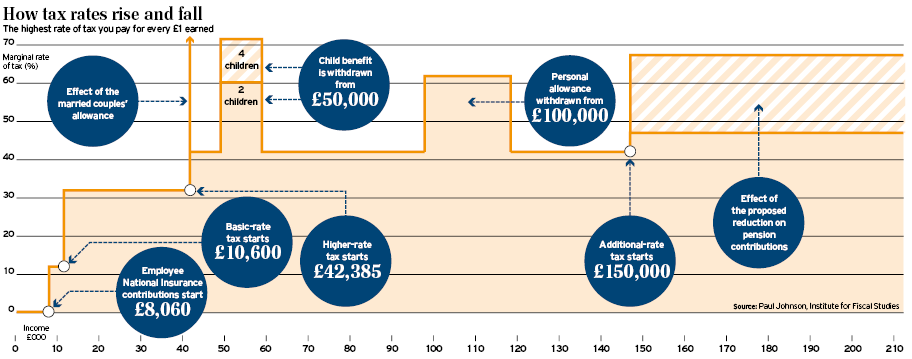
Marginal rate discontinuities in the UK income tax system [0] are driving highly undesirable (from the taxman's point of view) behaviour. The increase in marginal tax rate from £100K p.a. upwards has already led to:
- doctors going part-time to keep their income below £100K, in the middle of a shortage of doctors across the health system
- employees turning down promotions because with the combined effects of income tax, student loan repayments and loss of childcare subsidy the effective marginal rate of income tax between £100K and £117K is > 100% (!)
- single high earners (core voters of the present government) effectively subsidising families of middling earners (the opposition's core voters) because the discontinuities apply to single person's income, not combined household income
The behaviour changes are simple first order effects. The second order effects on public service workforce availability and overall tax take were also highly predictable.
[0] https://www.telegraph.co.uk/multimedia/archive/03270/tax_327...
Haha, I recall seeing a similar plot with a "suspicious discontinuity" when I looked up data on home appraisal price vs sale price. I remember asking the loan officer why the contract was forwarded to the appraiser before they did the appraisal, because that might bias their assessment. She gave me a funny look and replied "that's kind of the point."
The worst one of these that affected me was money helping people in the 2008 housing crisis. qualifying was based on what percentage of your income your mortgage payment was. So I would have got it if I had made a little less money, or if i had bought a house I knew I couldn’t afford. It felt like being punished for making the right decisions.
> It's generally believed that this is caused by a discontinuity in youth sports:
> 2. Within a given year, older kids are stronger, faster, etc., and perform better
I've seen a few youth ice hockey games and by god it's just unfair; there's a kid like a foot taller than the rest. I'm kind of surprised there isn't some system that buckets kids by size , it can't be fun for the small kids to get elbowed in the neck every time they bump the tall guy.
The author of the marathon paper explains the phenomenon he is observing, and then goes on to "reject that explanation" without attempting to do anything to control for it.
>For example, the 2013 Chicago Marathon provided pace teams for 3:00, 3:05, 3:10, 3:15, 3:20, 3:25, 3:30, 3:35, 3:40, 3:45, 3:50, 3:55, 4:00, 4:10, 4:25, 4:30, 4:40, 4:55, 5:00, 5:10, 5:25, and 5:45.T he institution of pace teams then could provide an alternative explanation for the bunching we observe at round numbers.
It would be easy to do, even. Restrict to marathons where the pace team spectrum is known to be of a specific type and see if the other spikes disappear. The author certainly has the data to do this, and isn't. That is suspicious.
Related:
Suspicious Discontinuities - https://news.ycombinator.com/item?id=28452926 - Sept 2021 (54 comments)
Suspicious Discontinuities - https://news.ycombinator.com/item?id=22378555 - Feb 2020 (297 comments)
We had something like this when we were on ACA one year. I hadn't been working that year, but I ended up getting a job in August and it looked like we were going to go over the income threshold because we have a rental and were getting rental income. I asked the renters to please not pay their rent for Sept-December until January of the next year. They happily complied. We were able to squeak under the threshold, but it was close.
> One reason people were looking for ways to lose money was that, in the U.S., there's a hard income cutoff for a health insurance subsidy at $48,560 for individuals (higher for larger households; $100,400 for a family of four). There are a number of factors that can cause the details to vary (age, location, household size, type of plan), but across all circumstances, it wouldn't have been uncommon for an individual going from one side of the cut-off to the other to have their health insurance cost increase by roughly $7200/yr. That means if an individual buying ACA insurance was going to earn $55k, they'd be better off reducing their income by $6440 and getting under the $48,560 subsidy ceiling than they are earning $55k.
Except that in real life there is no /dev/null that you can immediately pipe in exactly $6440 to hit your target.
You have to spend your time in order to achieve this reduction in AGI.
And discontinuities being discontinuous means that the number of people who have the necessary training/experience to confidently achieve this in, say, three hours, is probably in the same ballpark as people who can successfully set up encrypted email in the same amount of time.
For everyone else, it's going to take at least a week's worth of time to plan, double check, execute, triple check, etc. (And realistically double that, or more.)
At 55K, you've already spent that savings in the value of the time you gave up to get the savings.
People often make fun of free software developers for failing to properly value their own time. But at least that's not their domain of expertise. A financial hobbyist spending $2 of their time to save $1 is professional grade irony.
Edit: clarification
A friend of mine from a farming family in Europe once told me a story that his family would wait until the year one of his siblings was due to go to college and then invest in new farm machinery. Their reported net income for the year would reduce or go negative and the sibling would get to college effectively for free on a hardship tuition grant.
During the pandemic, as was the case for many organizations, my employer implemented pay cuts. In the name of fairness, they did it by income so that those with the highest incomes would pay a larger percentage. That sounds good, but they did it with discontinuities.
What upset me was couples with combined salaries far greater than mine but individually a little less so they were just below the cutoff. Their combined cut on considerably more income was less than mine. We were living on one income, and the cuts would have been tough to absorb if not for the stimulus checks.
We have some discontinuities in our tax code in Argentina, if you are an independent worker, and earn up to 11,916,410 pesos ($11,682) per year, you pay 793,332 pesos ($777) in taxes, around 6.6%, but if you earn one more peso, you enter the general regime, and start paying >50% in taxes.
Specific to the welfare/UBI/public benefits subthread of this (with a digression):
I saw the phrase "middle class solution to lower class problem ['MCSLCP']" applied to stuff like this years ago; that characterisation is possibly not politically correct today. It was discussing various forms of 'credit fine print' --- the ad for "Buy this recliner today, no interest, no payments for three months!!!" ... followed by five lines of fine print at the bottom of the ad (likely double the verbiage of this posting) about need to pay promptly, the upfront fees, etc etc, and the (somewhat usurious) rates and fees payable if the process wasn't followed to the letter.
What makes it 'MCSLCP' is that for a large percentage of the population that would look at this, if you have the time / savvy to assess the deal and make it work, you probably have better credit options available. [1]
It's super easy to comply with the terms if you have a personal organization system ('tickler') that works. Maintaining that system is really tough if you're a single parent/double job trying to keep the ship afloat... and also to have the funds to keep the deal working on the day that the tickler is triggered.
But the 'MCS' of the MCSLCP is, just buy it with the cash-back credit card, and pay the balance in full before the due date. Easy percentage, and you already do that as part of the monthly bill-payment chore.
For the vendor, the deal is a moneymaker since the majority of the takers will not (be able to) comply with the letter of the terms, and the fees and rates become the profit.
The public benefit aspect is that, the space to screw it up and lose the benefits is politically a feature, not a bug. The legislators can paint themselves as guardians of the public purse and the people who blew the cliff as thwarted welfare cheats.
[1] if I could 'ping' patio11 on this... I think some recent posts from 'bits about money' are in the same area as this.
Need to add this one here
https://twitter.com/martinmbauer/status/1769672126905090386
I disagree with the proposed solutions, all way to complex. The thing to do is simply give the subsidy to everyone and make up for it with higher taxes. That is how you achieve more equable outcomes, give fixed subsidies to everyone and recover via proportional taxes.
Instead we end up with a situation where we have arbitrary cutoffs, a large buerocracy just checking for eligibility and often even progressive subsidies (giving more to those with higher incomes)
We have some of these in the UK tax system, some of which are being resolved (or at least improved) but many which aren't.
Currently, if you have a child, you're entitled to a cash payment called child benefit. For a first child it's worth £26 per week and then any subsequent children you'd get £15.90 per week. However, you only get this if the highest earner's income is below £50,000. Between £50k and £60k, it's on a sliding scale, so at £55k you get 50%, £57.5k you get 25%, etc.
Side effects of this are that if you have two earners both on £49999, you get the full amount, and one earner on £60000 you get nothing. It means there's a crazily high effective marginal rate on people. If you put money into your pension, it can bring you down below the threshold again, so many people (if they can afford to) will do this.
From next month, they're changing the threshold to £60-80k over which it drops off, which is a big improvement, but the marginal tax rate effect is still there.
“Some other discontinuities are the TANF income limit, the Medicaid income limit, the CHIP income limit for free coverage, and the CHIP income limit for reduced-cost coverage.”
I know more than one person who intentionally keep low, part-time hours for this. One had a good, work ethic when on the job. Just didn’t want to lose those benefits.
Policy makers should definitely weight this into any decisions about reforms.
This is one of the many reasons that means tested, rather than universal programs end up producing perverse outcomes. People in countries with universal healthcare, daycare and education do not have to limit their participation or productivity in the real economy in order to access essential services.
There's also Poincare and the Bakery [0], which is quite possibly apocryphal but often told - esentially a departure from the normal disibution showing something odd going on.
I vaguely recall reading that the technique was used in the second world war to catch black marketers; if the distribution of weights of rationed items had a discontinuity near the weight limit, it was evidence that the seller was keeping the heavier portions back for private sales.
[0] https://houstonstatisticians.wordpress.com/2013/01/11/poinca...
I suspect the inconvenience and weirdness of dealing with a hard cut-off is easier than the complexity of dealing with some kind of continuous scale. Laws need to be, first of all, easily comprehensible so that all parties can plan accordingly. It's easy enough to plan to keep your income under $X, but hard to figure out the optimum benefit/income sliding scale and plan accordingly. The only other simple and fair option I can think of would be to implement a "judge" to issue approval on a case-by-case basis instead of a hard number.
I'd bet the race time data looks similar to weight-lifting data for certain thresholds, whether it's the number or plates or such. Goals people set and then they mentally stop themselves at that goal.
I was all excited when I saw on Zillow a decent new apartment complex in town with rents that were actually reasonable... until, after hours of studying photos and floorplans and neighborhood, I noticed a statement on Zillow, near the bottom of the scroll, in one of the tabs in right column, that the building is subsidized, and there's a permissible income range.
While some of us could qualify while on early startup salaries, I don't know how I'd feel about subsidies as a techbro, and I know I wouldn't feel good about having to move from a nice building (big time investment, moving monetary cost, and quite possibly moving to a crappier building) because the startup was doing OK.
I was disappointed, but not surprised. As a middle-class techbro, this is a very lite version of a much bigger problem that has affected many low-income people. News has long had stories about low-income people who are trapped with subsidies they need (housing, food, support for children, etc.). They make a lousy wage, and can't afford to get much of a better wage, because the societal safety net on which they depend would be ripped out from under them before they could afford it to.
The problem is labels, and beyond that political parties. Politicians like labels because the parties depend on labels for branding. They want to use rhetoric to group people, like “poor” or “rich” and the second you do that you create the discontinuity.
Avoiding benefit cliffs requires more than understanding the issue of discontinuities, it requires the reduction of identity politics which neither party is on board with. Parties themselves are labels. They cater to the human desire to simplify and form tribes around those labels.
Similar to car prices, we see the same mental rounding effect in rents. People will rent a home for $2100 or $2200, sometimes even $2150 for those truly dedicated to price finding, but hardly anyone rents an apartment for $2137.
Source: my data for the city of Berkeley https://observablehq.com/@jwb/berkeley-rent-board-data#cell-...
It's interesting how the marathon discrepancies mostly disappear at left and right of the curve (looking at 2:30 and 6:30). Presumably top runners are putting out 100% of sustainable effort the whole time so there's no reserve energy and the slowest are similarly doing all they can just to get the race done. The folks in the middle are the ones who are putting in something less than 100%.
I love the example with Russian elections! It's impressive that they allow themselves to be that low-effort in their fake results.
> However, a tax system that encourages people to lose money, perhaps by funneling it to (on average) much wealthier options traders by buying put options, seems sub-optimal.
In expectation, they're likely not really funneling that much money to options traders. Indeed - if the option pays out, they likely will not have to worry about medicare/healthcare for quite some time.
This happens in other countries as well. An option here is to donate to a charity. It is tax-deductible, carries no risk of accidentally making you more money, and typically does some good instead of lining the pockets of the wealthy.
Do check if that would work for you before wasting money on useless put options.
Another place this shows up is in online chess ratings.
See Lichess: https://lichess.org/stat/rating/distribution/blitz
Couldn't find this in Chess.com stats, but maybe they do some smoothing in their plot.
(2020), but still interesting.
Thresholds are almost always a bad solution (in engineering or otherwise) - the only advantage I have found for them is that they are usually easier to understand than the alternative.
The discontinuities at the used care sale prices graph seems like an arbitrage opportunity on depreciation. Buy right after a round number, sell right before another, pay less on dep.
For those of you that are fans of Jon Bois, he once noted in a video that the statistics for ball placement by an NFL ref is notably skewed towards 5 yard lines.
Because, he thought, refs are human.
I remember my deep disquiet at a tax return where my reportable income was exactly 2^n-1 for some integer n, naturally provoking obsessive checking and audit on my part.