▲ 76 points
back
46 comments
I hope they make out of this recent recession but people should be cautious in using words like "the economy surged" when describing a 1.3% increase in economic activity.
If anything, Argentina is known for being a economic rollercoaster fueled by populist after populist government. It never works out and the current situation seems like more of the same.
> If anything, Argentina is known for being a economic rollercoaster fueled by populist after populist government. It never works out and the current situation seems like more of the same
As the saying goes, there are 4 types of economies. Developed, developing, Japan (stagnation for decades with no negative ramification as normally would be expected) and Argentina (basket case).
The negative ramification for Japanese economy is demographics.
This kind of stagnation with no serious full employment kills remaining hopes of future generation, prevents them from owning housing and causes negative birth rates resulting in further collapse of social security plus social problems.
And this is the sort of thing there really needs to be a big "what matters?" conversation. 1% GDP growth is not important. With growth rates like that, what matters is sustaining 1% growth over 10-20 years so that the impacts become material. I hope Argentina is doing well, maybe Argentina is doing well, but this article contains no evidence Argentina is doing well, badly or otherwise.
And by all the heavens, could people please resist the urge to try and judge economic performance after a candidate has been in office for 1 quarter. Good economic management takes requires a decade or so before the fruits ripen. And mad scheme can work for 12 months and goose the figures if people care to.
Their inflation has been a rollercoaster but their GDP per capita has pretty consistently been on a downward trend for half a century.
https://substackcdn.com/image/fetch/w_1456,c_limit,f_webp,q_...
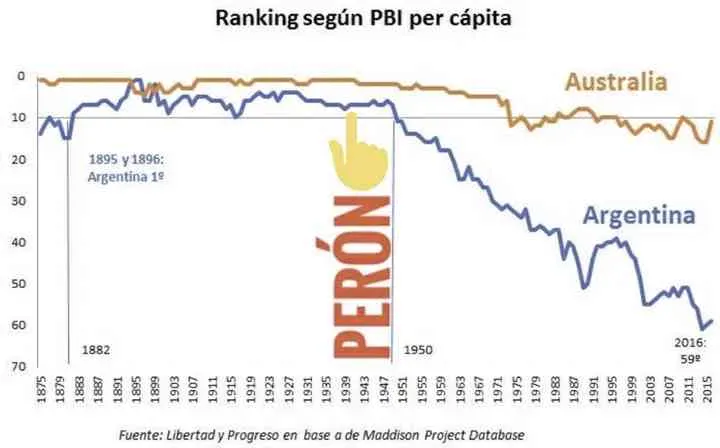
Also calling the politics just a series of populists does not accurately represent the economic agendas which have been exactly the same thing (basically left leaning populism via a heavy administrative state) repeated ad nauseam with the exact same outcome.
The whole reason Milei won was because the competition was from the same parties as always, proposing the same solutions as always, and he was the only one demanding something change, so people saw it as and opportunity and looked past the more radical stuff he was saying.
> Also calling the politics just a series of populists does not accurately represent the economic agendas which have been exactly the same thing (basically left leaning populism via a heavy administrative state)
I don't understand this paragraph. It's not a series of populists, because it's been the same populist agendas? Is there some typo?
I see a distinction between economics and politics messaging. If the economics agenda is exactly the same that's all that matters to this discussion.
When every gov before him did the exact same pattern of going repeatedly goes into huge debt and uses gov social/economics projects to fix things, then the variations in their populists messaging is not really relevant.
I think maybe OP is thinking “populist” generally is a slur for non-social democrat right wing governments these days.
I'd say you don't know what you're talking about.
Milei cut back government spending by 30% from the first month on (that's a 15% gdp of spending cuts in a month), and achieved fiscal surplus/superavit on that month. Contrary to the (very wrong) keynsian economics, deficit spending doesn't promote economic growth and Milei's measures and results demonstrate that actually having a smaller government with surplus promotes economic growth.
Positive ROI spending promotes growth.
For example paying for unemployment benefits and end-of-life healthcare just gets consumed. Similarly increasing military spending and having people just live on bases likely has a very negative ROI (as it removes people from the labor market).
The argument is that the government is in a unique position to fund infrastructure projects and do long-term investment in underfunded sectors. (Very high expected ROI, because - by definition - these are areas where some money goes a long way, that's what underfunded means, right? But simply maintaining a very large welfare state while economic productivity is bad is ... you won't believe it, but it's bad and unsustainable.)
Governments don't know what has positive ROI... because they don't care about it. Private companies would go down if they do projects with negative ROI.
Tell me the incentives and I'll tell you the result.
> Private companies would go down if they do projects with negative ROI.
private companies indeed go bankrupt all the time.
> Governments [don't care]
many governments care.
see the table on the second page https://www.oecd-ilibrary.org/cost-benefit-analysis-of-inves...
> Governments don't know what has positive ROI
and? no one knows with absolute certainty.
we should prefer market based solutions when they work, and we should work on making markets applicable to as many problems as possible, and we should definitely keep an eye on the usual regulatory capture problems (revolving door, incumbents lobbying to keep competition out, etc..)
markets work when the playing field is clear and equal. (for example global trade works if the seas are clear of pirates, and when there are mechanisms to keep rate of counterfeiting low enough to have trust between consumers and producers.)
https://marginalrevolution.com/marginalrevolution/2020/01/wh...
Every function that the government is doing, was done (better) at some point by private enterprises.
About levelling the playing field, the problem is regulation in general. Monopolies are only bad if they are supported by violence=governments (for example you could consider Google a monopoly but it's a market based one). You don't need a lot of competition, just remove all regulatory barriers to entry/exit (note: barriers to exit are also important).
> and achieved fiscal superavit
I didn't understand what you mean by "superavit"
Then I realised you are using the Spanish word superávit instead of its English equivalent "surplus"
I'd say you don't really understand Keynesian economics, also known as macroecon 101. Nowhere is it claimed that deficit spending promotes economic growth indefinitely and in all circumstances. Deficit spending (or just more spending, whether financed by deficits or not) can, and demonstrably does, temporarily dampen the effects of economic downturns. It can also promote economic growth if investments that are made will enable longer-term growth, e.g. by investing in infrastructure, education or research. Clearly none of that prescribes structural deficits ad infinitum and spending your way to hyperinflation in order to make good on idiotic populist promises, otherwise known as Argentinian macroecon 101 before Milei. The fact that it took chainsaw guy to trick Argentinians into electing someone who implements adult policies is a damning indictment of the average Argentinian voters, so I'd say leave poor John Maynard Keynes out of it, no one in Argentina was listening to him anyway, possibly ever.
Also, just say surplus.
I always thought keynes gets a bad wrap because he didnt understand or atleast didnt explain that for his ideas to work the politicians need to be reasonably sure they will be voted out if their deficit spending isnt atleast mostly positive roi stuff or very short duration negative roi stuff, which isnt true unless all voters have real losses when politicians run deficits or decades of negative roi stuff has left a majority of voters sure things cant get better or atleast keep them insulated from the bad down that path.
Well, Argentina has been in recession for more than a decade. Now, he's cut 30% of the government spending and... the economy is back to growth.
So, sorry for destroying your Keynesian beliefs.
Back to growth?
This month uptick YoY appears to be driven by their agricultural sector which last year had suffered due to a severe drought.
The IMF just revised their GDP projections down from -2.8% to -3.5% for this year.
Seems a wee bit premature to start gloating.
> Argentina has been in recession for more than a decade.
To the rest of us layman not familiar with your language, they just entered into a recession earlier this year[1]. And on behalf of us laymen, we'd love to know more about the etymology and context of your use of "more than a decade". To the rest of us, that normally means 10s of years, not mere months.
[1] https://www.reuters.com/world/americas/argentina-jobless-rat...
Well, nominal GDP was US $642.5b in 2015 and they haven't recovered yet. And if you measure real gdp (not nominal), even worse. What do you call having lower GDP year after year? I call it recession.
How is that US$642.5b calculated? IIRC in 2015 we had at least two values for the dollar/pesos ratio. The official one was like 10AR$/US$, but you could buy a small amount of dollars at that value. And the street value (so called "blue dolar") was like 15AR$/US$. So which one was used? It's like a 50% difference.
(Now we had like 10 definitions of the dollar/pesos ratio. The official one is 950AR$/US$ but it's almost imposible to buy at that price. To buy dollars, the prices are around 1300AR$/US$ or 1500AR$/US$ depending on the day of the week.)
Honestly, consider taking a macroeconomics 101 course. I promise, the economic terminology you're throwing around will make a lot more sense, as will Keynes' ideas and how they relate to the way every single mature economy is run since circa the 1940s.
Well, wasn't it Hitler that pulled the US out of the Depression by forcing it to spend 40% of GDP of military?
Keynes just suggested, that there may be better options to end a recession than to fight a war.
Argentina, like most South American countries, has too much red tape, too much bureaucracy, too much corruption, too many people with entitlement. I don't think Keynes has much to do with it. And please spare me the ideas of god' ol Ludwig who has not worked one day of his life in private entrerprises.
except economy is not growing.. IMF even recently reviewed their projections down for their economy..
https://business.inquirer.net/464261/imf-downgrades-argentin...
people spending is low because people are afraid to spend and\or just do not have money to do anything, most people are barely affording food right now.. also unemployment is increasing..
https://www.reuters.com/markets/emerging/argentine-inflation...
Dolar blue exchange rates are sky rocketing and is more then 4x higher then before Milei..
https://bluedollar.net/informal-rate/
Poverty is also sky rocketing and already affect more then half of the country population.
https://apnews.com/article/argentina-poverty-levels-uca-stud...
https://foreignpolicy.com/2024/03/05/argentina-milei-economy...
He made a surplus in the first month because he basically withheld all the money he could and some the he couldn't, to the point that Chubut governor, that is also right wing himself, was threatening to withhold all the oil produced there. Milei lost the battle in courts..
https://buenosairesherald.com/politics/the-rosca/chubut-will...
He also immediately faced huge protests when he announced his plans in the first month.
https://www.bbc.com/news/world-latin-america-68085197
And protests against his policies have being a constant..
https://www.reuters.com/world/americas/argentinas-milei-face...
https://edition.cnn.com/2024/06/12/americas/protests-argenti...
People did not voted in Milei because they liked him or his ideias, they voted against the other candidate that was the minister of economy from the previous president, and that was clearly not making a good job.
Likely anyone running against him would have won, Milei was just luck to be the one.
And Milei is not even the first right wing president in recent times, they had Mauricio Macri that is from a center-right party, in the government from 2015 to 2019. Macri did as poor of a job dealing with the country economic problems as all the left wing governments previous and after.. Milei is managing to do even worst..
My guess is that as happened with Macri in 2019, Milei will is unlikely to be elected for a second term or to elect a right wing successor if he decide to not run again himself..
In fact, i doubt he would win again in a election held today..
"Dolar blue exchange rates are sky rocketing and is more then 4x higher then before Milei.."
That is just false. When Milei took over, the dollar blue was at 1188 pesos, and it's now at 1445 pesos. That's an increase of 21.6% after 7 months, not 300%/4x. By the way in the 7 months previous to Milei, the increase was 160%.
And about poverty, it was already at 50% when Milei took over. But obviously if you're left-leaning you might want to avoid mentioning it...
Dollar blue exchange is at 4400? I don’t see it.
Protests? Yeah the same people who didn’t protest once in 4 years while the whole country was peaking in poverty? Very trustworthy group to use as a measuring factor of the country’s health. That’s just the unions and groups that were getting money under the table getting scared of having to actually work like everyone else.
I don’t know if you’re aware but the average worker did not join these protests like they did for example in the protests that happened during 2001.
Let’s not forget the country we had in 2023. Milei did not cause all these things. The country was already going HARD in this direction.
The reason people voted Milei is up to each person and what you said in your last paragraphs leaves so much untold that I don’t even know where to begin. Just because he’s not a “K/Peron” president doesn’t group him with Macri. Macri was very weak in all his policies and politics. If you have a very large vector going in one direction, it takes another large vector at a substantial angle to change it. Macri did neither.
I gotta say though, my shitty neighborhood was never better than during the macri times… wasn’t the left with their big present and spending state supposed to use all that money on the people? I rather have Milei not spend it and have surplus and not have to print money all the time than get devaluation and still not see any progress.
My guess is that your source of information speaks wonders of Lula and is very anti Milei, because all the things you quoted don’t imply what you think they imply. There are at least 70 years of baggage behind all that.
Since the beginning of 2024, official exchange rate of Argentina peso to USD is relatively flat compared to the declining rate before Milei was elected. To me, this indicates that inflation is slowly stablizing. But I know there is also "unofficial" exchange rate people use in Argentina. Does anyone know how the unofficial exchange rate?
If you search for: blue dollar argentina
You should find the "unofficial" rates.
I visited in May. When I left, at blue dollar rates, 1 USD = ~1040 Argentinine pesos; today, 1 USD = 1415 pesos. Ie, 35% inflation in 2.5 months. [1]
And every month, the government claims unbelievably low inflation: 4.2% in May, 4.6% in June.
Note that at the end of January the price was a ~1250AR$, then it strangely reduced to 1000AR$ until the middle of May. In the last 15 days it raised to ~1500AR$ and then go down to ~1450AR$. I guess it will go to $1400 next week, but who knows. https://www.dolarito.ar/cotizaciones-historicas/oficial
interesting puff piece.
The real title is "metrics foreign banks look at are rising because that's the only thing being focused. metrics for actual well being down". It's all there between the lines in their source reports.
I expect a huge, huge, loan soon. Then temporary reprieve for the population with some populist actions. Right around re-election.
Milei's whole pitch was that growth was never going to be immediate given the incredibly poor state the economy/administration was in and how dependent everyone had become on gov spending to do anything. He said from the beginning that there was going to be a period of economic hardship in the first years and then things will slowly start getting better as the system is restructured.
If anything the growth numbers might actually be a sign that the existing systems and institutions are still largely continuing (Milei never had full control of congress) and it might merely be optimism by financial systems that anything at all new is being attempted.
you are repeating the campaign, not actual economic argument.
why the country was broken? because it pandered to external loans and then small elite robbed everything.
what is the current economy doing? proving even less services than before just to prepare for new loans. money is still not reaching the services.
gov saving is a contradiction. gov spending is the goal of government. no government is a profit making machine. like he made you believe Argentina should be in the campaign. that's literal crazy talk. nobody look at a govt a judge it for how much it saved for retirement but how the people and infrastructure is being served. that is what brings real investments.
the point Millei supporters refuse to see is that there's no "improving a credit score via hardship" if the goal is not too reset back to loans and corruption.
two Brazil presidents ago the loan+corruption cycle was addressed by a president who didn't cut costs, she put laws against corruption in place, which led to a Senate coup against her. lol. but that's the real solution to a broken country. not "tightening the belt". again, that only makes future loans look better, not the overall economy. and if your care about loans instead of the country next step is kind obvious.
You’re repeating someone else’s campaign.
“Oh just do like Brasil”. The only thing Brasil and Arg have in common is the border and the Mercosur. You can’t compare the production momentum that Brazil carries with that of Argentina. What does Argentina produce anymore? Soy and gearboxes for VW? Seriously. The country could not spend anything else because it didn’t have anything else to spend.
What was your solution? Keep devaluating forever? We were already #1 in inflation in the world. Where was Brasil? Was that their main concern?
You can have the luxuries you talk about when the state is somewhat stable, not when it’s homeless shooting cocaine every night and spending it all to invite friends to dinners.
it's important to not feed the corrupt market participants, because they crowd out the actually productive ones.
yes, laws against corruption and waste, enforcement of said laws are how it should start. then with better accountability, transparency, mandatory reporting, and related regulations (and databases) are in place the old rentseeking organizations can be eliminated.
without those instruments what remains is just a blunt tool.
the question is ... if the government withdraws from sectors is there even any chance for legitimate businesses to move in or the old guard will just put their hands on these new relatively lucrative areas too?
usually inviting foreign companies helps. how easy it is to do business in Argentina? (official dollarization would definitely help ... after all it already happened in the actual economy ... https://cpsi.media/p/why-and-how-to-dollarize-argentina )
Yeah this piece is top tier delusional, I’m thinking it had to be written by someone with heavy crypto libertarian leanings. Argentina’s poverty rate is currently ~57%. See https://www.thedialogue.org/analysis/will-argentinas-poverty...
Not sure in what way high poverty levels invalidate the idea of the economy growing beyond expectations. Rwanda's economy is growing quite fast while we here in Canada are experiencing at best zero growth. That isn't really related to how our poverty levels compare.
you really don't see the contradiction in your own argument?
well i guess you must be a Canadian desperate to move to Rwanda then...
I think you misunderstand. Let's take imaginary points for example.
Canada in 2023: 100.
Rwanda in 2023: 10.
Canada in 2024: 102.
Rwanda in 2024: 20.
Does it make sense now?
Isn't that the whole trickle down unsubstantiated bullshit used to sell all sorts of non working measures to the masses?
So, the whole problem is pretty obvious: you cannot save enough to invest. Banks are not interested in savings, they're interested in extraction of cheap labor and resources - which requires owning. Investment as well is only provided under bad rates, under such speculation.
And when it's not the locals owning anything, they remain poor and cannot save.
Economic growth is a wrong measure of wealth: one needs to look at who grows.
Last trimester of 2023 poverty was 44.8% and first trimester of 2024 with the new government poverty is 55.5% on the rise[1]. That is 10.7% increase of poverty in 4 months, or 2,6% increase in poverty every month of the new government. I don’t completely blame the new government for the rapid increase in poverty but austerity measures such as firing people working in the public sector and reducing social assistance contributed a lot.
[1] https://www.ambito.com/economia/la-pobreza-trepo-al-555-el-p...
It's not that the title is hyperbolic, it's that expectations were so low that even modest growth is a headline making event.
I'm going to reserve judgement for a while longer and stay cautiously optimistic. The Argentinians are good people. If the current government successfully steers them away from the last century of economic turmoil, this can only be a good thing for them and for the world.
This is an interesting case study in how a reporter decides to word some basic facts. Here, the economy "surged by 1.3%", but in the cited source (Bloomberg), the economy "rose by 1.3%".
That article also has more stats and context: https://archive.ph/zQdyP
The fact that economic activity year over year has increased at all (after 7 months with Milei) is just astonishing.
It is astonishing because Milei inherited a deficit of 15% of GDP, so he cut 30% of government spending on the first month to get to fiscal surplus that month. He inherited a broke central bank (-11.8B in reserves) and he's recovered back to -4B (still some way to go). He inherited 50B of debt with exporters (they have "cepo cambiario"/exchange control policies). So even after having to cut down so much, now the economy is starting to recover.
BTW the reason Argentina just can't stand ANY deficit at all is because it creates inflation. It creates inflation because NO ONE loans them money, so the only way to have deficit is to "print money" from thin air.