▲ 143 points
back
39 comments
I wanted a nixie clock and there are three options:
1) Build yourself, using second-hand tubes (typically 'new old stock' which means Soviet-era but unused) and your own PCB or a kit. Lots of these kits online, but be warned it involves high voltages, so not a good beginner project. IN-12 tubes are small and easy to find, larger tubes are more expensive.
2) Pay someone else to make a hand-made one - very expensive
3) Buy a Chinese one. Some of these use real nixie tubes (add 'IN-12' to your search) and cost $50-ish. There are many products titled nixie tube that actually use LCD screens and look terrible.
I settled on the PV electronics QTC kit and some tubes from eBay that were pre-soldered to QTC mounts. They can literally just be plugged into the kit and replaced easily if they fail.
I finally took a different path and did it with VFD. No high voltage, they're cheaper, and one could say VFDs and Nixies are family :p
I took the open source project Flora-ESP8266 [0] in the IV-22 size, changed a couple things in the BOM that weren't available, and ordered a bunch of pcbs. Now I have a bunch of extra PCBs that I could use to build extra clocks :-)
I would have loved to change the PCB to use an ESP32 instead, because that project uses ESP8285 (something like an 8266 but a bit more powerful) and those are harder to come by today.
0: https://github.com/mcer12/Flora-ESP8266Numitrons are another option; they only require 5V to light the segments. They have a very strange, almost steampunk aesthetic (though Technology Connections is not a fan…) Unlike Nixies or VFDs, they emit a broad spectrum of light, so you can put any color filter you like in front of them (red, green, blue)
I made an alarm clock from some unusual Soviet 9-segment Numitrons a while ago. The code/design is in GitHub as well as a link to a video. https://github.com/74hc595/Numitron-Clock
Oh nice! I'll save that on my list of cool displays. I might do something with them one day...
(Same as with the bunch of vintage HP QDSP-6064 tiny bubble displays that I have. I bought a dozen of them for a dollar or two each some years ago, when some NOS stock appeared by surprise, but now they're running like 20 to 40$ a piece in eBay if you can find them.)
VFDs are also nice, but for decorative purposes I like more the sight of gas tubes with cathodic light, like Nixies, where you see the light being generated in an apparently empty space, instead of coming from inside a solid, like in VFDs, CRTs, LEDs, incandescent lamps or fluorescent lamps.
Some VFDs do fit that bill
https://www.tube-tester.com/sites/nixie/different/futura/fut...
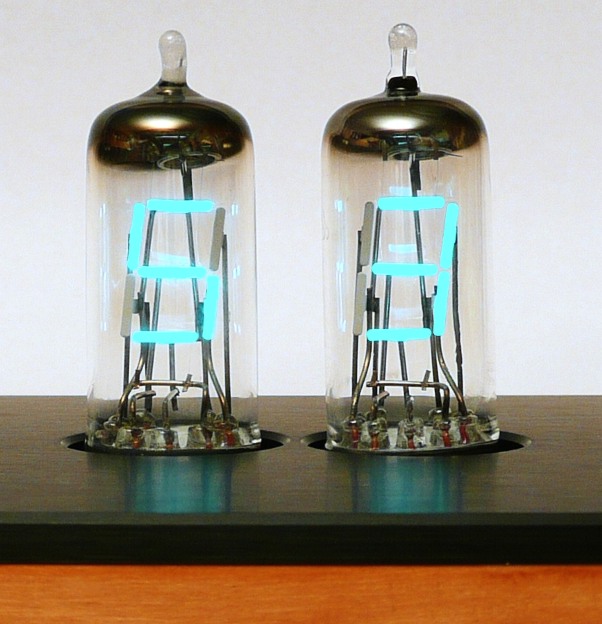
True, this IV-22 modules, that are individual digits, look a bit more like a Nixie than the classic flat VFD display of an old CD player or a vending machine (of course, not the same):
https://raw.githubusercontent.com/mcer12/Flora-ESP8266/main/...
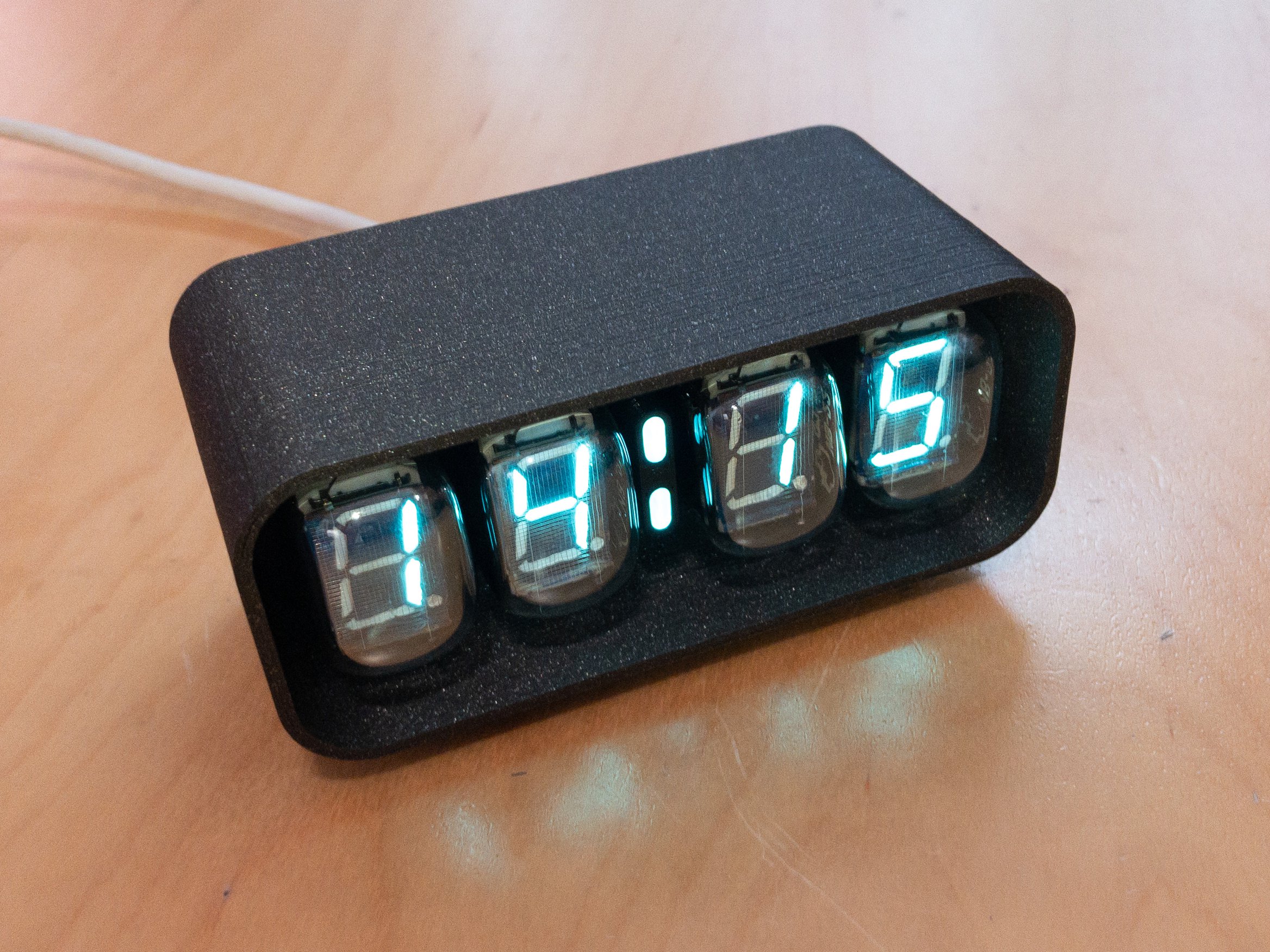
My idea is also painting the interior of the clock with a super matte black paint (Black 3.0 from Culture Hustle) so it looks a bit more like if the numbers were floating there...
4) Salvage a broken piece of test equipment like a frequency counter or multimeter. If the tubes light up, swap out the control circuitry for an Arduino or your microcontroller of choice. It’ll already have the high voltage DC supply and maybe even some 74141 decoder/driver chips. (Just don’t spend a lot of money on something that deserves to be restored.)
An additional point on 1): if you buy a DIY kit online, be prepared to get a package full of SMT chips, not ones that can be soldered by hand unless you have very stable hands. You'll need a reflow oven, heat gun, or some other way to get SMTs onto a PCB.
I disagree. Most SMD components are perfectly fine to solder by hand. Using a good soldering station with a knife cartridge makes the job much easier. Same with a microscope, but I home I use a headband with magnifying glasses. It does of course take some more practice than through hole components and in many cases it's easier to solder them in an oven, but then you need solder paste and preferably a stencil.
The only types where I'd reach for a heat gun are packages like TO-252 and TO-263 where the backside is soldered directly to a pad on the PCB, but for hobbyist purposes I think even that could be doable with a powerful iron and a large tip.
Yep, I discovered late than SMD parts were way easier to solder than I expected. Sometimes even easier and faster than thru-hole components if they aren't too small, as you don't have to be flipping the board back and forth all the time.
I just bought a couple of super cheap SMD soldering learning kits from AliExpress and spent an afternoon or two practicing. They are just 1 or 2 dollars each.
Those kits are just a small PCB with a bunch of SMD resistors and stuff you can solder. When you finish you can measure the resistance of the whole circuit to check if you've soldered them all properly or you've shorted or killed any of the components. Some of them have also a couple SOP and QFP footprint chips or even some LEDs on a functioning circuit, so you can power it later and see if it works.
Edit: Corrected QFN for QFP
I'll add to the chorus of disagreement here. If you can see the pins (YMMV on whether you need magnification for this), SMT isn't drastically more difficult to solder than through-hole, in some cases easier. It is slightly less tolerant of bad equipment, though.
(And I have pretty shaky hands, but SMD is still fine after a decent amount of caffeine)
Outside of QFN, DFN and BGA, I do most of my smd soldering by hand, no reflow (toaster) oven required.
Just an iron with a suitable tip is what I have required so far.
There are now many suppliers if kits, just search nixie kit and there are lots of suppliers. There are even companies making new nixie tubes now.
There is still a small company building new tubes: https://www.daliborfarny.com/
Their youtube channel is well worth checking out:
A website that gives off an instant impression of care and attention to detail.
Curious, the article author is Czech, and so is this Dalibor Farny. Is Czech Republic a nixie tube superpower?
There was a Nixie manufacturer there called “Tesla”. But I think volume wise other countries produced more. Many you can find in old stock are from the former Soviet Union countries.
They are very expensive.
They are highly specialized items under a small production run, not too surprising
Just to offer a potentially interesting anecdotal data point (or depending on your interpretation, three data points) I have had three IN-18 tubes running pretty much 24/7 on the same three digits since 2008.
My friends and I put it together in a box as a street address sign. It contains the minimum viable circuitry; there's no logic or surge protection of any kind. It lives plugged into an AC outlet and glows 342 from my bookshelf.
It looks awesome. IN-18 tubes are one of the biggest available. If you're going to use Nixie Tubes, my $0.02 is that you should always go for the most impressive ones available because you only live once.
The location is long gone, but every passing year I am more impressed with the longevity of these tubes. If there's a takeaway from this story, it's that in my lived experience, cycling the digits to increase longevity is almost certainly more mythology than necessity.
Agreed. I bought a set of IN-18s for 30USD each back in 2009, now they go for over $100.
I finally designed and built a clock for them about 3 years ago, and it sits right under my main monitor. They are captivating. I added “tasteful” (IMHO) digit cycling effects and a PIR sensor to turn off the display when no one is around to prolong the lifetime of the tubes, but your experience with the longevity of your IN-18s is remarkable.
I’ve always wondered what equipment they were originally designed for, given their size. Most likely military I imagine, or maybe public signage?
The author has a great youtube channel - DiodeGoneWild. His teardowns of vintage (eg. soviet RF tubes) and contemporary (eg. various products of chinese ingenuity) are worth checking out.
Love to see Diode Gone Wild here! One of the best YouTube electronics channels
MORE SALT?
The Nixie Tube Watch I received from Kickstarter is as wonderful as it looks:
https://www.kickstarter.com/projects/1944794242/timeless-ele...
Very cool. Any idea if it contains mercury?
yes, IN-16 contain mercury. You want nixie tubes with mercury, especially for a clock, since it significantly prolongs their lifespan
They wildly exceeded their funding goal
Iconic time clock used in the time-travel anime 'Steins;Gate'.
Wikipedia says it is "considered one of the best anime series of all time by critics and fans alike.". [https://en.wikipedia.org/wiki/Steins;Gate_(TV_series)]
In the anime is for display the "distance" of the "current world line" from the "original" timeline in a multipath universe.
A "divergence meter".
Yes, one of the best anime. The original, not the sequels.
There are very active technical discussions of nixies going on here
Does anyone know the significance of the letters for the symbol tubes?
> All symbols of Tesla ZM1047 (T S F N Z Y G H M X).
Are those letters particularly useful?
Apparently that's for CNC machines, so I am guessing G-code.
Sources:
Not sure what equipment these were used in, but
X, Y, Z for a digital readout on a CNC machine
M, G, T are SI prefixes
S, F, N, H are units
It’s also likely that they have meanings in German or another language I’m not familiar with. Large tubes like these have been used in elevators, so they could be floor designations.
I love how Petzold's Code went over the details of switching segments for a clock using these tubes.
Technology Connections' Alex has a great video on the subject: https://www.youtube.com/watch?v=YGT1EvmDJh4
those are numitrons, they use tungsten filament, whereas nixie tubes work by neon glow discharge
Obligatory shout out for the Techmoan Youtube channel, he loves these things and has had a bit of quest over the years [1] for new and interesting ones (and lesser alternatives). All of his latest ones come via a Ukrainian company, Millclock [2].