▲ 244 points
back
90 comments
Nice article about artifacts that make the past more immediate, that allow us to connect our experiences to people hundreds or thousands of years ago.
My favorite example is the writings of Onfim, who was a little boy in the 1200s in present day Russia whose scribbling and homework were exquisitely preserved on birch bark fragments. It’s so immediately recognizable as a little boy’s endearing doodles about knights and imaginary beasts, yet its 800 years old.
Similarly, when I read Meditations by Marcus Aurelius I was struck by how normal everything seemed. While he was an Emperor the everyday banality of what he talked about going through 2,000 years ago was amazing.
Humans really haven't changed that much at all.
I’ve had similar feeling when realizing that the bells that we sometimes hear in old cities of Europe are exact same bells producing exact same sound as 1000 years ago
I like the adorable animal shaped sippy cups for babies:
https://www.nytimes.com/2019/09/25/science/prehistoric-baby-...
Or the rune-rods which were "the medieval snapchat"
https://www.nrk.no/vestland/gamle_-norske-ord-for-kjonnsorga...
(google translate isn't half bad on this article)
or a more PG version https://sprakprat.no/2017/06/22/middelalderkvinner-og-runeku... where a rune-rod simply says "Gyda says you have to come home" (I guess hubby had been out too late with his no-good friends?)
Wow, haven't seen this before, thank you. Amazing that the writing can still be read by a modern reader (that said, really helps to know what it's supposed to say though). The note I found most relatable is the one with greetings to his classmate.
I like the extreme modesty in the wikipedia article:
> One of the drawings features a knight on a horse, with Onfim's name written next to him, stabbing someone on the ground with a lance, with scholars speculating that Onfim pictured himself as the knight.
Wonderful, here's another similar example I saw recently, 14000 year old cave art doodling by kids: https://www.science.org/content/article/enigmatic-cave-art-w...
Not as old, but I loved reading about this:
350 year old paper cuttings found under Sutton House floorboards go on display [0]
It really feels immediate
[0] https://museumsandheritage.com/advisor/posts/350-year-old-pa...
Kids had school 800 years ago? If he didn't work in the fields musta been rich
insert David Lynch quote about red ants
I agree these objects (just like colourised photos) help bridge the distance to the past. But I've had the same experience purely with text. If you read Cicero's letters and diaries, and then just imagine him - suffering writer's block, wracked with anxiety and self-doubt, desperate for his friends to cheer him up - as a neurotic, terminally-online Twitter user, it fits perfectly and breathes life into his every word.
The bakers stamp on the bread is interesting branding
https://substackcdn.com/image/fetch/w_1456,c_limit,f_webp,q_...
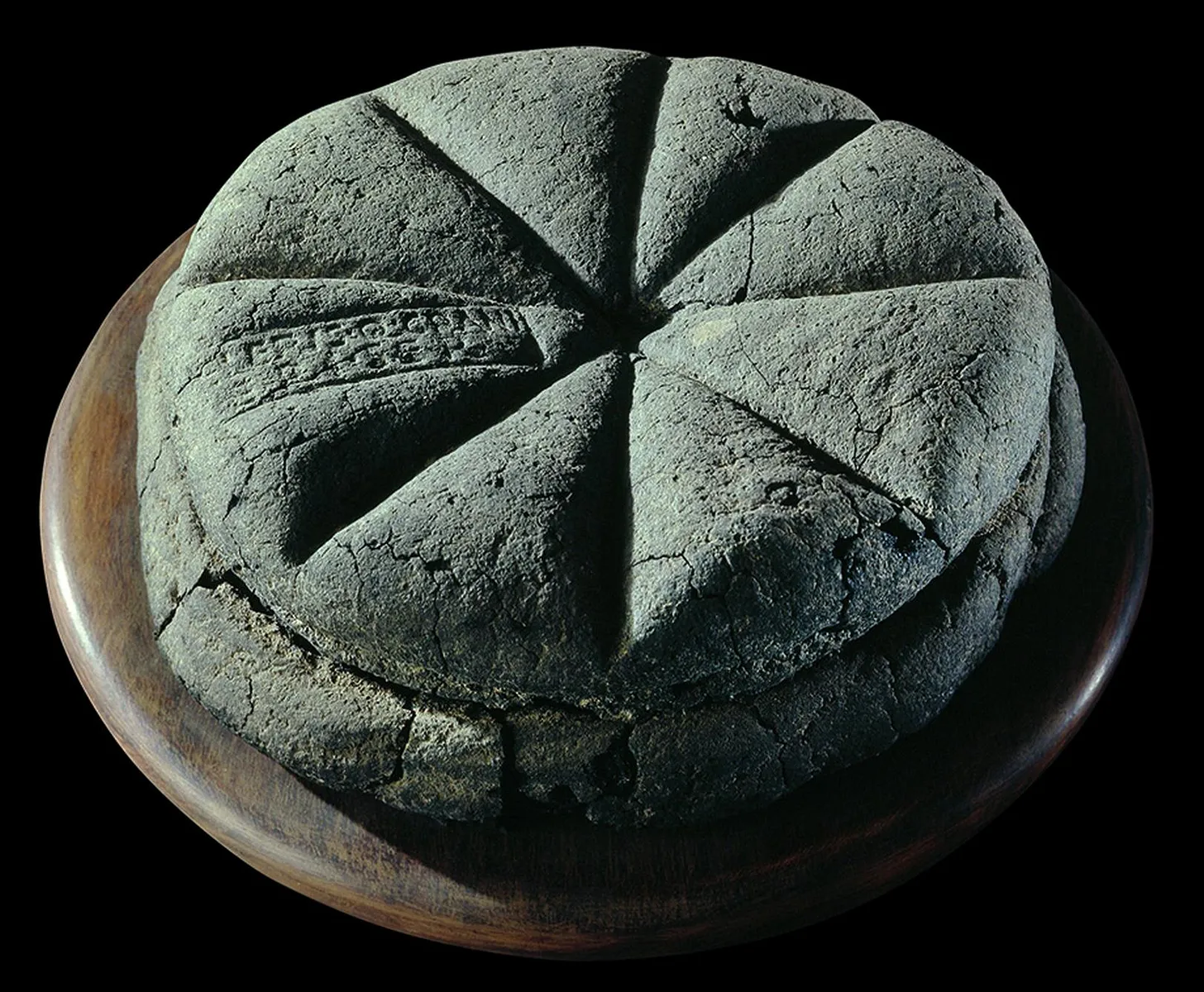
While we're on the subject of ancient bread, ACOUP had a nice and extensive series of posts detailing how it was made and distributed, with a lot of info on Romans specifically:
https://acoup.blog/2020/07/24/collections-bread-how-did-they...
It is! I found the sword quite fascinating as well. The older Chinese lettering on it looks really neat, too
Agreed, this was the most poignant object for me in the article!
I think it was the equivalent of a tax stamp
One of the most interesting parts of Pompeii for me was seeing the area where they've restored a vineyard, to the point of planting the rows of vines in the exact spots that held vines 2000 years ago.
While large areas of the city consists of ruins of buildings that you kind of have to infer the layout of from the floorplans, the vineyard was the one of the spots where I most felt like I was looking back in time, and seeing the spot more-or-less as it would have looked in 79CE.
One interesting recent discovery at Pompeii was what appears to have been, for all intents and purposes, a fast food restaurant - complete with a serving counter set up much like a modern-day steam table. Many of the original wall paintings are intact - it's not hard to imagine what it would have looked like, and it's surprisingly familiar.
https://arstechnica.com/science/2020/12/archaeologists-excav...
The inscription on the Sword of Goujian, the translation for which is displayed in the article, says that the King of Yue made and used the sword himself. How literally do people with knowledge of the period take that? Is it surprising / unlikely for a king of that period to make anything themselves, especially something so ornate, rather than commission it?
I don't think anyone knows enough about the period to answer that question. Our main written source is the Annals of Spring and Autumn (春秋), from Lu (not Yue https://en.wikipedia.org/wiki/Yue_(state)) which spends 18000 words on 242 years, in chronological order. For many of those years it simply says something like "螽" ("locusts"). It does not go into any detail on questions like which hobbies the kings of other countries spent their spare time on, and that's a difficult thing to infer from archaeological evidence, too. The written records of Yue were destroyed by order of 秦始皇 in the 焚書坑儒.
So we kind of have to guess. My guesses are not the most informed.
The sword (https://en.wikipedia.org/wiki/Sword_of_Goujian) is bronze, so it was probably cast (you can forge bronze but the cost/benefit ratio is terrible). You could imagine a king pouring the hot bronze into the mold—that would be much quicker than forging an iron sword—but you probably wouldn't want him to make a habit of it, because contaminants in the metals would expose him to arsenic vapor, though this sword in particular is almost arsenic-free.
Then all that's left is sharpening the blade, which any warrior has to be good at, and what is a king if not a warrior foremost? So it's plausible that a king might have put in most of the work embodied in the blade himself, with a grindstone, even if he didn't go around casting bronze regularly.
Honestly I wouldn't be surprised if he actually made it himself (though I agree the inscription is hardly proof). We have this view of Kings as fat, lazy bureaucratic blowhards because we're closest to the tailend of the history of monarchy. When this King was around there were a lot more regional leaders who fought and strength was admired the most, if a King was seen as weak he had just as much internal attempts that were way more physical than the political coups of today. You could not be a king or survive being a king without being a good fighter and knowing a bit about how weapons are made and used.
When you have some sort of divine right to rule, the most money, a palace filled with servants and responsibilities that can be neglected with no immediate consequences, well you have a lot of free time.
That said, while it's possible this King was really into swordsmithing, more likely he's just taking credit for the work or something gets lost in the translation. Like if Elon said he "built the Falcon 9". It's not explicitly true, he certainly wasn't machining parts or writing code for it, but he was involved enough that no one would really call it a lie either.
Even recent kings have this grand education from the best of the best if not from actual geniuses, examples abound like Alexander the great and Aristotle, and usually there’s other examples in wikipedia articles for most recent kings, even without tutoring here’s a list of books that could have been used to educate royalty in less ancient times than this case but of course maybe a book wont teach craftsmanship
https://en.m.wikipedia.org/wiki/Mirrors_for_princes
The elite/aristocracy of these old ages was at the top for reasons that make some sort of sense even though it could be violent it would be perhaps not completely uncorrelated with ability, if a prince is born into it they’d sometimes get taught multiple languages, music, poetry, on top of the reasonable politics and warfare, strategy etc. As for craftsmanship that is a good question since it’s working with ones hands but with the examples here so far it would make sense if they could just get instructed by the best craftsmen as well to learn that too of course this is maybe too far backwards and another continent to extrapolate
Well, everyone needs a hobby :)
Here's another one, different king, similar inscription: https://en.wikipedia.org/wiki/Spear_of_Fuchai - seems likely it should be read more as "caused this to be made".
It wouldn't be unprecedented. Every now and then you get a monarch who just happens to like doing something with his hands. It's rare enough that it's usually specifically noted when it happens, but e.g. consider Peter the Great of Russia, who famously partook in building ships for his fleet as a carpenter (although in his case it seems to have been driven more by relentless perfectionism and dissatisfaction with quality of other people's work).
Well kings have always said they made/build anything they ordered. I would simply not believe Yue's claim. It's much like the things Wolfram "creates".
Julius Caesar made the dang calendar. People had a lot of free time.
41 AD was a very good year.
OMG! The only question is did anyone try it?
According to wikipedia:
> Analysis of mineral salts in the wine revealed a high concentration of potassium salts, indicative of the cremains in the wine
I kinda wanted to try it too before I read this.
The most profound story of this type is the account of finding a leaf, in 10's of million year old clay, that when exposed, was green, but then very very rapidly oxidised and crumbled.Ref: from somewhere in the great lakes region? 90's mag, likely sciam.Also similar storys of other very ancient soft tissues, somewhat contentious, though
it is understood that,unless lithified, ancient organic remains are exceptionaly fragile and do crumble quickly without meticulous and complicated
preservation tecniques, the three common reasons for presevation in situ are freezing ,water saturation, or drying/mumification.
The shear volume of artifacts that humans have, and are leaving behind, insures plenty of interesting finds availible into the far future.
There are a few unconfirmed stories about people eating mammoth meat that had been frozen in ice for thousands of years
https://strangeanimalspodcast.blubrry.net/2023/12/04/episode...
The thing that surprised me the most was to discover that there was patchouli perfume. I always associated it hippies and the hippie trail from the 60s and was thinking it was from Asia
After checking patchouli is indeed a south Asian plant, that is not endemic from the Mediterranean area, so it's even more fascinating than the wine
Fascinating! The wine discovery reminds me one scene from the book 'The Dark Forest'[0] when the protagonist drinks a wine from some centuries before... spoiler: it wasn't good.
"All this has happened before, and all this will happen again" --Battlestar Galactica (originally from Peter Pan though)
"What has been is what will be, and what has been done is what will be done, and there is nothing new under the sun."[1] from Ecclesiastes 1:9. Apparently the quote not only describes the phenomenon, but has become witness to itself.
[1] https://www.chabad.org/library/bible_cdo/aid/16462/jewish/Ch...
While the tomb was sealed it wasn't a vacuum, so how did the liquid not evaporate over time?
Looking at the images in the article, I think c), d) and e) in the first group, and the close-up image a couple of paragraphs later, are all the same item.
So. e) looks like d) with a top covering taken off. And, from the curved "handles" visible in c), e) and the close-up, they could all be the same glass vessel. We can see in c) that the vessel does have a lid. In e) and the close-up, there appears to be a residue where the lid rested against the container.
So it's possible that liquid from the jar got to the join, evaporated, and left behind a substance that sealed the container against further evaporation?
You'd probably have to read the full report for an actual explanation, but that's my guess from what's reported in the linked article itself.
I'm curious how dangerous it would be to drink the wine?
Probably not that dangerous. The ethanol has likely evaporated leaving behind vinegar and unpleasant byproducts. There’s a risk of mold and bacterial contamination depending on how well the seal has remained intact. Depending on the process used, it’s possible the wine could contain lead salts (for sweetness), which are toxic. I doubt it would kill you, but it’d likely be very unpleasant to drink.
Wine? More likely vinegar I'd guess
I can't wait to read about the uncanny immediacy of the unreasonable effectiveness of the timeless aesthetic of the past.
How on earth did the wine not evaporate out of the vessel over such a long period of time?
The vessel was made of glass and airtight. It was also in a lead case in a sealed tomb underground.
It is always fascinating when Americans re-discover that old things actually exist.
But, as they say, an American thinks that 100 years is a long time while a European thinks that 100 miles is a long way.
Please don't post nationalistic flamebait to HN. That's a pretty insulting variant of it.
(I love the adage you quote, though. When I first heard it it said "Canadian" and "Englishman", which probably says something about how far back it goes.)