back

by tchalla·1y ago·view on hn ↗
Buffet on Tariffs

> “It’s a big mistake, in my view, when you have seven and a half billion people that don’t like you very well, and you got 300 million that are crowing in some way about how well they’ve done - I don’t think it’s right, and I don’t think it’s wise,” Buffett said. “The United States won. I mean, we have become an incredibly important country, starting from nothing 250 years ago. There’s not been anything like it.”
4 comments
I’m a bit slow in this field. Could someone explain how this quote relates to tariffs? I’ve re-read it three times now, looking for the connection to a tax on imported goods, but I just can’t see it.

I think it’s saying that the US population is crowing about how well we’ve done, and so we should be able to tax whatever imports we want? But what an odd way to say that if so. How well we’ve done seems completely unrelated to tariffs.

Then the quote caps off with some back-patting about how we’ve only been around 250 years, and that our rise is unprecedented. Again seemingly unrelated to tariffs.

Part of the justification for tarriffs is that America is somehow being 'taken advantage' of by the rest of the world and the tarriffs are the rest of the world finally paying their fair share. The reality is that (until now) America has had a uniquely privileged position in the world economy that got America, in general, very beneficial trade deals.

He's commenting on the attitude driving the tariffs.

Uniquely privileged position?

The only unique thing about America is free markets. Any country can become highly successful by enacting free markets. The only thing in the way is their disbelief that they work.

There's a common thread across the world and history. The more free market a country is, the more it prospers.

This is only true if you ignore the important material and historical factors that go into the success of a country. Like for example, the immense wealth of natural resources and variation in climates that the US has. Or how about escaping much of the devastation that Europe faced in WW2 and benefiting immensely from helping them rebuild. Or having (for the most part) incredibly safe and stable relationships with neighbors to the north and south. Free markets have certainly contributed to success, but to say it's the only unique thing about America is just wrong.
The Sovied Union and Communist China all had vast natural resources. But a third world economy.

Japan, S Korea and Hong Kong have next to no natural resources. Great prosperity.

Germany turned to free markets after WW2 and enjoyed the "German Miracle". (Germany has since turned to socialism, with predictable results.) Germany received far, far less Marshall Plan money than Britain and France, who had no miracle.

> but to say it's the only unique thing about America is just wrong

History shows otherwise.

This is painfully naive.

Simple, obvious contradiction: can every country enjoy the benefits of issuing the de facto reserve currency for the world? Just by having free markets?

The US has been incredibly privileged. I’d argue that was earned in some ways and lucky in others. But it’s undeniably true.

> The US has been incredibly privileged.

Free markets are a choice the US made. Any country can choose to have a free market, and some have. The reserve currency thing has nothing to do with it.

>The only unique thing about America is free markets

This is less unique than the dollar being the dominant reserve currency and dominant currency for settling international trade.

And why do you think the dollar is dominant in international trade?

You appear to be putting the cart before the horse.

> The only unique thing about America is free markets

Is that unique to America? I'm in EU, I thought we had free markets too.

> The more free market a country is, the more it prospers.

Some countries, including the US, reached prosperity by protecting their markets.

One of the biggest “services” expenses, i think maybe the biggest, comes in the form of employees.

Afaik the EU is regulated much more heavily in that area than the US, like here in Australia.

It makes sense to me that some amount of the US’ economic advantage comes from their ability to more efficiently match employees with the work currently demanded by the market.

> I'm in EU, I thought we had free markets too

Significantly less free than in the US, and correspondingly less prosperity.

> Some countries, including the US, reached prosperity by protecting their markets.

Not true. If it was true, N Korea would be massively prosperous.

> Some countries, including the US, reached prosperity by protecting their markets.

Protecting markets is done with tariffs. Are you sure you want to assert that tariffs are good for the economy?

They created one kind of prosperity early on by protecting their markets and letting industries develop. Many other countries have done the same thing.

The unique thing was that they then created another, less broadly shared, kind of prosperity by eliminating those protections and offshoring those industries, and focusing instead on dollar diplomacy.

I would say that the dollar being the global reserve currency is a unique privilege, yes.
It's a result of American prosperity, not the cause.
> Any country can become highly successful by enacting free markets.

And the existence proof for that assertion is which country, exactly? Lots of nations lack regulation of some form or another, many of them are "freer" than the US. The US isn't entirely "free" of trade barriers either (c.f. tariffpocalype).

Basically this sounds like a no-true-scotsman in the making. No, it's not that simple.

The US is not a perfect free market. But it is closer than other countries.

Socialism, on the other hand, makes things worse the closer one gets to "true" socialism.

Besides the many factors (e.g. reserve currency) others have already mentioned, here's another one:

Digital services not being taxed/tariffed when exported whereas physical goods are, is purely a historical artifact. The US has managed to get the whole world addicted to their doomscrolling dopamine algorithms, raking in trillions of dollars. If these were physical goods, this would've been entirely different.

The heroine dealer of the world. So far they've been allowed this position, which is incredibly privileged. And now that the EU sometimes takes a (paltry) step towards slightly taxing the drugs, the dealer screams and kicks, "it's unfair! They're targeting just me!".

https://en.m.wikipedia.org/wiki/Exorbitant_privilege

Not sure is this is what OP meant, but it's a huge advantage that the current administration seems bent on getting rid of

Free markets are the end state, not what is required to become successful. We can see this in countries that have prospered over the last century.

Japan and South Korea both had huge land reforms effectively killing the landlord class and redistributing farms to families.

They then forced businesses to export while maintaining high tariffs and once that was all in place they relaxed the tarifs and opened up the markets.

Countries that took the free market approach include Indonesia and Cambodia.

America was uniquely positioned due to the dollar being the world's most desired reserve currency. This enabled the USA to spend far beyond what it produced.
> There's a common thread across the world and history. The more free market a country is, the more it prospers.

As long as the trend of capitalist market+power consolidation is considered to be 'less free market', I think I'd agree with you.

- Sincerely, an otherwise raging leftie

Just for fun, name the largest 10 US corporations in 1920, and how they came to consolidate power today.
Good question, and I think the misunderstanding is Buffett is speaking against, not for, tariffs here. I’m surprised none of the responses have spelled that out clearly yet.

He’s saying tariffs are making 7.5 billion people dislike us even more, and that jeopardizes our unique position in the world.

He's saying starting a trade war with china is really dumb - you don't want 7.5 people mad at you.
China doesn’t (yet) have 7.5 [billion] people.

That number in his quote is referring to the entire rest of the world.

Because we're letting one clown running a circus toss it all on a bonfire because 10% of the population lost manufacturing jobs.
Buffett actually does share a fear of trade deficits, though. His proposed solution, as an alternative to tariffs, were "import certificates"-essentially a marketable credit required to import goods. These would be earned via exports by exporters, be freely priced and traded, and would essentially bind import levels to export levels.
That sounds awful a lot like we had it back in the Yugoslavia days. It wasn't exactly free market, as you might know. Companies that exported stuff had credits attached to them and with that quota they could then import goods. They couldn't trade those credits. You then had absurd situations like a company that sells agricultural stuff and has stores for those was also selling, for example, commodore 64 in their stores since that's what they imported.
It's really a non-problem.

Net capital inflows into the U.S. = U.S. trade deficit. The balance of payments is simply: Sales of assets – Purchases of assets = Purchases of goods – Sales of goods

If you balance the trade, it means foreigners must stop investing into the US.

If you balance the trade, it means reduced foreign ownership of U.S. assets, yes, which means ownership of U.S. assets by domestic citizens will increase. One of the primary problems with an unbalanced trade deficit is that your own inhabitants are left with less wealth over time, as assets are sold off to fund consumption.
That’s zero-sum thinking. Increases demand for US assets can make americans wealthier in many ways (e.g. providing more capital to american businesses).
> If you balance the trade, it means reduced foreign ownership of U.S. assets, yes, which means ownership of U.S. assets by domestic citizens will increase.

Proportionately, perhaps, but that doesn't mean by value of assets owned. It just means the aggregate value of assets in the US will be less.

>U.S. assets by domestic citizens will increase.

You think zero sum like accountant or land owner.

They money coming is invested for opportunities. There will be less opportunities for startups, less VC money. Less affordable loans for corporations to expand and invest.

Why would it even be desirable to have less foreign ownership of US assets?

Like what is the sound logic here?

As an Italian I would love more foreign ownership of Italian businesses, that would not only bring capital but more scrutiny.

>which means ownership of U.S. assets by domestic citizens will increase

Which to be clear will be largely domestic oligarchs and other whales since the vast majority of domestic citizens in the US don't have enough capital to own any significant amount of assets, US or otherwise.

It was a problem to Warren Buffet and he used a parable in the past to explain the issue:

A perpetuation of this transfer will lead to major trouble. To understand why, take a wildly fanciful trip with me to two isolated, side-by-side islands of equal size, Squanderville and Thriftville. Land is the only capital asset on these islands, and their communities are primitive, needing only food and producing only food. Working eight hours a day, in fact, each inhabitant can produce enough food to sustain himself or herself. And for a long time that’s how things go along. On each island everybody works the prescribed eight hours a day, which means that each society is self-sufficient.

Eventually, though, the industrious citizens of Thriftville decide to do some serious saving and investing, and they start to work 16 hours a day. In this mode they continue to live off the food they produce in eight hours of work but begin exporting an equal amount to their one and only trading outlet, Squanderville.

The citizens of Squanderville are ecstatic about this turn of events, since they can now live their lives free from toil but eat as well as ever. Oh, yes, there’s a quid pro quo–but to the Squanders, it seems harmless: All that the Thrifts want in exchange for their food is Squanderbonds (which are denominated, naturally, in Squanderbucks).

Over time Thriftville accumulates an enormous amount of these bonds, which at their core represent claim checks on the future output of Squanderville. A few pundits in Squanderville smell trouble coming. They foresee that for the Squanders both to eat and to pay off–or simply service–the debt they’re piling up will eventually require them to work more than eight hours a day. But the residents of Squanderville are in no mood to listen to such doomsaying. Meanwhile, the citizens of Thriftville begin to get nervous. Just how good, they ask, are the IOUs of a shiftless island? So the Thrifts change strategy: Though they continue to hold some bonds, they sell most of them to Squanderville residents for Squanderbucks and use the proceeds to buy Squanderville land. And eventually the Thrifts own all of Squanderville.

At that point, the Squanders are forced to deal with an ugly equation: They must now not only return to working eight hours a day in order to eat–they have nothing left to trade–but must also work additional hours to service their debt and pay Thriftville rent on the land so imprudently sold. In effect, Squanderville has been colonized by purchase rather than conquest. It can be argued, of course, that the present value of the future production that Squanderville must forever ship to Thriftville only equates to the production Thriftville initially gave up and that therefore both have received a fair deal. But since one generation of Squanders gets the free ride and future generations pay in perpetuity for it, there are–in economist talk–some pretty dramatic “intergenerational inequities.”

Source: https://www.berkshirehathaway.com/letters/growing.pdf

The failure of this parable is the assuming that money that comes in to Squanderville is spent on consumption.

In reality people in Thriftville invest money in Squanderville and that money grows new sectors other than manufacturing while the share of manufacturing as GDP declines everywhere.

If they're the "investors" then aren't they also the equity owners? Yes they're growing new sectors, but they own the profits of those sectors, not the people in Squanderville, who have no capital left to invest. Hence the "colonization" analogy in the parable.
By this definition "investing in" includes people overspending and getting themselves in a huge hole with debt. Sure, tell yourself that "creditors are investing in them".
With respect, I’m not sure I’ll take an internet commenter’s Econ 101 dismissal over the word of the greatest investor of all time.
Sounds like it would achieve a similar effect, but would be far more complex to implement and yet would still have the effect of being a tax on imports while not actually generating any revenue for the federal government.
Also buffet on tariffs (2003)

https://www.berkshirehathaway.com/letters/growing.pdf

Though he makes the distinction between "import certificates" and Trump's version of tariffs.

Contra:

> A common response I’ve seen to this is Warren Buffett repeatedly expressing concern about the trade deficit. Buffett’s main concern has always been that we’re sending pieces of paper abroad that give foreigners claims on US assets. And this is true, but I’d argue it’s been a massive net positive on the whole. First, as a percentage of total ownership, foreign ownership of US securities is actually flat since 2008. So despite 20 years of a persistent current account deficit there hasn’t been a huge change in foreign ownership as a percentage of the total. But the current account deficit also reflects the way many firms in the USA outsource their comparative advantage. And that accrues to US firms (and households) as increases in net worth. This is a big reason why corporate profit margins have expanded so much in the last 30 years. Global competition has made US firms more efficient and that’s accrued to Americans as a huge gain in net worth. So this isn’t a situation where we’re just sending Dollars abroad for no good reason. We’re doing it in large part because that is investment in our businesses that has added value to those very firms and their owners. Could that all reverse? For sure. And weirdly, the thing that would cause it to reverse is ultra protectionist measures thereby reducing demand for US Dollar assets and reducing investment in US firms.

* https://disciplinefunds.com/2025/04/24/three-things-you-gues...

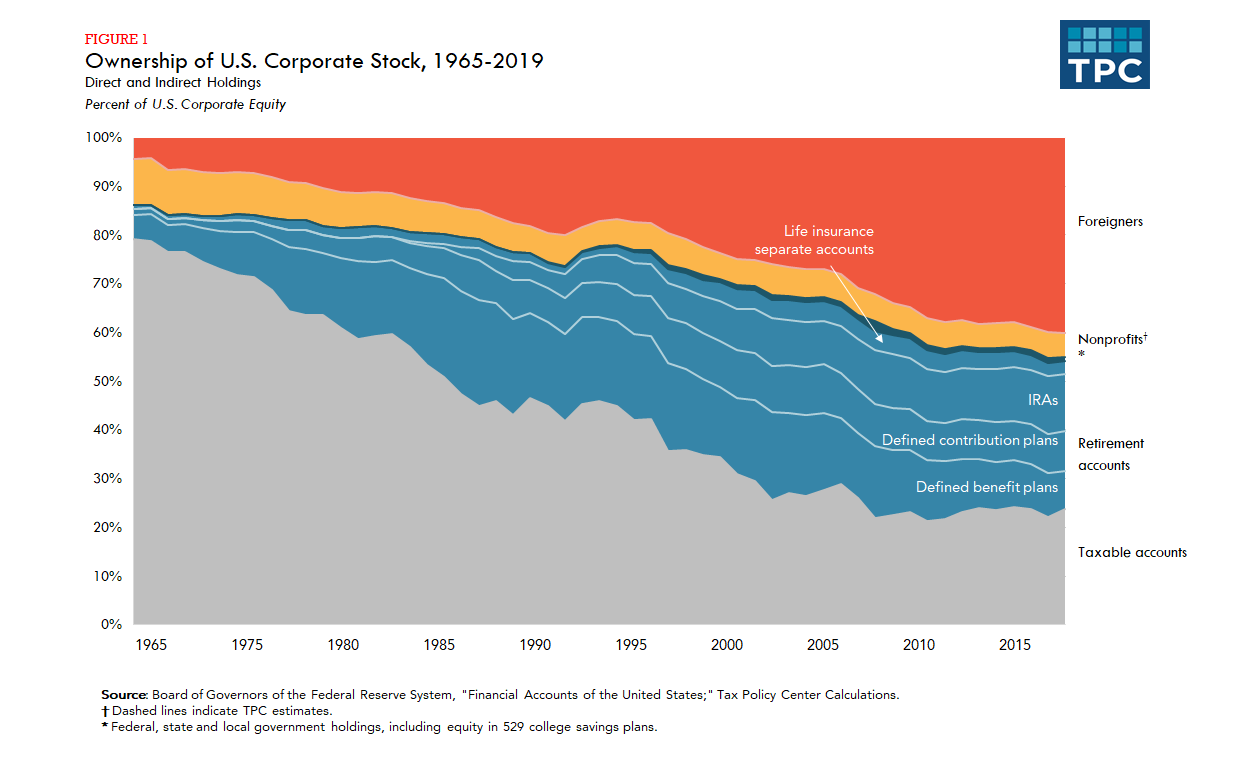
> foreign ownership of US securities is actually flat

Totally incorrect according to this graph: https://taxpolicycenter.org/sites/default/files/figure1_25.p...

From article: https://taxpolicycenter.org/taxvox/who-owns-us-stock-foreign...

Can you cite a source for what you've written?

Change in general, should always come gradually , that way the inevitable consequences rear their head early. Its the bold paintstrokes that topple the world on its side. Obamas biofuels come to mind triggering the arab spring by raising bread prices.
> Obamas biofuels come to mind triggering the arab spring by raising bread prices.

Why do you call them "Obama biofuels" when biofuel mandates were passed while Bush was president?

Standards for biofuels appeared in the Energy Policy Act of 2005 [0] (mandating 4 billion gallons of biofuel by 2006, 7.5 billion by 2012) and the Energy Independence and Security Act of 2007 [1], aka the Clean Energy Act of 2007 (mandating 36 billion gallons of biofuel by 2022). Bush signed both laws.

I assume that corn-state representatives were pushing for more biofuels, since farmers want to sell more corn, regardless of how green anything is, or is not. At the time Obama was one of many in congress, both Democrats and Republicans, who voted in favor of these laws.

I would agree with you that biofuel production exacerbated food supply issues leading into the Arab Spring.

[0] https://en.wikipedia.org/wiki/Energy_Policy_Act_of_2005

[1] https://en.wikipedia.org/wiki/Energy_Independence_and_Securi...