▲ 273 points
back
185 comments
I work with the engineer behind this (different team, but we interact semi-often and work on overlapping projects), but had no idea it was him until I looked at the little copyright notice in the footer. He is a fascinating guy and a fantastic engineer (one of those 10x engineers you hear about) while being humble and always willing to help out.
Thanks for the site for the last 15 years, it's helped me a number of times.
If he doesn't read the thread here, please tell him that a random internet user would like to thank him very much for providing this awesome service, fully understands his choice, and congratulates him for having the willpower to make the choice that is right for him rather than lighting himself on fire to keep others warm.
Wow I saw jfesler on the page and instantly knew who. I never knew either! Awesome guy.
Unfortunately the reason is not because IPv6 is now globally available and IPv4 disappeared :(
Either way, a huge thank you from my side as well, this website has been (and still is) a very good troubleshooting tool to fix my IPv6 deployments
For me personally, IPv6 still feels like something that only exists in datacenters. I've had it for ages on my servers, but never in my life have I seen a home internet connection that supports it. I'm always surprised to see that I'm using IPv6 whenever I travel e.g. to Europe.
Unfortunately, a lot of the remaining holdouts are just network engineers who just can't be arsed to learn anything new...
Something about the tone of that post is troubling me. Is it just me or does anybody else sense a bit of distress in those words? He seems to want to keep it private, though. Whatever it is, I hope he has better times ahead with the gratitude of all those who used his service.
Reach out to ben[1] from IPinfo, he took over ip4.me, ip6.me and a number of other websites following the passing of Kevin Loch earlier this year[2]. I am sure he would be happy to keep test-ipv6.com running without compromising it :) Very reputable, a great track record!
Thank you, appreciate it! I've reached out to Jason - hopefully we're able to keep the site alive!
Tangential, but does anyone else struggle with their ISP implementing poor routing over IPv6 which results in packet loss? Mine does and I'm forced to use IPv4 which is behind CGNAT so that causes other issues but at least no lost packets.
The tier 2 support I've talked to has hot patched issues but then they re-surface a few weeks later.
Not my ISP (Init7 FTW!), but my router (Mikrotik) is notoriously infamous for being a total crap at IPv6 (see for example https://michael.stapelberg.ch/posts/2021-05-28-configured-an...)
In my particular case there seems to be an odd bug / misconfiguration from my side that makes the router / clients from time to time loose the IPv6 routing. The fallback is... a connection hanging forever. The only fix? Reconnecting to the Wi-Fi to get refresh the DHCP lease.
I debugged it for waay too long, and at this point I'm 80% convinced it's a Mikrotik bug of some sort.
Yes - see https://www.reddit.com/r/ipv6/comments/1nf3ytq/how_do_i_comp...
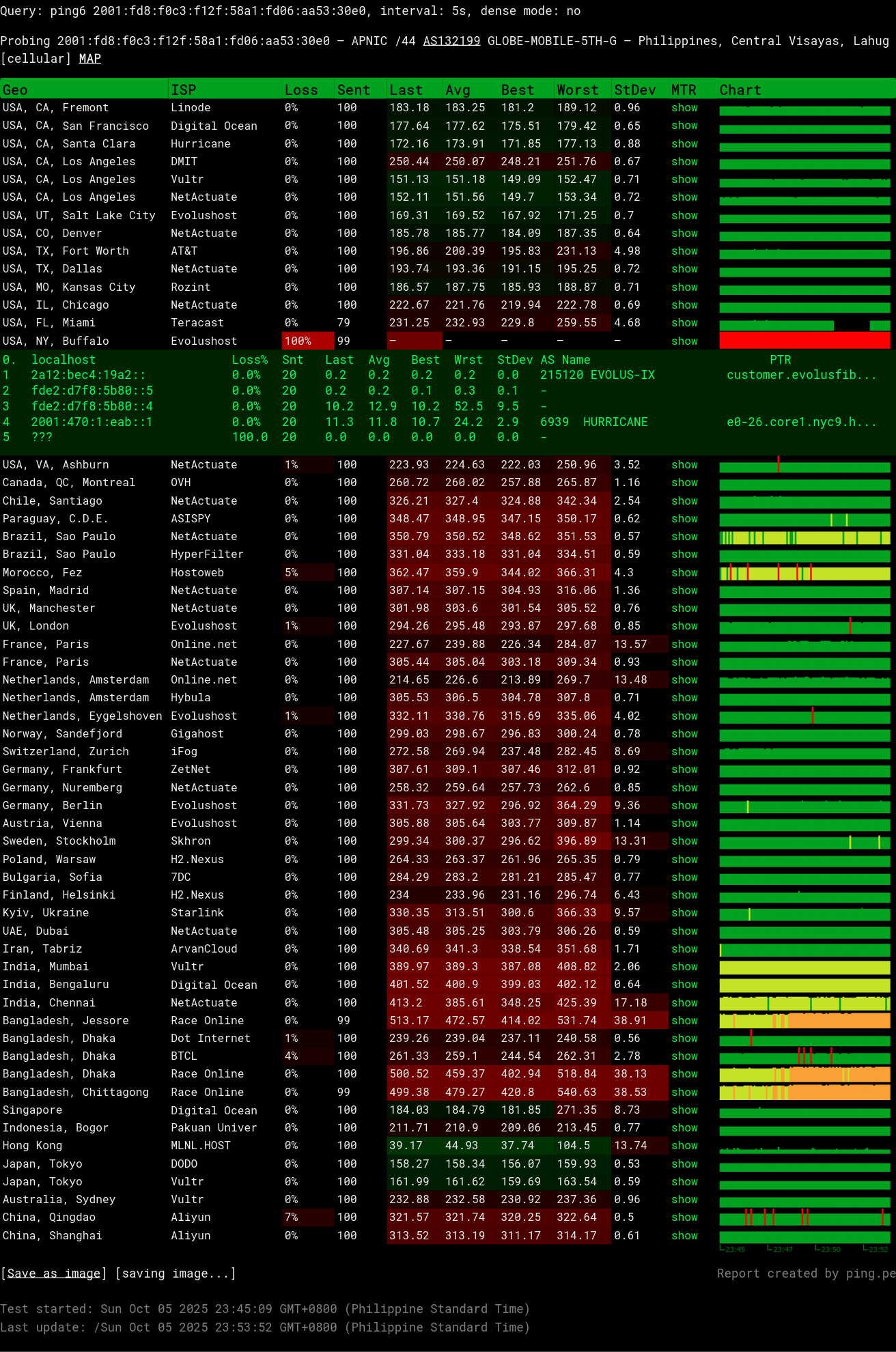
I could not escalate this inside Globe Telecom (no way to reach engineers that understand what a "peering issue" is), and Level3 (the transit provider where all failed traceroutes were going through) did not respond to emails.
Thankfully, it's mostly fixed now - Level3 is no longer the last successful hop on any of the traceroutes. The only failing link is with Evoluhost, and the problem has been traced to a routing loop involving 2001:fe0:4775:1c0::1 inside Globe (that I have no way to complain about).
Today's situation: https://i.ping.pe/j/9/img_j99kbqkn.png
Sadly, my ISP does not support IPv6 at all. And I'm sure there are many ISPs like that out there.
I haven't seen that, but I do regularly see different routing for v6 and v4, so it's not surprising that sometimes it's bad routing.
I also saw things were IPv4 was MTU 1500 and v6 was 1492 (presumably because it was 6rd and the network had a lot of PPPoE) and then ICMP needs frag was rate limited which would end up with lots of stalled communications. (It took me a long time to build it, but I have a v4/v6 mtu test site now http://pmtud.enslaves.us )
And then there's he.net tunnels which used to be pretty nice, but now get you flagged for captchas and I've seen periods of 300ms added latency, which I assume means they're being abused. I had to stop advertising the range on my lan because it caused more problems than any benefits.
If your ISP provides reasonable CPE and v6 is enabled by default, most consumer equipment will use it, and most of the high traffic sites are available via v6; I would expect poor v6 routing affects more of their customers than poor v4 routing.
Potentially unrelated but it confused me for weeks:
If you are using 24.0 or 24.1 of OpenWRT, there is a catastrophic bug affecting IPv6 throughput. Most recent version fixes it.
Name and shame.
I can't use telegram web over IPv6, never figured out why.
I’ve experienced this on ATT
A big thank you to the creator. Was one of my goto sites to debug IPv6 issues on random devices over the years.
If you are deploying a greenfield project in 2025 and you don’t bother setting up IPv6, you are failing. Also all internal virtual networks should by this point be IPv6 only or at least dual stack. The fact that we got unit testing to be the norm before IPv6 is negligent.
I can't see any advantages at all. I deployed it at home and in a few networks my company runs. We had nothing but stupid issues and zero benefit, and I was looking for them.
Basic stuff like getting automatically applied dynamic hostnames from the ISP fighting with whatever things are called internally wastes alot of time. I think most devices were getting 4 different addresses for various purposes and the devs had no idea which one they should be using.
I'm sure we were doing it wrong, or used the wrong gear, or whatever. But again, no discernable benefit to anyone involved. If we were located in a place with no IPv4 availability, probably a different story... but we don't. We turned it off except for a few networks that just provide client internet.
For my home network, I really tried. But in the end, after several times running into weird issues where some pages were working and others weren't, which were reliably resolved by turning off IPv6, I decided to leave the setting in the "Internet works" position.
I don't know what the issue was the last time, and I don't want to know. In particular, I don't want to have to know. When I open the tap, I expect clear, safe, drinking water, not having to debug why the pipe isn't working.
I'll call you the next time HE decides to stop routing ipv6 from europe to new york or when your corporate vpn is ipv4 only but your resolver is preferring AAAA records
Well, IPv6 would be nice but my experience so far was that having it enabled on my machines/local network usually resulted in something not working :/
Why?
IPv4 works. IPv6 often doesn't. I'd love to see a benefit in ipv6, I see no benefits at all, I can't run an ipv6 only network, so I have to run ipv4, and everything I need runs on ipv4, why do I need to double my workload to run ipv6 and ipv4.
My ipv6 only ssid at home sits idle other than a test vm because when I reach a problem I just move onto my ipv4 only ssid and everything works.
It's true that at this point future proofing demands it.
Is anyone happy about it in ipv4 land? No.
I just think it is ironic that the biggest use of ipv6 is cgnat, and it's what they crow about in ipv6 uptake, despite the fact ipv6 is religiously opposed to NATs.
Regular NATs you have control over with poking holes. Cgnat you are restricted to tail scale stuff.
Just spent the last 6 months delivering a code low deploy high platform / initiative for a government agency; v6 didn't make it on the requirements or nice to haves. Not a single user on the platform (so far) has said "oh I wish this was on IPv6".
The comment above was being downvoted quite a lot, and I'd quite like to know why. It seems reasonable to ensure that IPv6 works as a basic requirement for new projects (at least, ones which can be connected to a network).
my ISP gives me native v6 and a /56. I had sooo much trouble, I gave up and just disabled v6 in the kernel.
For example some sites might resolve a v6 address which is unreachable and the fallback takes ages. Some sites would resolve, connect but never load. Some must have been routing issues, etc. I'm not going to individually hunt down the issues, disabling is easier.
Agree 100%. There is no excuse other than "v6 addressing and subnetting is haaaard". It makes most things a lot easier than its v4 counterparts. I'd go so far as to say not deploying v6 is actively negligent.
For anyone who is in need of a basic IPv6 test:
What does this test? It tells me I don't have IPv6, but I won't have any problems. Green check-mark.
What does this mean at all? I went tot he page for info on my IPv6 connectivity, not a politician's campaign doublespeak.
How much does it cost to run this sort of website? This one in particular has been a great help to me many times.
There's a lot of bad actors on the internet, which makes running a small website quite a chore -- and this one is much more visible than the average small website. At the very minimum you must keep it up to date, because it will be under a constant barrage of exploit attempts. Then there are DDoS attacks (people have tried to used my webserver as a way to DDoS my ISP in the past). Then there's the crazy people who will email you demanding why you broke their IPv6 or that you urgently fix some issue that and they are "losing money" because of it.
Geolocation queries are probably one of the bigger costs. Google is a rip-off here but to use them as an example, they charge $2.83 per 1000 lookups for the first 90k/month. You could easily spend a few hundred per month that way.
It is absolutely amazing to me how far IPV4 + NAT have taken us.
Ah, so I'll never be able to experience finally passing that test.. couldn't you wait like 50 years or something? My ISP needs some time..
Thanks for the service. Showed that site to my own ISP's technicians when they were having difficulties to activate IPv6 support.
Oh this hurts a lot. I don't know of a good alternative to this website. Other sites I've found either run fewer tests (so are less useful for debugging) or incorrectly claim I don't have IPv6 (I do?).
I don't suppose we can donate some money to keep this website up? Or perhaps some company like CloudFlare would like to host a mirror?
Maybe the ISG would be interested in taking this over, possibly with some sponsorship money?
Naive question, but does this site actually require much ongoing maintenance?
I’ve used it for years and find it incredibly useful (& am appreciative of its existence) - just didn’t realize it needed much upkeep.
Anyone have a good replacement if a different organization is not able to take over? This has always been my favorite IPv6 test site, and really appreciate the author maintaining it for so long.
Thanks for the service. I used it to figure out what's wrong with my ISP's ipv6 and even though I never figured it out a fix your website definitely helped a lot.
Side note: I find ipv6 complex and very difficult to use. Might be because of the poor experience with my ISP, but still...
> I am shutting the site down, with a target of "during winter break" (December) 2025.
there is an engineer somewhere out there who will get paged on christmas due to a hidden dependency on this site being up, heh. that old xkcd comic comes to mind.
It was a great service over the past 1.5 decades.
Meanwhile Github still does not support IPv6
Could this site be run essentially free on Cloudflare using their managed transform headers features?
I definitely owe this guy a beer or coffee and hope to have a chance to make good on it.
Please don’t turn it over to Cloudflare.