▲ 143 points
back
112 comments
> Daedong-beob unified the various forms of taxes to a single kind: rice. This, in effect, made growing rice equivalent to growing money, encouraging even more production than strictly necessary.
This is still relevant these days, whenever someone talks about linking a currency (and taxes collected in that currency) to a commodity like gold. The market for the metal becomes distorted, and the overall economy distorted as well, vulnerable to anything that might impacts the the mining or refinement of the metal.
Another historical connection might be how the weird status of silver and gold are linked to European colonization.
Rice makes quite a good currency, especially if you only have one primary cultivar. It's relatively fungible and dried white rice more or less lasts forever without spoiling. It's quite nice it has the side effect of also literally being food. If rice had been common in Rome, we might still be paying taxes in rice.
One thing that has stuck me in old tax records is that when taxes were paid in natura according to fixed exchange rates (e.g. one cow is two sheep, one measure of butter is three squirrel skins etc.), then government probably actually valued some income more than others. The "market value" of these goods almost certainly didn't match the fixed exchange rates, but people's ability to trade for the best tax unit were also limited (and often legally restricted to the same exchange rates!).
So e.g. pastoralists who paid their tax in actual skins may have been more valued than people who paid their tax in "a skins worth" of grain.
I wonder if there's some good books on this sort of thing.
>Another historical connection might be how the weird status of silver and gold are linked to European colonization.
Land is a finite resource so people fight over it. If you make your money a finite resource, then people will fight over money as well. It's not very complicated.
> the rice bowl in the photo was 3.5 inches tall with a diameter of over 6 inches, holding nearly a liter of rice to be eaten with soup that came in an even larger bowl, with an assortment of side dishes. For one person. In one meal.
1 liter of Korean-style cooked white rice weighs about 500 grams. It contains about 1.5 Calories per gram, judging from the label on my Hetbahn. So that's about 750 Calories tops. The photo doesn't look like white rice, so the caloric content is probably lower.
I would give at most 100 Calories for the soup and all the side dishes combined. The soup is mostly water, with very little solid content. (That chunk you see in the photo is rice. Dude is dunking his rice in the soup to make it softer, because who wants to munch on 1 liter of rough brown rice?) Meanwhile, his side dishes are leafy vegetables like kimchi and namul. Side dishes made of animal products like ham and eggs were considered a luxury until only 60 years ago. Fat was also a luxury, so everything had to be lean. This is in stark contrast to a Western meal, where fatty side dishes contribute a lot of Calories.
So that's about 850 Calories for the whole table, or about one Big Mac with medium fries and a sugar-free drink. Not a particularly heavy meal for an adult male who spends most of his time working in the field.
The reason Koreans ate a lot of rice, fruit, and vegetables is because those foods have low caloric density by modern standards. It's mostly just water and carbohydrates. If not for their high energy expenditure, Koreans would all have died of diabetes.
What is your take on the comparisons with Japan and the comments left by European visitors, both of whom who likely ate similar ingredients in Asia both of whom were noted to eat a lot less?
To me the article doesn’t really make sense. Either the Korean diet was being overstated (likely, but why if it was consistently noted?), or there was some unexplained extra energetic expenditure by Koreans versus Japanese (unlikely), or Koreans were significantly more fat than Japanese (unlikely).
> To Koreans, they looked more like sauce bowls, leading them to conclude that the Japanese had starved themselves to stretch out the siege.
As a Bengali man, that's exactly how I felt when I came to USA and first visited japanese restaurants. Part of the reason we consume so much rice is that rice is kind of the main dish (not a side)- it literally takes up central and most of the space in your food plate.
https://commons.wikimedia.org/wiki/File:%E0%A6%87%E0%A6%B2%E...

Typical Japanese will devour their small rice bowl until there's none of rice grain is left over, since they're taught from the very young age not to waste food.
Most of other Asian nations will not eat their rice until it's completely finished. Even with their most delicious biryani dish there're always many rice grains left in the plate. I think the small bowl make it much easier to completely consume the rice unlike the big bowl or plate.
Ilish fish also known as hilsa, the king of fish. That’s one delicious fish.
> One man in my parish is aged between 30 and 45, and in a bet he ate seven bowls—and that’s not counting the bowls of rice wine he drank. One old man, aged 64 or 65, said he had no appetite, and finished five bowls.
Surprisingly comical record-keeping.
What do you find comical about it?
Similar situation in South India too. Eating culture is shaped by foods available. Here in western world, I'm shocked by how little rice they serve at my office lunch and at restaurants (we call it as cat food). I usually eat 4-6 times of that rice per meal at home. Still my people make a special observation that I eat very less food at home.
This is why South Asians have all our metabolic issues (I'm talking about those living in the west). It took me so many years to break myself of this habit. It's not healthy to consume this much white rice. The bowl size at a Japanese restaurant is appropriate for one meal.
Carbohydrates and fats are very cheap in developed countries (and developing countries, like India). Protein is not cheap and is underconsumed in most countries. Meals should be focused around protein. It's basically impossible to not get enough carbs and fats living in the United States or any developed nation. In fact, you're probably getting more than you need relative to the amount of protein you consume.
Of course, if you live a traditional South Indian lifestyle including lots of manual labor, fishing, farming, etc, then you may have higher carb requirements. For most people today, this is overkill.
I've seen this problem in my own family, including untimely deaths, metabolic problems, etc.
I'm sure that if you went back 100 years you'd be less surprised, but of course the rice would've been replaced with oat porridge or potatoes.
A korean meal is only limited by the size of the table. I've visited resturants in korea where there were no less than 30 plates that came out of 1 set meal.
I've visited Turkish breakfast restaurants, where the whole family sits around a table with 50-80 plates of various stuff, for about 15€. Eating needs 2 hours.
What do they do with all the food that doesn’t get eaten?
As someone who works in food service, that sounds like a nightmare, not just to prepare but to bring all of that to the table.
> Daedong-beob unified the various forms of taxes to a single kind: rice. This, in effect, made growing rice equivalent to growing money, encouraging even more production than strictly necessary.
This is not much of an explanation, since feudal Japan had basically the same system: https://en.wikipedia.org/wiki/Kokudaka
maybe Japan's feudal lords were more corrupt, disincentivizing production. Whereas Koreans paid directly to the king
AIUI that was a bit different; that was _notional_ rice (the tax wasn't necessarily paid in kind).
For centuries, Korean peasants lacked food and endlessly complained of hunger but I won't cherry pick random historical (and foreign) observations to support it.
Two thoughts:
* Korean are tall by East Asian standards; 3-4 cm taller than Chinese and Japanese
* Thais don't eat that much, but they will massively over-cater, and there's not really the same taboo as in Europe of food wastage. My father, who like me spent a couple of decades in Thailand (although at different times) reckoned it was because historically they've had very few food shortages compared to other countries
Taller than the Chinese average, perhaps, but northern Chinese are generally much taller than southern Chinese. Guess what's next to northeastern China? That's right, Korea.
Thais don't have big meals, but they do snack incessantly, which makes up for it. And overcatering for guests is a pan-Asian or arguably a global phenomenon.
What happened to all the excess calories they are eating? Huge bowl of rice, table filled with food, and the people look almost malnourished.
From the other comment by kijin - 1 liter of rice isn't actually that much (~500g, which approximates to 750 kcal). And given that most Koreans in the area didn't eat that much outside of rice (only vegetables and fruits) since access to meat was reserved for the super-wealthy, most Koreans were probably malnourished when also factoring in the manual labor they needed to do (rice farming is very labor-intensive)
probably eating once a week
This is similar in terms of macros to the traditional Irish diet in the 19th century, which for workers was purportedly made up of around 13 pounds of potatoes a day for an adult man. This traditional Korean diet appears to also be extremely high in carbs as a proportion. Of course these groups had significantly higher energy expenditures than most moderns, but it does seem possible that caloric excess in the absence of significant dietary fat does not drive obsesity / metabolic disease in the same way.
What's the hypothesis there? Were they just shitting out the extra starch without digesting it? Due to conservation of energy the calories can't just vanish.
It doesn't seem physically possible for most adult men to consume 13 pounds of potatoes a day. I'm a large man and I think I'd burst or vomit before choking down that much, regardless of how hard I'd been working. Most likely that number is just wrong.
The Irish had milk also with all the potatoes. It made it a diet that could keep you alive and even thrive.
>Potatoes and milk, particularly buttermilk, were a nutritionally complete diet for many Irish peasants before the famine, allowing them to be healthier than some European counterparts who ate a bread-based diet.
> it does seem possible that caloric excess in the absence of significant dietary fat does not drive obsesity / metabolic disease in the same way.
FWIW this is exactly the opposite hypothesis to that of the Keto diet (whereby consuming fat in absence of carbs does not drive obesity / metabolic disease)
To me seems more likely they were just burning more calories
i been to a museum that showed what Koreans in the 16th century ate with and I was shocked to find how huge the spoon and bowls were. It's not uncommon to find very tall Koreans 6ft and up these days but they are eating a lot less so I wonder how they've become all so tall.
More protein
When we visit my Korean in-laws, I can confirm a glorious feast is going to happen.
It was a fun reading as a Korean and my hometown Jeonju was even mentioned! My partner is non-Korean and I can definitely tell the difference in rice consumption for sure. I can eat much more much faster. But the funny thing is she can eat more bread faster than me.
Anecdotal story. Once I stumbled into Korean restaurant in China Town in NYC. I just ordered something like lunch. I was alone. They kept bringing plates after plates of various dishes. I was ashamed to leave so much food. Paid like 11 dollars but it was in ~2015.
Come back and try KTown on 32nd. (Get off the ground floors.)
$20 will buy a good meal. $40, decadence. (Avant alcohol.)
Reading the comments here and elsewhere, and these from my Korean friends -- this is not reflected in Korean restaurants, at least in France.
I have tried a few in and around Paris (the latest was yesterday, a small family-run one lost in some random street), and the food is at best normal size, and less positively massively overpriced.
You usually get 3 tiny plates (with two leaves of kimchi, to give some context) and a normal plate of food + a small bowl of rice.
This is enough for my French stomach, but reading about the lavish servings and whatnot, this may just be a local thing.
Native Korean living in Korea here. Many restaraunts in South Korea have self-bars where you can refill the kimchi (and other various banchan (side dish) assortments) as much as you want - and in the rest of the places that don't have this you can just ask the waiter to give some more for free instead! Refusing to give free kimchi isn't just considered bad service here; it's just outright weird.
Only the "touristy" Korean restaraunts outside of the country don't do this - they charge hefty prices to innocuous side dishes like kimchi, and I've even heard places in Europe sell soju in shots (which is outright ridiculous, soju is one of the most cheap-ass low-brow artificially made commodity liquor here!)
I suppose people adapt serving sizes to local norms.
That said, the first Korean place I ever went to (in Dublin) served comically large amounts of food. I could never figure out how they made the economics work; they were the same price as the neighbouring Chinese places but must have been using at least twice as much food.
I’m not surprised.
When I went London over ten years ago, the recommended Korean restaurant paled to what’s in NYC.
I imagine competition and easy access to Korean ingredients are the main factors.
Yeah that sounds very westernized. This is what you'd see for one person at an average, traditional Korean restaurant in the US: https://s3-media0.fl.yelpcdn.com/bphoto/GZx0kD7qjv5983YOuGd_.... Depending on the place you might see a few more/less sides.
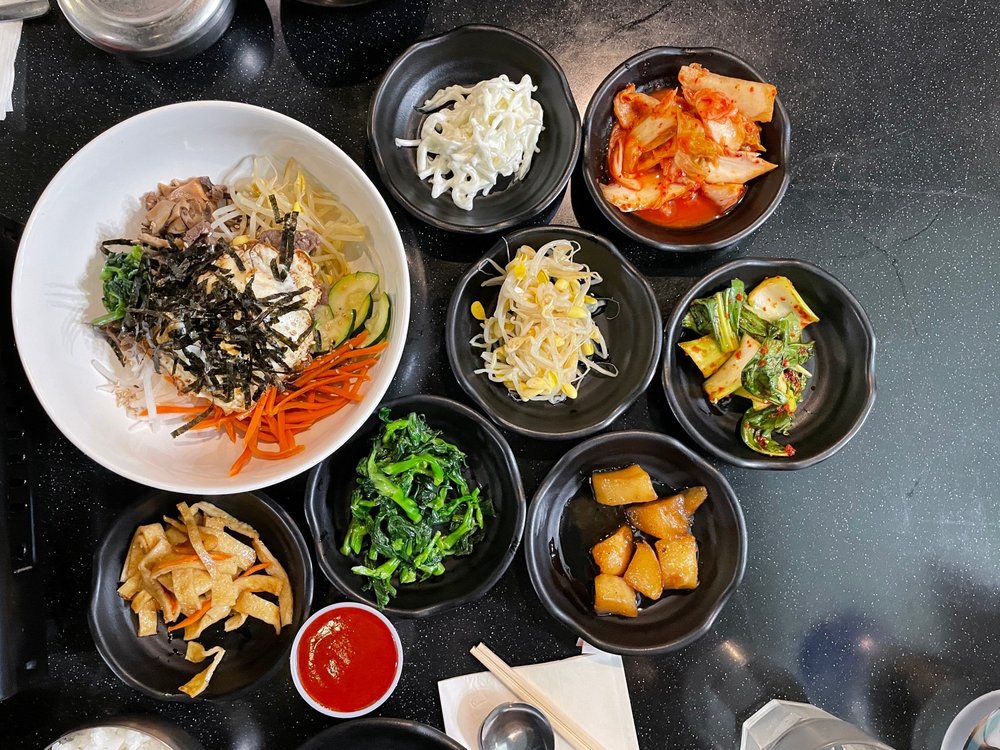
There are also places like what you describe that don't give you all the sides, where it's just focused on having an entree, so more like this: https://www.yelp.com/biz_photos/mamas-kitchen-bellevue-2?sel.... I can understand this because I've seen groups of non-Koreans at the traditional places leaving all the banchan untouched.
This article seems somewhat fanciful. Medieval Koreans ate two meals a day, and famines were common. Only a small area of the country is suitable for rice cultivation. The photos seem to show only upper-class clothing and furniture.
I've been to that makgeolli place in Jeonju, and it sells drinks and food as a set; there is no free food.
I am amazed how a narrative could be formed by select samples. The Korean peninsula has very little arable land, and much of Joseon Dynasty's history was marked by famine and mass starvation.
Well yeah, isn’t korea the origin of the conspicuous gluttony of mukbang?