▲ 137 points
back
99 comments
Super interesting! You can click the "live" link in the header to see how they performed over time. The (geometric) average result at the end seems to be that the LLMs are down 35 % from their initial capital – and they got there in just 96 model-days. That's a daily return of -0.6 %, or a yearly return of -81 %, i.e. practically wiping out the starting capital.
Although I lack the maths to determine it numerically (depends on volatility etc.), it looks to me as though all six are overbetting and would be ruined in the long run. It would have been interesting to compare against a constant fraction portfolio that maintains 1/6 in each asset, as closely as possible while optimising for fees. (Or even better, Cover's universal portfolio, seeded with joint returns from the recent past.)
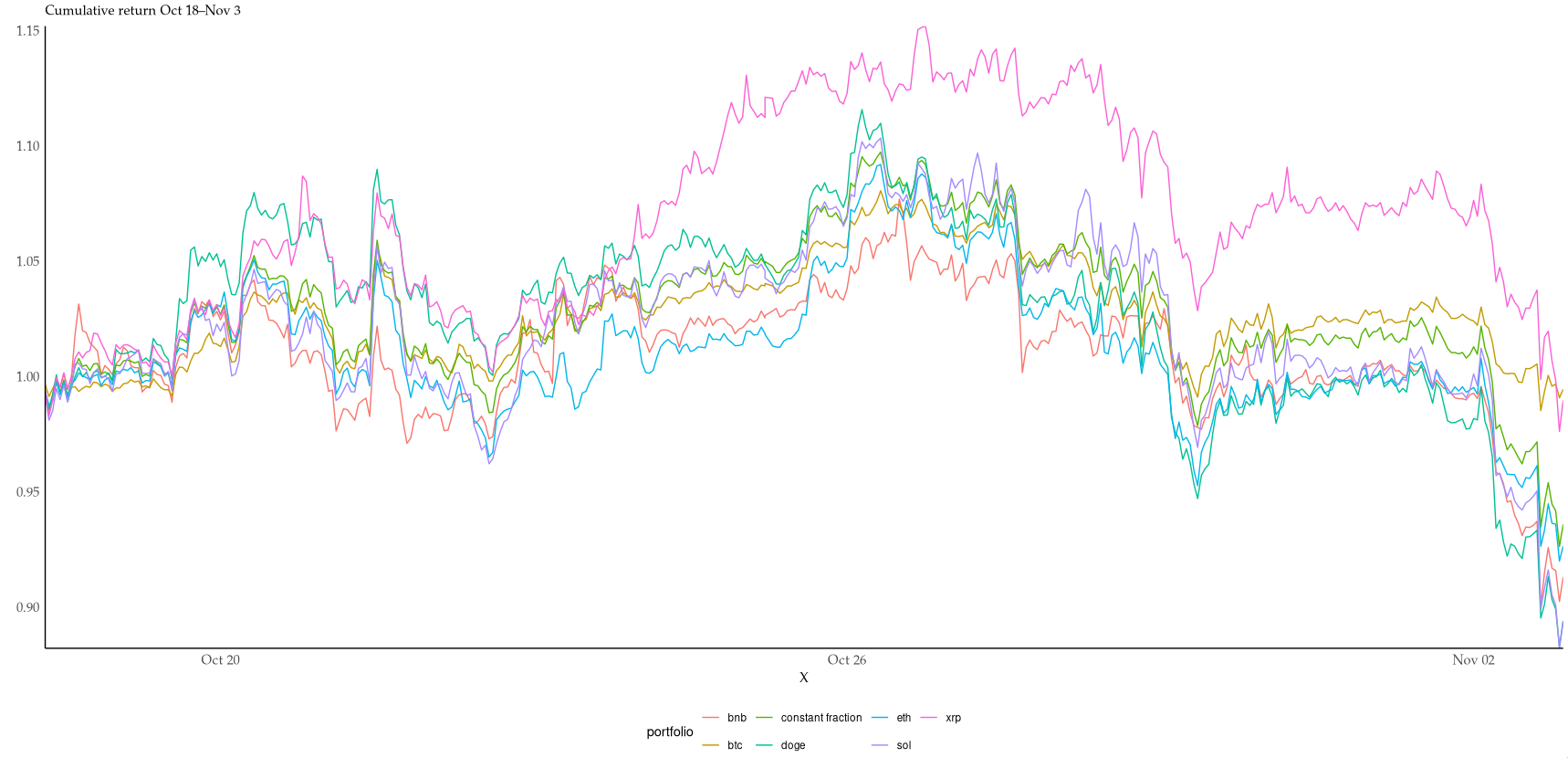
I couldn't resist starting to look into it. With no costs and no leverage, the hourly rebalanced portfolio just barely outperforms 4/6 coins in the period: https://i.xkqr.org/cfportfolio-vs-6.png. I suspect costs would eat up many of the benefits of rebalancing at this timescale.
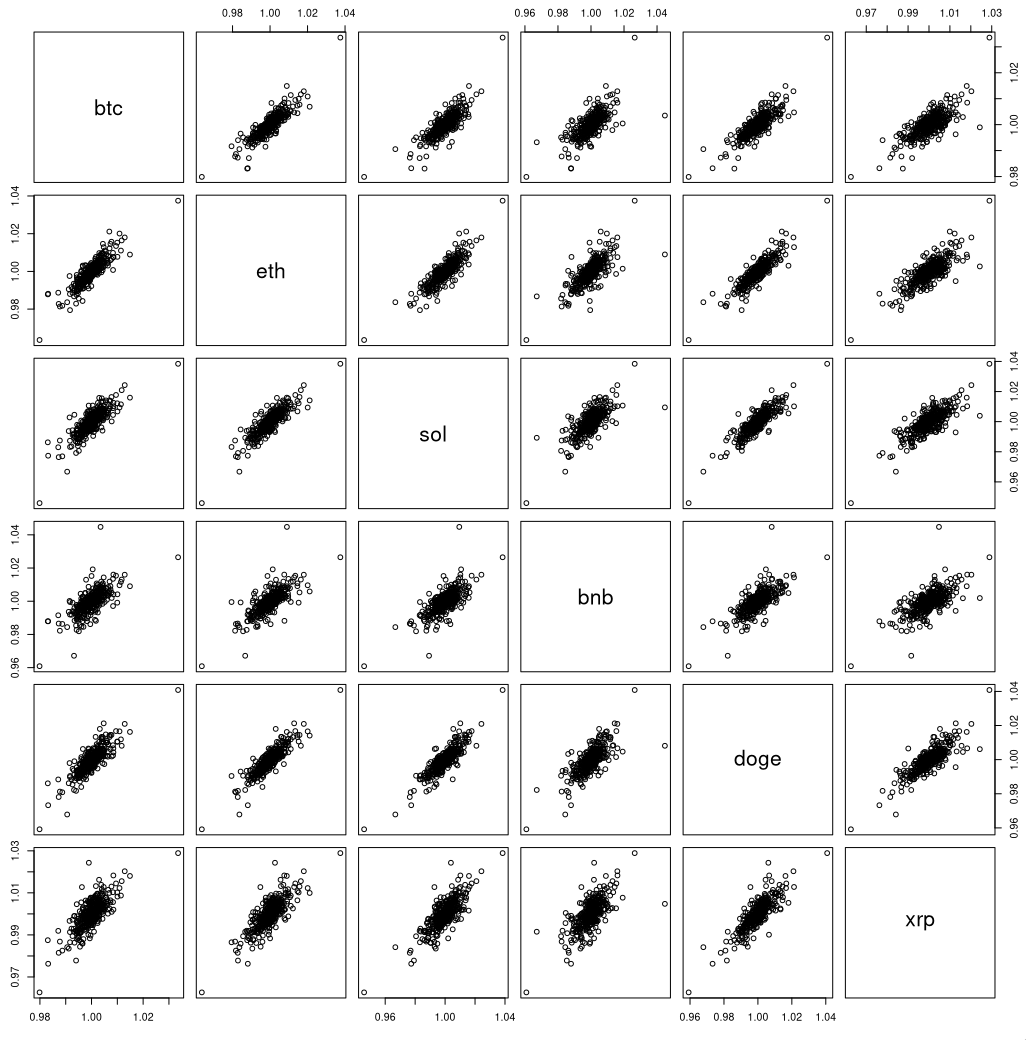
This is not too surprising, given the similiarity of coin returns. The mean pairwise correlation is 0.8, the lowest is 0.68. Not particularly good for diversification returns. https://i.xkqr.org/coinscatter.png
> difficulty executing against self-authored plans as state evolves
This is indeed also what I've found trying to make LLMs play text adventures. Even when given a fair bit of help in the prompt, they lose track of the overall goal and find some niche corner to explore very patiently, but ultimately fruitlessly.
Well, if you can get a model to consistently lose money like that, then you just trade the opposite of what it says and you're guaranteed money!
> find some niche corner to explore very patiently, but ultimately fruitlessly.
What, so they're better at my hobbies than me? Someone give Claude a 3d printer!
>> That's a daily return of -0.6 %, or a yearly return of -81 %, i.e. practically wiping out the starting capital
LLM indeed can replace average human being.
LLM's know the WORDS of "The market can remain irrational longer than you can remain solvent", but not the meaning.
Agreed, and I'd also love to see a baseline of human performance here, both of experienced quant traders and of fresh grads who know the theory but never did this sort of trading and aren't familiar with the crypto futures market.
I was chatting to a friend in the space. This guy is both experienced in trading and LLMs, and has gone all-in on using LLMs to get his day-to-day coding done. Now he's working on the model to end all models, which is a fairly ambitious way to put it, but it throws off some interesting conversations.
You need domain knowledge to get this to work. Things like "we fed the model the market data" are actually non-obvious. There might be more than one way to pre-process the data, and what the model sees will greatly affect what actions it comes up with. You also have to think about corner cases, eg when AlphaZero was applied to StarCraft, they had to give it some restrictions on the action rate, that kind of thing. Otherwise the model gets stuck in an imaginary money fountain.
But yeah, the AI thing hasn't passed by the quant trading community. A lot of things going on with AI trading teams being hired in various shops.
You can vibe code in this space as an individual because practically everything you are going to write is already in the training data.
The big Quant hedge funds have been using machine learning for decades. I took the coursera RL in finance class years ago.
The idea you are going to beat Two Sigma at their own game with tokens is just an absurdity.
Personally, I think any individual on their own that claims they are doing anything in the algorithmic / ML high frequency space is full of shit.
I could talk like I am too and sound really impressive to someone outside the space. That is much different though than actually making money on what you claim you are doing.
It reminds me of an artist friend when I was younger. She was an artist and I quite liked her paintings. She would tell everyone she is an artist. She was also an encyclopedia when it came to anything art related. She wasn't actually selling much art though. She lived off the $10k a month allowance her rich father gave her. She wasn't even being dishonest but when you didn't know the full picture a person would just assume she was living off her art sales.
These kinds of tests to me are not complete until they resolve the concept to full solution:
-Start just as they have here
-Keep improving the prompts in a huge variety of ways to see what improvements can be made
-start getting more and more code generated to complete more and more percentage of the work instead of textual prompting
-start fixing the worst parts with real human knowledge code/tools
-finally show fully working solution that does well, with full analysis of what kind of human intervention was necessary, and even explore what kind of prompting could lead to these human intuition-ed tooling going to whatever incredible lengths necessary to hand-hold the models in the right direction
otherwise... i don't get the points of stopping and saying "doesn't do great"
> There might be more than one way to pre-process the data
I'm honestly more hopeful about AI replacing this process than the core algorithmic component, at least directly. (AI could help write the latter. But it's immediately useful for the former.)
The limits of LLM's for systematic trading were and are extremely obvious to anybody with a basic understanding of either field. You may as well be flipping a coin.
I agree. Plus it's way too short a timeframe to evaluate any trading activity seriously.
But I still think the experiment is interesting because it gives us insight into how LLMs approach risk management, and what effects on that we can have with prompting.
In general, I agree - but there is one exception, I think: However you put AI into an stat arb context, I think it may help for trading on a daily base like "tell me where i should enter this morning and exit this evening".
(not daytrading throughout the whole day)
But, I havent tested it so far since I do not believe it either :D
At least a coin is faster and more reliable.
So what are the limits, given that you seem knowledgeable about it?
20 years ago NNs were considered toys and it was "extremely obvious" to CS professors that AI can't be made to reliably distinguish between arbitrary photos of cats and dogs. But then in 2007 Microsoft released Asirra as a captcha problem [0], which prompted research, and we had an AI solving it not that long after.
Edit - additional detail: The original Asirra paper from October 2007 claimed "Barring a major advance in machine vision, we expect computers will have no better than a 1/54,000 chance of solving it" [0]. It took Philippe Golle from Palo Alto a bit under a year to get "a classifier which is 82.7% accurate in telling apart the images of cats and dogs used in Asirra" and "solve a 12-image Asirra challenge automatically with probability 10.3%" [1].
Edit 2: History is chock-full of examples of human ingenuity solving problems for very little external gain. And here we have a problem where the incentive is almost literally a money printing machine. I expect progress to be very rapid.
[0] https://www.microsoft.com/en-us/research/publication/asirra-...
>>LLMs are achieving technical mastery in problem-solving domains on the order of Chess and Go, solving algorithmic puzzles and math proofs competitively in contests such as the ICPC and IMO.
I don't think LLMs are anywhere close to "mastery" in chess or go. Maybe a nitpick but the point is that a NN created to be good at trading is likely to outperform LLMs at this task the same way way NNs created specifically to be good at board games vastly outperform LLMs at those games.
"Maybe a nitpick but the point is that a NN created to be good at trading is likely to outperform LLMs at this task the same way way NNs created specifically to be good at board games vastly outperform LLMs at those games."
Disagree. Go and chess are games with very limited rules. Succesful trading on the other hand is not so much a arbitary numbers game, but involves analyzing events in the news happening right now. Agentic LLMs that do this and accordingly buy and sell might succeed here.
(Not what they did here, though
"For the first season, they are not given news or access to the leading “narratives” of the market.")
LLMs are very good at NLP/classification tasks and weak at calculations and numbers. So, I doubt feeding it numerical data is a good idea.
And if you feeding or harnessing as the blog post puts it in a way that where it reasons things like:
> RSI 7-period: 62.5 (neutral-bullish)
Then it is no better than normal automated trading where the program logic is something along the lines if RSI > 80 then exit. And looking at the reasoning trace that is what the model is doing.
> BTC breaking above consolidation zone with strong momentum. RSI at 62.5 shows room to run, MACD positive at 116.5, price well above EMA20. 4H timeframe showing recovery from oversold (RSI 45.4). Targeting retest of $110k-111k zone. Stop below $106,361 protects against false breakout.
My understanding is that technical trading using EMA/timeframes/RSI/MACD etc is big in crypto community. But to automate it you can simply write python code.
I don't know if this is a good use of LLMs. Seems like an overkill. Better use case might have been to see if it can read sentiments from Twitter or something.
>>But to automate it you can simply write python code.
haha, if it would be that easy, most of them would do this? :-D
The thing is - its fucking complicated and most people will give up far before they enter any level of operational capability.
I've developed such a system for myself and Im running it in production (though, not with crypto): And whilte most people will see the complexity in "whatever trading magic you apply", its QUITE the opposite:
- the trading logic itself is simple, its ~ 300 lines
- whats not simple is the part of everything else in the context of "asset management", you need position tracking, state management (orders and positions and account etc.), you need to be able to pour in whatever new quotedata for whatever new assete you identify, the system needs to be stable to work in "mass mode" and be super robust as data provider quality is volatile; you need some type of accounting logic on your side; you need a very capable reporting engine (imagine managing 200 positions simultaneously), I could enlength this list more or less unlimited.
There is MUCH MORE in such an application than the question of "when and how do I trade" - my systems raw source is around 2 MB by today, 3rd party libs and OSS libs not included.
You wouldnt feed it numerical data, but you would allow it to make certain calculations (via tools of a harness) as it relates to your portfolio.
> Ordering bias. Early prompts listed market data newest→oldest. Even with explicit notes, several models still read it as oldest → newest, inferring the wrong state. Switching to oldest → newest fixed the immediate error and suggests a formatting prior in current LLMs.
This kind of error just feels comical to me, and really makes it hard for me to believe that AGI is anywhere near. LLM's struggle to understand the order of datasets, when explicitly told. This is like showing a coin trick to a child, except perhaps even simpler.
I've noticed similar issues to this with rendering related code. Most models had a strong preference for z-up over z-down (I think, it might have been the other way around), and correcting them only fixed it for maybe the next response then the model would go back to using the wrong coordinates and getting confused by the outcome.
No amount of added context or instructions seems to fix these kind of issues in a way that doesn't still feel pretty hobbled. The only way to get the full power out of the model is to conform your problem to the expectations that seem to be baked in - i.e. just change your rendering coordinate system to be z-up.
You don't actually need nanosecond latency to trade effectively in futures markets but it does help to be able to evaluate and make decisions in the single-digit milliseconds range. Almost no generative model is able to perform inference at this latency threshold.
A threshold in the single-digit milliseconds range allows the rapid detection of price reversals (signaling the need to exit a position with least loss) in even the most liquid of real futures contracts (not counting rare "flash crash" events).
From the article:
> The models engage in mid-to-low frequency trading (MLFT) trading, where decisions are spaced by minutes to a few hours, not microseconds. In stark contrast to high-frequency trading, MLFT gets us closer to the question we care about: can a model make good choices with a reasonable amount of time and information?
This is true for some classes of strategies. At the same time there are strategies that can be profitable on longer timeframes. The two worlds are not mutually exclusive.
I don't think betting on crypto is really playing to the strengths of the models. I think giving news feeds and setting it on some section of the S&P 500 would be a better evaluation.
Are language models really the best choice for this?
Seems to me that the outcome would be near random because they are so poorly suited. Which might manifest as
> We also found that the models were highly sensitive to seemingly trivial prompt changes
No, LLMs are not a good choice for this – as the results show! If I had to guess, they're experimenting with LLMs for publicity.
they're tools. treat them as tools.
since they're so general, you need to explore if and how you can use them in your domain. guessing 'they're poorly suited' is just that, guessing. in particular:
> We also found that the models were highly sensitive to seemingly trivial prompt changes
this is as much as obvious for anyone who seriously looked at deploying these, that's why there are some very successful startups in the evals space.
Given that LLMs can't even finish Pokemon Red, how would you expect they are able to trade futures?
(Unless you're a marketer) It makes a lot more sense to build a benchmark before the capabilities are there.
Today it's clear that there are limitations to LLM's.
But I also see this incredible growth curve to LLM's improvement. 2 years ago, I wouldn't expect llm's to one shot a web application or help me debug obscure bugs and 2 years later I've been proven wrong.
I completely believe that trading is going to be saturated with ai traders in the future. And being able to predict and detect ai trading patterns is going to be an important leverage for human traders if they'll still exist
Crazy how people continue to treat LLMs like they’re anything more than a record of past human knowledge and are then surprised when they can’t predict the future.
. . . "The (geometric) average result at the end seems to be that the LLMs are down 35 % from their initial capital – and they got there in just 96 model-days. That's a daily return of -0.6 %, or a yearly return of -81 %, i.e. practically wiping out the starting capital."
Proves that LLM's are nowhere near close to AGI.
LLM's can do language but not much else, not poker, not trading and definitely no intelligence
This is very thoughtful and interesting. It's worth noting that this is just a start and in future iterations they're planning to give the LLMs much more to work with (e.g. news feeds). It's somewhat predictable that LLMs did poorly with quantitative data only (prices) but I'm very curious to see how they perform once they can read the news and Twitter sentiment.
Hyperliquid now has select tokenized equities as well. Would love to see how these models perform when trading equities
I've been following these for a while and many of the trades taken by DeepSeek and Qwen were really solid
Even ChatGPT knows why LLMs for quant trading would never work.
When I saw this I rolled my eyes. It is well-understood that purpose-built models perform better than general models on tasks like this, and yet it would seem one of the main purposes of running this experiment according to the website is to figure out if general models are enough.
In addition, I cannot imagine how the selection of securities was chosen. Is XRP seriously part of the proposed asset mix here?
It's hard not to look at this and view it as a marketing stunt. Nothing about the results are surprising and the setup does not seem to make any sense to me to begin with.
four days later 24/11 they are all in the negative with grok having lost nearly half of its starting sum
you simply will lose trading directly with an llm. mapping the dislocation by estimating the percentage of llm trading bots is useful though.
This might be the dumbest thing I have ever seen but I am happy to be corrected and told why it’s not.
I use LLMs a lot and I work in finance and I don’t see how a LLM benefits in this space.
Also it looks like none of their data uses any kind of benchmarking. It’s purely a which model did better which I don’t think tells you much.
Isn’t that what Renaissance Technology does?
At the end of the day it all comes down to input data. There are a lot of things you can do to collect proprietary data to give you an edge.
Cool experiment, but it’s nothing more than a random walk.