▲ 190 points
back
101 comments
There are thousands of different proofs of the Pythagorean theorem, and some of them are really cool. The purely trigonometric proof that was found by some high school students recently is a great one. However, I think the greatest proof of all is this little gem that has been attributed to Einstein [1].
Take any right triangle. You can divide it into two non-overlapping right triangles that are both similar to the original triangle by dropping a perpendicular from the right angle to the hypotenuse. To see that the triangles are similar, you just compare interior angles. (It's better to leave that as an exercise than to describe it in words, but in any case, this is a very commonly known construction.) The areas of the two small triangles add up to the area of the big triangle, but the two small triangles have the two legs of the big triangle as their respective hypotenuses. Because area scales as the square of the similarity ratio (which I think is intuitively obvious), it follows that the squares of the legs' lengths must add up to the square of the hypotenuse's length, QED.
It's really a perfect proof: it's simple, intuitive, as direct as possible, and it's pretty much impossible to forget.
[1] https://paradise.caltech.edu/ist4/lectures/Einstein%E2%80%99...
This proof assumes that the area a triangle is some function k c^2 of the hypotenuse c where k is constant for similar triangles.
This doesn’t seem super obvious to me, and it’s a bit more than just assuming area scales with the square of hypotenuse length, it indeed needs to be a constant fraction.
To me that truth isn’t necessarily any less fundamental than the Pythagorean theorem itself. But to each their own.
BTW Terrence Tao has a write up of this proof as well: https://terrytao.wordpress.com/2007/09/14/pythagoras-theorem...
That is interesting and made me think. Only after following some of the other subcomments did I manage to understand it. Personally, replacing the word similarity ratio with scale factor made all the difference. At first I thought it was a circular argument, relying on pythag to prove pythag but that scale factor is the key actually, and the fact that side lengths scale linearly but the area scales quadratically. It feels like a similar trick we see when adding logarithms gives us multiplication.
unfortunately doesn't work for me because of difficulty visualizing things, so I suppose there are probably a good number of people with the same problem.
So I guess for one particular subset of the population it is difficult, impossible to understand, and because it cannot be understood it will not be remembered.
Not complaining just noting the amusing thing that different explanations may have all sorts of problems with it.
Although if there was a video of it I guess I would understand it then. Not sure if everyone with visualization issues would though.
> it follows that...
"Now just draw the rest of the owl."
Does it not feel like you skipped something here? The areas add up and area scales quadratically, therefore... Pythagorean Theorem? It definitely is not clear how this follows, even after the questionable assumption that it's obvious area scales quadratically.
Indeed, a wonderful proof. It does, though, make one implicit assumption that if one stretches the fabric by the same amount, all holes in it stretch by the same amount. In particular, it assumes that triangle stretching is size-independent. Perhaps there are fabrics where that is not true...
Also, iterating that triangular subdivision gives rise to the Pythagorean tree fractal: https://en.wikipedia.org/wiki/Pythagoras_tree_(fractal)
> The purely trigonometric proof that was found by some high school students recently is a great one.
It was geometric, using trigonometric vocabulary.
I think proof #6 on this page is easier to follow and uses the same similar triangles. But then it’s just some basic algebra without assuming anything about areas of similar triangles :)
> The purely trigonometric proof that was found by some high school students recently is a great one.
I failed to understand what was so cool about that proof. It relied on concepts such as Cartesian coordinate systems, and the measure of an angle (not just a pure geometric concept), and even concepts like convergence of infinite sums, which weren't purely geometric.
Geometry had been formalized in the 20th century and had moved past informal proofs
Einstein's proof relies on the fact that the theorem works with any shape, not just squares, such as pentagons: https://commons.wikimedia.org/wiki/File:Pythagoras_by_pentag...

Or any arbitrary vector graphics, like Einstein's face. So in the proof, the shape on the hypotenuse is the same as the original triangle, and on the other two sides there are two smaller versions of it, which when joined have the same area (and shape) as the big one.
Fair enough. However, none of the hundreds or thousands of proofs explain it. They all prove it, like by saying "this goes here, that goes there, this is the same as that, therefore logically you're stupid," but it still seems like weird magic to me. Some explanation is missing.
We can imagine another copy of the trapezoid, rotated 180 degrees and situated on top; the pair of them create a square with side lengths of a + b. This cancels all the 1/2s out of Garfield's equations, and also makes the result more geometrically obvious: the entire square (a + b)^2 = a^2 + 2ab + b^2 is the inscribed square c^2 plus four copies of the original triangle 4 * ab/2 = 2ab.
This then becomes a restatement of another classic proof (the simple algebraic proof given near the top of the main Wikipedia page for the theorem). So we can imagine Garfield discovering this approach by cutting that diagram (https://en.wikipedia.org/wiki/Pythagorean_theorem#/media/Fil...) in half and describing a different way to construct it.

Yeah this is the high-school proof, just cut in half.
Garfield was in many ways the most personally appealing and brilliant of the American presidents, rising from poverty and obscurity by being absurdly talented across many fields and eloquent.
He was assassinated early and barely got to serve. The story of his life, the shooting, and the subsequent medical drama (featuring even a cameo by Alexander Graham Bell improvising a diagnostic device) are so epic you have to wonder if time travelers are messing with us.
His legacy was the nonpartisan professional civil service, a key part of his agenda that his successor felt obligated to carry out, an accomplishment that recently came under particularly heavy attack.
Netflix just came out with the miniseries about him, 'Death by Lightning,' based on the book 'Destiny of the Republic.' His earlier life is featured prominently in '1861: The Civil War Awakening' by Adam Goodheart. There are a few great C-SPAN/Book TV videos by some of the authors that tell the story concisely and convey why some of us are so fascinated by that history.
The Netflix miniseries was very funny and engaging, but I can’t help but to think that it over-valorizes Garfield as some sort of fallen benevolent sage-king in the same way Oliver Stone’s JFK and other Camelot hagiographies do.
The man was not above the corrupt politics of the day, at least earlier in his career, after all.
That looks like "half" of the proof using a square:
https://www.onlinemathlearning.com/image-files/xpythagorean-...
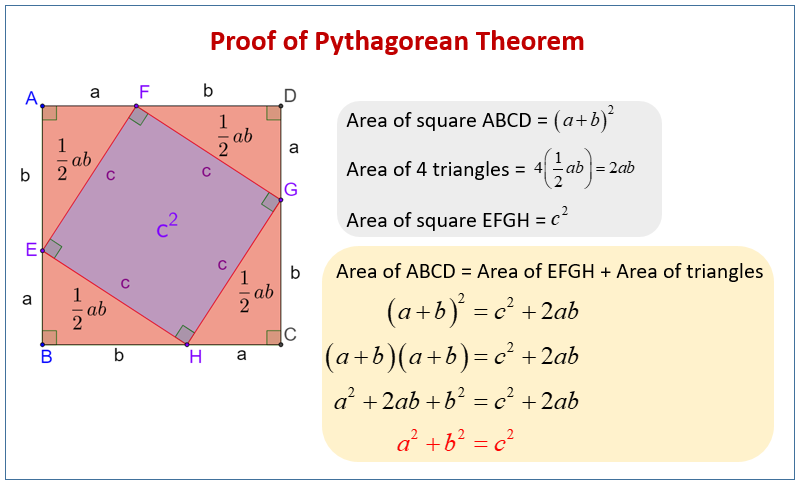
where you draw three extra triangles, not just one, and they surround a square of c x c. Think about it as making two copies of the trapezoid, one rotated on top of the other.
I shared this one with my son, the step where the 2ab expressions cancel out gave him a little aha moment.
This was exactly what I thought of as well.
Garfield’s version seems more complicated since you have to calculate the area of a trapezoid instead of the area of a square, but conceptually they are the same.
May be a repeat here, but best proof I saw was inscribe a square with sides of length c inside another square, but rotated such that the interior square’s corners intersect the outer square’s edges. The intersecting points divide the outer square’s edge making lengths a and b.
This produces an inner square’s edge with sides length c and four equal right triangles of sides a, b, and c.
Note that the area of the outer square equals the sum of the inner square plus the area of the four triangles. Solve this equality.
American presidents used to be smart.
they also use to be bullet magnets
I was ready for it to involve lasagna.
There's no feline involvement but there is a good proof of Pythagorean theorem in Neil Stephenson's Anathem[1] demonstrated by deviding cake.
Same!
Glad it wasn’t just me hahaha
Imagine having a president with the intellectual ability to create a novel mathematical proof, and the humility to publish it without claiming to be the greatest mathematician of all time…
I don’t have to imagine.
https://www.proquest.com/docview/301464456/
If we had a president that could create novel mathematic proofs, I'd be happy to tolerate the arrogance at this point. At least there'd be some substance there.
Peru's experience with a President with a math degree didn't go that well
Not to bash the former president, but I'm failing to see what's so clever or nice about the proof... could someone please explain if I'm missing something? If you're going solve it with algebra on top of the similar triangles and geometry anyway, why complicate it so much? Why not just drop the height h and be done with it? You have 2 a b = 2 c h, c1/a = h/b, c2/b = h/a, c = c1 + c2, so just solve for h and c1 and c2 and simplify. So why would you go through the trouble of introducing an extra point outside the diagram, drawing an extra triangle, proving that you get a trapezoid, assuming you know the formula for the area of a trapezoid, then solving the resulting equations...? Is there any advantage at all to doing this? It seems to make strictly more assumptions and be strictly more complicated, and it doesn't seem to be any easier to see, or to convey any sort of new intuition... does it?
I can't follow your reasoning at at. "Drop the height h" is completely ambiguous.
And the nice thing about Garfield's proof is that all it requires that you know is the area of a right triangle and the basic Euclidean premises. You can easily get the area of a trapezoid from that.
I'm having some trouble with this part of the explanation:
> From the figure, one can easily see that the triangles ABC and BDE are congruent.
I must confess I do not easily see this. It's been a long time since I did any geometry, could someone help me out? I'm probably forgetting some trivial fact about triangles.
So, the line BE is just the line CB extended. It's the same line. And we know that the angles of a triangle add up to 180. And we know that the line BD is defined as perpendicular to AB.
That means the angle ABC and angle DBE must add up to 90. But that's also true of the angles ABC and angle CAB. That means that angle DBE and angle CAB must be the same. Both triangles ABC and BDE are both right triangles, so that means angles ABC and BDE are the same. So they're similar triangles: They have all the same angles.
Additionally, the point D is just at a point so that the length of line segment BD and the length of line segment AB are both the same: c. Since we know that the hypotenuse of triangle ABC is c, and the hypotenuse of triangle BDE is also c, and we know they're both similar triangles, then these triangles must be congruent as well.
AFAIK: Pythagoras never wrote about this Triangle Theorem. There's no proof that he ever even knew about it. But he had mandated to his Pythagorean school (students) that any discovery or invention they made would be attributed to him instead.
The earliest known mention of Pythagoras's name in connection with the theorem occurred five centuries after his death, in the writings of Cicero and Plutarch.
Interestingly: the Triangle Theorem was discovered, known and used by the ancient Indians and ancient Babylonians & Egyptians long before the ancient Greeks came to know about it. India's ancient temples are built using this theorem, India's mathematician Boudhyana (c. ~800 BCE) wrote about it in his Baudhayana Shulba (Shulva) Sutras around 800 BCE, the Egyptian pharoahs built the pyramids using this triangle theorem.
Baudhāyana, (fl. c. 800 BCE) was the author of the Baudhayana sūtras, which cover dharma, daily ritual, mathematics, etc. He belongs to the Yajurveda school, and is older than the other sūtra author Āpastambha. He was the author of the earliest Sulba Sūtra—appendices to the Vedas giving rules for the construction of altars—called the Baudhāyana Śulbasûtra. These are notable from the point of view of mathematics, for containing several important mathematical results, including giving a value of pi to some degree of precision, and stating a version of what is now known as the Pythagorean theorem. Source: http://en.wikipedia.org/wiki/Baudhayana
Baudhyana lived and wrote such incredible mathematical insights several centuries before Pythagoras.
Note that Baudhayana Shulba Sutra not only gives a statement of the Triangle Theorem, it also gives proof of it.
There is a difference between discovering Pythagorean triplets (ex 6:8:10) and proving the Pythagorean theorem (a2 + b2 = c2 ). Ancient Babylonians accomplished only the former, whereas ancient Indians accomplished both. Specifically, Baudhayana gives a geometrical proof of the triangle theorem for an isosceles right triangle.
The four major Shulba Sutras, which are mathematically the most significant, are those attributed to Baudhayana, Manava, Apastamba and Katyayana.
Refer to: Boyer, Carl B. (1991). A History of Mathematics (Second ed.), John Wiley & Sons. ISBN 0-471-54397-7. Boyer (1991), p. 207, says: "We find rules for the construction of right angles by means of triples of cords the lengths of which form Pythagorean triages, such as 3, 4, and 5, or 5, 12, and 13, or 8, 15, and 17, or 12, 35, and 37. However all of these triads are easily derived from the old Babylonian rule; hence, Mesopotamian influence in the Sulvasutras is not unlikely. Aspastamba knew that the square on the diagonal of a rectangle is equal to the sum of the squares on the two adjacent sides, but this form of the Pythagorean theorem also may have been derived from Mesopotamia. ... So conjectural are the origin and period of the Sulbasutras that we cannot tell whether or not the rules are related to early Egyptian surveying or to the later Greek problem of altar doubling. They are variously dated within an interval of almost a thousand years stretching from the eighth century B.C. to the second century of our era."
They assassinated him because he uncovered too much forbidden knowledge about the triangles
A side thought, how would a natural number sequence of hypotenuses that satisfies the equation a^2 + b^2 = c^2 look like? Or what interesting properties would it have if any.
I sometimes wonder what mathematics and physics would have looked like if the Pythagorean theorem was a really ugly formula, or something you couldn't write in closed form.
This is actually one of the most well-known proof
There’s a sci-fi/time travel thriller here where he was assassinated because of his mathematical prowess.
Oh. It’s not that cat.
Netflix recently released a mini-series on Garfield's election and presidency: https://www.themoviedb.org/tv/245219-death-by-lightning.
Fun fact: Garfield LOVES lasagna, and hates Mondays.
Oh. Wait!
I must confess I clicked through hoping to see a comic of Garfield the cat using pizza slices to approximate right triangles.
It's as good as Piers Morgans legendary pythagorean theorem:
He was also the 20th president of the USA.